Workflow
BAOWU MAGNESIUM(002182)
icon
Search documents
宝武镁业(002182) - 2025 Q3 - 季度财报
2025-10-27 08:05
宝武镁业科技股份有限公司 2025 年第三季度报告 证券代码:002182 证券简称:宝武镁业 公告编号:2025-44 宝武镁业科技股份有限公司 2025 年第三季度报告 本公司及董事会全体成员保证信息披露的内容真实、准确、完整,没有虚假记载、误 导性陈述或重大遗漏。 重要内容提示: 1.董事会及董事、高级管理人员保证季度报告的真实、准确、完整,不存在虚假记载、误导性陈述或重 大遗漏,并承担个别和连带的法律责任。 2.公司负责人、主管会计工作负责人及会计机构负责人(会计主管人员)声明:保证季度报告中财务信息 的真实、准确、完整。 3.第三季度财务会计报告是否经过审计 □是 否 1 宝武镁业科技股份有限公司 2025 年第三季度报告 一、主要财务数据 | | | | 单位:元 | | --- | --- | --- | --- | | 项目 | 本报告期金额 | 年初至报告期期末金额 | 说明 | | 非流动性资产处置损益(包括已计提资产减值 | -314,551.94 | -83,066.89 | | | 准备的冲销部分) | | | | | 计入当期损益的政府补助(与公司正常经营业 务密切相关、符合国家政 ...
宝武镁业股价涨5.1%,华夏基金旗下1只基金位居十大流通股东,持有378.15万股浮盈赚取268.49万元
Xin Lang Cai Jing· 2025-10-27 06:20
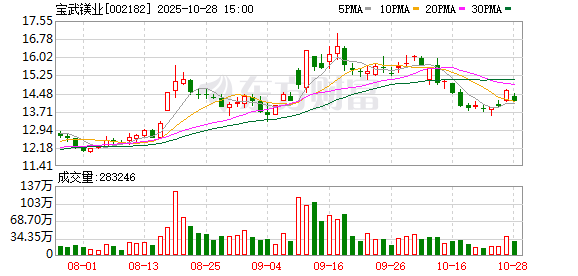
Core Viewpoint - Baowu Magnesium Industry's stock price increased by 5.1% to 14.64 CNY per share, with a trading volume of 440 million CNY and a market capitalization of 14.52 billion CNY as of October 27 [1] Company Overview - Baowu Magnesium Industry Technology Co., Ltd. is located in Lishui District, Nanjing, Jiangsu Province, established on November 30, 1993, and listed on November 13, 2007 [1] - The company's main business involves the production, deep processing, and sales of magnesium and aluminum alloy materials [1] Revenue Composition - Revenue breakdown: - Aluminum alloy extrusion products: 35.90% - Magnesium alloy products: 26.03% - Intermediate alloys: 13.14% - Magnesium-aluminum alloy die-casting products: 11.10% - Aluminum alloy products: 6.67% - Others (supplement): 2.83% - Template leasing: 1.27% - Mineral products: 1.19% - Others: 1.04% - Metallic strontium: 0.82% [1] Shareholder Information - Huaxia Fund's Huaxia CSI 1000 ETF (159845) entered the top ten circulating shareholders of Baowu Magnesium Industry, holding 3.7815 million shares, representing 0.44% of circulating shares, with an estimated floating profit of approximately 2.6849 million CNY [2] - The fund was established on March 18, 2021, with a current scale of 38.227 billion CNY, yielding 25.9% this year [2] Fund Performance - Huaxia Fund's Huaxia Economic Driven Mixed A (017598) held 755,600 shares of Baowu Magnesium Industry, accounting for 3.08% of the fund's net value, with an estimated floating profit of about 536,500 CNY [4] - The fund was established on February 21, 2023, with a current scale of 259 million CNY, yielding 39.35% this year [4]
工信部力挺,电池技术新方向,这些概念股获大幅加仓
Zheng Quan Shi Bao· 2025-10-25 23:41
Core Insights - The Ministry of Industry and Information Technology emphasizes the importance of technological innovation in the development of new battery technologies, particularly solid-state and metal-air batteries [1][2]. Industry Overview - Metal-air batteries utilize common metals like zinc, magnesium, and aluminum in conjunction with oxygen or seawater, representing a hybrid energy storage and fuel technology [3]. - The global market for metal-air batteries is projected to grow from $296 million in 2023 to $852 million by 2031, with a compound annual growth rate (CAGR) exceeding 14% [5]. Technological Advantages - Metal-air batteries offer significant advantages over lithium-ion batteries, including energy density that can exceed 3 to 4 times that of lithium-ion batteries, efficient charging, and longer range [4]. - They are considered environmentally friendly, aligning with carbon neutrality goals, as they do not release harmful substances during manufacturing, usage, or recycling [4]. Market Dynamics - The zinc-air battery segment currently holds the largest market share, being the most commercially mature, while aluminum-air batteries follow [8]. - Several domestic companies are actively engaging in the metal-air battery sector, with notable stock performance; for instance, Shanghai Xiba has seen a year-to-date increase of nearly 241% [10][11]. Academic Contributions - Multiple universities in China have achieved breakthroughs in metal-air battery technology, enhancing the development of high-performance catalysts and battery designs [9]. Company Developments - Companies such as Penghui Energy, Yun Aluminum, and China Aluminum are involved in the metal-air battery supply chain, with significant stock price increases observed in 2023 [10][12]. - Notable stock performance includes Yun Aluminum with a year-to-date increase of over 70% and Penghui Energy with an increase of nearly 15% in financing [11][12].
宝武镁业涨2.17%,成交额1.58亿元,主力资金净流入390.69万元
Xin Lang Zheng Quan· 2025-10-21 05:29
Core Viewpoint - Baowu Magnesium's stock price has shown volatility, with a year-to-date increase of 25.82% but a recent decline over the past five and twenty trading days [2] Company Overview - Baowu Magnesium Technology Co., Ltd. is located in Lishui District, Nanjing, Jiangsu Province, established on November 30, 1993, and listed on November 13, 2007 [2] - The company's main business involves the production and deep processing of magnesium and aluminum alloy materials [2] Revenue Composition - The revenue composition of Baowu Magnesium is as follows: - Aluminum alloy extrusion products: 35.90% - Magnesium alloy products: 26.03% - Intermediate alloys: 13.14% - Magnesium-aluminum alloy die-casting products: 11.10% - Aluminum alloy products: 6.67% - Others (supplement): 2.83% - Template leasing: 1.27% - Mineral products: 1.19% - Others: 1.04% - Metal strontium: 0.82% [2] Stock Performance - As of October 21, Baowu Magnesium's stock price was 14.13 CNY per share, with a market capitalization of 14.014 billion CNY [1] - The stock experienced a net inflow of 3.9069 million CNY from main funds, with significant buying and selling activity [1] Financial Performance - For the period from January to June 2025, Baowu Magnesium achieved a revenue of 4.352 billion CNY, representing a year-on-year growth of 6.78%, while the net profit attributable to shareholders decreased by 46.47% to 64.1242 million CNY [2] Shareholder Information - As of September 30, the number of shareholders increased to 63,300, with an average of 13,666 shares per shareholder, a decrease of 1.41% from the previous period [2] - The top ten circulating shareholders include Hong Kong Central Clearing Limited and various ETFs, indicating a diversified shareholder base [3]
金属矿企入局低空经济:一场不能输的“空中材料战争”
经济观察报· 2025-10-19 06:40
Core Viewpoint - A materials revolution driven by both policy and market forces is accelerating, with the "low-altitude economy" being highlighted in government work reports, indicating significant growth potential for aviation-grade materials [2][3][39]. Market Dynamics - The low-altitude economy is projected to consume over 1.25 million tons of aluminum by 2025, with a market size reaching 32 billion yuan and a compound annual growth rate exceeding 36% [3]. - The demand for aviation-grade aluminum is surging, with prices for aluminum ingots reaching 24,200 yuan per ton, a 23% increase from the previous year, while orders for low-altitude aircraft are rapidly increasing [5][6]. Industry Transformation - Traditional metal mining companies are facing a critical need to transform their operations to capture opportunities in the low-altitude economy, as failure to adapt could result in losing market share [4][7]. - Major metal companies are making strategic shifts, with some investing heavily in expanding aviation-grade aluminum production capacity to meet the growing demand from eVTOL and logistics drone manufacturers [8][12]. Competitive Strategies - Companies are adopting collaborative approaches, such as forming alliances for lightweight material development and engaging in joint research projects to enhance their competitive edge [13][21]. - The negotiation dynamics between material suppliers and drone manufacturers are becoming increasingly complex, focusing on both pricing and technical standards [15][20]. Technological Innovations - The materials revolution is pushing for advancements in material technology, with companies exploring the use of rare elements like scandium to enhance the performance of aluminum alloys [27]. - Innovations in titanium alloys are also being pursued to meet the high-temperature requirements of eVTOL engines, showcasing the industry's commitment to overcoming technical challenges [28]. Challenges and Barriers - The transition to aviation-grade materials is fraught with challenges, including lengthy certification processes and a shortage of skilled talent in the aerospace materials sector [30][31]. - Significant capital investments are required for transformation, with companies facing pressure to deliver returns within a short timeframe to satisfy investors [32]. Future Outlook - The industry is witnessing a shift towards integrated solutions, where companies are not only supplying materials but also providing design and operational support to clients [35][38]. - The competitive landscape is evolving, with companies aiming to position themselves as global suppliers for the low-altitude economy, indicating a broader strategic vision for future growth [36][39].
全市有色金属产业迈入千亿级新时代
Qi Lu Wan Bao· 2025-10-15 11:30
Core Viewpoint - The city of Liaocheng is focusing on the development of the non-ferrous metal and deep processing industry chain, emphasizing green, low-carbon, and high-quality growth while enhancing the industrial structure and competitiveness [1][2]. Group 1: Industry Development - Liaocheng has established a dual-chain development pattern centered on copper and aluminum, attracting leading companies such as Yunhai Metal and Hailiang Co., Ltd. [1] - By 2024, the city is expected to have 68 large-scale enterprises in this industry, achieving a revenue of 119.51 billion yuan [1]. - The non-ferrous metal and deep processing industry is recognized as a traditional advantageous industry in Liaocheng, with a focus on high-end, intelligent, and green development [2]. Group 2: Competitive Advantages - The establishment of a national quality inspection center for copper and aluminum products and the formation of a research institute for non-ferrous metals have strengthened the industry [1]. - The market share of several products from companies like Xinfeng Group and Yunxin Technology ranks among the top in the country [1]. Group 3: Green and Low-Carbon Initiatives - Liaocheng has cultivated 4 national and 9 provincial green factories, with Xiangguang Copper Industry recognized as a national "energy efficiency leader" [2]. - Xinfeng Group has completed carbon quota transactions totaling 35.73 million tons, with a transaction value of 2.322 billion yuan, accounting for about 5% of the national total [2]. - The city is actively promoting the peak carbon emissions in the non-ferrous metal industry and increasing the proportion of recycled non-ferrous metals [2]. Group 4: Digital Transformation - The integration of industrial internet and big data technologies is being promoted to enhance the intelligent manufacturing level of non-ferrous metal enterprises [3]. - The development of a digital platform for green functional aluminum aims to improve the digitalization of the industry chain and resource allocation efficiency [3].
小金属板块10月15日跌1.67%,北方稀土领跌,主力资金净流出20.92亿元
Market Overview - The small metal sector experienced a decline of 1.67% on October 15, with Northern Rare Earth leading the drop [1] - The Shanghai Composite Index closed at 3912.21, up 1.22%, while the Shenzhen Component Index closed at 13118.75, up 1.73% [1] Individual Stock Performance - Shenghe Resources (600392) saw a closing price of 26.26, with an increase of 5.04% and a trading volume of 3.19 million shares, amounting to a transaction value of 8.597 billion [1] - Anning Co. (002978) closed at 33.85, up 2.05%, with a trading volume of 68,400 shares and a transaction value of 231 million [1] - Northern Rare Earth (600111) closed at 54.50, down 4.05%, with a trading volume of 3.03 million shares and a transaction value of 1.6617 billion [2] Capital Flow Analysis - The small metal sector experienced a net outflow of 2.092 billion from main funds, while retail investors saw a net inflow of 2.265 billion [2] - The main funds showed a significant outflow in several stocks, including Baotai Co. (600456) with a net outflow of 27.17 million [3] - Retail investors contributed positively to stocks like Shenghe Resources (600392) with a net inflow of 65.96 million [3]
宝武镁业:镁基轻合金与镁合金本质上属于包含关系
Zheng Quan Ri Bao· 2025-10-09 10:10
Core Viewpoint - Baowu Magnesium Industry clarified the relationship between magnesium-based light alloys and magnesium alloys, stating that magnesium alloys are a subset of magnesium-based light alloys [2] Group 1 - Magnesium-based light alloys encompass all lightweight alloy materials with magnesium as the base [2] - Magnesium alloys are the most common type of magnesium-based light alloys [2]
宝武镁业:赛力斯的问界镁合金产品均为公司提供,单车用量目前已达20Kg以上
Mei Ri Jing Ji Xin Wen· 2025-10-09 03:44
Group 1 - The company has confirmed its collaboration with Chongqing 601127 Sairus, providing magnesium alloy products for Sairus's vehicles [1] - The current usage of magnesium per vehicle has exceeded 20 kg, with potential to reach 50-100 kg as larger magnesium die-cast components are integrated into vehicles [1]
趋势2025!中国储氢合金行业基本原理、技术路线、产业链全景、技术创新及未来发展前景分析:资源优势巩固行业地位,创新引领打开市场空间[图]
Chan Ye Xin Xi Wang· 2025-10-02 03:40
Core Insights - Hydrogen storage alloys are critical materials in the hydrogen energy industry due to their high safety, volumetric hydrogen density, and long-cycle stability [1][2] - China has established a complete hydrogen storage alloy industry chain driven by rare earth resources and strong policies, featuring upstream resource monopolization, midstream technological iteration, and downstream diverse applications [1][8] - The global hydrogen storage alloy market is dominated by rare earth-based alloys, with rapid iterations of magnesium-based, titanium-based, and solid-state materials [1][9] Industry Overview - Hydrogen storage alloys (HSA) are special functional materials capable of reversible absorption and release of hydrogen under normal conditions, forming metal hydrides for safe and efficient hydrogen storage [2][3] - The main hydrogen storage methods include high-pressure gas storage, low-temperature liquid storage, and solid-state storage using hydrogen alloys, each with its advantages and disadvantages [5][6] Technological Development - Current mainstream hydrogen storage methods are compared, highlighting solid-state hydrogen storage alloys as the leading technology due to their safety and volumetric density [5][6] - The preparation methods for hydrogen storage alloys significantly influence their microstructure and hydrogen absorption performance, with various techniques available [7] China's Industry Background - Hydrogen is a key carrier for building a new energy system and achieving carbon neutrality, with hydrogen storage alloys being essential materials supported by national strategies and policies [8] - The Chinese government has implemented comprehensive policies to promote the hydrogen energy industry, including standards for solid-state hydrogen storage alloys [8] Industry Chain Structure - The Chinese hydrogen storage alloy industry chain features upstream resource monopolization, midstream technological advancements, and diverse downstream applications, with companies like Xiamen Tungsten and China Rare Earth Group leading the midstream [8][9] - The industry is characterized by close cooperation among upstream, midstream, and downstream enterprises, forming a collaborative innovation model [8] Global and Domestic Market Analysis - The global hydrogen storage alloy industry is at a critical juncture of technological breakthroughs and large-scale applications, with a projected market size of $440 million by 2030 [9] - China's hydrogen storage alloy sector has seen significant advancements in technology and enterprise layout, focusing on high capacity, low working temperature, and long cycle life [9][10] Future Trends - The future of China's hydrogen storage alloy industry will focus on technological innovation, industry integration, and international competition [11][12][14] - Technological innovation will lead to performance upgrades, with a focus on developing new multi-component alloy systems and optimizing kinetic performance [11] - Industry integration will involve increased mergers and acquisitions, creating industry leaders and enhancing overall competitiveness [12] - In international competition, Chinese enterprises will leverage their scale and resource advantages while addressing high-end technology gaps through increased R&D investment [14]