
Kaiser(002425)

Search documents
停牌!汕头上市公司明起摘帽!女掌门打游戏,破局了?
Sou Hu Cai Jing· 2025-12-10 08:32
Core Viewpoint - ST Kevin (002425) has successfully removed its "ST" designation, indicating a recovery in its financial status, with stock trading resuming on December 11, 2025 [2]. Company Summary - ST Kevin's stock will be renamed to "Caesar Culture," while the stock code remains "002425." The trading limit will increase from 5% to 10% starting December 11, 2025 [2]. - The company received an administrative penalty notice from the China Securities Regulatory Commission (CSRC) on September 13, 2024, due to false financial disclosures in its annual report. This led to a temporary suspension of trading on September 18, 2024, and the implementation of risk warnings from September 19, 2024 [4]. - The company has corrected accounting errors in its financial statements for the years 2021 to 2023 and the first half of 2024, following the CSRC's administrative penalty decision [4]. Financial Performance - In the third quarter of 2025, ST Kevin reported a significant improvement in performance, with revenue of 147 million yuan, a year-on-year increase of 67.41%. The net profit attributable to shareholders showed a reduction in losses, with a decrease of 0.24% [5]. - For the first three quarters of 2025, the company achieved a total revenue of 420 million yuan, reflecting a year-on-year growth of 28.62%. The net cash flow from operating activities increased by 40.69% [5]. - The stock price of ST Kevin has risen by 88.89% year-to-date as of December 9, 2025, indicating positive market sentiment towards the company's recovery [5]. Industry Context - The gaming industry in China has shown signs of recovery, with a 6.96% quarter-on-quarter increase in actual sales revenue in the third quarter of 2025, ending a continuous decline since the fourth quarter of 2024 [7]. - ST Kevin holds a strong portfolio of intellectual properties (IPs) including popular titles such as "One Piece," "Yu Yu Hakusho," and "Saint Seiya," positioning it as a leading player in the domestic entertainment sector [7]. - The company has established solid partnerships with major platforms like Tencent, Alibaba, and ByteDance, enhancing its market presence and IP value [7]. - Research and development expenditures reached 31.63 million yuan in the first three quarters of 2025, accounting for 7.53% of total revenue, demonstrating the company's commitment to innovation [7].

12月10日重要公告一览
Xi Niu Cai Jing· 2025-12-10 02:38
Group 1 - Jinggong Technology signed a sales contract with Hubei Yuchuang worth 729 million yuan, accounting for 42.16% of the company's audited revenue for 2024 [1] - Heshun Electric is expected to win a bid for a State Grid procurement project worth 107 million yuan, representing 24.97% of the company's 2024 revenue [2] - Yongmaotai plans to invest approximately 400 million yuan in a new intelligent manufacturing project for magnesium-aluminum alloy materials [3] Group 2 - Longi Green Energy announced the termination of its plan to issue global depositary receipts abroad, stating it will not significantly impact its operations [4] - Bai Ao Intelligent is expected to win bids for projects totaling 27.5 million yuan [5] - Lian Biological is planning a change of control and asset purchase, leading to a temporary suspension of its stock [6] Group 3 - Bo Rui Communication intends to acquire 51% of Meijing Technology for 66.49 million yuan [7] - Huitai Medical plans to repurchase shares worth 200 to 250 million yuan for employee stock ownership plans [8] - Yifang Biological is planning to issue H-shares and apply for listing on the Hong Kong Stock Exchange [9] Group 4 - Jiuqiang Biological's shareholders signed an agreement for the transfer of 5% of the company's shares to China National Pharmaceutical Investment [11] - Songcheng Performing Arts plans to repurchase shares worth 100 to 200 million yuan for capital reduction [12] - Zhonghong Medical's subsidiary is expected to be selected for a centralized procurement project in Jiangxi Province [13] Group 5 - Xingfu Electronics plans to invest 480 million yuan in a new electronic-grade phosphoric acid project [14] - Jiaao Environmental Protection's stock will be subject to risk warnings due to an administrative penalty [15] - ST Nuotai received a drug registration certificate for a new injection [16] Group 6 - Haimo Technology plans to sell its controlling subsidiary, Xian Sitian Instrument, for 370 million yuan [17] - Jingce Electronics signed multiple sales contracts with a single customer totaling 433 million yuan [18] - Donghua Testing's controlling shareholder plans to reduce its stake by up to 1.99% [19][20] Group 7 - Xingqi Eye Medicine completed the first subject enrollment for a Phase II clinical trial of its eye drop product [21] - Kute Intelligent's controlling shareholder plans to reduce its stake by up to 2% [22] - Dongcheng Pharmaceutical's subsidiary received approval for a new specification of a heparin sodium injection [23] Group 8 - Zhaoyi Innovation is in the process of issuing H-shares and has received regulatory approval [24] - Aokang International's shareholder plans to reduce its stake by up to 3% [25] - Jiamei Packaging's controlling shareholder is planning a change of control, leading to a temporary stock suspension [26] Group 9 - ST Kevin's stock will have its risk warning lifted and will resume trading [27] - Zaiseng Technology's controlling shareholder plans to transfer 6.04% of the company's shares [28] - Lide New Energy's shareholder plans to reduce its stake by up to 1% [29] Group 10 - Srypu terminated its plan to acquire shares and will resume trading [30] - Longjiang Transportation's subsidiary plans to invest 2.679 billion yuan in a graphite mining project [31] - Haowei Group's controlling shareholder has not reduced its stake and has terminated the reduction plan [32] Group 11 - Huilun Crystal received an administrative penalty notice for information disclosure violations [33] - Haiguang Information terminated a major asset restructuring plan [34] - Zhongke Shuguang announced a cash dividend plan [35] Group 12 - Fushuo Technology's share purchase plan was approved by the Shenzhen Stock Exchange [36] - Dongbai Group's shareholder reduced its stake by 25.95 million shares [38]


凯撒文化12月11日“摘帽” 行业东风下的泛娱乐价值重估
Quan Jing Wang· 2025-12-10 00:48
Core Viewpoint - The company, Caesar Culture, has successfully applied to revoke its risk warning status, which will enhance its stock liquidity and broaden financing channels, aligning with the growth trends in the pan-entertainment industry [1][2][3] Group 1: Company Developments - Caesar Culture's application to revoke the risk warning has been approved, allowing its stock to resume trading under the name "Caesar Culture" with a price fluctuation limit increased from 5% to 10% [1] - The company has made significant improvements in governance, evidenced by a 41.57% reduction in short-term loans and a 52.40% decrease in financial expenses due to lower bank loan interest [1] - The net cash flow from operating activities has increased by 40.69% year-on-year, indicating a substantial alleviation of liquidity pressure [1] Group 2: Industry Positioning - Caesar Culture is focused on building an internet entertainment ecosystem centered around premium IP, leveraging various entertainment content to amplify IP value [2] - The company has seen a 76.66% year-on-year increase in R&D expenses, with a focus on applying AI and cloud computing technologies in game development [2] - The company's collaboration with leading platforms like Tencent Animation has strengthened its IP resource reserves, supporting future product iterations [2] Group 3: Strategic Outlook - The revocation of the risk warning aligns with the favorable trends in the pan-entertainment industry, as the Chinese government increases support for high-quality domestic content [2] - The dual-driven model of "classic IP moat + new technology growth" positions the company well for future growth, with stable cash flow from existing products funding new developments [3] - The application of AI technology in various development stages is expected to enhance efficiency and optimize product experiences, shortening the time to market for new products [3]
操盘必读:影响股市利好或利空消息_2025年12月10日_财经新闻
Xin Lang Cai Jing· 2025-12-10 00:38
Industry News - A new polysilicon platform company named Beijing Guanghe Qiancheng Technology Co., Ltd. has been registered with a capital of 3 billion, established on December 9, 2025, in Beijing. The company aims to explore potential strategic cooperation opportunities within the industry, such as technology upgrades and market expansion [25][25]. - The National Retail Innovation Development Conference is being held in Beijing from December 9 to 10. The Deputy Minister of Commerce, Sheng Qiuping, emphasized the need for further improvement in retail layout, supply-demand matching, and online-offline balance, while also encouraging the development of new business models and scenarios to stimulate consumer potential [25][25]. - The State Administration for Market Regulation has approved the release of two mandatory national standards for civil unmanned aerial vehicles, which will take effect on May 1, 2026 [25][25]. - Alibaba has established the Qianwen C-end Business Group, aiming to develop Qianwen into a super app and the primary entry point for users in the AI era [26][26]. - Huawei's 2012 Lab has established a foundational model department focused on advancing base model development and is actively recruiting young research talents with outstanding academic backgrounds [26][26]. - The Ministry of Agriculture and Rural Affairs reported that pork supply in November was sufficient, with prices slightly decreasing. The average daily market volume of pork in Beijing's Xinfadi market was 2,128.8 heads, a 10.57% increase from October and a 7.54% increase year-on-year [26][26]. - The National Development and Reform Commission indicated that the coking coal market shifted from tight to loose in November, with price expectations declining. The coking coal price expectation index fell to below the 50% threshold, indicating weak support for the market [26][26]. Company News - Jiaao Environmental Protection announced that due to false records in the 2022 and 2023 annual reports, the company's stock will be subject to other risk warnings [27][27]. - Huilun Crystal also announced that its 2021 and 2022 annual reports contained false records, leading to similar risk warnings for its stock [27][27]. - Haiguang Information announced the termination of its major asset restructuring with Zhongke Shuguang [28][28]. - Zhongke Shuguang announced the termination of its share swap absorption merger with Haiguang Information and the associated fundraising [29][29]. - Tianyuan Dike announced that its chairman, Chen You, has been placed under detention [30][30]. - Lain Biological announced that its controlling shareholder is planning a change of control and intends to acquire at least 80% of Beijing Jinkangpu's shares, leading to a stock suspension [30][30]. - Shengyi Technology announced an investment of approximately 198 million yuan to build an annual production project of 2,400 tons of ultra-high molecular weight polyethylene fiber, expanding its application value in humanoid robots [30][30]. - HoloWave announced a significant increase in orders for satellite testing systems, primarily from commercial aerospace satellite manufacturers and testing service providers [30][30]. - Longi Green Energy announced the termination of its overseas issuance of global depositary receipts [31][31]. - Zaiseng Technology announced that its controlling shareholder, Guo Mao, plans to transfer 6.04% of the company's shares to Zhongrong Huaxin [31][31]. - Si Rui Pu announced the termination of its plan to acquire shares of Aola, and its stock will resume trading [32][32]. - Fosun Pharma announced that its subsidiary, Yaoyou Pharmaceutical, has signed a licensing agreement with Pfizer [33][33].


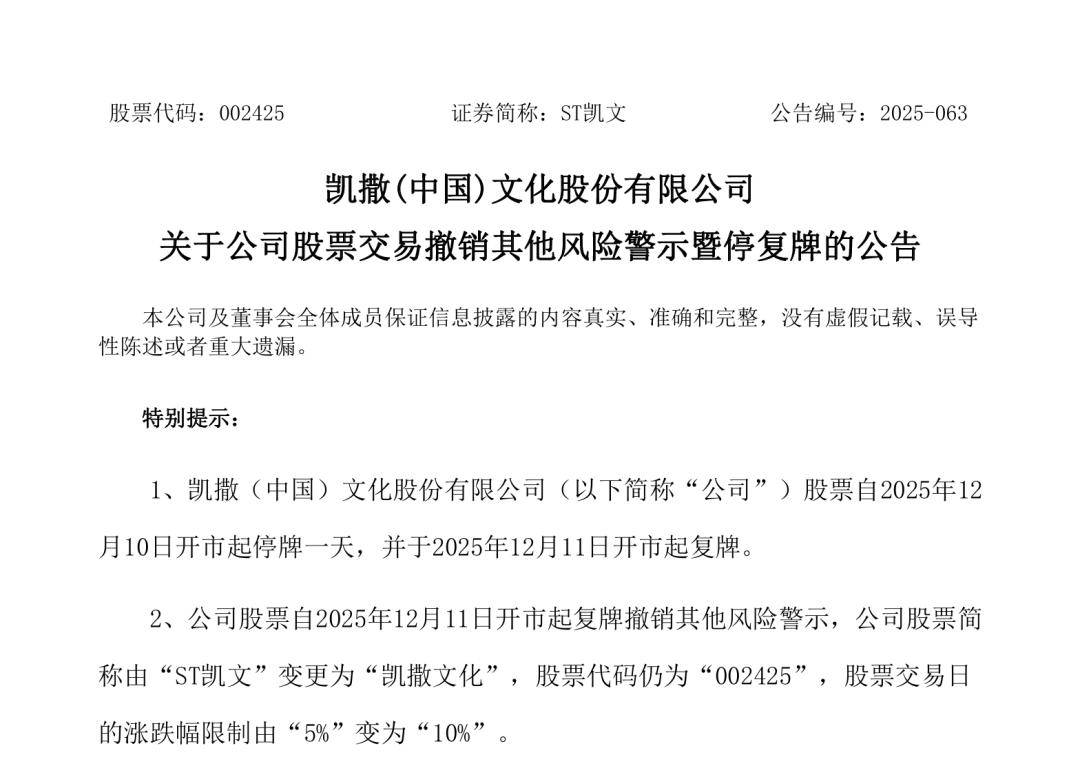
凯撒(中国)文化股份有限公司关于公司股票交易撤销其他风险警示暨停复牌的公告
Shang Hai Zheng Quan Bao· 2025-12-09 19:50
2、公司股票自2025年12月11日开市起复牌撤销其他风险警示,公司股票简称由"ST凯文"变更为"凯撒文 化",股票代码仍为"002425",股票交易日的涨跌幅限制由"5%"变为"10%"。 登录新浪财经APP 搜索【信披】查看更多考评等级 股票代码:002425 证券简称:ST凯文(维权) 公告编号:2025-063 凯撒(中国)文化股份有限公司 关于公司股票交易撤销其他风险警示暨停复牌的公告 本公司及董事会全体成员保证信息披露的内容真实、准确和完整,没有虚假记载、误导性陈述或者重大 遗漏。 特别提示: 1、凯撒(中国)文化股份有限公司(以下简称"公司")股票自2025年12月10日开市起停牌一天,并于 2025年12月11日开市起复牌。 一、股票种类、简称、股票代码、停复牌安排以及撤销其他风险警示的起始日 1、股票种类:人民币普通股; 2、股票简称:由"ST凯文"变更为"凯撒文化"; 3、股票代码:002425; 4、停复牌安排:自2025年12月10日开市起停牌一天,并于2025年12月11日开市起复牌; 5、撤销其他风险警示起始日:2025年12月11日; 6、股票交易日的涨跌幅限制:由"5%"变为" ...
每天三分钟公告很轻松 | 莱茵生物和嘉美包装控股股东筹划公司控制权变更 10日起停牌



Shang Hai Zheng Quan Bao· 2025-12-09 16:17
Group 1 - Rhein Biotech and Jia Mei Packaging's controlling shareholders are planning changes in company control, with trading suspension starting from December 10, 2025, for Rhein Biotech expected to last no more than 10 trading days and for Jia Mei Packaging no more than 2 trading days [1][2] - Rhein Biotech intends to acquire at least 80% of Beijing Jinkangpu Food Technology Co., Ltd. through a combination of issuing shares and cash payment, which will make Beijing Jinkangpu a subsidiary included in the consolidated financial statements [1] - Jia Mei Packaging's controlling shareholder is also in discussions regarding a potential change in control, with specific transaction details still under negotiation [2] Group 2 - Haiguang Information has terminated its plan to merge with Zhongke Shuguang through a share exchange, as approved in a board meeting on December 9, 2025 [3] - Huatai Medical plans to repurchase shares with a total amount not less than RMB 200 million and not exceeding RMB 250 million, with a repurchase price cap of RMB 315 per share [4] - Songcheng Performing Arts and Jingu Co., Ltd. also announced share repurchase plans, with Songcheng aiming for a total of RMB 100 million to RMB 200 million and Jingu targeting RMB 30 million to RMB 60 million [4] Group 3 - Xiamen Airport is planning to acquire 100% of the shares of Zhaoxiang Technology, a wholly-owned subsidiary of its controlling shareholder, Xiamen Xiangye Group [5] - Borui Communication intends to acquire 51% of Meijing Technology from related parties for a total price of RMB 66.49 million [6] - Gu Ao Technology's actual controller is planning a change in control, with trading suspension starting from December 8, 2025, and expected to last no more than 3 trading days [6] Group 4 - ST Kevin's application to revoke the risk warning on its stock has been approved, with trading suspension for one day on December 10, 2025, and resuming trading on December 11, 2025 [6] - Huailun Crystal's stock will be suspended for one day starting December 10, 2025, due to false disclosures in its annual reports for 2021 and 2022 [7] - The stock of Jia Ao Environmental Protection will also be suspended for one day on December 10, 2025, due to an administrative penalty notice received from the regulatory authority [12] Group 5 - The company Yongmota plans to invest approximately RMB 400 million in a new project for magnesium-aluminum alloy components for the automotive and robotics industries [20] - ST Ningke is executing a capital reserve transfer plan to increase its share capital, with a total share increase from 684.88 million to 1.62 billion shares [21] - Yingpais plans to increase its shareholding through a combination of bank loans and self-funding, with a total investment of no less than RMB 60 million and no more than RMB 120 million [22]
晚间公告|12月9日这些公告有看头
Di Yi Cai Jing· 2025-12-09 15:09
Group 1 - Zhongke Shuguang announced the termination of the major asset restructuring plan involving Haiguang Information due to significant changes in market conditions and prolonged discussions, which will not adversely affect the company's operations and financial status [2] - Huilun Crystal's stock will be subject to risk warnings due to false records in its 2021 and 2022 annual reports, changing its trading name to "ST Huilun" [3] - SIRUI decided to terminate the acquisition of shares in Ningbo Aola Semiconductor, with its stock set to resume trading [4] Group 2 - ST Kevin's stock will resume trading after the removal of risk warnings, changing its name to "Caesar Culture" and adjusting the daily trading limit from 5% to 10% [5] - Jiamei Packaging announced that its controlling shareholder is planning a change in control, leading to a temporary suspension of its stock [6] - Zai Sheng Technology's controlling shareholder plans to transfer 6.04% of the company's shares to Zhongrong Huaxin for a total price of 344 million yuan [7] Group 3 - Xingfu Electronics plans to invest 480 million yuan in a project to build a 40,000 tons/year electronic-grade phosphoric acid facility, expected to start construction on December 15, 2025 [8] - Jiaao Environmental Protection received an administrative penalty notice, leading to risk warnings on its stock, which will change its name to "ST Jiaao" [9] - Longi Green Energy decided to terminate its overseas issuance of Global Depositary Receipts (GDR) due to changes in external factors [10] Group 4 - Yingpais announced that its controlling shareholder plans to increase its stake in the company by 60 million to 120 million yuan [12] - Aokang International's shareholder plans to reduce its stake by up to 3% due to personal financial needs [13] - Shenzhou Information's controlling shareholder plans to reduce its stake by up to 2.95% [14] Group 5 - Bai'ao Intelligent is pre-bidding for a project worth 27.5 million yuan with a large state-owned company [16] - Jingce Electronics received orders for semiconductor testing equipment totaling approximately 433 million yuan [17] - ST Weihai, in a joint venture, won a bid for a smart agriculture project worth 652 million yuan, representing 26.27% of its audited revenue for 2024 [18]



撤销其他风险警示,ST凯文12月10日停牌一天
Bei Jing Shang Bao· 2025-12-09 12:45
北京商报讯(记者 马换换 王蔓蕾)12月9日晚间,ST凯文(002425)披露公告称,公司股票将于12月 10日停牌一天,12月11日开市起撤销其他风险警示,股票简称由"ST凯文"变更为"凯撒文化",股票代码 仍为"002425"。 交易行情显示,截至12月9日收盘,ST凯文股价收涨0.25%,收于4.08元/股,总市值39.03亿元。 公告显示,撤销其他风险警示后,公司股票交易的日涨跌幅限制由"5%"变为"10%"。 ...
ST凯文(002425.SZ):公司股票交易撤销其他风险警示 股票停牌

Ge Long Hui A P P· 2025-12-09 12:25
格隆汇12月9日丨ST凯文(002425.SZ)公布,公司股票自2025年12月11日开市起复牌撤销其他风险警示, 公司股票简称由"ST凯文"变更为"凯撒文化",股票代码仍为"002425",股票交易日的涨跌幅限制 由"5%"变为"10%"。股票自2025年12月10日开市起停牌一天,并于2025年12月11日开市起复牌。 ...
ST凯文(002425.SZ)即将撤销其他风险警示 12月10日起停牌一天
智通财经网· 2025-12-09 12:25
ST凯文(002425.SZ)公告,公司股票自2025年12月10日开市起停牌一天,并于2025年12月11日开市起复 牌。公司股票自2025年12月11日开市起复牌撤销其他风险警示,公司股票简称由"ST凯文"变更为"凯撒 文化"。 ...