Vanward(002543)

Search documents
万和电气:与深圳市优必选科技股份有限公司暂无业务往来
Zheng Quan Ri Bao Wang· 2026-02-03 13:40
Group 1 - The company, Wanhe Electric (002543), is a specialized manufacturer in the domestic water heater, kitchen appliance, and hot water system sectors [1] - There is currently no business relationship between the company and Shenzhen Ubtech Robotics Co., Ltd. [1] - The company has not engaged in any liquid cooling technology-related business [1]

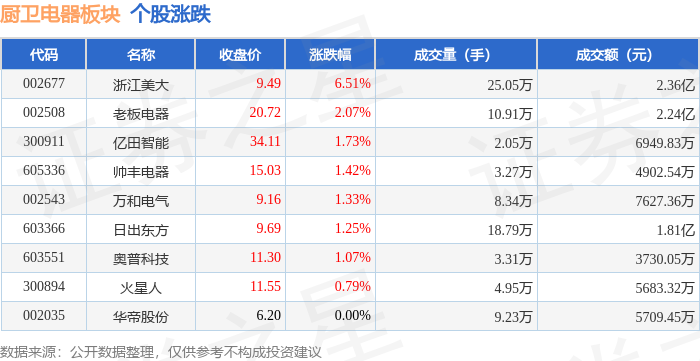
厨卫电器板块2月3日涨1.86%,浙江美大领涨,主力资金净流入2824.93万元
Zheng Xing Xing Ye Ri Bao· 2026-02-03 09:03
Group 1 - The kitchen and bathroom appliance sector increased by 1.86% on February 3, with Zhejiang Meida leading the gains [1] - The Shanghai Composite Index closed at 4067.74, up 1.29%, while the Shenzhen Component Index closed at 14127.1, up 2.19% [1] - Key stocks in the kitchen and bathroom appliance sector showed varied performance, with Zhejiang Meida rising by 6.51% to a closing price of 9.49 [1] Group 2 - The main capital inflow in the kitchen and bathroom appliance sector was 28.25 million yuan, while retail investors experienced a net outflow of 5.27 million yuan [1] - Among individual stocks, Boss Electric had a main capital inflow of 34.75 million yuan, but also saw a retail outflow of 16.90 million yuan [2] - Zhejiang Meida experienced a main capital inflow of 10.21 million yuan, with retail investors contributing a net inflow of 0.49 million yuan [2]





万和电气(002543.SZ):目前未涉及液冷技术相关业务
Ge Long Hui· 2026-02-03 07:17
Group 1 - The company, Wanhe Electric (002543.SZ), is a professional manufacturer in the domestic water heater, kitchen appliance, and hot water system sectors [1] - There is currently no business relationship between the company and Shenzhen Ubtech Robotics Corp [1] - The company has not engaged in any liquid cooling technology-related business [1]
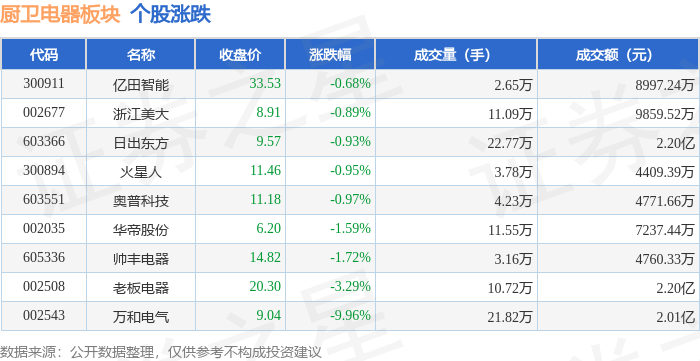
厨卫电器板块2月2日跌2.77%,万和电气领跌,主力资金净流入214.06万元
Zheng Xing Xing Ye Ri Bao· 2026-02-02 09:15
Market Overview - The kitchen and bathroom appliance sector experienced a decline of 2.77% on February 2, with Wanhe Electric leading the drop [1] - The Shanghai Composite Index closed at 4015.75, down 2.48%, while the Shenzhen Component Index closed at 13824.35, down 2.69% [1] Stock Performance - The following stocks in the kitchen and bathroom appliance sector showed notable price changes: - Yitian Intelligent: Closed at 33.53, down 0.68% with a trading volume of 26,500 shares and a turnover of 89.97 million yuan [1] - Zhejiang Meida: Closed at 8.91, down 0.89% with a trading volume of 110,900 shares and a turnover of 98.60 million yuan [1] - Rishidongfang: Closed at 9.57, down 0.93% with a trading volume of 227,700 shares and a turnover of 220 million yuan [1] - Huati Co.: Closed at 6.20, down 1.59% with a trading volume of 115,500 shares and a turnover of 72.37 million yuan [1] - Wanhe Electric: Closed at 9.04, down 9.96% with a trading volume of 218,200 shares and a turnover of 201 million yuan [1] Capital Flow - The kitchen and bathroom appliance sector saw a net inflow of 2.14 million yuan from institutional investors, while retail investors experienced a net outflow of 11.79 million yuan [1] - The capital flow for individual stocks is as follows: - Boss Electric: Net inflow of 11.70 million yuan from institutional investors, with a net outflow of 20.41 million yuan from retail investors [2] - Yitian Intelligent: Net inflow of 9.23 million yuan from institutional investors, with a net outflow of 2.75 million yuan from retail investors [2] - Wanhe Electric: Net outflow of 17.06 million yuan from institutional investors, with a net inflow of 13.71 million yuan from retail investors [2]
广东万和新电气股份有限公司 2025年度业绩预告
Zheng Quan Ri Bao· 2026-01-30 23:30
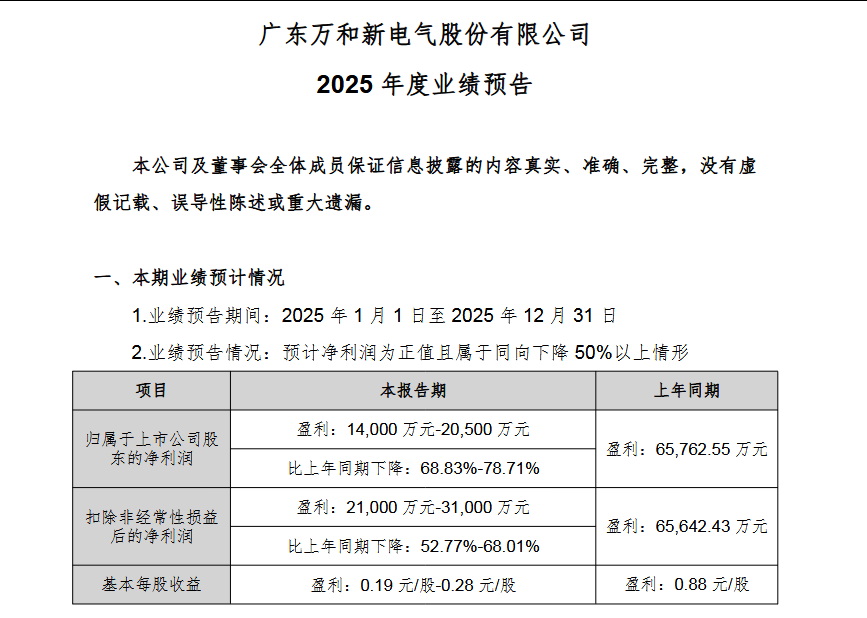
Performance Forecast - The company expects a positive net profit for the year 2025, but anticipates a decline of over 50% compared to the previous year [2] Reasons for Performance Changes - The commissioning of factories in Thailand and Egypt has led to increased costs due to depreciation, operational preparation, and market development, impacting net profit in the short term. However, these overseas bases are expected to enhance global capacity, reduce logistics and tariff costs, and improve market responsiveness and share in the long run [3] - The company is increasing its focus on overseas market expansion, with a rising proportion of export revenue. Adjustments in pricing strategies to capture market orders have resulted in a decrease in gross margin. Future strategies include creating a product matrix with different pricing tiers, focusing on high-margin products, and optimizing product structure through dynamic monitoring [3] - To stimulate consumer demand and enhance brand penetration, the company is increasing promotional expenditures for both offline and online channels, including new direct sales channels and digital marketing efforts. This expansion is accompanied by a rise in warehousing and operational costs due to business growth and digital transformation investments [4] - Management expenses have slightly increased due to rising employee compensation and social security costs, alongside higher R&D investments in the new energy sector. Financial expenses have also risen due to exchange losses [4] - The company anticipates a decrease of approximately 30.49 million yuan in fair value changes from a fund, and a reduction of about 26.26 million yuan in other income due to decreased government subsidies, both of which will be recorded as non-recurring gains and losses [4]
万和电气,业绩大降七成
Shen Zhen Shang Bao· 2026-01-30 12:01
Core Insights - The company, Wanhe Electric, reported a significant decline in net profit for 2025, with estimates ranging from 140 million to 205 million yuan, representing a decrease of 68.83% to 78.71% compared to the previous year [2] - The adjusted net profit, excluding non-recurring gains and losses, is projected to be between 210 million and 310 million yuan, down 52.77% to 68.01% year-on-year [2] - Basic earnings per share are expected to be between 0.19 yuan and 0.28 yuan, compared to 0.88 yuan in the same period last year [2] Financial Performance - For the first three quarters of 2025, Wanhe Electric achieved a revenue of 5.524 billion yuan and a net profit attributable to shareholders of 479 million yuan, indicating a substantial loss in the fourth quarter of the previous year [3] Reasons for Performance Decline - The decline in performance is attributed to five main factors: 1. Increased costs due to the launch of factories in Thailand and Egypt, leading to higher depreciation and operational expenses [2] 2. A strategic adjustment in pricing to capture market orders, resulting in a decrease in gross margin as export revenue proportion increased [2] 3. Increased promotional expenses to enhance brand penetration and investments in digitalization and R&D to improve operational efficiency [2] 4. A slight increase in management expenses due to rising employee compensation and social security costs [2] 5. A reduction in government subsidies and a decrease in fair value change gains, leading to a decline in other income [2]
万和电气(002543.SZ):预计2025年净利润同比下降68.83%-78.71%
Ge Long Hui A P P· 2026-01-30 11:48
Core Viewpoint - Wanhe Electric (002543.SZ) expects a significant decline in net profit for 2025, projecting a range of 140 million to 205 million yuan, which represents a decrease of 68.83% to 78.71% compared to the previous year [1] Financial Performance - The net profit attributable to shareholders is forecasted to be between 140 million and 205 million yuan, indicating a substantial year-on-year decline [1] - The net profit after deducting non-recurring gains and losses is estimated to be between 210 million and 310 million yuan, reflecting a decrease of 52.77% to 68.01% year-on-year [1] Impact Factors - The preliminary valuation results from Qianhai Equity Investment Fund indicate a decrease in fair value change income by approximately 30.49 million yuan year-on-year [1] - A reduction in government subsidies is expected to lead to a decrease in other income by about 26.26 million yuan year-on-year [1] - Both of these impacts are included in non-recurring gains and losses [1]
万和电气:2025年全年净利润同比预减68.83%—78.71%
2 1 Shi Ji Jing Ji Bao Dao· 2026-01-30 09:41
Core Viewpoint - The company forecasts a significant decline in net profit for 2025, with expected figures ranging from 140 million to 205 million yuan, representing a year-on-year decrease of 68.83% to 78.71% [1] Group 1: Financial Performance - The projected net profit attributable to shareholders is expected to be between 140 million and 205 million yuan, a decrease of 68.83% to 78.71% year-on-year [1] - The forecasted net profit after deducting non-recurring gains and losses is estimated to be between 210 million and 310 million yuan, reflecting a year-on-year decline of 52.77% to 68.01% [1] Group 2: Operational Strategy - The company is focusing on optimizing its operational layout and enhancing business quality and efficiency in response to complex external market conditions and evolving consumer trends [1] - New factories in Thailand and Egypt are currently in the ramp-up phase, leading to increased costs related to fixed asset depreciation, operational preparation, and market development, which have impacted net profit [1] Group 3: Market Expansion and Pricing Strategy - The company is increasing its overseas market presence, with export revenue steadily rising; however, adjustments in pricing strategies to capture market orders have led to a decline in gross margins [1] - Future strategies include creating a product matrix with different pricing tiers, focusing on high-margin products, and optimizing product structure through dynamic monitoring of gross margins [1] Group 4: Marketing and Digital Investment - To stimulate end-consumer demand and enhance brand penetration, the company is increasing promotional expenditures, particularly in new direct sales channels and offline store upgrades [1] - Online marketing efforts will focus on key areas such as platform promotions, brand live streaming, and community marketing to improve operational efficiency [1] Group 5: Cost Management - Management expenses have seen a slight increase due to rising employee compensation and social security costs, alongside higher R&D investments in the new energy sector [1] - Financial expenses have also risen due to exchange losses, and a decrease in government subsidies is expected to reduce other income by approximately 2,626 million yuan [1]
万和电气(002543) - 2025 Q4 - 年度业绩预告
2026-01-30 09:25
Financial Performance Expectations - The company expects a net profit of 140 million yuan for 2025, representing a decline of 68.83% to 78.71% compared to the previous year's profit of 657.63 million yuan [2]. - The net profit after deducting non-recurring gains and losses is projected to be 210 million yuan, down by 52.77% to 68.01% from 656.42 million yuan in the same period last year [2]. - Basic earnings per share are anticipated to be 0.19 yuan, a decrease from 0.88 yuan per share in the previous year [2]. Operational Challenges - The establishment of factories in Thailand and Egypt is currently in the capacity ramp-up phase, leading to increased costs that impact net profit [4]. - The company is enhancing its overseas market presence, with export business revenue steadily increasing, although this has resulted in a decline in gross margin due to pricing adjustments [5]. - Increased promotional expenses are being allocated to optimize offline terminal layouts and enhance online marketing effectiveness, including live streaming and community marketing [6]. - Rising employee compensation and social security costs have led to a slight increase in management expenses, alongside increased R&D investment in the new energy sector [6]. Income and Valuation Changes - The company anticipates a decrease in fair value change income by approximately 30.49 million yuan due to preliminary fund valuation results [6]. - Other income is expected to decrease by about 26.26 million yuan due to reduced government subsidies [6]. - The company has not identified any significant uncertainties that would affect the accuracy of this earnings forecast [7].
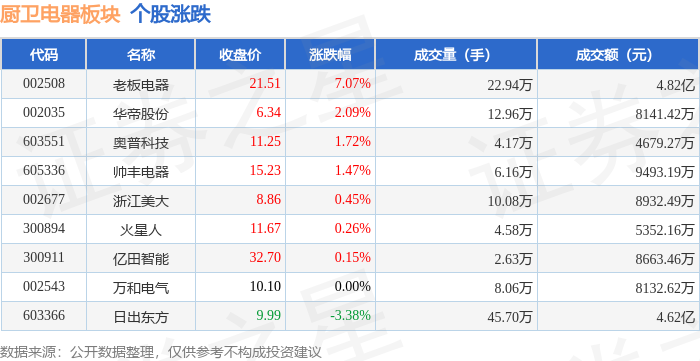
厨卫电器板块1月29日涨2.18%,老板电器领涨,主力资金净流出3067.38万元
Zheng Xing Xing Ye Ri Bao· 2026-01-29 09:03
Core Viewpoint - The kitchen and bathroom appliance sector experienced a 2.18% increase on January 29, with Boss Electric leading the gains, while the overall market showed mixed results with the Shanghai Composite Index rising by 0.16% and the Shenzhen Component Index falling by 0.3% [1] Group 1: Market Performance - The closing price of Boss Electric was 21.51, reflecting a 7.07% increase, with a trading volume of 229,400 shares and a transaction value of 482 million yuan [1] - Other notable performers included Vatti Corporation with a 2.09% increase, Aupu Technology with a 1.72% increase, and Shuaifu Electric with a 1.47% increase [1] - The overall kitchen and bathroom appliance sector saw a net outflow of 30.67 million yuan from main funds, while retail investors contributed a net inflow of 32.48 million yuan [1] Group 2: Fund Flow Analysis - Boss Electric had a main fund net inflow of 19.57 million yuan, but retail investors showed a net outflow of 16.25 million yuan [2] - Vatti Corporation experienced a main fund net inflow of 3.44 million yuan, while retail investors had a net inflow of 0.97 million yuan [2] - Zhejiang Meida saw a main fund net inflow of 3.00 million yuan, with retail investors contributing a net outflow of 9.26 million yuan [2]