ZHENGZHOU BANK(002936)

Search documents
郑州银行跌2.42%,成交额2.24亿元,主力资金净流出637.88万元
Xin Lang Cai Jing· 2025-11-21 05:34
Core Viewpoint - Zhengzhou Bank's stock price has experienced a decline, with a 2.88% drop year-to-date and a 2.42% drop in the last five trading days, indicating potential concerns among investors [1]. Company Overview - Zhengzhou Bank, established on November 16, 1996, and listed on September 19, 2018, is located in Zhengdong New District, Zhengzhou, Henan Province, and Hong Kong [2]. - The bank primarily provides financial services through four business segments: corporate banking (53.01% of revenue), funding business (28.33%), retail banking (18.47%), and other services (0.19%) [2]. Financial Performance - As of September 30, the number of shareholders increased to 108,400, with an average of 61,863 circulating shares per person, showing a slight decrease [3]. - For the period from January to September 2025, Zhengzhou Bank reported a net profit of 2.279 billion yuan, reflecting a year-on-year growth of 1.56% [3]. Dividend Information - Since its A-share listing, Zhengzhou Bank has distributed a total of 1.662 billion yuan in dividends, with 182 million yuan distributed over the past three years [4].

“村改支”浪潮来袭!村镇银行加速“离场”,银行业开启减量提质新阶段
Jin Rong Shi Bao· 2025-11-20 13:07
Core Viewpoint - The recent approvals by the National Financial Supervision Administration for several banks to acquire their affiliated rural banks and convert them into direct branches signify a shift from quantity expansion to quality enhancement in the rural banking sector [1][2]. Group 1: Recent Developments - Multiple cases of "village to branch" transformations have been approved, indicating a significant acceleration in the reform and restructuring of small and medium-sized banks [2]. - In November, Shanghai Pudong Development Bank successfully acquired two rural banks, converting them into branches, showcasing a trend among various banking institutions to engage in mergers and acquisitions of rural banks [2]. - The restructuring methods "village to branch" and "village to division" are becoming mainstream, allowing banks to absorb rural banks and enhance their operational capabilities [2][3]. Group 2: Strategic Implications - The absorption of rural banks into larger banking institutions enhances service capabilities and risk resilience for rural banking services [3]. - For the parent banks, the restructuring expands their business scope and allows for the potential establishment of new branches in areas where they previously had no presence [3]. Group 3: Policy and Market Dynamics - The acceleration of rural bank integration aligns with regulatory directives aimed at reducing the number of financial institutions while improving service quality [4]. - As of mid-2025, the number of rural banks is projected to decrease to 1,440, reflecting a significant reduction in the sector, which is part of a broader strategy to enhance service quality through consolidation [4]. - The integration of rural banks is not merely about reducing the number of branches but represents a strategic shift towards more focused and quality-driven financial services [4].

金融监管总局批复,同意收购!
Jin Rong Shi Bao· 2025-11-20 12:48
Core Viewpoint - The recent approvals by the National Financial Supervision Administration for several banks, including SPDB and Zhengzhou Bank, to acquire their affiliated rural banks and convert them into direct branches indicate a shift from quantity expansion to quality improvement in rural banking services [1][2]. Group 1: Recent Developments - Multiple cases of "village to branch" transformations have been approved in various regions, including Zhejiang and Inner Mongolia, reflecting a significant acceleration in the reform and restructuring of small and medium-sized banks [2]. - SPDB successfully acquired Zezhou Rural Bank and established it as a branch, marking its second acquisition of a rural bank in November [2]. - Zhengzhou Bank announced plans to acquire shares from other shareholders of Xun County Rural Bank and convert it into a branch, showcasing the trend of "village to branch" and "village to division" as mainstream methods of restructuring [2]. Group 2: Strategic Implications - The absorption and conversion of rural banks into branches enhance service capabilities and risk resilience for the main banks, while also broadening their operational scope [3]. - The restructuring aligns with regulatory goals to reduce the number of financial institutions while improving service quality, as evidenced by a reduction in the number of rural banks from 1,440 by mid-2025, down from 1,538 at the end of 2024 [4]. - The integration of rural banks is not merely about reducing the number of branches but represents a strategic shift towards more refined financial services and diversified product offerings to meet varied customer needs [4].
城商行板块11月18日跌0.75%,郑州银行领跌,主力资金净流出1.83亿元
Zheng Xing Xing Ye Ri Bao· 2025-11-18 08:11
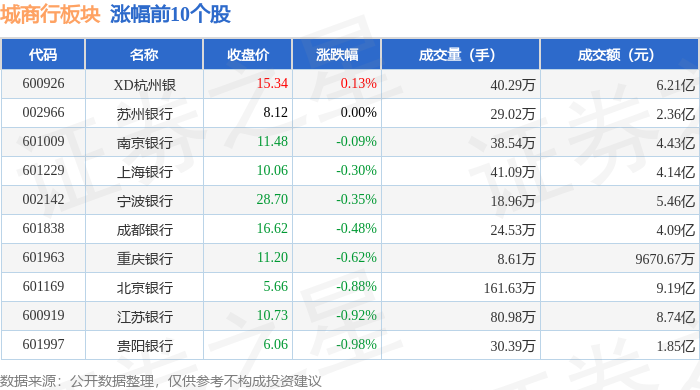
Market Overview - The city commercial bank sector experienced a decline of 0.75% on November 18, with Zhengzhou Bank leading the drop [1] - The Shanghai Composite Index closed at 3939.81, down 0.81%, while the Shenzhen Component Index closed at 13080.49, down 0.92% [1] Individual Stock Performance - Zhengzhou Bank's stock closed at 2.03, down 1.46% with a trading volume of 1.3032 million shares and a transaction value of 266 million [2] - Xiamen Bank closed at 7.13, down 1.38%, with a trading volume of 144,000 shares [2] - Nanjing Bank closed at 11.48, down 0.09%, with a trading volume of 385,400 shares [1] - The highest closing price was for Ningbo Bank at 28.70, down 0.35% [1] Capital Flow Analysis - The city commercial bank sector saw a net outflow of 183 million from institutional investors, while retail investors contributed a net inflow of 74.99 million [2] - The main capital inflow was observed in stocks like Nanjing Bank, which had a net inflow of 62.45 million from institutional investors [3] - Conversely, stocks like Xiamen Bank and Zhengzhou Bank experienced significant net outflows from institutional investors, amounting to 8.32 million and 4.80 million respectively [3]





瑞丰银行、郑州银行等多家银行撤销监事会获监管核准
2 1 Shi Ji Jing Ji Bao Dao· 2025-11-14 10:33
Core Viewpoint - The recent approval by regulatory authorities for banks to abolish their supervisory boards and transfer their functions to the audit committee of the board is a significant shift in corporate governance within the banking sector in China [1][2][3] Group 1: Regulatory Changes - Over ten banks have announced the approval to abolish their supervisory boards, including prominent banks such as Wuxi Rural Commercial Bank, Changshu Bank, Zhengzhou Bank, and Shanghai Bank [1] - The new Company Law, effective from July 1, 2024, allows joint-stock companies to establish an audit committee composed of directors to perform the functions of the supervisory board, eliminating the need for a supervisory board [2] - The National Financial Supervision Administration's notification in December 2025 further clarifies that financial institutions can set up an audit committee in accordance with their articles of association, thereby not requiring a supervisory board [2] Group 2: Historical Context and Implications - The supervisory board system was introduced in the 1990s in China's banking sector, modeled after the German system, to establish an independent supervisory layer [3] - The original intent of the supervisory board was to act as a supervisor in corporate governance, ensuring compliance and asset safety, but it has often struggled to fulfill this role effectively [3] - The transition to an audit committee, typically composed of directors with financial and risk management backgrounds, is expected to enhance governance efficiency by integrating supervisory functions into the decision-making core of the board [3]




【盘中播报】113只个股突破半年线
Zheng Quan Shi Bao Wang· 2025-11-14 06:29
Core Points - The Shanghai Composite Index is at 4017.68 points, above the six-month moving average, with a slight decline of 0.29% [1] - A total trading volume of A-shares reached 15648.48 billion yuan today [1] - 113 A-shares have surpassed the six-month moving average, with notable stocks showing significant deviation rates [1] Summary by Category Stock Performance - The top three stocks with the highest deviation rates from the six-month moving average are: - Electric Investment and Financing (9.07%) - Jie Rong Technology (7.54%) - Annie Shares (4.91%) [1] - Other stocks with smaller deviation rates that have just crossed the six-month line include: - Baoland, Zhongnong Lihua, and Subote [1] Trading Data - The trading performance of selected stocks includes: - Electric Investment and Financing: +9.94% with a turnover rate of 2.09% - Jie Rong Technology: +10.00% with a turnover rate of 8.20% - Annie Shares: +6.44% with a turnover rate of 18.47% [1] - Additional stocks with notable performance include: - Yahua Electronics: +6.29% - Zhonglu Shares: +7.08% - Jinlihua Electric: +4.81% [1]


银行研思录25:银行股息率排名与中期分红进度梳理-20251114
CMS· 2025-11-14 03:02
Investment Rating - The report does not explicitly state an investment rating for the banking sector, but it provides detailed insights into dividend yields and distribution processes, which can inform investment decisions. Core Insights - The report outlines the latest dividend yields and mid-term dividend processes for A and H shares of listed banks, emphasizing the importance of accurately calculating dynamic dividend yields to avoid discrepancies across periods [1][2]. - It details the two processes for mid-term dividends following the 2023 revision of the regulatory guidelines, highlighting the conventional and simplified processes for implementing mid-term dividends [2]. - The report provides a comprehensive overview of key dates related to dividend distribution for both A and H shares, including the importance of purchasing shares before the ex-dividend date to qualify for dividends [3][4]. Summary by Sections Dynamic Dividend Yield Calculation - A simplified yet accurate method for calculating dynamic dividend yield is introduced, defined as "rolling 12-month EPS * cash dividend rate / share price," which helps avoid issues related to overlapping or missing annual and mid-term dividends [1]. - The report calculates the cash dividend rate using a standardized approach across different banks, resulting in a clear comparison of dividend yields as of November 13, 2025 [1]. Mid-Term Dividend Processes - The report explains the two processes for mid-term dividends: the conventional process requiring shareholder approval and a simplified process allowing for quicker implementation [2]. - The simplified process is designed to enhance flexibility for companies in distributing mid-term dividends, thereby improving shareholder returns [2]. Dividend Distribution Key Dates - For A shares, investors must purchase shares before the ex-dividend date to receive dividends on the same day, while H shares typically see a delay of about one month for dividend payments [3][4]. - The report outlines the differences in the dividend distribution timeline between A and H shares, emphasizing the need for investors to be aware of these timelines to maximize their returns [3][4]. Mid-Term Dividend Progress - As of November 13, 2025, 31 A-share banks have confirmed mid-term dividends, while 11 H-share banks have also confirmed their dividend distributions [9][11]. - The report categorizes banks based on their dividend status, detailing those that have implemented dividends, those that are pending, and those that have opted not to distribute dividends [9][10][11]. - It highlights that the end of 2025 and early 2026 is expected to be a peak period for mid-term dividend distributions, suggesting potential investment opportunities for dividend-seeking investors [11].





城商行板块11月13日跌0.02%,长沙银行领跌,主力资金净流出6796.93万元
Zheng Xing Xing Ye Ri Bao· 2025-11-13 08:45
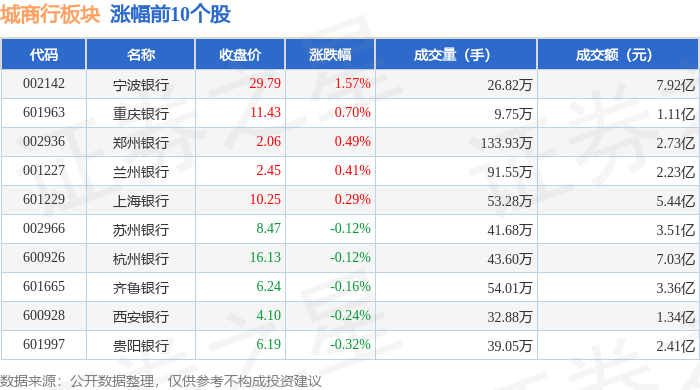
Core Points - The city commercial bank sector experienced a slight decline of 0.02% on November 13, with Changsha Bank leading the drop [1] - The Shanghai Composite Index closed at 4029.5, up 0.73%, while the Shenzhen Component Index closed at 13476.52, up 1.78% [1] Summary by Category Stock Performance - Ningbo Bank (002142) closed at 29.79, with an increase of 1.57% and a trading volume of 268,200 shares, totaling a transaction value of 792 million yuan [1] - Chongqing Bank (601963) closed at 11.43, up 0.70%, with a trading volume of 97,500 shares, totaling 111 million yuan [1] - Zhengzhou Bank (002936) closed at 2.06, up 0.49%, with a trading volume of 1,339,300 shares, totaling 273 million yuan [1] - Other banks such as Lanzhou Bank, Shanghai Bank, and Suzhou Bank showed minor fluctuations in their stock prices, with varying trading volumes and values [1] Capital Flow - The city commercial bank sector saw a net outflow of 67.9693 million yuan from main funds, while retail funds experienced a net outflow of 99.3293 million yuan [3] - Conversely, speculative funds recorded a net inflow of 166.7 million yuan [3]


城商行板块11月12日涨0.05%,长沙银行领涨,主力资金净流入2.2亿元
Zheng Xing Xing Ye Ri Bao· 2025-11-12 08:49
Core Insights - The city commercial bank sector experienced a slight increase of 0.05% on November 12, with Changsha Bank leading the gains [1] - The Shanghai Composite Index closed at 4000.14, down 0.07%, while the Shenzhen Component Index closed at 13240.62, down 0.36% [1] Stock Performance - Changsha Bank (601577) closed at 10.08, up 0.90% with a trading volume of 199,800 shares and a transaction value of 201 million yuan [1] - Shanghai Bank (601229) closed at 10.22, up 0.89% with a trading volume of 597,100 shares and a transaction value of 611 million yuan [1] - Other notable performances include: - Lanzhou Bank (001227) at 2.44, up 0.41% - Jiangsu Bank (616009) at 11.13, up 0.27% - Beijing Bank (601169) at 5.73, up 0.17% [1] Capital Flow - The city commercial bank sector saw a net inflow of 220 million yuan from main funds, while retail investors experienced a net outflow of 200 million yuan [2] - Key capital flows include: - Jiangsu Bank (600919) with a net inflow of 10.4 million yuan from main funds [2] - Beijing Bank (601169) with a net inflow of 62.5 million yuan from main funds [2] - Shanghai Bank (601229) with a net inflow of 58.5 million yuan from main funds [2]


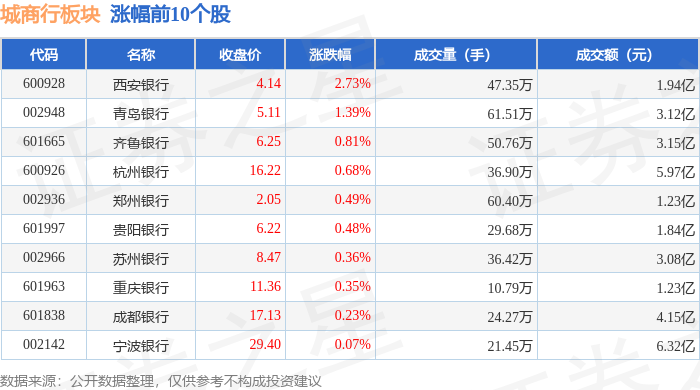
城商行板块11月11日跌0%,上海银行领跌,主力资金净流入2.41亿元
Zheng Xing Xing Ye Ri Bao· 2025-11-11 08:46
Market Overview - The city commercial bank sector experienced a slight decline of 0.0% on November 11, with Shanghai Bank leading the drop [1] - The Shanghai Composite Index closed at 4002.76, down 0.39%, while the Shenzhen Component Index closed at 13289.0, down 1.03% [1] Individual Bank Performance - Xi'an Bank saw the highest increase in share price, closing at 4.14 with a rise of 2.73% [1] - Qingdao Bank and Qilu Bank also reported positive performance, with increases of 1.39% and 0.81% respectively [1] - Shanghai Bank, on the other hand, closed at 10.13, down 0.98%, indicating a significant decline in its stock price [2] Trading Volume and Capital Flow - The city commercial bank sector recorded a net inflow of 241 million yuan from institutional investors, while retail investors saw a net outflow of 290 million yuan [2] - Jiangsu Bank attracted the highest net inflow from institutional investors at 113 million yuan, representing 11.75% of its trading volume [3] - In contrast, Zhengzhou Bank experienced a net outflow of 421,280 yuan from institutional investors, indicating a negative sentiment towards its stock [3]