
ZHENGZHOU BANK(002936)

Search documents
2026首份银行增持公告来了!顶流银行ETF(512800)上探1%,机构:历次春节前银行胜率最高,值得重视
Xin Lang Cai Jing· 2026-01-13 11:44
Core Viewpoint - The banking sector shows resilience with significant stock price increases, driven by executive buybacks and insurance capital inflows, indicating strong confidence in the sector's fundamentals and long-term value [3][12]. Group 1: Market Performance - On January 13, the market experienced a pullback, but the banking sector remained active, with notable gains: Ningbo Bank up over 4%, Hangzhou Bank up over 3%, and several others including CITIC Bank and Chongqing Rural Commercial Bank up over 2% [1][9]. - The top-tier banking ETF (512800) saw an intraday price increase of over 1%, closing up 0.37% and surpassing the 5-day moving average [1][10]. Group 2: Executive Buybacks - The first executive buyback announcement of 2026 was made by Chongqing Rural Commercial Bank, where some directors and executives purchased 192,000 shares from the secondary market, with a maximum investment of 1.23 million yuan [3][12]. - Nanjing Bank reported that its major shareholder, Zijin Group, increased its stake by 123,472,060 shares, representing 1.00% of the total share capital, continuing from previous increases since September 2025 [3][12]. Group 3: Insurance Capital Inflows - Insurance capital has been actively purchasing bank stocks, with Ping An Life announcing it reached a 20% stake in China Merchants Bank H-shares, triggering a mandatory bid [3][12]. - In 2025, insurance capital made 41 stake increases, the highest in nearly a decade, with bank stocks accounting for about 40% of these actions, highlighting their dominance in this area [3][12]. Group 4: Seasonal Trends - Historically, the banking sector has performed well before the Spring Festival, with the Shenwan Banking Index showing over 80% win rate in the past decade, except for 2020 [4][16]. - The average absolute return of the Shenwan Banking Index before the Spring Festival is 4.4%, with an average excess return of 4.9% compared to the Shanghai Composite Index, making it the highest among 31 industry indices [4][16]. Group 5: Future Outlook - Factors expected to drive the banking sector's performance leading up to the Spring Festival in 2026 include continued growth policies, ongoing insurance asset scarcity, and increased market volatility [7][16]. - The banking ETF (512800) is noted for its efficiency in tracking the banking sector, with a current scale of 11.95 billion yuan and an average daily trading volume exceeding 800 million yuan since 2025, making it the largest and most liquid banking ETF in A-shares [7][16].






城商行板块1月13日涨1.55%,宁波银行领涨,主力资金净流入2.38亿元
Zheng Xing Xing Ye Ri Bao· 2026-01-13 09:06
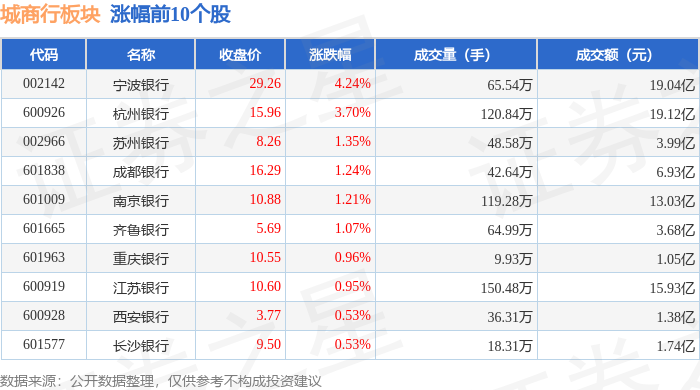
Core Insights - The city commercial bank sector experienced a rise of 1.55% on January 13, with Ningbo Bank leading the gains [1] - The Shanghai Composite Index closed at 4138.76, down 0.64%, while the Shenzhen Component Index closed at 14169.4, down 1.37% [1] Stock Performance - Ningbo Bank (002142) closed at 29.26, up 4.24%, with a trading volume of 655,400 shares and a transaction value of 1.904 billion [1] - Hangzhou Bank (600926) closed at 15.96, up 3.70%, with a trading volume of 1,208,400 shares and a transaction value of 1.912 billion [1] - Suzhou Bank (002966) closed at 8.26, up 1.35%, with a trading volume of 485,800 shares [1] - Chengdu Bank (601838) closed at 16.29, up 1.24%, with a trading volume of 426,400 shares and a transaction value of 693 million [1] - Nanjing Bank (600109) closed at 10.88, up 1.21%, with a trading volume of 1,192,800 shares and a transaction value of 1.303 billion [1] - Qilu Bank (601665) closed at 5.69, up 1.07%, with a trading volume of 649,900 shares and a transaction value of 368 million [1] - Chongqing Bank (601963) closed at 10.55, up 0.96%, with a trading volume of 99,300 shares and a transaction value of 10.5 million [1] - Jiangsu Bank (616009) closed at 10.60, up 0.95%, with a trading volume of 1,504,800 shares and a transaction value of 1.593 billion [1] - Xi'an Bank (600928) closed at 3.77, up 0.53%, with a trading volume of 363,100 shares and a transaction value of 13.8 million [1] - Changsha Bank (601577) closed at 9.50, up 0.53%, with a trading volume of 183,100 shares and a transaction value of 174 million [1] Capital Flow - The city commercial bank sector saw a net inflow of 238 million from institutional investors, while retail investors contributed a net inflow of 199 million [2] - The sector experienced a net outflow of 437 million from speculative funds [2] Individual Stock Capital Flow - Hangzhou Bank (600926) had a net inflow of 70.42 million from institutional investors, while it faced a net outflow of 12.4 million from speculative funds [3] - Shanghai Bank (601229) saw a net inflow of 66.71 million from institutional investors, with a net outflow of 33.15 million from speculative funds [3] - Ningbo Bank (002142) had a net inflow of 37.18 million from institutional investors, with a net outflow of 1.4 million from speculative funds [3] - Suzhou Bank (002966) experienced a net inflow of 34.87 million from institutional investors, while facing a net outflow of 24.25 million from speculative funds [3] - Jiangsu Bank (601577) had a net inflow of 20.83 million from institutional investors, with a net outflow of 15.24 million from speculative funds [3]



城商行板块1月12日涨0.25%,厦门银行领涨,主力资金净流出6140.56万元
Zheng Xing Xing Ye Ri Bao· 2026-01-12 09:10
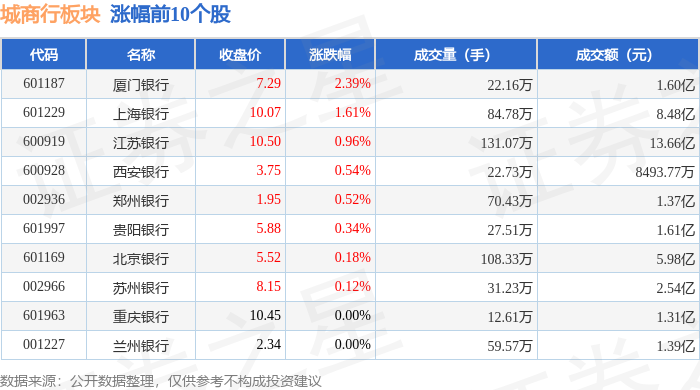
Market Performance - The city commercial bank sector increased by 0.25% compared to the previous trading day, with Xiamen Bank leading the gains [1] - The Shanghai Composite Index closed at 4165.29, up 1.09%, while the Shenzhen Component Index closed at 14366.91, up 1.75% [1] Individual Bank Performance - Xiamen Bank (601187) closed at 7.29, up 2.39% with a trading volume of 221,600 shares and a transaction value of 160 million yuan [1] - Shanghai Bank (601229) closed at 10.07, up 1.61% with a trading volume of 847,800 shares and a transaction value of 848 million yuan [1] - Jiangsu Bank (616009) closed at 10.50, up 0.96% with a trading volume of 1,310,700 shares and a transaction value of 1.366 billion yuan [1] - Other banks such as Xi'an Bank, Zhengzhou Bank, and Beijing Bank also showed minor increases in their stock prices [1] Capital Flow Analysis - The city commercial bank sector experienced a net outflow of 61.41 million yuan from institutional investors, while retail investors saw a net inflow of 66.54 million yuan [2] - The individual capital flow for Jiangsu Bank showed a net inflow of 47.88 million yuan from institutional investors, while retail investors had a net outflow of 51.39 million yuan [3] - Xiamen Bank had a net inflow of 17.18 million yuan from institutional investors, but retail investors experienced a net outflow of 8.30 million yuan [3]

城商行板块1月8日跌0.89%,重庆银行领跌,主力资金净流入673.97万元
Zheng Xing Xing Ye Ri Bao· 2026-01-08 08:56
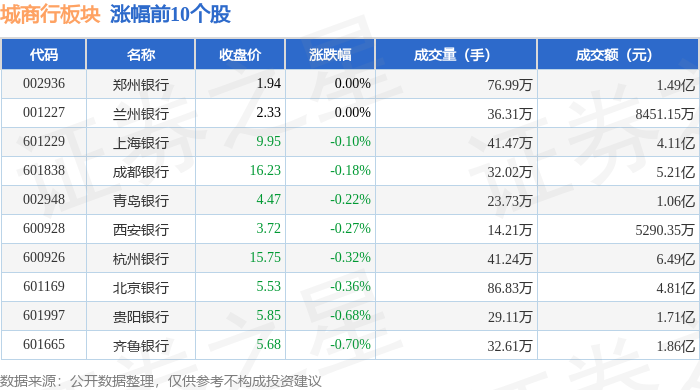
Market Overview - The city commercial bank sector experienced a decline of 0.89% on January 8, with Chongqing Bank leading the drop [1] - The Shanghai Composite Index closed at 4082.98, down 0.07%, while the Shenzhen Component Index closed at 13959.48, down 0.51% [1] Individual Stock Performance - Zhengzhou Bank closed at 1.94 with no change, while Lanzhou Bank also remained unchanged at 2.33 [1] - Shanghai Bank closed at 9.95, down 0.10%, and Chengdu Bank closed at 16.23, down 0.18% [1] - Chongqing Bank saw a significant decline of 2.70%, closing at 10.45, with a trading volume of 99,000 shares [2] Trading Volume and Turnover - The trading volume for Zhengzhou Bank was 769,900 shares with a turnover of 149 million yuan, while Lanzhou Bank had a trading volume of 363,100 shares and a turnover of 84.51 million yuan [1] - The highest turnover was recorded for Nanjing Bank at 1.342 billion yuan with a trading volume of 1,217,000 shares [2] Capital Flow Analysis - The city commercial bank sector saw a net inflow of 6.7397 million yuan from institutional investors, while retail investors experienced a net outflow of 70.5351 million yuan [2] - Chengdu Bank had a net inflow of 87.0825 million yuan from institutional investors, but a net outflow of 46.0321 million yuan from retail investors [3] Summary of Capital Flows - Institutional investors showed a positive net flow for several banks, including Hangzhou Bank with 77.8301 million yuan and Qingdao Bank with 8.4480 million yuan [3] - Conversely, Chongqing Bank had a negative net flow of 535,600 yuan from institutional investors, indicating a lack of confidence [3]

中小银行改革化险提速,开年吉林、江西、海南等多地传新进展
Xin Lang Cai Jing· 2026-01-07 13:34
Core Insights - Multiple provinces in China are advancing reforms in rural credit cooperatives and village banks, with significant consolidations and mergers taking place [2][11][12] Group 1: Recent Developments - Yunnan plans to integrate 123 rural commercial banks and credit cooperatives to form a provincial-level rural commercial bank [2][11] - Jilin Rural Commercial Bank has been approved to absorb and merge 56 institutions, including 8 rural commercial banks and 48 village banks [3][13] - Hainan Rural Commercial Bank has received approval to absorb Hainan Baoting Rongxing Village Bank [4][14] - Zhengzhou Bank and Zhongyuan Bank have been approved to acquire 5 village banks [4][14] - Jiangxi Rural Commercial Union Bank has been approved to acquire stakes in multiple rural commercial banks and to take over shares from other banks due to debt settlements [4][14] Group 2: Reform Progress - The reforms in Jilin, Hainan, and Jiangxi have progressed significantly, with previous steps already completed [5][15] - Jilin Rural Commercial Bank was established in August 2025 through the merger of 13 institutions and aims to unify the province's rural banking under one legal entity [6][15] - Hainan Rural Commercial Bank, established in May 2024, has also been actively merging with local banks since its inception [6][16] - Jiangxi Rural Commercial Bank, which opened in April 2025, has been deepening its equity reforms and has been approved for significant capital injections [6][16] Group 3: Reform Strategies - The gradual reform approach taken by provinces like Jilin, Hainan, and Jiangxi aims to maintain financial stability while consolidating rural financial institutions [7][18] - The strategy of phased mergers allows for better management of risks and challenges associated with integrating multiple institutions [7][18] - The ongoing reforms have seen 13 provinces complete their rural credit cooperative reforms, with various models adopted, including unified legal entities and joint banking systems [8][18]

地产旧账围城中的郑州银行,想去县域寻新机
Hua Er Jie Jian Wen· 2026-01-07 09:49
Core Viewpoint - Zhengzhou Bank is transitioning from a reliance on real estate to focusing on county-level markets, seeking new growth opportunities amid rising non-performing loans in the real estate sector [1][10]. Real Estate Issues - Zhengzhou Bank won a court ruling regarding an 11 billion yuan loan to Jinwei Industrial, but the defendant's lack of assets raises concerns about actual recovery [2][3]. - The bank's real estate non-performing loan ratio surged from 0.15% in 2019 to 9.75% by mid-2025, indicating a significant deterioration in asset quality [7]. - The bank has faced multiple large-scale real estate bad debts, with 22 billion yuan in principal exceeding its net profit from the previous year [5]. Strategic Shift - To address asset quality, Zhengzhou Bank is reducing its real estate loan ratio from 13.62% in 2019 to around 5% [8]. - The bank has initiated a "de-real estate" transformation, including transferring 15 billion yuan in assets at a discount to manage existing risks [8][9]. - By the end of Q3 2025, the bank's non-performing loan ratio improved to 1.76%, outperforming the average for city commercial banks [9]. County-Level Focus - Zhengzhou Bank is shifting its focus to county-level markets, which exhibit stronger anti-cyclical capabilities compared to urban economies [10]. - The bank's strategy has evolved through three phases, with a significant shift in 2024 towards viewing county economies as key growth areas [11][12]. - The bank's county-level business now operates on a "retail + corporate" dual-drive model, enhancing its service offerings [14]. Future Outlook - The bank's credit resources are increasingly being redirected from real estate to county-level markets, with a nearly 70 billion yuan reduction in real estate loans by Q3 2025 [17]. - However, challenges remain, including rising non-performing loans and increased competition from local rural commercial banks [19][20].
城商行板块1月7日涨0%,杭州银行领涨,主力资金净流出1.7亿元
Zheng Xing Xing Ye Ri Bao· 2026-01-07 08:58
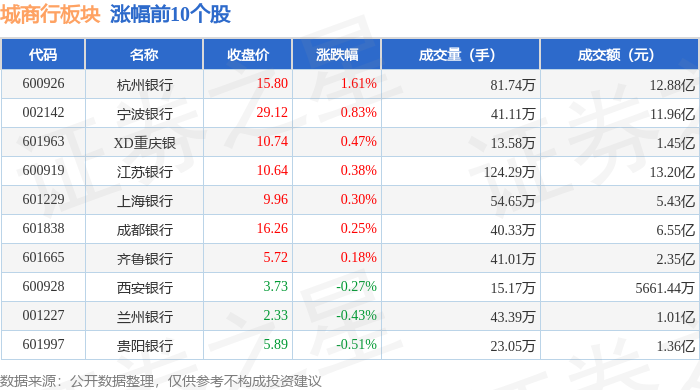
Market Performance - The city commercial bank sector experienced a slight increase of 0.0% on January 7, with Hangzhou Bank leading the gains [1] - The Shanghai Composite Index closed at 4085.77, up 0.05%, while the Shenzhen Component Index closed at 14030.56, up 0.06% [1] Individual Stock Performance - Hangzhou Bank (600926) closed at 15.80, with a rise of 1.61% and a trading volume of 817,400 shares [1] - Ningbo Bank (002142) closed at 29.12, up 0.83%, with a trading volume of 411,100 shares [1] - Other notable performances include Jiangsu Bank (601963) at 10.64 (+0.38%) and Shanghai Bank (601229) at 9.96 (+0.30%) [1] Capital Flow Analysis - The city commercial bank sector saw a net outflow of 170 million yuan from institutional investors, while retail investors contributed a net inflow of 188 million yuan [2] - The overall capital flow indicates a mixed sentiment, with institutional investors withdrawing funds while retail investors increased their positions [2] Detailed Capital Flow by Bank - Jiangsu Bank had a net inflow of 123 million yuan from institutional investors, while retail investors saw a net outflow of 27 million yuan [3] - Hangzhou Bank experienced a net inflow of 84 million yuan from institutional investors, but retail investors had a significant outflow of 132 million yuan [3] - Chengdu Bank recorded a net inflow of 55 million yuan from institutional investors, with retail investors also experiencing a net outflow [3]
2025年银行CIO盘点:建行、中行CIO离任,多家中小银行行外引进CIO
Xin Lang Cai Jing· 2026-01-07 03:33
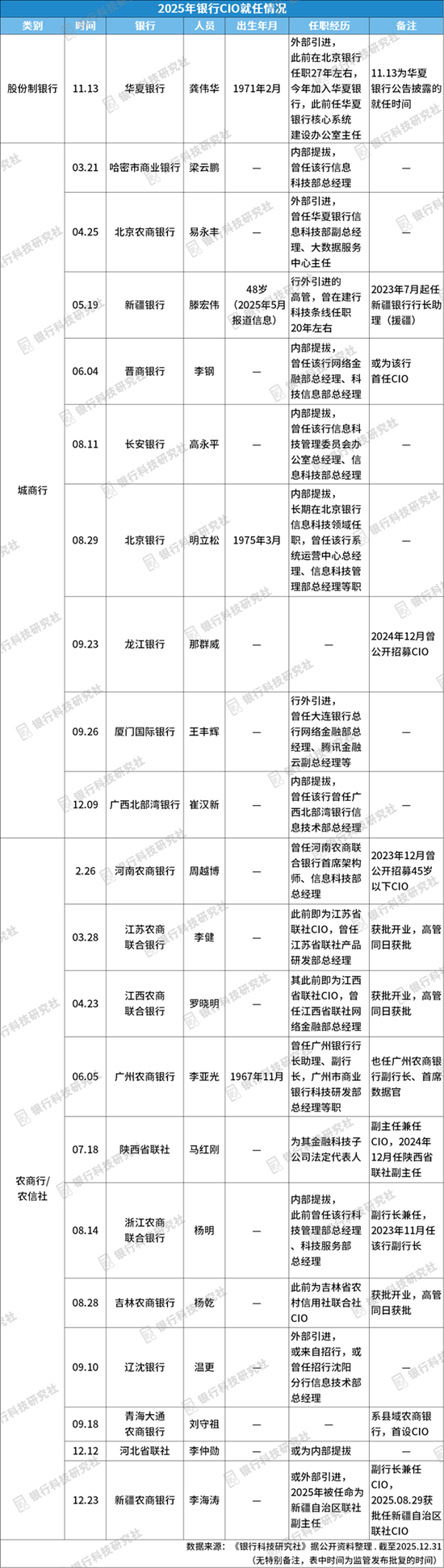
Core Insights - The digital transformation is crucial for the banking industry, with a significant focus on the restructuring of digital talent, particularly the Chief Information Officers (CIOs) [1][2] Group 1: Changes in CIO Positions - In 2025, several major banks experienced changes in their technology leadership, with the CIOs of China Construction Bank (CCB) and Bank of China (BOC) resigning [2][4] - CCB's former CIO, Jin Panshi, resigned due to age reasons after serving for four years [2][3] - BOC's former CIO, Meng Qian, also resigned for age reasons after a 38-year tenure, during which she held multiple senior positions [4][6] - The Industrial and Commercial Bank of China (ICBC) also saw its technology leader, CTO Lv Zhongtao, leave at the end of 2025 [7][8] Group 2: New Appointments and Trends - In 2025, 21 new CIOs were appointed, primarily in small and medium-sized banks, with many being external hires [10][11] - Notable new CIOs include Gong Weihua at Huaxia Bank and Wang Fenghui at Xiamen International Bank, both of whom were brought in from outside the banking sector [11][12] - The trend indicates a shift towards external recruitment for CIO positions, with 48% of the new appointments being external hires [16] Group 3: Recruitment Trends in Smaller Banks - Many small and medium-sized banks have publicly announced CIO recruitment in 2025, including Xiamen International Bank and Zhengzhou Bank [18][19] - Recruitment criteria often include age limits and specific experience requirements, such as a minimum of six years in information technology and four years in senior management roles [18][20] - The trend reflects a growing emphasis on digital leadership within smaller banks, as they seek to enhance their technological capabilities [18][19]
2025年A股银行板块涨幅放缓 个股分化显著 机构看好2026年上市银行营收利润增速改善
Xin Lang Cai Jing· 2026-01-06 23:23
Core Viewpoint - The A-share banking sector is expected to achieve a market value breakthrough in 2025, but the overall growth rate is slowing and underperforming compared to the broader market, with significant individual stock differentiation [1][7]. Market Performance - As of December 31, 2025, the Wind Banking Index reached 7180.68 points, with an annual growth of 12.04%, lower than the previous year's 43.56%. The total market value of the sector at year-end was 15.71 trillion yuan, an increase of over 15% from the beginning of the year, having briefly surpassed 16 trillion yuan [1][7]. - The banking sector exhibited a clear phase differentiation throughout the year, with a mild increase in Q1, a significant rise in Q2, a deep correction in Q3, and a recovery in Q4 [2][8]. Individual Stock Performance - In 2025, 35 out of 42 A-share listed banks saw their stock prices rise, accounting for over 83%. Among the six banks with over 20% growth, Agricultural Bank led with a 52.66% increase, followed by Xiamen Bank, Shanghai Pudong Development Bank, Chongqing Bank, Industrial and Commercial Bank, and Ningbo Bank with growth rates ranging from 20.68% to 35.78% [3][9]. - Conversely, seven banks experienced declines, with Huaxia Bank at the bottom with a 9.82% drop, and Zhengzhou Bank, Beijing Bank, and China Everbright Bank all declining by over 5% [3][9]. Future Outlook - Multiple brokerage firms predict an improvement in revenue and profit growth for listed banks in 2026, with expected revenue growth rates of +2.5% and +3.6% for 2026 and 2027, respectively, and net profit growth rates of +1.9% and +2.6% [4][10]. - The improvement in revenue and profit growth is attributed to several factors, including a reduction in net interest margin pressure, a shift towards quality in credit issuance, and a stabilization in fee income growth [4][10]. Investment Strategy - In light of the different characteristics of new inflows, the equity market in 2025 is characterized by increased stable return strategy products, enhanced structural trends, and greater individual stock volatility. For 2026, it is recommended to prioritize stable stocks and adopt a bottom-fishing strategy, while also considering elastic stocks for rotation trading [6][12].



郑州银行(002936) - H股公告 - 截至二零二五年十二月三十一日止月份之股份发行人的证券变动月报表
2026-01-06 11:15
股份發行人及根據《上市規則》第十九B章上市的香港預託證券發行人的證券變動月報表 截至月份: 2025年12月31日 狀態: 新提交 致:香港交易及結算所有限公司 公司名稱: 鄭州銀行股份有限公司 (於中華人民共和國註冊成立的股份有限公司) 呈交日期: 2026年1月6日 I. 法定/註冊股本變動 | 1. 股份分類 | 普通股 | 股份類別 H | | | 於香港聯交所上市 (註1) | | 是 | | | --- | --- | --- | --- | --- | --- | --- | --- | --- | | 證券代號 (如上市) | 06196 | 說明 | H股 | | | | | | | | | 法定/註冊股份數目 | | | 面值 | | 法定/註冊股本 | | | 上月底結存 | | | 2,020,458,000 | RMB | | 1 RMB | | 2,020,458,000 | | 增加 / 減少 (-) | | | 0 | | | RMB | | 0 | | 本月底結存 | | | 2,020,458,000 | RMB | | 1 RMB | | 2,020,458,000 | ...