ZHENGZHOU BANK(002936)

Search documents
郑州银行行长助理高瑞任职资格获批
Bei Jing Shang Bao· 2026-01-30 11:25
简历显示,高瑞,1981年8月出生,工商管理硕士。高瑞自2006年8月至2025年3月于兴业银行郑州分行 任职,曾任支行零售业务处副处长、机构业务处处长,支行行长助理,企业金融业务总部总裁,企业金 融业务部总监,支行行长。 北京商报讯(记者 孟凡霞 周义力)1月30日,郑州银行发布公告,该行于近日收到国家金融监督管理总 局河南监管局下发的《河南金融监管局关于高瑞郑州银行股份有限公司行长助理任职资格的批复》,核 准高瑞担任该行行长助理的任职资格。 ...
郑州银行(002936) - 郑州银行股份有限公司关于高级管理人员任职资格获核准的公告
2026-01-30 10:31
郑州银行股份有限公司 证券代码:002936 证券简称:郑州银行 公告编号:2026-002 关于高级管理人员任职资格获核准的公告 2026 年 1 月 31 日 高 瑞 女 士 的 简 历 请 见 本 行 于 2025 年 3 月 28 日 在 巨 潮 资 讯 网 (http://www.cninfo.com.cn)发布的《郑州银行股份有限公司第八届董事会第一 次会议决议公告》(公告编号:2025-016)。 特此公告。 郑州银行股份有限公司董事会 郑州银行股份有限公司(以下简称"本行")及董事会全体成员保证公告内容的真实、准 确、完整,没有虚假记载、误导性陈述或重大遗漏。 本行于近日收到国家金融监督管理总局河南监管局下发的《河南金融监管局 关于高瑞郑州银行股份有限公司行长助理任职资格的批复》(豫金复〔2026〕36 号),核准高瑞女士本行行长助理的任职资格。 ...
城商行板块1月29日涨2.54%,青岛银行领涨,主力资金净流入7.02亿元
Zheng Xing Xing Ye Ri Bao· 2026-01-29 09:03
证券之星消息,1月29日城商行板块较上一交易日上涨2.54%,青岛银行领涨。当日上证指数报收于 4157.98,上涨0.16%。深证成指报收于14300.08,下跌0.3%。城商行板块个股涨跌见下表: | 代码 | 名称 | 主力净流入(元) | 主力净占比 游资净流入(元) | | 游资净占比 散户净流入(元) | | 散户净占比 | | --- | --- | --- | --- | --- | --- | --- | --- | | 600919 江苏银行 | | 3.22 Z | 14.99% | -1.71 Z | -7.95% | -1.51 Z | -7.04% | | 002142 | 宁波银行 | 1.51亿 | 11.12% | -241.36万 | -0.18% | -1.49 Z | -10.94% | | 601169 | 北京银行 | 1.07 乙 | 8.92% | -2694.44万 | -2.24% | -8037.98万 | -6.68% | | 601229 | 上海银行 | 4165.56万 | 6.03% | 847.76万 | 1.23% | -5013.31万 | ...





城商行板块1月27日涨0.13%,青岛银行领涨,主力资金净流入4.04亿元
Zheng Xing Xing Ye Ri Bao· 2026-01-27 09:06
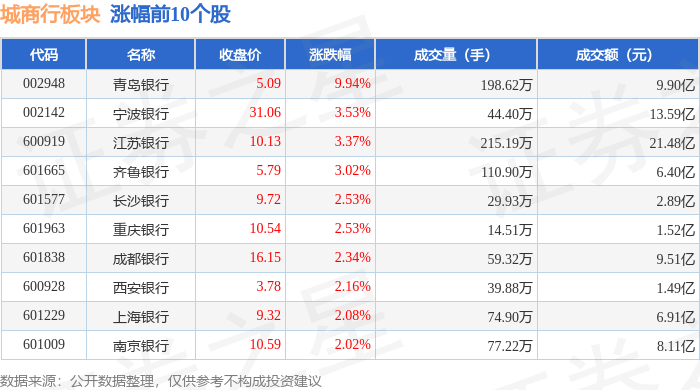
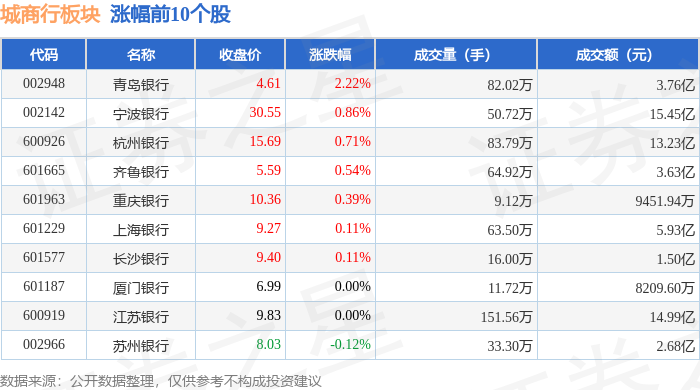
Market Performance - The city commercial bank sector increased by 0.13% compared to the previous trading day, with Qingdao Bank leading the gains [1] - The Shanghai Composite Index closed at 4139.9, up 0.18%, while the Shenzhen Component Index closed at 14329.91, up 0.09% [1] Individual Stock Performance - Qingdao Bank (002948) closed at 4.61, up 2.22% with a trading volume of 820,200 shares and a transaction value of 376 million [1] - Ningbo Bank (002142) closed at 30.55, up 0.86% with a trading volume of 507,200 shares and a transaction value of 1545 million [1] - Hangzhou Bank (600926) closed at 15.69, up 0.71% with a trading volume of 837,900 shares and a transaction value of 1323 million [1] - Qilu Bank (601665) closed at 5.59, up 0.54% with a trading volume of 649,200 shares and a transaction value of 363 million [1] - Chongqing Bank (601963) closed at 10.36, up 0.39% with a trading volume of 91,200 shares and a transaction value of 94.52 million [1] - Shanghai Bank (601229) closed at 9.27, up 0.11% with a trading volume of 635,000 shares and a transaction value of 593 million [1] - Other banks such as Changsha Bank, Xiamen Bank, and Suzhou Bank showed minimal changes in their stock prices [1] Capital Flow - The city commercial bank sector saw a net inflow of 404 million from main funds, while retail investors experienced a net outflow of 4.15 billion [2] - The main funds' net inflow and outflow for individual banks varied, with Ningbo Bank and Jiangsu Bank showing significant inflows [3] - Retail investors showed notable outflows in several banks, indicating a shift in investment sentiment [3]

低价股一览 29股股价不足2元
Zheng Quan Shi Bao Wang· 2026-01-23 09:30
Group 1 - The average stock price of A-shares is 14.84 yuan, with 29 stocks priced below 2 yuan, the lowest being *ST Aowei at 0.73 yuan [1] - Among the low-priced stocks, 8 are ST stocks, accounting for 27.59% of the total [1] - In terms of market performance, 26 of the low-priced stocks increased in price, with *ST Changyao, *ST Lifang, and Yabo shares leading the gains at 19.48%, 13.91%, and 10.06% respectively [1] Group 2 - The stock price rankings of low-priced stocks show *ST Aowei at 0.73 yuan with a daily decline of 5.19%, while *ST Changyao and *ST Lifang have daily increases of 19.48% and 13.91% respectively [1] - The trading volume for *ST Changyao is notable with a turnover rate of 19.92%, while *ST Lifang has a turnover rate of 26.78% [1] - Other low-priced stocks include *ST Jinke at 1.49 yuan and Chongqing Steel at 1.54 yuan, with respective daily changes of 0.68% and 2.67% [1]


城商行板块1月23日跌1.01%,上海银行领跌,主力资金净流入1.48亿元
Zheng Xing Xing Ye Ri Bao· 2026-01-23 09:04
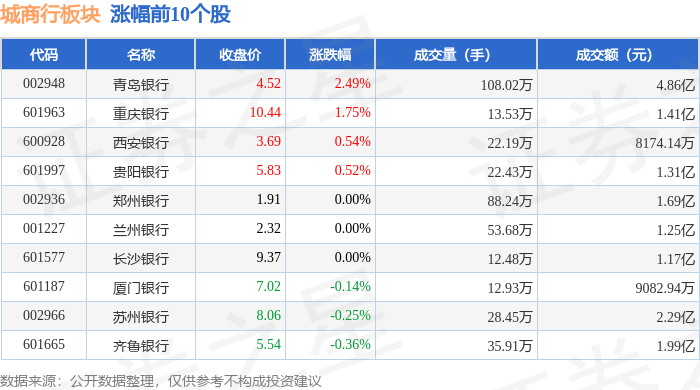
证券之星消息,1月23日城商行板块较上一交易日下跌1.01%,上海银行领跌。当日上证指数报收于 4136.16,上涨0.33%。深证成指报收于14439.66,上涨0.79%。城商行板块个股涨跌见下表: | 代码 | 名称 | 收盘价 | 涨跌幅 | 成交量(手) | 成交额(元) | | --- | --- | --- | --- | --- | --- | | 002948 | 青岛银行 | 4.52 | 2.49% | 108.02万 | 4.86亿 | | 601963 | 重庆银行 | 10.44 | 1.75% | 13.53万 | 1.41亿 | | 600928 | 西安银行 | 3.69 | 0.54% | 22.19万 | 8174.14万 | | 601997 | 豊阳银行 | 5.83 | 0.52% | 22.43万 | 1.31亿 | | 002936 | 郑州银行 | 1.91 | 0.00% | 88.24万 | 1.69亿 | | 001227 | 兰州银行 | 2.32 | 0.00% | 53.68万 | 1.25亿 | | 601577 | 长沙银行 | 9.37 | ...
城商行板块1月21日跌0.55%,重庆银行领跌,主力资金净流入5.08亿元
Zheng Xing Xing Ye Ri Bao· 2026-01-21 08:54
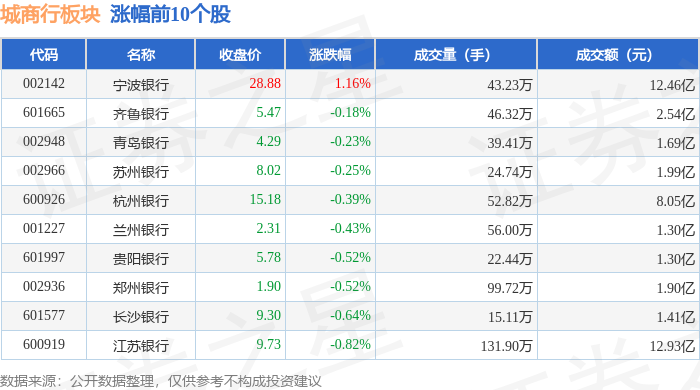
Market Overview - The city commercial bank sector experienced a decline of 0.55% on January 21, with Chongqing Bank leading the drop [1] - The Shanghai Composite Index closed at 4116.94, up 0.08%, while the Shenzhen Component Index closed at 14255.12, up 0.7% [1] Individual Stock Performance - Ningbo Bank closed at 28.88, with an increase of 1.16% and a trading volume of 432,300 shares, amounting to a transaction value of 1.246 billion [1] - Chongqing Bank closed at 10.25, down 1.82%, with a trading volume of 106,800 shares and a transaction value of 110 million [2] - Other notable performers include Xiamen Bank, which closed at 7.13, down 1.66%, and Chengdu Bank, which closed at 15.72, down 1.38% [2] Capital Flow Analysis - The city commercial bank sector saw a net inflow of 508 million from institutional investors, while retail investors experienced a net outflow of 566 million [2] - The capital flow for individual stocks indicates that Hangzhou Bank had a net inflow of 158 million from institutional investors, while it faced a net outflow of 86.5 million from retail investors [3] - Shanghai Bank also saw a net inflow of 107 million from institutional investors, with a net outflow of 121 million from retail investors [3]

城商行板块1月16日跌1.27%,江苏银行领跌,主力资金净流出2.29亿元
Zheng Xing Xing Ye Ri Bao· 2026-01-16 08:56
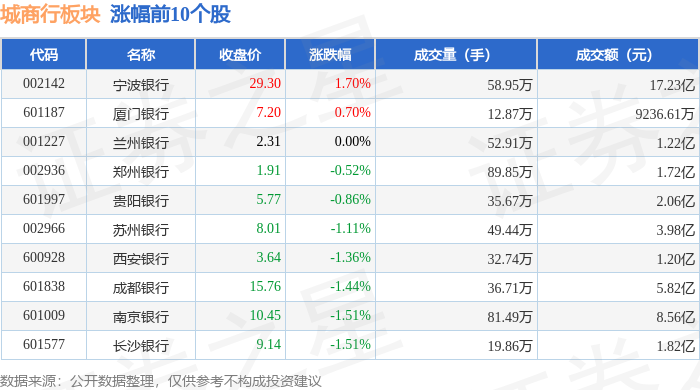
Core Viewpoint - The city commercial bank sector experienced a decline of 1.27% on January 16, with Jiangsu Bank leading the drop. The Shanghai Composite Index closed at 4101.91, down 0.26%, while the Shenzhen Component Index closed at 14281.08, down 0.18% [1]. Group 1: Stock Performance - Ningbo Bank closed at 29.30, up 1.70% with a trading volume of 589,500 shares and a transaction value of 1.723 billion [1]. - Xiamen Bank closed at 7.20, up 0.70% with a trading volume of 128,700 shares and a transaction value of 92.3661 million [1]. - Jiangsu Bank closed at 9.76, down 2.69% with a trading volume of 2,061,300 shares and a transaction value of 2.033 billion [2]. - Shanghai Bank closed at 9.64, down 2.43% with a trading volume of 961,200 shares and a transaction value of 933.3 million [2]. Group 2: Capital Flow - The city commercial bank sector saw a net outflow of 229 million from main funds, while speculative funds had a net inflow of 716 million, and retail investors experienced a net outflow of 487 million [2]. - Hangzhou Bank had a main fund net inflow of 153 million, while retail investors saw a net outflow of 113 million [3]. - Nanjing Bank recorded a main fund net inflow of 70.5 million and a retail net outflow of 131 million [3].
郑州银行:公司将加强与各类科技型企业的业务合作
Zheng Quan Ri Bao Wang· 2026-01-15 11:43
Core Viewpoint - Zhengzhou Bank (002936) aims to enhance its financial service capabilities in technological innovation and strengthen business cooperation with various technology enterprises to provide robust financial service support [1] Company Summary - Zhengzhou Bank is committed to improving its financial services by focusing on technological innovation [1] - The bank plans to collaborate with different technology companies to ensure effective financial service delivery [1]
城商行板块1月15日跌0.59%,青岛银行领跌,主力资金净流入2.21亿元
Zheng Xing Xing Ye Ri Bao· 2026-01-15 08:59
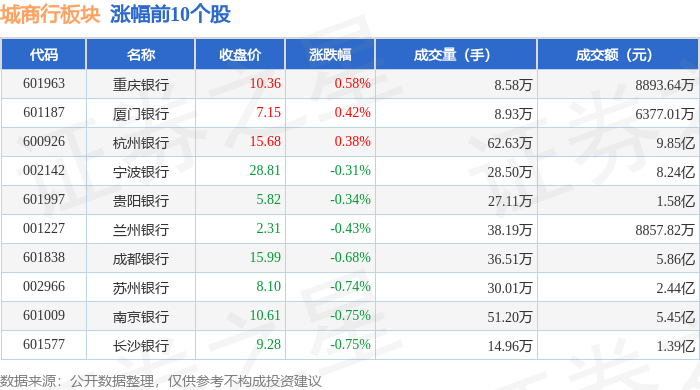
Market Performance - The city commercial bank sector declined by 0.59% on January 15, with Qingdao Bank leading the decline [1] - The Shanghai Composite Index closed at 4112.6, down 0.33%, while the Shenzhen Component Index closed at 14306.73, up 0.41% [1] Individual Stock Performance - Chongqing Bank closed at 10.36, up 0.58% with a trading volume of 85,800 shares and a transaction value of 88.94 million [1] - Xiamen Bank closed at 7.15, up 0.42% with a trading volume of 89,300 shares and a transaction value of 63.77 million [1] - Hangzhou Bank closed at 15.68, up 0.38% with a trading volume of 626,300 shares and a transaction value of 9.85 billion [1] - Ningbo Bank closed at 28.81, down 0.31% with a trading volume of 285,000 shares and a transaction value of 824 million [1] - Chengdu Bank closed at 15.99, down 0.68% with a trading volume of 365,100 shares and a transaction value of 586 million [1] Capital Flow Analysis - The city commercial bank sector saw a net inflow of 221 million from institutional investors and a net inflow of 296 million from speculative funds, while retail investors experienced a net outflow of 517 million [2] - Hangzhou Bank had a net inflow of 123 million from institutional investors, accounting for 12.51% of its total [3] - Shanghai Bank had a net inflow of 97.02 million from institutional investors, representing 20.87% of its total [3] - Nanjing Bank had a net inflow of 37.40 million from institutional investors, making up 6.86% of its total [3]