
HYBIO(300199)

Search documents
主力资金 | 尾盘拉涨停,主力资金出逃超9亿元!
Zheng Quan Shi Bao· 2025-08-05 10:44
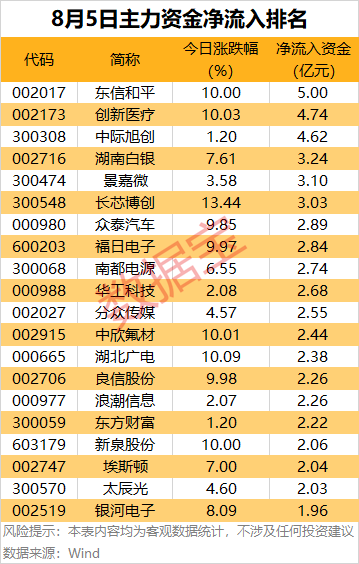
Market Overview - A-shares' three major indices collectively rose on August 5, with the Shanghai Composite Index returning above 3600 points [1] - The majority of industry sectors experienced gains, particularly in communication equipment, consumer electronics, plastic products, insurance, automotive parts, banking, transportation equipment, and wind power equipment [1] Capital Flow - The net outflow of main funds in the Shanghai and Shenzhen markets reached 12.523 billion yuan for the day [1] - Six industries saw net inflows, with the communication industry leading at 1.722 billion yuan, followed by non-bank financials (866 million yuan), non-ferrous metals (292 million yuan), construction decoration (222 million yuan), real estate (187 million yuan), and home appliances (51 million yuan) [1] - The pharmaceutical and biological industry had the highest net outflow, totaling 4.245 billion yuan, followed by machinery equipment and computer industries, each exceeding 2 billion yuan [1] Notable Stocks - Dongxin Peace (002017) saw a net inflow of 500 million yuan, with a daily increase of 10% [4] - Innovation Medical (002173) experienced a net inflow of 474 million yuan, also rising by 10% [4] - The digital currency concept stock Dongxin Peace attracted 500 million yuan in main fund purchases, focusing on enhancing "digital identity+" applications [2] - Innovation Medical's stock surged due to the support of new pricing mechanisms for innovative drugs and medical devices, particularly in the brain-computer interface sector [3] Tail-End Capital Movement - At the end of the trading day, the main funds saw a net inflow of 666 million yuan, with non-bank financials, media, banking, computing, and automotive industries receiving over 100 million yuan each [5] - Notable stocks with significant tail-end inflows included Dongxin Peace and Daily Interaction, each exceeding 100 million yuan [7][8] Major Outflows - The stocks with the highest net outflows included Shanhai Intelligent (002097) and Hanyu Pharmaceutical (300199), with outflows of 978 million yuan and 935 million yuan, respectively [6] - Other companies with significant outflows included Xingsen Technology, Aileda, Jianghai Co., and Aerospace Electronics [5]




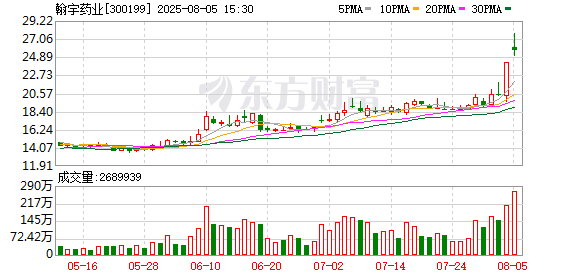
医药生物行业资金流出榜:翰宇药业等9股净流出资金超亿元
Zheng Quan Shi Bao Wang· 2025-08-05 09:03
沪指8月5日上涨0.96%,申万所属行业中,今日上涨的有31个,涨幅居前的行业为综合、银行,涨幅分 别为1.98%、1.59%。医药生物行业今日上涨0.12%。 资金面上看,两市主力资金全天净流出116.76亿元,今日有10个行业主力资金净流入,通信行业主力资 金净流入规模居首,该行业今日上涨1.25%,全天净流入资金24.85亿元,其次是非银金融行业,日涨幅 为1.23%,净流入资金为15.67亿元。 | 代码 | 简称 | 今日涨跌幅(%) | 今日换手率(%) | 主力资金流量(万元) | | --- | --- | --- | --- | --- | | 002173 | 创新医疗 | 10.03 | 25.23 | 47179.97 | | 603538 | 美诺华 | 6.50 | 21.23 | 19759.76 | | 603259 | 药明康德 | 1.57 | 1.95 | 12168.60 | | 600276 | 恒瑞医药 | 0.48 | 0.85 | 10240.72 | | 002275 | 桂林三金 | 10.00 | 4.48 | 9485.99 | | 600252 | 中 ...
8月5日主力资金流向日报
Zheng Quan Shi Bao Wang· 2025-08-05 08:53
Market Overview - On August 5, the Shanghai Composite Index rose by 0.96%, the Shenzhen Component Index increased by 0.59%, the ChiNext Index went up by 0.39%, and the CSI 300 Index gained 0.80% [1] - Among the tradable A-shares, 3,903 stocks rose, accounting for 72.17%, while 1,327 stocks declined [1] Capital Flow - The main capital saw a net outflow of 11.676 billion yuan throughout the day [1] - The ChiNext experienced a net outflow of 6.731 billion yuan, while the STAR Market had a net outflow of 1.542 billion yuan [1] - The CSI 300 constituent stocks saw a net inflow of 2.692 billion yuan [1] Industry Performance - Out of the 31 first-level industries classified by Shenwan, the top-performing sectors were Comprehensive and Banking, with increases of 1.98% and 1.59% respectively [1] - The Communication industry led the net inflow of main capital, with a net inflow of 2.485 billion yuan and a daily increase of 1.25% [1] - The Non-bank Financial sector followed with a daily increase of 1.23% and a net inflow of 1.567 billion yuan [1] Industry Capital Outflow - The Pharmaceutical and Biological industry had the largest net outflow, with a net outflow of 5.336 billion yuan despite a daily increase of 0.12% [1] - The Computer industry also saw significant outflow, with a net outflow of 3.102 billion yuan and a daily increase of 0.25% [1] - Other industries with notable net outflows included Defense and Military, Machinery Equipment, and Electronics [1] Individual Stock Performance - A total of 1,999 stocks experienced net inflows, with 742 stocks having net inflows exceeding 10 million yuan [2] - Among these, 83 stocks had net inflows exceeding 100 million yuan, with Dongxin HePing leading at a net inflow of 570 million yuan and a daily increase of 10.00% [2] - The stocks with the largest net outflows included Shanhe Intelligent, Hanyu Pharmaceutical, and Aerospace Electronics, with net outflows of 910 million yuan, 909 million yuan, and 588 million yuan respectively [2]

幽门螺杆菌概念下跌0.50%,主力资金净流出49股
Zheng Quan Shi Bao Wang· 2025-08-05 08:45
Group 1 - The Helicobacter pylori concept sector declined by 0.50%, ranking among the top declines in concept sectors, with notable declines in stocks such as Keta Bio, Anglikang, and Asia-Pacific Pharmaceutical [1][2] - Among the 49 stocks in the Helicobacter pylori concept sector, 27 stocks saw price increases, with Zhongheng Group, Hanyu Pharmaceutical, and *ST Sansheng leading the gains at 9.85%, 5.63%, and 5.05% respectively [1][4] - The Helicobacter pylori concept sector experienced a net outflow of 1.725 billion yuan in main funds, with Hanyu Pharmaceutical seeing the largest outflow of 909.33 million yuan [2][3] Group 2 - The top gainers in the concept sectors included the Armament Reorganization concept at 6.12%, PEEK materials at 4.11%, and Brain-Computer Interface at 2.72% [2] - The main funds saw inflows in stocks such as Zhongheng Group, Baicheng Pharmaceutical, and Asia Treasure Pharmaceutical, with inflows of 88.23 million yuan, 63.86 million yuan, and 19.51 million yuan respectively [2][4] - The stocks with the largest net outflows in the Helicobacter pylori concept included Asia-Pacific Pharmaceutical at -8.16%, Keta Bio at -10.28%, and Anglikang at -9.46% [2][3]


流感概念下跌0.50%,11股主力资金净流出超5000万元
Zheng Quan Shi Bao Wang· 2025-08-05 08:44
Group 1 - The flu concept sector declined by 0.50%, ranking among the top declines in the concept sectors, with companies like Qizheng Tibetan Medicine, New Light Pharmaceutical, and Weikang Pharmaceutical experiencing significant drops [1][2] - Among the flu concept stocks, 56 stocks saw price increases, with Chengyi Pharmaceutical, Kehua Bio, and Guilin Sanjin leading with gains of 10.04%, 10.00%, and 10.00% respectively [1][2] Group 2 - The flu concept sector experienced a net outflow of 2.651 billion yuan, with 116 stocks seeing net outflows, and 11 stocks having outflows exceeding 50 million yuan [2] - The stock with the highest net outflow was Hanyu Pharmaceutical, with a net outflow of 909 million yuan, followed by Tibet Pharmaceutical, Yipinhong, and Zhendong Pharmaceutical [2][3] Group 3 - The top inflow stocks in the flu concept sector included Guilin Sanjin, Borui Pharmaceutical, and Kehua Bio, with net inflows of 948.599 million yuan, 871.114 million yuan, and 772.718 million yuan respectively [2][7] - The overall market performance showed a mixed trend, with various sectors experiencing different levels of gains and losses, indicating a volatile market environment [2][6]



仿制药一致性评价概念下跌0.55%,5股主力资金净流出超亿元
Zheng Quan Shi Bao Wang· 2025-08-05 08:41
Market Performance - As of August 5, the generic drug consistency evaluation concept declined by 0.55%, ranking among the top declines in the concept sector [1] - Within the sector, notable declines were seen in companies such as Angli Kang, Asia-Pacific Pharmaceutical, and Nanxin Pharmaceutical, while 46 stocks experienced price increases, with Chengyi Pharmaceutical, Guilin Sanjin, and Zhongheng Group leading with increases of 10.04%, 10.00%, and 9.85% respectively [1] Capital Flow - The generic drug consistency evaluation sector saw a net outflow of 3.403 billion yuan, with 112 stocks experiencing net outflows, and 5 stocks seeing outflows exceeding 100 million yuan [2] - The stock with the highest net outflow was Hanyu Pharmaceutical, with a net outflow of 909.3 million yuan, followed by Asia-Pacific Pharmaceutical, Guangsheng Tang, and Yipinhong with net outflows of 192.45 million yuan, 135.13 million yuan, and 119.26 million yuan respectively [2] Top Gainers and Losers - The top gainers in the sector included Chengyi Pharmaceutical, Guilin Sanjin, and Zhongheng Group, with respective net inflows of 102 million yuan, 94.85 million yuan, and 88.22 million yuan [6] - Conversely, the top losers included Hanyu Pharmaceutical, Asia-Pacific Pharmaceutical, and Guangsheng Tang, with significant net outflows [2][3]



翰宇药业开创先河:新药"研发能力上链"新范式
Zheng Quan Shi Bao· 2025-08-05 03:35
Core Viewpoint - The strategic partnership between Hanyu Pharmaceutical and KuCoin aims to explore the tokenization of future revenue rights from innovative drug research and development in Hong Kong, marking a significant step in the integration of technology, medicine, and finance [1][2][3] Group 1: Company Overview - Hanyu Pharmaceutical has over 20 years of experience in peptide drugs and possesses a comprehensive formulation pipeline covering mainstream peptide targets globally [3] - The company expects a substantial increase in net profit for the first half of 2025, projecting between 142 million to 162 million yuan, representing a year-on-year growth of 1,471% to 1,664% [3] - Hanyu's collaboration with KuCoin is expected to enhance its competitive edge in the GLP-1 peptide drug sector by leveraging blockchain technology [6] Group 2: Industry Context - The pharmaceutical industry faces high research costs, lengthy development cycles, and significant risks, making capital market financing essential for many innovative drug companies [4] - Traditional financing models often rely on private equity and venture capital, leading to dilution of equity and uncertainty regarding IPO success [4][5] - The emergence of the RWA model represents a new financing solution, allowing the tokenization of intangible assets, which can facilitate broader investor participation and reduce reliance on traditional intermediaries [5][6] Group 3: Technological Integration - KuCoin's capabilities include ensuring a clear patent foundation for Hanyu's GLP-1 pipeline and converting key milestones into programmable revenue rights for tokenization [6] - The implementation of the RWA model under the new stablecoin regulations in Hong Kong is expected to enhance legal compliance and reduce trust costs, thereby protecting investor rights [6] - Successful execution of this model could establish a new paradigm for financing in China's innovative drug development sector, promoting digitalization and globalization [6]
主力个股资金流出前20:山河智能流出6.77亿元、翰宇药业流出5.01亿元





Jin Rong Jie· 2025-08-05 03:35
截至8月5日开盘一小时,主力资金流出前20的股票分别为:山河智能(-6.77亿元)、翰宇药业(-5.01 亿元)、航天电子(-4.23亿元)、爱乐达(-3.77亿元)、建设工业(-3.09亿元)、宁德时代(-2.27亿 元)、比亚迪(-2.18亿元)、东山精密(-1.96亿元)、东方财富(-1.95亿元)、利君股份(-1.90亿 元)、神州数码(-1.89亿元)、东芯股份(-1.81亿元)、万兴科技(-1.72亿元)、万泽股份(-1.66亿 元)、江海股份(-1.65亿元)、指南针(-1.64亿元)、内蒙一机(-1.57亿元)、利欧股份(-1.55亿 元)、长城电工(-1.52亿元)、天坛生物(-1.51亿元)。 作者:金股通 本文源自:金融界 ...
一周内 两起新药RWA革命正在颠覆创新药行业 为什么是现在?
智通财经网· 2025-08-05 02:46
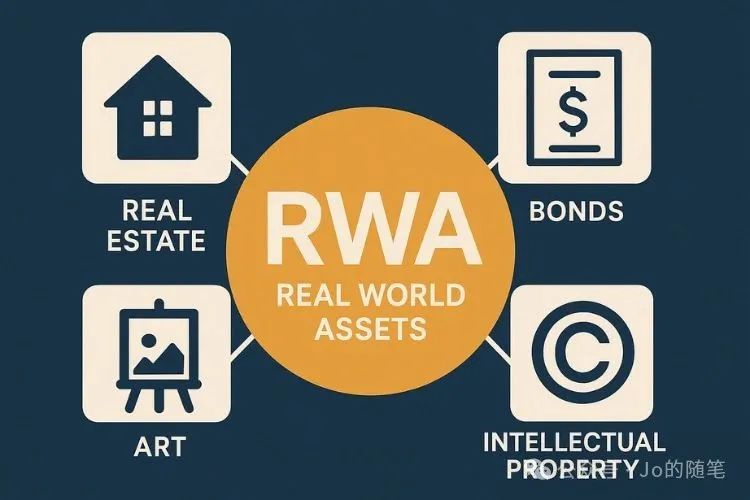
Core Insights - The emergence of RWA (Real World Assets) is revolutionizing the innovative pharmaceutical industry, shifting from "license-out" to "asset optionization" for global expansion [1] - Two companies, Huajian Medical and Hanyu Pharmaceutical, have recently launched RWA projects that unlock liquidity in the pharmaceutical sector, indicating a paradigm shift in how Chinese innovative drugs can access global markets [1] Group 1: RWA and Market Dynamics - RWA utilizes blockchain technology to tokenize real-world assets, enabling on-chain transactions and enhancing liquidity in traditionally illiquid markets [2] - The RWA market is projected to reach $4.5 trillion by 2030, with significant contributions from the pharmaceutical sector, which is expected to see rapid growth in asset tokenization [4] - The current tokenization of only 0.1% of medical assets presents a vast growth opportunity, with the potential for the medical asset share in the RWA market to exceed 20% by 2030 [11] Group 2: RWA vs Traditional Finance - RWA offers higher liquidity compared to traditional finance, allowing for real-time global trading of tokens, while traditional financing methods often involve lengthy cycles [5] - The entry barrier for investors is significantly lowered in RWA, allowing retail investors to participate with minimum investments, contrasting with the high capital requirements of traditional financing [5] - RWA provides greater transparency through immutable on-chain records, unlike traditional finance which relies on audit reports [5] Group 3: Challenges and Solutions - Traditional licensing models face issues such as valuation discounts and long cycles, which RWA aims to address by allowing for the tokenization of future revenue streams [6][7] - RWA can diversify risk by enabling retail investors to share in the funding of drug development, thus reducing the financial burden on single institutions [7] - The recent regulatory developments, such as the implementation of the "Stablecoin Regulation" in Hong Kong, create a conducive environment for RWA projects in the pharmaceutical sector [10] Group 4: Future Outlook - The successful implementation of RWA could release trillions in dormant assets from over 3,000 clinical pipelines in China, transforming the global positioning of Chinese pharmaceutical companies [23] - The collaboration between pharmaceutical companies and blockchain platforms is expected to redefine the relationship between capital, research, and market dynamics, moving towards a new era of global pricing power for Chinese drugs [23]
翰宇药业开创先河:新药“研发能力上链”新范式
Zheng Quan Shi Bao Wang· 2025-08-05 02:29
Core Viewpoint - The strategic partnership between Hanyu Pharmaceutical and KuCoin aims to explore the tokenization of future revenue rights from innovative drug research and development in Hong Kong, marking a significant step in the integration of technology, finance, and pharmaceuticals under the new stablecoin regulations [1][3][4]. Group 1: Partnership Details - Hanyu Pharmaceutical has partnered with KuCoin to leverage its expertise in blockchain technology and RWA (Real World Asset) solutions for the tokenization of intangible assets related to drug development [2][3]. - KuCoin, established in 2017, has over 40 million registered users and ranks fourth globally in futures trading, with a daily trading volume exceeding $6.1 billion [2]. - The collaboration is positioned as a response to the new regulatory environment in Hong Kong, aiming to transform the valuation and trading of intangible assets in the pharmaceutical sector [3][4]. Group 2: Hanyu Pharmaceutical's Strengths - Hanyu Pharmaceutical's core competencies lie in its extensive GLP-1 peptide drug pipeline and over 500 patents, which provide a significant technological barrier [3][4]. - The company anticipates a substantial increase in net profit for the first half of 2025, projecting between 142 million to 162 million yuan, representing a year-on-year growth of 1,471% to 1,664% [4]. - Recent collaborations, including a partnership with Carbon Cloud Peptide for the development of a new GLP-1R/GIPR/GCGR triple agonist, highlight the company's rapid global expansion and innovation [4]. Group 3: Implications for the Industry - The partnership is expected to create a new paradigm for international pricing and financing of Chinese innovative drugs, addressing the high costs and risks associated with drug development [5][6]. - The RWA model offers a solution to the uncertainties of traditional financing methods, allowing for the tokenization of intangible assets and broader investor participation [6][7]. - Successful implementation of the RWA model could enhance Hanyu Pharmaceutical's competitive edge in the GLP-1 drug sector and set a precedent for future pharmaceutical RWA projects in China [7].