SUNWODA(300207)

Search documents
欣旺达(300207) - 董事会薪酬与考核委员会关于注销2022年限制性股票与股票期权激励计划首次授予部分第三个行权期已到期未行权的股票期权的核查意见
2026-02-11 10:45
欣旺达电子股份有限公司 1 公司本次注销股票期权事项,符合《上市公司股权激励管理办法》等法律、 法规、规范性文件及《2022 年限制性股票与股票期权激励计划(草案)》的相 关规定。董事会薪酬与考核委员会同意对公司本次激励计划首次授予部分第三个 行权期已到期未行权的 474.28 万份股票期权进行注销。 董事会薪酬与考核委员会同意本次注销2022年限制性股票与股票期权激励 计划首次授予部分第三个行权期已到期未行权的股票期权的事宜。上述事项符合 相关法律、法规及规范性文件所规定的条件,不存在损害公司及股东利益的情形。 欣旺达电子股份有限公司 董事会薪酬与考核委员会 2026 年 2 月 12 日 董事会薪酬与考核委员会 关于注销 2022 年限制性股票与股票期权激励计划首次授予部分第三 个行权期已到期未行权的股票期权的核查意见 欣旺达电子股份有限公司(以下简称"公司")董事会薪酬与考核委员会依 据《中华人民共和国公司法》、《中华人民共和国证券法》、《上市公司股权激 励管理办法》、《深圳证券交易所创业板股票上市规则》、《深圳证券交易所创 业板上市公司自律监管指南第 1 号——业务办理》等相关法律、法规、规范性文 件 ...

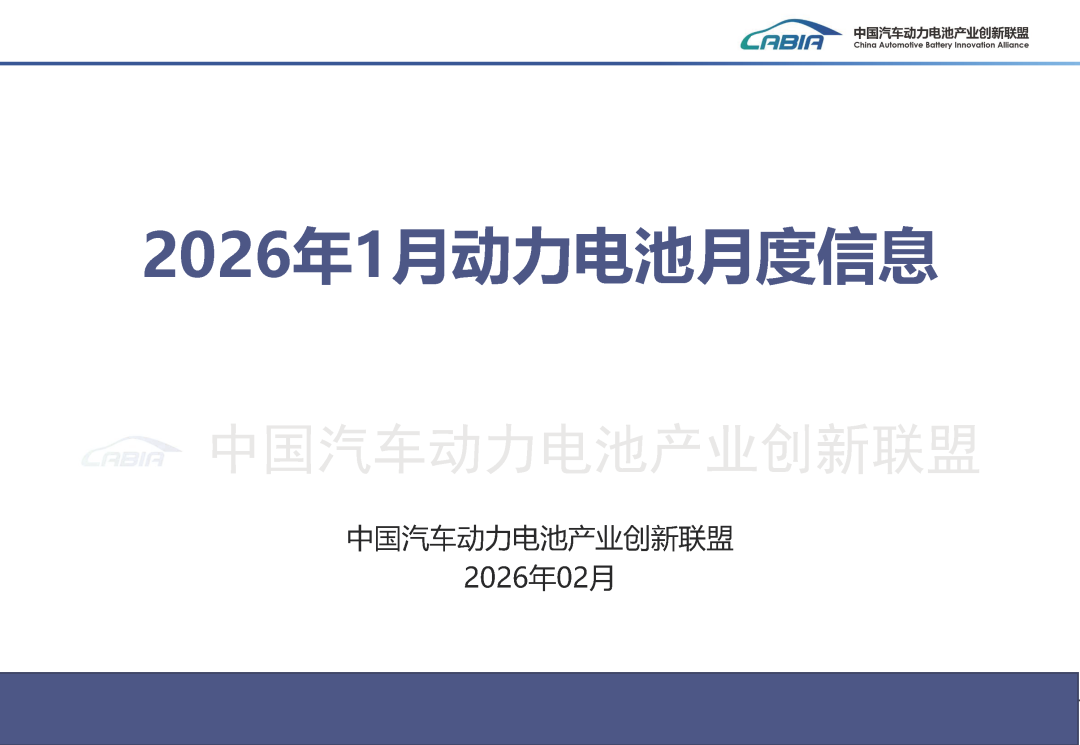
中国汽车动力电池产业创新联盟:1月我国动力和储能电池合计产量为168.0GWh 环比下降16.7% 同比增长55.9%
Zhi Tong Cai Jing· 2026-02-11 09:02
Group 1: Production Data - In January 2026, the total production of power and energy storage batteries in China was 168.0 GWh, a month-on-month decrease of 16.7% but a year-on-year increase of 55.9% [1][6]. - The production of ternary batteries was 31.3 GWh, accounting for 18.6% of total production, with a month-on-month decrease of 23.1% and a year-on-year increase of 51.1% [13]. - The production of lithium iron phosphate batteries was 136.7 GWh, making up 81.3% of total production, with a month-on-month decrease of 14.8% and a year-on-year increase of 57.1% [13]. Group 2: Sales Data - In January 2026, the total sales of power and energy storage batteries in China reached 148.8 GWh, a month-on-month decrease of 25.4% but a year-on-year increase of 85.1% [2][14]. - Power battery sales were 102.7 GWh, accounting for 69.0% of total sales, with a month-on-month decrease of 28.6% and a year-on-year increase of 63.2% [2][18]. - Energy storage battery sales were 46.1 GWh, making up 31.0% of total sales, with a month-on-month decrease of 17.0% and a year-on-year increase of 164.0% [2][19]. Group 3: Export Data - In January 2026, the total export of power and energy storage batteries was 24.1 GWh, a month-on-month decrease of 26.0% but a year-on-year increase of 38.3%, accounting for 16.2% of total sales [2][22]. - Power battery exports were 17.7 GWh, representing 73.3% of total exports, with a month-on-month decrease of 7.1% and a year-on-year increase of 59.3% [2][24]. - Energy storage battery exports were 6.4 GWh, accounting for 26.7% of total exports, with a month-on-month decrease of 52.6% and a year-on-year increase of 1.4% [2][26]. Group 4: Installation Data - The domestic installation of power batteries in January 2026 was 42.0 GWh, a month-on-month decrease of 57.2% but a year-on-year increase of 8.4% [3][40]. - Ternary battery installations were 9.4 GWh, accounting for 22.3% of total installations, with a month-on-month decrease of 48.6% and a year-on-year increase of 9.6% [3][44]. - Lithium iron phosphate battery installations were 32.7 GWh, making up 77.7% of total installations, with a month-on-month decrease of 59.1% and a year-on-year increase of 8.1% [3][44]. Group 5: Key Material Demand - In January 2026, the demand for key materials for power and energy storage batteries included 63,000 tons of ternary materials and 342,000 tons of lithium iron phosphate materials [64][65]. - The demand for negative electrode materials was 235,000 tons, while the demand for separators was 3.36 billion square meters [64]. - The demand for electrolyte for ternary batteries was 28,000 tons, and for lithium iron phosphate batteries, it was 205,000 tons [64][65].





欣旺达动力等在合肥成立科技公司,注册资本1.1亿元
Qi Cha Cha· 2026-02-11 06:36
Group 1 - A new technology company, Hefei Hongchu Technology Co., Ltd., has been established with a registered capital of 110 million yuan [1] - The legal representative of the company is Xie Xiaoyong, and its business scope includes battery manufacturing, battery sales, new material technology promotion services, battery component production, energy storage technology services, and contract energy management [1] - The company is jointly held by Hefei Renchuang Phase IV Venture Capital Partnership (Limited Partnership) and Xinnengda Power Technology Co., Ltd. [1]
欣旺达:公司未与特斯拉洽谈人形机器人电池的供应
Mei Ri Jing Ji Xin Wen· 2026-02-10 14:43
每经AI快讯,有投资者在投资者互动平台提问:贵司是否有和特斯拉洽谈Optimus人形机器人电池供 应? 欣旺达(300207.SZ)2月10日在投资者互动平台表示,您好!感谢您对公司的关注与支持。公司未与其 洽谈人形机器人电池的供应,谢谢。 (文章来源:每日经济新闻) ...

3.2GWh!昌吉国投4个储能项目招标!要求宁德时代/海辰储能/亿纬锂能/中创新航等10家电芯厂商
Xin Lang Cai Jing· 2026-02-10 12:41
Core Viewpoint - Changji Guotou Xin Energy Development Co., Ltd. has announced a tender for four shared energy storage projects with a total scale of 800MW/3.2GWh, focusing on advanced battery technologies comparable to leading companies in the industry [2][3]. Group 1: Project Overview - The total scale of the energy storage projects is 800MW/3.2GWh, with specific projects including: - Changji Guotou Hutu Bih County: 200MW/800MWh - Changji Guotou Mulei County: 300MW/1200MWh - Changji Guotou Jimusaer County: 100MW/400MWh - Changji Guotou Qitai County: 200MW/800MWh [3][18][30]. - The tender includes a comprehensive range of equipment such as lithium iron phosphate battery storage, battery management systems (BMS), power conversion systems (PCS), energy management systems (EMS), and associated fire protection systems [3][18][30]. Group 2: Technical Requirements - The technical requirements for the battery cells are to be comparable to those of leading companies such as CATL, Hicharge Energy, Yiwei Lithium Energy, and others [2][9][21]. - The delivery period for the equipment is set to be completed within 90 calendar days from the issuance of the supply notice after the contract is signed [3][18][30]. Group 3: Tendering Process - The tender is open to independent legal entities registered in the People's Republic of China, with specific qualifications required for bidders, including experience in energy storage systems [7][20][30]. - A bid security of 500,000 yuan is required, and the tender documents can be downloaded from the Changji Public Resources Trading Network [23][31].
23亿天价索赔43天闪电和解:吉利亮剑 欣旺达买单?
Xin Lang Cai Jing· 2026-02-10 08:32
来源:新浪财经 2月6日,国内动力电池供应商欣旺达发布公告,宣布其子公司欣旺达动力与吉利子公司威睿电动汽车技 术公司达成和解,后者将在协议生效后撤回起诉。这场始于2025年12月、索赔金额高达23.14亿元的电 池纠纷,在不到两个月的时间里迅速落幕。 这场纠纷的核心在于欣旺达向吉利供应的一批电池电芯。2025年12月,吉利旗下威睿公司向浙江省宁波 市中级人民法院提起诉讼,指控欣旺达动力在2021年6月至2023年12月期间交付的电芯存在质量问题, 造成重大损失。 威睿公司提出的索赔金额高达23.14亿元,这一数字接近欣旺达2023年与2024年两年净利润之和。 诉讼背景源于吉利高端新能源品牌极氪001车型出现的问题。自2024年上半年开始,大量极氪001 WE86 车主反馈车辆存在充电速度变慢、电池容量衰减异常等问题。 2024年12月,极氪汽车发布通知,针对存在电池健康度异常的极氪001 WE86车辆,启动专项检测并为 符合条件的用户免费更换全新电池包。 此外,其港股上市进程虽因和解得以推进,但估值可能会因质量问题受到影响,融资规模或不及预期。 根据和解协议,欣旺达动力将分5年支付应承担的费用:2026年支 ...
研报掘金丨东吴证券:维持欣旺达“买入”评级,目标价41元
Ge Long Hui A P P· 2026-02-10 06:44
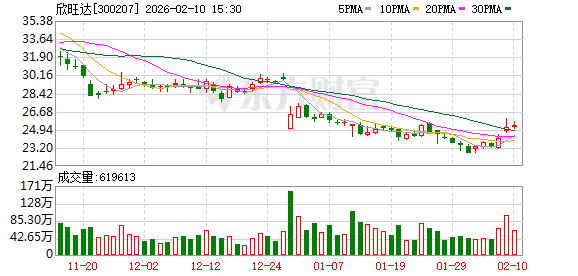
东吴证券研报指出,欣旺达与威睿诉讼和解,港股上市推进顺利,动储业务高增长。测算25年欣旺达动 力计提费用12.5-20亿元,相关计提处理非常充分,不会影响26年及之后业绩,本次和解避免陷入长期 的价格战和诉讼战,同时消除对未来港股上市、海外扩张、新客户导入和银行合作等多方面的不确定 性,集中全部精力回归经营基本面。公司26年动力毛利率目标15%,同增2pct,储能目标10-12%,同增 2-3pct,海外客户占比提升(由30%提升至40-50%),并通过技术创新、规模效应、良率提升覆盖未传 导的成本,全年动力扭亏目标不变。由于诉讼事件影响25年盈利、但26、27年公司动储业务出货强劲, 预计25-27年归母净利润14.1/30.3/41.2亿元(原预测值为20.5/30.0/41.1亿元),同比-4%/+115%/+36%, 对应PE为32x/15x/11x,给予26年25x估值,对应目标价41元,维持"买入"评级。 ...

邀请函丨2026(第二届)起点锂电圆柱电池技术论坛暨圆柱电池20强排行榜发布会4月10日深圳举办!
起点锂电· 2026-02-10 05:20
Group 1 - The core viewpoint of the article highlights the explosive growth of the large cylindrical battery and all-tab technology market, with a projected increase of over 15% in China's cylindrical battery shipments by 2025, and a growth rate exceeding 40% for large cylindrical batteries [3] - Major companies in the large cylindrical battery sector, such as EVE Energy, Molicel, and CATL, are expected to face supply shortages due to high demand, indicating a robust market outlook for 2026 [3] - The article emphasizes the rapid adoption of large cylindrical battery products in various applications, including lightweight power, electric two- and three-wheelers, portable storage, and automotive power [3][6] Group 2 - The event organized by Qidian Lithium Battery and Qidian Research Institute (SPIR) aims to discuss cutting-edge technologies, processes, and materials related to cylindrical batteries, showcasing the industry's competitive landscape through a comprehensive ranking of the top 20 companies [3][6] - The agenda includes discussions on high-power cylindrical battery technology, innovations in household and portable energy storage, and the development trends of automotive-grade large cylindrical batteries [7][8] - The forum will also feature roundtable discussions on overcoming market entry barriers and identifying emerging application markets for cylindrical batteries [7][8] Group 3 - The event is set to take place on April 10, 2026, at the Venus Royal Hotel in Bao'an, Shenzhen, with an expected attendance of over 600 participants [6] - Various companies from the cylindrical battery sector, including EVE Energy, CATL, and BYD, as well as downstream application enterprises and equipment manufacturers, are invited to participate [10] - Different registration options are available, including SVIP, VIP, and free attendance, with specific benefits associated with each tier [11][12][13]


3.2GWh!昌吉国投4个储能项目招标!技术要求宁德时代/海辰储能/亿纬锂能/中创新航等10家电芯厂商
中关村储能产业技术联盟· 2026-02-10 04:00
Core Viewpoint - The article discusses the procurement of energy storage system equipment for four shared energy storage projects by Changji Guotou Xin Energy Development Co., Ltd., with a total scale of 800 MW/3.2 GWh [2]. Group 1: Project Overview - The total scale of the shared energy storage projects is 800 MW/3.2 GWh, with specific projects including: - Changji Guotou Hutu Bih County: 200 MW/800 MWh - Changji Guotou Mulei County: 300 MW/1200 MWh - Changji Guotou Jimusaer County: 100 MW/400 MWh - Changji Guotou Qitai County: 200 MW/800 MWh [3][20][31]. Group 2: Technical Requirements - The technical requirements for the battery technology reference or are equivalent to major manufacturers such as CATL, Hicharge Energy, Yiwei Lithium Energy, and others [2][11]. - The procurement includes complete sets of equipment such as energy storage battery cabins (lithium iron phosphate batteries), battery management systems (BMS), energy management systems (EMS), and associated fire protection systems [3][20][31]. Group 3: Procurement and Delivery - The delivery period is set to be completed within 90 calendar days from the issuance of the supply notice after the contract is signed [4][20][31]. - The procurement is funded by a combination of self-raised funds (30%) and bank loans (70%) [20][31]. Group 4: Bidder Qualifications - Bidders must be independent legal entities registered in the People's Republic of China and must have the capability to manufacture at least one core component of the energy storage system [9][22][33]. - Bidders are required to have experience in at least two projects involving energy storage systems with a single capacity of no less than 400 MWh over the past three years [9][22][33]. Group 5: Bid Submission and Requirements - The bidding process is conducted electronically, and bidders must register on the Changji Public Resource Trading Network to participate [27][28]. - A bid security of 500,000 yuan is required, and it must be paid before the bid submission deadline [25][34].
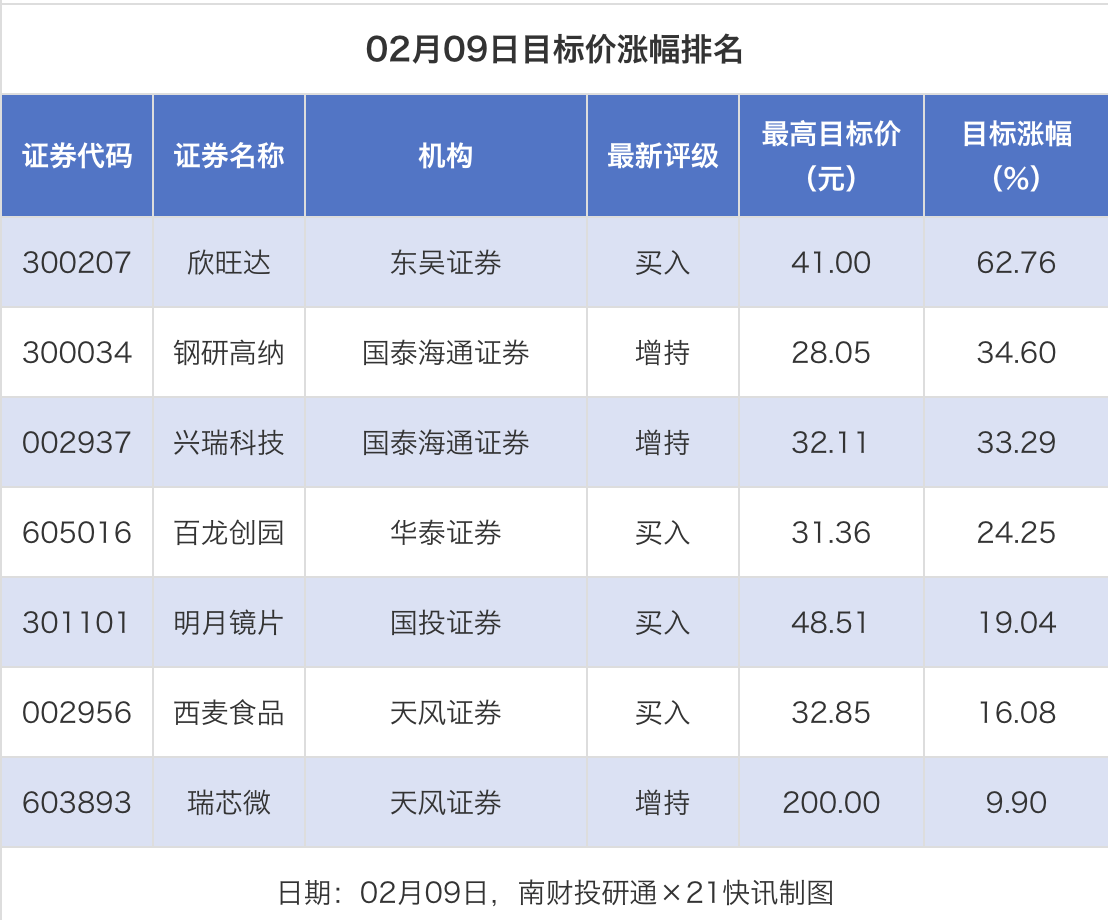
23股获推荐 欣旺达目标价涨幅超60%丨券商评级观察
2 1 Shi Ji Jing Ji Bao Dao· 2026-02-10 03:00
从券商推荐家数来看,2月9日有23家上市公司得到券商推荐,其中电投绿能、博源化工、汇嘉时代等获得1家推荐。 评级调高方面,2月9日,券商调高上市公司评级1家次,最新数据包括了中邮证券对中微半导的评级从"增持"调高至"买入"。 | | 1 家最新被调高评级的公司 | | | | | --- | --- | --- | --- | --- | | 证券代码 | 证券名称 | 机构 | 此前评级 | 最新评级 | | 688380 | 中微半导 | 中邮证券 | 増持 | 买入 | | | 日期:02月09日,南财投研通×21快讯制图 | | | | 首次覆盖方面,2月9日券商共给出了10次首次覆盖,其中博源化工获得东北证券给予"买入"评级,汇嘉时代获得国盛证券给予"买入"评级,钢研高纳、兴瑞 科技获得国泰海通证券给予"增持"评级,西麦食品获得天风证券给予"买入"评级。 | 证券代码 | 证券名称 | 机构 | 最新评级 | 最高目标价 | 目标涨幅 | | --- | --- | --- | --- | --- | --- | | | | | | (元) | (%) | | 300207 | 欣旺达 | 东吴证券 ...