AMD(AMD)

Search documents
AMD unveils new chips at CES event in Las Vegas
Reuters· 2026-01-06 03:00
Core Insights - Advanced Micro Devices (AMD) CEO Lisa Su introduced the MI455 GPU chips at the CES trade show in Las Vegas, highlighting the company's commitment to advancing GPU technology [1] Company Developments - The unveiling of the MI455 GPU chips signifies AMD's ongoing innovation in the graphics processing unit sector, aiming to enhance performance and efficiency [1]


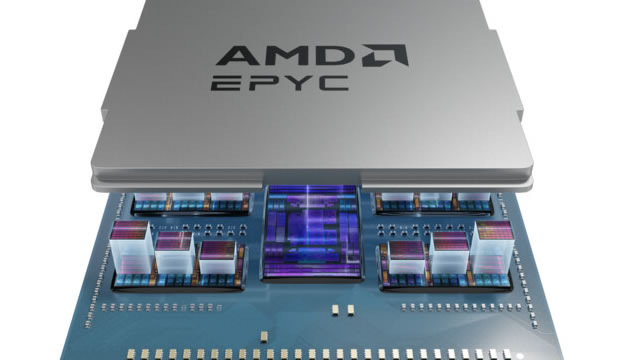
AMD (NasdaqGS:AMD) 2026 Earnings Call Presentation
2026-01-06 02:30
AI Market and Applications - AI is pervasive, with an estimated 5 billion people using AI daily within 5 years[14] - AI is expanding from cloud to personal computing and edge devices[18] - AI model innovation is accelerating compute demand, with training flops increasing 4x every year[28] AMD's AI Solutions for Data Center - AMD is building a blueprint for yotta scale infrastructure[31] - The AMD "Helios" AI Rack features 2.9 Exaflops of AI compute, 31 TB of HBM4 memory, and 43 TB/s scale out bandwidth[38] - AMD Instinct MI455X offers a 10x performance increase compared to MI355X[40] - AMD is extending its leadership roadmap with the next-gen MI500 series, targeting a >1000x AI performance increase in 4 years[52] AMD's AI Solutions for PCs - AMD is at the forefront of AI PC innovation, introducing the first x86 NPU[60] - AMD Ryzen AI 400 Series powers next-generation AI PCs, offering up to 1.3x faster multitasking and 1.7x faster content creation compared to Intel Core Ultra 9 288V[66] - AMD Ryzen AI Max+ demonstrates up to 1.4x faster AI performance compared to Apple Macbook Pro M5[77] and up to 1.8x faster content creation[78] - AMD Ryzen AI Max+ achieves up to 1.7x-1.8x tokens/sec per dollar compared to Nvidia DGX Spark in AI development tasks[81] AMD's Broader Impact - AMD powers over 1 billion gamers & creators[90] - AMD is the compute foundation for modern science, contributing to climate forecasting with an 85% reduction in time to generate forecasts[111] and antibody optimization[119]
Stock market today: Dow, S&P 500, Nasdaq futures take a breather after Dow's record-setting rally
Yahoo Finance· 2026-01-05 23:52
Group 1 - US stock futures paused as investors focused on Nvidia and AMD's next-generation AI platforms unveiled at CES [1][2] - Nvidia's CEO Jensen Huang introduced the Vera Rubin AI superchip platform and plans for a humanoid robot, while AMD's CEO Lisa Su showcased the Helios system with a promise of significant performance improvements in data center GPUs [1] - Updates from Intel, Qualcomm, and other tech companies at CES are expected to boost optimism in the AI sector, contributing to a positive market sentiment [2] Group 2 - The market reacted to the ousting of Venezuela's President Maduro, interpreting it as a potential opportunity for US corporations in energy and defense rather than a source of global instability [2] - Commodities showed a cautious trend, with gold futures experiencing their strongest daily gain since October as investors sought protection [3]

Stock market today: Dow, S&P 500, Nasdaq futures take a breather after Dow's record rally
Yahoo Finance· 2026-01-05 23:52
Market Overview - US stock futures are stable as investors evaluate AI roadmaps from Nvidia and AMD, with S&P 500 contracts hovering just below flat and Nasdaq 100 down approximately 0.2% [1] - The Dow Jones Industrial Average futures are also little changed following a record-setting rally on Monday [1] AI Developments - Nvidia's CEO Jensen Huang introduced the next-generation Vera Rubin AI superchip platform and plans for a humanoid robot at CES, while AMD's CEO Lisa Su showcased the Helios system, promising significant performance improvements in upcoming data center GPUs [2][3] - Updates from Intel, Qualcomm, and other tech companies at CES are expected to enhance optimism for the AI sector, which has positively influenced stock performance [3] Commodities and Corporate News - Copper prices surged past $13,000 per ton for the first time, driven by concerns over potential Trump tariffs and increased stockpiling in the US [5][11] - Vistra's stock rose 4% premarket after announcing a $4.7 billion acquisition of Cogentrix Energy to meet rising power demand for AI data centers [5] - Novo Nordisk's stock increased nearly 5% after announcing new pricing for its Wegovy pill, while Microchip Technology's stock rose 4% following an upward revision of its sales forecasts [6] - Under Armour shares climbed almost 3% after a filing revealed Fairfax Financial Holdings owns a 22% stake in the company [7] International Market Trends - Chinese stock markets reached multiyear highs, with the CSI 300 Index up 1.6% and the Shanghai Composite Index rising 1.5%, driven by optimism in AI development and signs of economic growth [8] - Asian stocks are experiencing their best start to a year, with gains in currencies and bonds as investors seek opportunities beyond the US [9]
Acer Introduces the Veriton RA100 AI Mini Workstation, a Windows 11 Copilot+ PC Powered by AMD Ryzen AI Max+ 395 Processors for Advanced AI Performance
Prnewswire· 2026-01-05 23:15
Core Insights - Acer has launched a new range of Veriton desktop computers aimed at enhancing productivity and creativity for businesses, including all-in-ones, a large tower, and an AI mini workstation [2][3] Group 1: Product Offerings - The Acer Veriton RA100 AI Mini Workstation is designed for prosumers, creators, and gamers, featuring AMD Ryzen AI Max+ 395 processors and advanced AI capabilities, supporting demanding workloads with up to 128 GB LPDDR5X memory and 4 TB SSD storage [3][4][7] - The Acer Veriton Vero 4000 and 6000 All-in-One desktops combine strong AI performance with robust security, powered by Intel Core Ultra 9 processors, offering up to 64 GB DDR5 memory and 2 TB PCIe Gen 4 SSD storage [5][6][8] - The Acer Veriton 2000 Large Tower is tailored for content creation and everyday productivity, equipped with Intel Core Ultra 9 processors and NVIDIA GeForce RTX 5080 GPUs, providing significant AI processing power and storage options [9][10][11] Group 2: Features and Specifications - The Veriton RA100 supports high-frequency processing and multitasking, with features like adaptive performance modes for different workloads, ensuring efficient cooling and noise management [4][7] - The Veriton Vero AIOs feature a 23.8-inch Full HD display, Wi-Fi 7, Bluetooth 5.4, and a 5.0 MP infrared webcam, enhancing collaboration and connectivity in modern workplaces [6][8] - The Veriton 2000 Large Tower includes smart device management through Acer Sense, facilitating easy system monitoring and updates, and is designed for energy efficiency with Energy Star compliance [11][12] Group 3: Availability - The Acer Veriton RA100 AI Mini Workstation and the Veriton Vero 4000 and 6000 AIOs will be available in North America and EMEA in Q1 2026, while the Veriton 2000 Large Tower and All-In-One will also launch in EMEA during the same period [14][15]

What To Expect At CES 2026: Nvidia, AMD, Joby, Archer, D-Wave And More
Benzinga· 2026-01-05 20:02
Core Insights - CES 2026 is set to showcase advancements in physical AI and robotics, emphasizing real-world applications of AI technology [1][2] Group 1: AI Trends - The focus at CES 2026 has shifted from cloud-based solutions to on-device and agentic AI, with devices now capable of proactively completing tasks [2] - The concept of the "Zero Labor Home" is gaining traction, with companies like LG and Samsung leading the way in robotics that perform household chores [3] Group 2: Quantum Technology - CES 2026 marks a significant emphasis on quantum technology, with the CES Foundry highlighting practical applications in fields such as cryptography and material science [4] Group 3: Automotive Innovations - The automotive section at CES 2026 is centered around software-defined mobility, featuring the pre-production reveal of the Sony-Honda Afeela 1 and advancements in air taxis [5] Group 4: Notable Speakers - Keynote addresses will be delivered by industry leaders, including NVIDIA's CEO Jensen Huang, who is expected to discuss next-generation GPUs and AI applications [7] - AMD's CEO Lisa Su will focus on hardware developments for AI PCs, while Caterpillar's CEO Joe Creed will address AI and autonomy in sustainable construction [7]



AI Stocks Are in Focus as Nvidia's Huang, AMD CEO Su Set to Speak at CES Event
Investopedia· 2026-01-05 18:55
Core Insights - Investors are focusing on the CES consumer electronics trade show in Las Vegas, where key executives from major tech companies, including Nvidia and AMD, will present [1][6] - Nvidia CEO Jensen Huang and AMD CEO Lisa Su are the main speakers, with Huang's press conference scheduled for 4 p.m. EST and Su's keynote at 9:30 p.m. EST [1][2] Industry Context - CES serves as a platform for tech companies to unveil their visions for future products, which could influence major tech stock performance amid recent pressures related to potential AI market sustainability [3][4] - AI companies are facing scrutiny regarding the return on their substantial investments in data centers and AI model operations, raising concerns about the longevity of the AI boom that has supported the broader market [4] Company Highlights - Other notable companies scheduled to speak at CES include IBM, Alibaba, General Motors, Caterpillar, Target, and Best Buy, indicating a broad interest in AI and technology solutions across various sectors [5] - Shares of Nvidia and AMD experienced a decline of approximately 1% in early trading on Monday, reflecting market volatility and investor sentiment [6]
Top 20 Most-Searched Tickers On Benzinga Pro In 2025 – Where Do Tesla, Nvidia, Palantir, Apple Stocks Rank?
Benzinga· 2026-01-05 16:46
Core Insights - The most-searched tickers for 2025 include SPDR S&P 500 ETF Trust, Tesla, and NVIDIA, with SPY ranking first, indicating a shift in investor interest compared to 2024 [2][9] - Palantir Technologies and Opendoor Technologies emerged as significant players, with Palantir moving up in rankings and Opendoor showing the highest percentage gain among the top tickers [10][12] - CoreWeave Inc, which went public in March 2025, gained substantial attention, finishing the year ranked ninth among the most-searched tickers [12] Ticker Performance - SPDR S&P 500 ETF Trust (SPY) had a year-end price of $681.92, with a return of +16.6% [3] - Tesla Inc (TSLA) ended the year at $449.72, returning +18.6% [3] - NVIDIA Corporation (NVDA) saw a year-end price of $186.50, with a return of +34.8% [3] - Palantir Technologies (PLTR) achieved a remarkable return of +136.4%, ending at $177.75 [3] - Opendoor Technologies (OPEN) had a year-end price of $5.83, with an impressive return of +264.4% [3] - Advanced Micro Devices (AMD) finished at $214.16, returning +77.5% [3] - Apple Inc (AAPL) ended the year at $271.86, with a return of +11.5% [3] - Invesco QQQ Trust (QQQ) had a year-end price of $614.31, returning +20.4% [5] - CoreWeave Inc (CRWV) ended at $71.61, with a return of +79.0% [5] - Amazon.com Inc (AMZN) finished at $230.82, returning +4.8% [5] Ranking Trends - The top three most-searched tickers for 2024 and the first half of 2025 remained consistent, with SPY rising to first place [9] - Palantir moved from seventh place in 2024 to fourth in 2025, indicating growing popularity among retail investors [10] - AMD maintained its sixth-place ranking from 2024, showing increased interest in the second half of 2025 [11] - Stocks like Meta Platforms and Rigetti Computing ranked just outside the top 10, indicating fluctuating interest levels [10][11] - Stocks that dropped out of the top 10 included Super Micro Computer and GameStop, suggesting a shift in retail investor preferences [13][14]




今夜 美股暴涨!见证历史!
Zhong Guo Ji Jin Bao· 2026-01-05 16:16
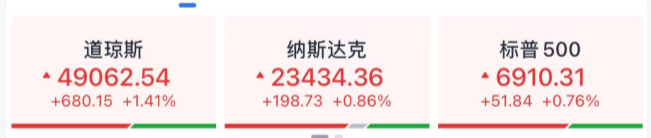
Market Performance - The Dow Jones Industrial Average surged nearly 700 points, breaking the 49,000 mark for the first time, marking a new high for the index [1] - The Nasdaq index rose by nearly 1%, while the S&P 500 index increased by approximately 0.7% [1] Geopolitical Impact - Despite concerns over geopolitical risks following the ousting of Venezuelan President Maduro, the market showed resilience, particularly in technology stocks [2][5] - The energy sector performed strongly, with major U.S. oil companies seeing gains, such as Chevron rising by 4.4% due to proposals for revitalizing Venezuela's oil and gas industry [5] Technology Sector - Chip stocks led the market rally, with ASML shares hitting a record high, increasing by over 5%, and TSMC shares also rising significantly after a 35% target price increase by Goldman Sachs analysts [3] Venezuelan Bonds - Venezuelan government and state oil company PdVSA's international bonds saw a collective price increase as investors speculated that the U.S. government's actions against Maduro would facilitate debt restructuring [6] - A 2031 maturity Venezuelan government dollar bond price rose from 34 cents to 40 cents on the dollar, while a 2027 maturity PdVSA dollar bond increased from 28 cents to 30 cents [9] Future Outlook - Analysts suggest that the ideal scenario for international bondholders would be for Maduro's vice president, Delcy Rodriguez, to assume leadership with U.S. support, which could lead to a recovery in Venezuela's oil and gas sector benefiting creditors [12]



A Look Into Advanced Micro Devices Inc's Price Over Earnings - Advanced Micro Devices (NASDAQ:AMD)
Benzinga· 2026-01-05 15:00
In the current session, the stock is trading at $228.72, after a 2.35% increase. Over the past month, Advanced Micro Devices Inc. (NASDAQ:AMD) stock increased by 3.20%, and in the past year, by 79.63%. With performance like this, long-term shareholders are optimistic but others are more likely to look into the price-to-earnings ratio to see if the stock might be overvalued.A Look at Advanced Micro Devices P/E Relative to Its CompetitorsThe P/E ratio measures the current share price to the company's EPS. It ...