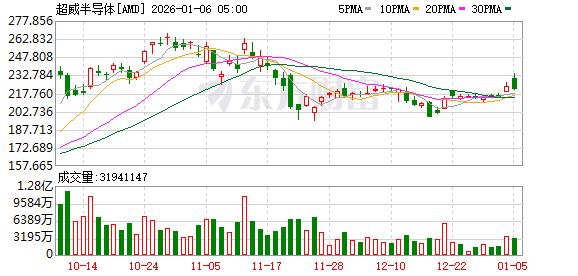
AMD(AMD)

Search documents
异动盘点0106 |内险股延续涨势, 不同集团反弹超34%;美国大型银行股走高,Datavault AI暴涨42.57%
贝塔投资智库· 2026-01-06 04:00
Group 1: Insurance Sector - The insurance sector continues to rise, with China Ping An (02318) up 5.17%, New China Life (01336) up 4.14%, China Life (02628) up 4.83%, and China Pacific Insurance (02601) up 3.29%. The National Financial Regulatory Administration reported that the insurance industry achieved a total premium income of 57,629 billion yuan, a year-on-year increase of 7.6% for the first 11 months of 2025 [1][2]. Group 2: Hydrogen Energy - Guofu Hydrogen Energy (02582) saw a rise of over 7.2% after announcing the delivery of a total of 424 sets of vehicle-mounted high-pressure hydrogen supply systems to clients, which will be used in fuel cell buses in Guangzhou [1]. Group 3: Coal Sector - Coal stocks collectively rose, with China Coal Energy (01898) up 4.33%, Yanzhou Coal Mining (01171) up 3.18%, and China Shenhua Energy (01088) up 2.31%. Since late November, port thermal coal prices have been on a downward trend, dropping from a high of 834 yuan/ton to a low of 670 yuan/ton, before rebounding on December 31, increasing by 8 yuan/ton to 678 yuan/ton [1]. Group 4: Solar Energy and AI - Junda Co., Ltd. (02865) increased by over 6.1% following a report from Guotai Junan that Elon Musk proposed a plan to deploy 100GW of solar AI satellites annually, driving demand for space photovoltaic technology [1]. Group 5: Lithium Mining - Lithium stocks were active, with Ganfeng Lithium (01772) up 4.22% and Tianqi Lithium (09696) up 2.85%. After breaking through the 130,000 yuan/ton mark, lithium carbonate futures surged over 8%, reaching a high of 137,760 yuan/ton [2]. Group 6: Real Estate Sector - Domestic real estate stocks continued to rise, with Beike-W (02423) up 3.44%, Longfor Group (00960) up 5.24%, China Jinmao (00817) up 5.34%, and China Resources Land (01109) up 3.64%. An article published in "Qiushi" magazine emphasized the need to improve and stabilize expectations in the real estate market [2]. Group 7: Baby Products - Different Group (06090) rebounded by over 34.99%. According to a report from China Merchants Securities, the company is positioned as a mid-to-high-end baby products brand with strong product development and channel expansion capabilities, targeting middle-class and high-net-worth consumers [3]. Group 8: Mining Sector - Zijin Mining (02899) rose nearly 6%, reaching a historical high. The company recently announced an annual profit forecast of 51 to 52 billion yuan, an increase of approximately 18.9 to 19.9 billion yuan compared to the previous year's profit of 32.051 billion yuan, representing a year-on-year growth of about 59% to 62% [3]. Group 9: U.S. Stock Market - The Dow Jones Industrial Average broke through 49,000 points, rising 1.3%, with major U.S. bank stocks reaching historical highs. Goldman Sachs (GS.US) rose 3.73%, JPMorgan Chase (JPM.US) rose 2.63%, and Morgan Stanley (MS.US) rose 2.55%. The U.S. ISM reported that the manufacturing PMI fell to 47.9 in December, below the expected 48.4 [4]. Group 10: Precious Metals - U.S. precious metal stocks collectively strengthened, with Hecla Mining (HL.US) up 4.56% and Barrick Gold (B.US) up 3.77%. Spot gold surged 2.5%, reclaiming the $4,400 mark, while spot silver rose 5%, surpassing $76 [4]. Group 11: AI and Technology - Datavault AI (DVLT.US) surged 42.57%, with a cumulative increase of 180% over three trading days after signing a procurement agreement with AP Global Holdings LLC for infrastructure and cybersecurity services [5]. Group 12: Bitcoin and Related Stocks - Bitcoin briefly reached the $93,000 mark, with related stocks rising, including Strategy (MSTR.US) up 4.81% and Coinbase (COIN.US) up 7.77% [6]. Group 13: Oil Sector - Oil stocks saw significant pre-market gains, with Chevron (CVX.US) up 5.1% and ConocoPhillips (COP.US) up 2.59%. Reports indicated that the U.S. had captured Venezuelan President Maduro through military action, leading to a strong performance in oil and gas services [7].



AMD推出下一代新品,4年内AI芯片性能有望提升1000倍
Xin Lang Cai Jing· 2026-01-06 03:59
Core Insights - AMD's CEO Lisa Su announced the next-generation AI chip MI455 GPU at CES, which will be manufactured using 2nm and 3nm processes and will feature advanced packaging with HBM4 [1] - The MI455 GPU will be integrated with the EPYC CPU, and the next-generation AI rack, Helios, will include 72 GPUs, enabling the construction of large AI clusters by connecting thousands of Helios racks [1] - The MI500 series chips are also in development, expected to utilize 2nm technology, with AMD aiming to enhance AI performance by 1000 times over the next four years with the launch of the MI500 series in 2027 [1]

AMD (NasdaqGS:AMD) 2026 Conference Transcript
2026-01-06 03:32
Summary of CES 2026 Keynote Address by AMD CEO Dr. Lisa Su Industry Overview - The keynote was part of CES 2026, a major technology event showcasing innovations across various sectors, particularly focusing on AI and high-performance computing [1][4][5] - AMD is positioned as a central player in the global AI transformation, emphasizing its role in high-performance and AI computing [5][6] Core Points and Arguments AI and Computing Demand - AI is described as the most important technology of the last 50 years, with AMD prioritizing its development [15][16] - The number of active AI users has surged from 1 million to over 1 billion, with projections of reaching over 5 billion users [16][17] - Global compute infrastructure demand is expected to grow from approximately 1 Zettaflop in 2022 to over 100 Zettaflops by 2025, necessitating a further increase to over 10 Yottaflops in the next five years [17][19] - AI's integration into various sectors, including healthcare, education, and productivity, is highlighted as transformative [15][16] AMD's Technological Innovations - AMD's Helios platform is introduced as a next-generation rack scale solution designed for AI, featuring advanced MI455 GPUs and EPYC CPUs [23][30] - The MI455 GPU boasts 320 billion transistors and is designed for high performance, delivering up to 10 times more performance compared to previous generations [27][30] - The Helios rack is designed for optimal serviceability and reliability, weighing nearly 7,000 pounds and integrating cutting-edge technologies [24][25][26] Partnerships and Collaborations - AMD's collaboration with OpenAI is emphasized, showcasing the need for increased compute capacity to support advanced AI models [31][39] - Luma AI's CEO, Amit Jain, discusses their partnership with AMD, highlighting the efficiency and performance improvements achieved through AMD's hardware [50][59] Future Outlook - The demand for compute is expected to continue growing, with AMD's next-gen MI500 series already in development, promising a 1,000x increase in AI performance over four years [63][64] - The Ryzen AI 400 Series is introduced as the most advanced family of AI PC processors, set to enhance productivity and content creation capabilities [67][68] Additional Important Content - The keynote emphasizes the collaborative nature of innovation, stating that AI is not a solo act but a shared pursuit among industry leaders [2][4] - The importance of an open ecosystem for AI development is stressed, with AMD advocating for shared technology standards across hardware and software [48][49] - The potential of AI in personal computing is highlighted, with AI PCs becoming essential partners in productivity and creativity [65][66] This summary encapsulates the key themes and innovations presented during the CES 2026 keynote by AMD's CEO, focusing on the transformative impact of AI and the company's strategic advancements in computing technology.
AMD Introduces Ryzen AI Embedded Processor Portfolio, Powering AI-Driven Immersive Experiences in Automotive, Industrial and Physical AI
Globenewswire· 2026-01-06 03:32
Core Insights - AMD has launched the Ryzen AI Embedded processors, specifically the P100 and X100 Series, aimed at enhancing AI-driven applications in various sectors such as automotive and industrial markets [2][10]. Product Features - The new processors utilize the "Zen 5" core architecture, RDNA 3.5 GPU, and XDNA 2 NPU, all integrated into a single chip, providing high performance and efficient AI compute capabilities [3][10]. - The P100 Series features 4-6 cores optimized for digital cockpits and human-machine interfaces, offering up to a 2.2X performance boost compared to the previous generation [5][10]. - The X100 Series is designed for more demanding applications, featuring higher CPU core counts and AI TOPS performance [4][10]. Performance Metrics - The P100 Series processors deliver an estimated 35% faster rendering, capable of supporting up to four 4K or two 8K displays at 120 frames per second [6][10]. - The XDNA 2 NPU in these processors can achieve up to 50 TOPS, providing up to 3X higher AI inference performance compared to previous models [7][10]. Software and Development - The processors come with a unified software stack that includes optimized CPU libraries and open-standard GPU APIs, facilitating easier development for OEMs and developers [8][9]. - The software stack is built on an open-source virtualization framework, allowing multiple operating systems to run securely in parallel, which aids in reducing costs and accelerating production timelines [9]. Availability - The P100 Series processors are currently sampling with early access customers, with production shipments expected in the second quarter of 2026 [12].

道指创历史新高,美股能源板块普涨
Zheng Quan Shi Bao Wang· 2026-01-06 03:31
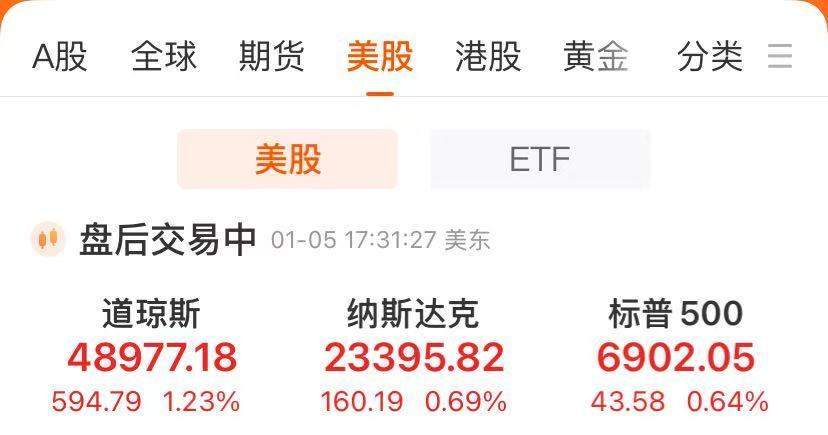
Market Performance - Major US stock indices closed higher, with the Dow Jones reaching a record high, driven by strong gains in financial stocks [1][3] - The Dow rose by 594.79 points, or 1.23%, closing at 48,977.18 points; the Nasdaq increased by 160.19 points, or 0.69%, to 23,395.82 points; and the S&P 500 gained 43.58 points, or 0.64%, ending at 6,902.05 points [3] Sector Performance - The S&P 500 energy sector index rose by 2.7%, with major stocks like ExxonMobil and Chevron seeing significant increases due to military actions in Venezuela [5] - The S&P 500 financial sector index increased by 2.2%, with both Goldman Sachs and JPMorgan Chase rising over 3% and reaching all-time highs [6] Technology Stocks - Most large-cap tech stocks saw gains, with Tesla up 3.10%, Amazon up 2.9%, and Meta up 1.29%. However, Microsoft fell by 0.02%, Nvidia dropped by 0.39%, and Apple decreased by 1.38% [3][4] Cryptocurrency and Related Stocks - Cryptocurrency-related stocks experienced a rise, with Strategy stock increasing nearly 5% and Coinbase surging by 7.8% as Bitcoin prices hit a three-week high [6] Chinese Stocks - The Nasdaq Golden Dragon China Index rose by 0.49%, with notable gains in stocks like Beike up over 6% and Bilibili and Tencent Music each up over 3% [6]


AMD Expands AI Leadership Across Client, Graphics, and Software with New Ryzen, Ryzen AI, and AMD ROCm Announcements at CES 2026
Globenewswire· 2026-01-06 03:31
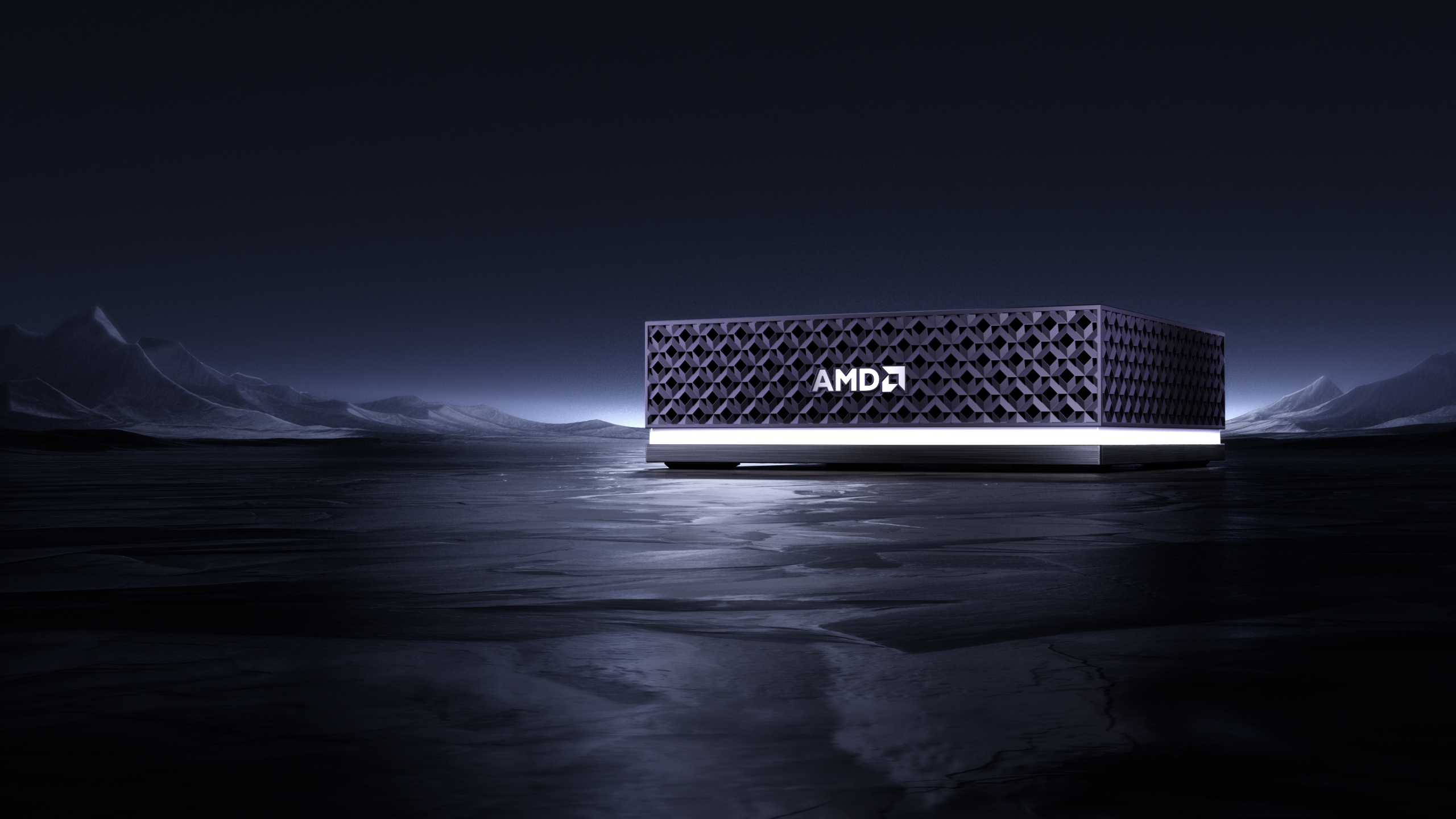
Core Insights - AMD has unveiled its latest generation of mobile and desktop processors, the Ryzen AI 400 Series and Ryzen AI PRO 400 Series, which enhance AI capabilities, gaming performance, and commercial features across a wider range of systems [2][3][4] Product Launch - The new AMD Ryzen AI 400 Series includes processors designed for Copilot+ PCs, while the Ryzen AI Max+ processors target premium ultra-thin notebooks and small form-factor desktops [3][4] - The Ryzen AI PRO 400 Series focuses on AI acceleration, modern security, and enterprise-class manageability for business laptops [3][7] AI Integration - AMD introduced the Ryzen AI Halo, its first AI developer platform, along with ROCm 7.2 software support for the Ryzen AI 400 Series, facilitating seamless AI adoption and development [4][11] - The Ryzen AI 400 Series processors deliver up to 60 TOPS of NPU AI compute, with features designed to meet the requirements for seamless AI experiences [7][11] Gaming Performance - The Ryzen 7 9850X3D processor is positioned as the fastest gaming CPU, offering a 400MHz higher boost clock than its predecessor, the Ryzen 7 9800X3D, and achieving up to 27% better gaming performance compared to Intel's Core Ultra 9 285K [5][19][20] - The new FSR "Redstone" technology enhances gaming experiences through machine learning frame generation and upscaling [5][30] Market Availability - Systems powered by the Ryzen AI 400 Series and Ryzen AI PRO 400 Series will be available starting Q1 2026 from major OEMs, with desktop versions expected in Q2 2026 [9][15][22] Developer Support - The AMD Ryzen AI Halo developer platform is designed to support AI development with capabilities to run large models locally, featuring up to 128GB of unified memory and optimized for AMD ROCm software [17][18] - The ROCm software platform has seen significant improvements, including a fivefold increase in AI performance and expanded compatibility across Windows and Linux [28][27] Ecosystem Growth - AMD is expanding its OEM partnerships, with a growing number of systems powered by AMD processors across consumer, commercial, and gaming segments [24][25] - Collaborations with software developers aim to integrate new AI features into everyday applications, enhancing user experiences [25][26]
Acer Introduces AMD Ryzen AI 400 Series Processors Across Copilot+ PC Portfolio
Prnewswire· 2026-01-06 03:30
Core Insights - Acer has launched new laptop models featuring the latest AMD Ryzen AI 400 Series processors, enhancing productivity and creative capabilities across various segments [1][2][3] Group 1: Product Offerings - The Acer Swift Go 16 AI is equipped with up to AMD Ryzen AI 9 465 processors, AMD Radeon 880M graphics, and offers up to 32 GB of LPDDR5x memory and 1 TB of PCIe Gen 4 SSD storage [2][9] - The Acer Aspire 14 AI and Aspire 16 AI models also feature up to AMD Ryzen AI 9 465 processors, with multi-day battery life and vibrant WUXGA displays, supporting up to 32 GB of memory and 1 TB of storage [3][10] - The Acer Nitro V 16 AI is designed for gaming, featuring up to AMD Ryzen AI 9 465 processors and NVIDIA GeForce RTX 5070 Laptop GPUs, with up to 32 GB DDR5 RAM and 2 TB of SSD storage [5][10] Group 2: Design and Features - The new Acer laptops emphasize user-centric design with features like large touchpads, full-flat 180-degree hinges, and advanced camera technology for enhanced video calls [4][5] - AI-powered features such as Acer Intelligent Space provide personalized task management and tool access, enhancing user experience [6][10] Group 3: Availability - The Acer Swift Go 16 AI will be available in North America in Q1 2026 and in EMEA in March 2026, while the Aspire models will be available in Q2 2026 [7][8]

AMD unveils new AI PC processors for general use and gaming at CES
TechCrunch· 2026-01-06 03:30
Core Message - AMD emphasizes the transformative potential of AI in personal computing, introducing new AI processors aimed at enhancing user experience and productivity [1][2]. Product Announcements - AMD unveiled the Ryzen AI 400 Series processor, which boasts 1.3x faster multitasking and 1.7x faster content creation compared to competitors, featuring 12 CPU cores and 24 threads [2]. - The Ryzen AI 400 Series is an upgrade from the Ryzen AI 300 Series, which was launched in 2024, and the Ryzen processor series has been in production since 2017 [2]. Market Expansion - AMD has expanded its AI PC platforms to over 250, doubling its presence in the market over the past year [3]. - The company envisions AI as a fundamental component of personal computing, impacting work, play, creation, and connectivity [3]. Additional Product Releases - AMD also announced the Ryzen 7 9850X3D, a gaming-focused processor, highlighting AI's role in enhancing everyday computing experiences [6]. - The Ryzen AI 300 Series and Ryzen 7 9850X3D processors will be available in the first quarter of 2026 [6]. Technological Advancements - AMD introduced the latest version of its Redstone ray tracing technology, which improves video game graphics without compromising performance [7].
AMD CEO苏姿丰:未来几年AI计算能力需要增加100倍
第一财经· 2026-01-06 03:10
记者|郑栩彤 编辑 |瑜见 AMD CEO苏姿丰在CES开幕前的主题演讲中表示,自ChatGPT推出以来,使用AI的活跃用户已经从 100万人增加至10亿人,这是互联网花了几十年才达到的里程碑,预计2030年使用AI的活跃用户将达 到50亿人。为了让AI无处不在,在未来几年内,需要将全世界的计算能力增加100倍。 ...

AMD CEO苏姿丰:未来几年AI计算能力需要增加100倍
Di Yi Cai Jing· 2026-01-06 03:06
AMD CEO苏姿丰在CES开幕前的主题演讲中表示,自ChatGPT推出以来,使用AI的活跃用户已经从100 万人增加至10亿人,这是互联网花了几十年才达到的里程碑,预计2030年使用AI的活跃用户将达到50 亿人。为了让AI无处不在,在未来几年内,需要将全世界的计算能力增加100倍。 (文章来源:第一财经) ...