
AstraZeneca(AZN)

Search documents
Trump reaches deal with AstraZeneca to lower U.S. drug prices
CNBC Television· 2025-10-10 22:30
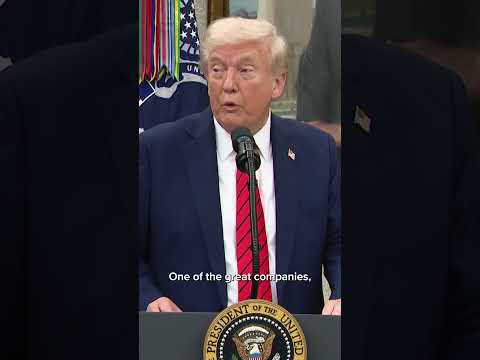
Astroenica, the largest pharmaceutical manufacturer in the United Kingdom, is committing to offer Americans major discounts on their vast catalog of prescription drugs. One of the great companies, by the way, and a most favored nation's pricing clause. So, most favored nation is uh you're going to pay whatever the lowest price anywhere in the world is.That's what you're going to be paying. ...


Pres. Trump announces deal with AstraZeneca to lower U.S. drug prices
CNBC Television· 2025-10-10 22:17
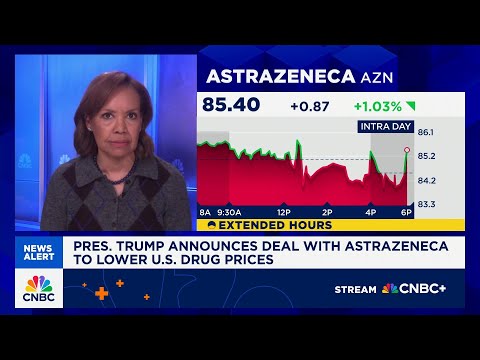
Government Policy & Drug Pricing - Melissa Astroenetica becomes the second drug maker to join President Trump's most favored nation drug price program [1] - The administration aims to align 95% of US drug prices with European levels [3] - Fizer reached an agreement to provide drugs at lower prices for Medicaid and invest $70 billion in the US, in exchange for tariff exemption for three years [2] - CMS administrator Dr Oz is central to these negotiations [1][2] - The next round of IRA price negotiation prices will be available next month [5] Company Investment & Operations - Melissa Astroenetica is breaking ground on a $45 billion plant in Virginia [1] - Fizer is making a $70 billion investment in the US, including manufacturing [2] Future Outlook & Negotiation Strategies - The administration is reaching out to many firms regarding drug pricing [3] - Medicare innovation pilots are being considered to address drug prices [5] - Dr Ash indicates that Medicare is also being considered [4] - The team is negotiating aggressively on drug prices [5]
Pres. Trump announces deal with AstraZeneca to lower U.S. drug prices
Youtube· 2025-10-10 22:17
Core Insights - Melissa Astroenetica has become the second pharmaceutical company to join President Trump's most favored nation drug price program, following the establishment of a $4.5 billion plant in Virginia [1] - The agreement with Fizer, which includes a $70 billion investment in the US and lower drug prices for Medicaid, was reached just 10 days prior, allowing Fizer to avoid tariffs for three years [2] - The goal of the administration is to align 95% of US drug prices with those in Europe, indicating ongoing negotiations with various firms [3] Company Developments - The specifics of the agreement with Astroenetica are not yet clear, but it is part of a broader strategy that includes negotiations with Medicare [4] - The CMS administrator has indicated that aggressive negotiations are ongoing, with the next round of IRA price negotiations expected next month [5]

TrumpRx makes more drug pricing moves and strikes a deal with AstraZeneca
Business Insider· 2025-10-10 22:05
Core Insights - President Trump has initiated a direct-to-customer pharmaceutical venture, announcing a deal with AstraZeneca to implement a "most-favored-nation" drug pricing policy aimed at reducing prescription costs in the US [1][2][3] Group 1: AstraZeneca's Commitment - AstraZeneca has pledged to invest $50 billion in the US over the next five years for research and development of new drugs and onshore manufacturing [2] - The company will offer Medicaid patients prices comparable to the lowest prices charged in other countries [2][3] - AstraZeneca is the largest pharmaceutical manufacturer in the UK, with key products including the cancer drug Tagrisso and the diabetes medication Farxiga [4] Group 2: Related Initiatives - In September, a similar agreement was made with Pfizer to provide reduced rates for its drugs on TrumpRx and for Medicaid patients in exchange for a three-year tariff exemption [9] - TrumpRx.com was launched to make drugs more affordable by eliminating intermediary companies [2] Group 3: Political Context - The announcement comes amid a government shutdown, with ongoing deadlock between Republicans and Democrats over extending enhanced premium subsidies for the Affordable Care Act [10] - The proposed Republican budget could lead to increased health insurance premiums, with some states potentially seeing premiums double without subsidies [11]
Trump says AstraZeneca to offer drugs to US at discounted prices
Reuters· 2025-10-10 21:54
Core Points - U.S. President Donald Trump announced an agreement with AstraZeneca for discounted prescription drugs [1] Company Summary - AstraZeneca will provide its catalog of prescription drugs to the United States at a discounted price [1]
X @The Wall Street Journal
The Wall Street Journal· 2025-10-10 20:00
Company Actions - AstraZeneca 与特朗普政府达成协议,旨在降低美国药品价格 [1]
AstraZeneca is the latest major drugmaker to strike a deal with the Trump administration on lowering U.S. drug prices, according to a person familiar with the matter
WSJ· 2025-10-10 19:45
Group 1 - The agreement follows last week's deal with Pfizer [1]

AstraZeneca to become latest drugmaker to strike deal with Trump. Its stock is down but outperforming the market.
MarketWatch· 2025-10-10 19:45
Core Insights - AstraZeneca PLC is preparing to announce a deal with U.S. President Donald Trump aimed at reducing drug prices, indicating a strategic alignment with government efforts to address pharmaceutical costs [1] Company Summary - The British drugmaker AstraZeneca is following the lead of Pfizer in engaging with the U.S. government to tackle drug pricing issues, which may enhance its market positioning and public perception [1]

Trump reaches deal with AstraZeneca to lower U.S. drug prices, MSNBC reports
CNBC· 2025-10-10 18:53
U.S. President Donald Trump participates in a bilateral meeting with Finland's President Alexander Stubb (not pictured), in the Oval office at the White House in Washington, D.C., U.S., Oct. 9, 2025.The Trump administration and AstraZeneca have reached an agreement for the U.K.-based pharmaceutical giant to cut drug prices in the U.S., MSNBC reported Friday.The deal with AstraZeneca would follow a similar pact with U.S. drugmaker Pfizer, which was announced late last month.President Donald Trump and AstraZe ...
X @Bloomberg
Bloomberg· 2025-10-10 16:58
Industry Dynamics - AstraZeneca is expected to announce a deal with Trump to slash drug prices [1] - AstraZeneca 将成为第二家与特朗普达成协议以推进其关键健康优先事项的制药公司 [1]