
CHINA POWER(CPWIY)

Search documents
2025年第四季度中国电力建设发展指数环比上升
Zhong Guo Xin Wen Wang· 2026-02-10 13:16
Core Viewpoint - The China Power Construction Development Index (PCDI) for the fourth quarter of 2025 is reported at 93.29, showing a year-on-year decline of 1.29 points but a quarter-on-quarter increase of 5.87 points, indicating mixed trends in the power construction sector [1]. Economic Impact - The sub-index for the economic impact of power construction is 80.00, reflecting a year-on-year decrease of 12.07 points and a quarter-on-quarter decrease of 0.05 points. The share of national power construction investment in total fixed asset investment (excluding rural households) increased by 0.34 percentage points year-on-year and 3.01 percentage points quarter-on-quarter [1]. Green Development - The green development sub-index stands at 93.19, with a year-on-year decline of 4.81 points but a quarter-on-quarter increase of 9.66 points. In the fourth quarter of 2025, the newly installed capacity for non-fossil energy generation is 14,208 MW, down 14.88% year-on-year but up 231.50% quarter-on-quarter, accounting for 79.18% of the total newly installed generation capacity nationwide [1]. Industry Scale - The industry scale sub-index is 95.50, showing a year-on-year decline of 0.93 points and a quarter-on-quarter increase of 4.87 points. New power projects started in the fourth quarter total 89,247 MW, down 28.04% year-on-year, while new installed capacity and investment completion amounts decreased by 5.88% and 13.74%, respectively. Conversely, new projects in the grid sector expanded to 27,510 kilometers, up 22.23% year-on-year, with new transmission lines increasing by 62.12%, although investment completion in this area decreased by 4% [2]. Economic Efficiency - The economic efficiency sub-index is reported at 92.93, reflecting a year-on-year increase of 3.53 points and a quarter-on-quarter increase of 9.15 points. The total revenue of the power construction industry reached 281.718 billion yuan, down 1.07% year-on-year, while the total value of new contracts signed is approximately 490.781 billion yuan, a slight year-on-year decrease of 0.14% [2].
中国电力建设企业协会:2025年第四季度中国清洁能源建设景气指数同比下降8.22点 处于较景气区间
智通财经网· 2026-02-10 08:06
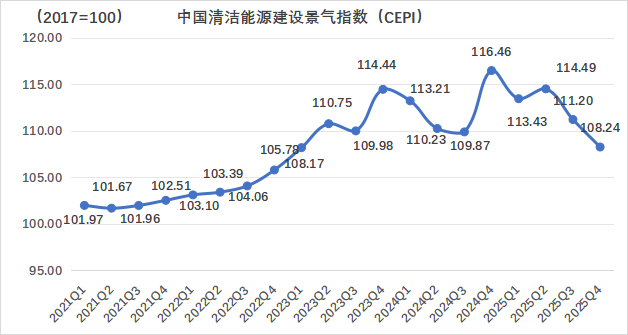
Core Viewpoint - The China Electric Power Construction Enterprise Association released the Clean Energy Construction Prosperity Index (CEPI) and Power Construction Development Index (PCDI) for Q4 2025, indicating a decline in the CEPI while remaining in a relatively prosperous range [1] Clean Energy Construction Prosperity Index (CEPI) - The CEPI for Q4 2025 is 108.242, down 8.22 points year-on-year and 2.96 points quarter-on-quarter, but still within a prosperous range [1] - The slowdown in the growth rate of new clean energy installed capacity in Q4 2025 contributed to the decline in the CEPI [3] Power Construction Development Index (PCDI) - The PCDI for Q4 2025 is 93.29, down 1.29 points year-on-year but up 5.87 points quarter-on-quarter, influenced by the increase in the four sub-indices [8] Installed Capacity and Generation - By the end of 2025, the total installed power generation capacity reached 3.89 billion kilowatts, a year-on-year increase of 16.12%, with clean energy accounting for over 60% at 2.352 billion kilowatts [3] - In Q4 2025, the new installed capacity for clean energy was 17.944 million kilowatts, down 5.88% year-on-year but up 144.44% quarter-on-quarter [3] - Clean energy generation in Q4 2025 was 1,685.9 billion kilowatt-hours, a year-on-year increase of 20.65%, representing 53.34% of the total national generation [3][6] Investment and Construction - The total investment in clean energy in Q4 2025 was 381 billion yuan, down 23.97% year-on-year [3] - The scale of clean energy under construction reached 73.518 million kilowatts by the end of 2025, a year-on-year decrease of 4.36% [3] Sector Performance - Hydropower new installed capacity in Q4 2025 was 4.99 million kilowatts, down 14.11% year-on-year, while hydropower generation increased by 11.07% to 466.4 billion kilowatt-hours [5] - Wind power new installed capacity surged by 45.92% year-on-year to 59.39 million kilowatts, with generation increasing by 11.31% to 360.1 billion kilowatt-hours [6] - Solar power new installed capacity decreased by 34.04% year-on-year to 77.24 million kilowatts, but generation rose by 37.69% to 736.1 billion kilowatt-hours [6] Economic Impact - The total investment in power construction in Q4 2025 was 695.8 billion yuan, down 11.13% year-on-year but up 82.19% quarter-on-quarter [10] - The contribution of power construction investment to GDP growth decreased year-on-year by 12.07 points [11] - The fixed asset investment (excluding rural households) in Q4 2025 was 11.3651 trillion yuan, with power construction investment accounting for an increasing share [11] Industry Indices - The green development index for Q4 2025 was 93.19, down 4.81 points year-on-year but up 9.66 points quarter-on-quarter [11] - The economic benefit index for Q4 2025 was 92.93, showing an increase of 3.53 points year-on-year [12] - The industry scale index for Q4 2025 was 95.50, down 0.93 points year-on-year but up 4.87 points quarter-on-quarter [12]

2026年中国电力铁塔行业供需、产业链及代表企业洞察:朝着高端化、智能化、绿色化方向高质量发展[图]
Chan Ye Xin Xi Wang· 2026-02-09 01:34
Core Insights - The demand for electric power towers in China is projected to reach 502.2 million tons by 2025, with maintenance and replacement demand at 100.5 million tons, leading to a total production increase to 638.8 million tons, indicating a positive supply-demand trend in the industry [8][9]. Electric Power Tower Industry Overview - Electric power towers are essential structures for supporting overhead transmission lines and maintaining safe distances between conductors and other objects. They are categorized by use (transmission, distribution, visual), structure (steel pipe, angle steel, concrete), voltage (ultra-high, high, medium, low), and form (straight, corner, terminal) [1][2]. Industry Development History - The electric power tower industry in China has evolved from using wood and cement to modern steel structures, with significant growth following the introduction of high-voltage lines and the first ultra-high voltage project in 2006, which enhanced equipment and technology levels [3]. Industry Policies - The industry is guided by clear policies covering planning, market cultivation, and technical standards. Key policies include the release of the T/EJCCCSE179-2025 standard for ultra-high voltage towers and initiatives to enhance the electricity service environment, which aim to promote high-quality development in the sector [4][5]. Industry Chain - The electric power tower industry chain consists of upstream raw materials (carbon steel, alloy steel, cables), midstream manufacturing (companies like Hongsheng Huayuan and Qingdao Dongfang Tower), and downstream demand from contractors and power companies driven by grid upgrades and new energy projects [6]. Current Industry Status - The supply-demand scale of electric power towers in China has shown significant fluctuations, with a notable increase in demand and production in 2020 due to the launch of ultra-high voltage projects. The market is expected to recover with the ongoing upgrades of old grids and new energy integration [7][8]. Market Size - The market size for electric power towers is driven by both new construction and maintenance needs, with projections indicating a total market size of 590.65 billion yuan by 2025, comprising 492.16 billion yuan from new projects and 98.49 billion yuan from maintenance [9][10]. Competitive Landscape - The electric power tower manufacturing industry exhibits a "low-end dispersed, high-end concentrated" competitive structure, with many small enterprises in the low-end market and a concentration of larger firms in the high-end market due to high barriers to entry [11]. Development Trends - The industry is transitioning towards smart monitoring and digital twin integration, with a focus on lightweight and green low-carbon materials. Innovations include the use of high-strength materials and environmentally friendly coating technologies to reduce carbon footprints and enhance operational efficiency [14].


大风起兮云飞扬,中国电力兮威震四方——中国是如何登上世界电力巅峰的?
Sou Hu Cai Jing· 2026-02-07 11:46
Core Insights - The competition in the AI industry fundamentally revolves around the underlying infrastructure, including energy, chips, and data centers, as highlighted by Huang Renxun's "five-layer cake" theory [2] - Elon Musk emphasized that the core bottleneck for AI applications is energy supply, noting that while AI chip production is rapidly increasing, global electricity supply is only growing at about 4% annually, leading to a potential mismatch between chip capacity and power availability [2] - China is positioned as an "exception" in this context due to its rapid growth in electricity production and capacity, which is critical for supporting its AI and technology sectors [2][3] Energy Consumption and Production - By 2025, China's annual electricity consumption is projected to exceed 10 trillion kilowatt-hours, accounting for 36.4% of the global total, which is 2.5 times that of the United States and 3.2 times that of the European Union [4] - In 2024, China's total electricity generation surpassed 10 trillion kilowatt-hours, with a global share exceeding 32% [5] - The "double ten trillion" milestone signifies China's significant lead in both electricity consumption and generation, achieved through nearly 80 years of continuous investment in power infrastructure [6] Infrastructure Development - China's extensive investment in hydropower, wind, and solar energy has established it as a global leader in electricity generation, with numerous large-scale projects across various regions [6][7] - The construction of major hydropower stations, such as those along the Yellow River and Yangtze River, showcases China's engineering capabilities and commitment to energy development [10][12] - The development of a vast high-voltage transmission network has enabled efficient electricity distribution across the country, supporting both regional and national energy needs [39][42] Renewable Energy Leadership - By 2025, China's wind power capacity is expected to reach 550 million kilowatts, representing 45% of the global total, while solar power capacity will reach 1.16 billion kilowatts, accounting for approximately 48% of the global market [21][22] - In 2024, China's wind and solar power generation combined was 2.5 times that of the United States, highlighting its dominance in renewable energy production [21] - China's complete supply chain for wind and solar energy, from manufacturing to installation, positions it as a global leader in these sectors [22] Nuclear Energy Development - China's nuclear energy program has evolved significantly since its inception, with advancements in third and fourth-generation nuclear technologies, positioning the country as a leader in nuclear power [28][30] - By 2025, China is expected to have 59 operational nuclear reactors, with a total capacity of 62.48 million kilowatts, representing 14.7% of the global total [31] - The development of advanced nuclear technologies is crucial for China's energy security and its strategic position in global energy markets [28][30] Strategic Energy Initiatives - The "West-to-East Power Transmission" project is a monumental initiative aimed at transferring electricity from resource-rich western regions to the eastern economic centers, with a total investment exceeding 1.2 trillion yuan [42][44] - This project has established a comprehensive energy network that supports China's transition to a cleaner, low-carbon energy system, aligning with its long-term sustainability goals [44] - The integration of advanced technologies in energy production and distribution reflects China's commitment to maintaining its competitive edge in the global energy landscape [45][46]
中国电力附属新源智储与托里公司订立BESS 采购合同
Zhi Tong Cai Jing· 2026-02-05 10:04
Core Viewpoint - China Power (02380) announced a procurement contract for a Battery Energy Storage System (BESS) with Tori Company, valued at RMB 452 million (approximately HKD 507.9 million) [1] Group 1: Contract Details - The contract is set to be executed on February 5, 2026, and involves New Source Intelligent Storage, a non-wholly owned subsidiary of the company, supplying energy storage system equipment and components along with related services for the Tacheng project [1] - The contract price aligns with current market rates for similar energy storage system equipment and services offered by other companies [1] Group 2: Strategic Implications - This procurement will enable New Source Intelligent Storage to gain market share and build capabilities in the energy storage sector, supporting the company's strategic goal of transforming into a comprehensive green low-carbon energy supplier and service provider [1] - The board believes that the terms and pricing of the BESS procurement contract are competitive compared to what the company charges independent third parties [1]
中国电力(02380.HK)附属新源智储作为供应方与托里公司订立BESS采购合同
Xin Lang Cai Jing· 2026-02-05 09:57
中国电力(02380.HK)公告,于2026年2月5日,新源智储(公司一家非全资拥有的附属公司),作为供应 方,与托里公司订立了一份BESS采购合同,据此新源智储将为塔城项目提供储能系统设备和组件以及 其相关服务,代价人民币4.5亿元。 ...
中国电力(02380)附属新源智储与托里公司订立BESS 采购合同
智通财经网· 2026-02-05 09:56
Core Viewpoint - China Power (02380) announced a procurement contract for a Battery Energy Storage System (BESS) with Tori Company, valued at RMB 452 million (approximately HKD 507.9 million), to supply energy storage systems and related services for the Tacheng project [1] Group 1: Contract Details - The BESS procurement contract is set to be executed on February 5, 2026, by New Source Intelligent Storage, a non-wholly owned subsidiary of the company [1] - The contract price aligns with current market rates for similar energy storage systems and services offered by other companies [1] Group 2: Strategic Implications - The provision of energy storage systems and related services will enable New Source Intelligent Storage to gain market share and strengthen its capabilities in the energy storage sector [1] - This initiative supports the company's strategic goal of transforming into a comprehensive green low-carbon energy supplier and service provider [1]
中国电力(02380) - 储能系统设备採购合同
2026-02-05 09:47
香港交易及結算所有限公司及香港聯合交易所有限公司對本公告的內容概不負責,對其準確性或完整性 亦不發表任何聲明,並明確表示,概不就因本公告全部或任何部份內容而產生或因倚賴該等內容而引致 的任何損失承擔任何責任。 中 國 電 力 國 際 發 展 有 限 公 司 China Power International Development Limited (在香港註冊成立的有限責任公司) (股份代號:2380) 關連交易 儲能系統設備採購合同 於二零二六年二月五日,新源智儲(本公司一家非全資擁有的附屬公司), 作為供應方,與托里公司訂立了一份 BESS 採購合同,據此新源智儲將為 塔 城 項 目 提供儲能系統 設備和組件以 及其相關服務, 代 價 人民幣 452,050,600 元(約相等於 5 07,922,000 港元)。 於本公告日期,國家電投擁有本公司已發行股本約 65 .6 1%。由於國家電投 為本公司的最終控股股東,根據上市規則定義,國家電投、其附屬公司及 聯繫人均為本公司的關連人士。 托里公司為國家電投一家非全資擁有的間接附屬公司。因此,托里公司為 本公司的關連人士,而訂立 BESS 採購合同根據上市規 ...
规模惊人!马斯克连续转发两条中国电力生产的帖子
Xin Lang Cai Jing· 2026-02-05 07:15
本周较早时,马斯克在回复"特斯拉硅谷车主俱乐部"的另一条帖子时表示:"中国是令人惊叹的制造业 强国,并且非常清楚太阳能是未来发展方向。这是不争的事实!" 责任编辑:于健 SF069 美国科技亿万富翁埃隆·马斯克周四在社交平台X上连续转发了两条关于中国电力生产的帖子。 美国科技亿万富翁埃隆·马斯克周四在社交平台X上连续转发了两条关于中国电力生产的帖子。 在其中一条帖子中,"零重力"公司创始人、奇点大学执行主席彼得·迪亚曼迪斯写道:"中国生产的电力 比美国和欧盟的总和还要多出40%。在这场能源等于智能的全球竞赛中,我们必须开始觉醒了。" 另一条由"特斯拉硅谷车主俱乐部"发布的帖子称:"中国目前发电量占全球总发电量的33.2%,是美国 (约14.2%)的两倍多。这相当于全球总发电量的三分之一。世界其他地区的总发电量占比:52.6%。 规模惊人。" 这不是马斯克第一次对中国在电力生产方面的进展表示赞叹,他在最近的一次播客访谈中预测,2026年 中国的发电量可能达到美国的3倍,这将足以支撑高耗能的数据中心。中国通过光伏、风电等清洁能源 的布局以及特高压电网的建设,已经为AI的发展筑牢了基础,成为全球能源领域的领跑者。 ...

图说研报 | 中国电力何时见底?
Xin Lang Cai Jing· 2026-02-04 23:25
Core Viewpoint - The article discusses the contrasting trends in electricity supply and demand between China and the United States, highlighting the differences in base load power generation growth and electricity pricing dynamics. Group 1: Electricity Supply and Demand Trends - The growth rate of base load power generation in China is expected to outpace that of the United States, leading to a significant divergence in supply dynamics during the "14th Five-Year Plan" period [6][18]. - After 2025, it is anticipated that the growth rate of electricity demand in China will remain consistently higher than that of base load power generation, indicating a potential supply gap [7][19]. - The article notes that both countries are experiencing a slowdown in the growth of base load power generation, which is a critical factor contributing to electricity shortages [19][28]. Group 2: Electricity Pricing Dynamics - The average price-to-book (PB) ratio of electricity stocks in the U.S. has widened significantly compared to China, reaching over 2 times [12]. - The article predicts that by 2026, industrial electricity prices in China will be significantly lower than those in the U.S., enhancing the competitiveness of Chinese manufacturing [47][51]. - The rising fuel costs in the U.S. are expected to contribute to a 70% increase in electricity prices from 2024 to 2026, while China's electricity prices are projected to decline due to falling coal prices [45][65]. Group 3: Future Projections - The article forecasts that the growth rate of base load power generation in both countries will peak around 2025, after which a notable decline is expected [68]. - It is anticipated that the electricity supply gap in China will not begin to narrow until 2025, as the demand for electricity continues to rise [37][39]. - The article emphasizes that the electricity pricing structure in the U.S. is significantly influenced by the costs associated with fuel, while China's pricing is more affected by coal price fluctuations [41][63].
