
CHINA POWER(CPWIY)

Search documents
中国电力(02380) - 股份发行人的证券变动月报表
2026-03-04 07:01
股份發行人及根據《上市規則》第十九B章上市的香港預託證券發行人的證券變動月報表 | 截至月份: | 2026年2月28日 | 狀態: 新提交 | | --- | --- | --- | | 致:香港交易及結算所有限公司 | | | | 公司名稱: | 中國電力國際發展有限公司 | | | 呈交日期: | 2026年3月4日 | | | I. 法定/註冊股本變動 不適用 | | | FF301 第 1 頁 共 10 頁 v 1.2.0 FF301 II. 已發行股份及/或庫存股份變動及足夠公眾持股量的確認 1. 股份分類 普通股 股份類別 不適用 於香港聯交所上市 (註1) 是 證券代號 (如上市) 02380 說明 已發行股份(不包括庫存股份)數目 庫存股份數目 已發行股份總數 上月底結存 12,370,150,983 0 12,370,150,983 增加 / 減少 (-) 0 0 本月底結存 12,370,150,983 0 12,370,150,983 足夠公眾持股量的確認(註4) | 根據《主板上市規則》第13.32D(1)條或第19A.28D(1)條 / 《GEM上市規則》第17.37D(1)條或第 ...
中国电力建设股份有限公司 2026年1月主要经营情况公告
Xin Lang Cai Jing· 2026-03-04 06:29
Core Viewpoint - China Power Construction Corporation has released its main operational data for January 2026, providing insights for investors [2][7]. Summary by Business Type - The company categorizes its operations into four main business types: 1. Energy and Power Business, which includes hydropower, wind power, solar power, thermal power, new energy storage, nuclear power, power grid, hydrogen energy, geothermal energy, marine energy, and biomass energy [8]. 2. Water Resources and Environmental Business, covering water conservancy, water services, water environment governance, ecological restoration, marine engineering, soil remediation, environmental engineering (non-water, soil), and energy-saving projects [9]. 3. Urban Construction and Infrastructure Business, which encompasses building construction, railways, urban rail transit, highways, municipal projects, airports, ports and waterways, and mining [9]. 4. Other Business, which refers to all activities not included in the above three categories [9]. Summary by Regional Distribution - The operational data is also segmented by regional distribution, although specific figures are not provided in the text [10]. Additional Notes - The data presented is preliminary and may differ from the figures disclosed in regular reports, serving only as a reference for investors [4][10].

外资入局中国电力市场,数据安全如何实现合规可控?
Xin Lang Cai Jing· 2026-03-02 08:23
Core Insights - The joint venture, Bitong Energy, established by Bicheng Energy and Octopus Energy, focuses on electricity trading and smart energy services, emphasizing data security solutions [1][2] - The collaboration took approximately seven months to finalize, driven by a strong alignment in strategy, resources, and vision between the two companies [1] - Bicheng Energy aims to localize technology solutions to meet the complex regulatory environment of the Chinese electricity market, rather than simply importing foreign platforms [1][2] Data Security Framework - Bitong Energy's core principle is that all data, systems, operations, and security frameworks for domestic business will operate within China [2] - The company will adhere to Chinese data security laws, implementing strict data classification and access control measures, while minimizing unnecessary cross-border data flow [2] - New research and intellectual property developed for the Chinese market will be managed locally, ensuring core capabilities remain within the domestic team [2] Technical Strategy - The company plans to adapt its technical strategies and models to the unique characteristics of different provincial electricity markets, allowing for dynamic adjustments [3] - Bitong Energy's development aligns with national policies promoting the integration of renewable energy into the electricity market [3][4] - The company intends to utilize virtual power plants to aggregate user-side adjustable loads and distributed energy resources, enhancing flexibility and market participation [4] Market Positioning - The innovative model aims to help commercial users reduce energy costs while providing support during peak demand periods, thereby enhancing grid resilience [4] - As the electricity market undergoes reform, the ability to drive innovation through technology is becoming a critical competitive factor for market participants [4]
外资入局中国电力市场 数据安全如何实现合规可控?
Zhong Guo Dian Li Bao· 2026-03-02 08:10
Core Insights - The joint venture between Bicheng Energy and Octopus Energy, named Bichong Energy, has made significant progress in its focus on electricity trading and smart energy services, particularly regarding data security solutions [1] - The partnership emphasizes a localized technology approach tailored to the complexities of the Chinese electricity market, rather than simply importing foreign platforms [2] - Bichong Energy aims to ensure that all data, systems, operations, and security frameworks for its domestic business operate within China, adhering to local data security laws and regulations [2][3] Data Security Framework - Bichong Energy's core principle is to maintain a closed-loop operation for data and systems within China, following strict data classification and access control measures [2] - The company plans to minimize unnecessary cross-border data flow and will utilize techniques like data anonymization to protect sensitive information [3] - The joint venture's R&D outcomes and intellectual property will be managed domestically, ensuring that core competencies remain within local teams [3] Technical Strategy - Bichong Energy's technology strategy will adapt to the diverse electricity supply and demand, market rules, and trading mechanisms across different provinces in China [4] - The company intends to implement a virtual power plant model to aggregate controllable loads, distributed energy sources, and storage resources, addressing the fragmented nature of commercial loads in the Chinese market [4][5] - This approach aims to convert user-side flexibility into quantifiable and tradable market products, helping commercial users reduce energy costs while enhancing grid resilience during peak demand [5] Industry Context - The collaboration aligns with China's recent push for renewable energy integration into the electricity market, supporting the development of a new energy system [4] - As the electricity market undergoes reforms, the ability to innovate through technology is becoming a critical competitive factor for market participants [5] - Bichong Energy's exploration of balancing safety, low carbon, and low cost in energy solutions is a significant industry proposition that warrants ongoing attention [5]
中国电力设备凭啥“爆单”全球
Ke Ji Ri Bao· 2026-03-02 00:27
Core Insights - The Chinese power equipment manufacturing industry is experiencing a surge in demand due to the explosive growth in global computing power infrastructure and energy projects, with orders extending to 2027 and a significant increase in overseas orders [1][2]. Group 1: Industry Growth and Demand - The transformer manufacturing sector is a critical component of the power equipment industry, with companies like Baoding Tianwei Baobian Electric Co., Ltd. reporting that over 40% of their orders are for key high-voltage and nuclear power projects [2]. - The demand for transformers is expected to grow significantly, with China's transformer industry comprising about 3,000 companies and accounting for approximately 60% of global production capacity [3]. - By 2025, China's transformer export value is projected to reach 64.6 billion yuan, representing a nearly 36% increase from 2024 [3]. Group 2: Technological Advancements - Chinese power equipment manufacturers are enhancing their competitiveness through breakthroughs in high-voltage IGBT chips, intelligent monitoring systems, and flexible transmission technologies, leading to increased domestic production rates and international market competitiveness [4]. - The successful development of a 345 kV fully insulated ultra-high-capacity transformer by Jiangsu Yawen Transformer Co., Ltd. marks a significant technological advancement, filling a gap in the domestic market for such products [5][6]. Group 3: Supply Chain and Global Positioning - China's stable delivery capabilities in the context of global power equipment shortages are reshaping the market dynamics, with companies like Jiangsu Yawen successfully securing international contracts due to their superior technology and quality control [5][6]. - Major players in the transformer industry, such as Igor Electric Co., Ltd., are expanding their production capacity in countries like Thailand, the USA, and Mexico, with expectations of significant output increases by 2027 [6]. Group 4: Meeting New Energy Demands - The construction of computing centers and supercomputing clusters in China is accelerating, creating new demands for power equipment that ensure stable and efficient energy supply [7]. - Companies are actively pursuing technological innovations to meet the stringent requirements for power supply stability and efficiency, particularly in the context of the "East Data West Computing" initiative [7][8].

中国电力:库存低位下,国内动力煤现货价格同比上涨 10%;更看好电网及电厂设备供应商,而非运营商-China Power PRC Spot Coal Price Up 10 YoY amid Low Inventory Prefer Grid and Plant Equipment Suppliers to Operators
2026-03-01 17:23
Summary of Key Points from the Conference Call Industry Overview - **Industry**: Power Generation and Energy Storage in China - **Key Focus**: Coal prices, independent energy storage systems (ESS), and power generation capacity Key Insights on Coal Prices - **Current Coal Price**: PRC Sxcoal spot coal price at Qinhuangdao is Rmb732/tonne as of February 25, 2026, reflecting a 1.0% week-over-week increase, 5.8% month-over-month increase, and 8.9% year-over-year increase [1] - **Inventory Levels**: Coal inventory at Qinhuangdao Port decreased by 3.4% week-over-week to 4.90 million tonnes, which is 23.2% below the 2025 average of 6.38 million tonnes [1] - **Market Dynamics**: The increase in coal prices is attributed to low inventory levels, while on-grid tariffs for independent power producers (IPPs) are expected to decline year-over-year in 2026 due to increased competition and new supply from wind and solar energy [1] Insights on Power Generation Capacity - **Capacity Growth**: China's power generation capacity has increased by an average of 15% per annum over the last three years (2023-2025), significantly outpacing electricity demand growth of 5-6% per annum [1] - **Margin Pressure**: PRC power plant operators are anticipated to face margin cuts in 2026 due to the competitive landscape and lower market-based tariffs [1] Independent Energy Storage Systems (ESS) - **Policy Clarification**: Only grid-side independent ESS are eligible for capacity payments as per the NDRC policy issued on January 30, 2026. Wind and solar farm-owned ESS do not qualify [2] - **Market Expectations**: Global ESS shipments are expected to double year-over-year in 2026, but the impact of the new policy on installations is expected to be mild due to the low percentage of independent ESS installations [2] - **Forecast for Solar Installations**: A projected drop of 21% year-over-year in solar installations to 250GW in 2026 from 315GW in 2025 is anticipated, which will also affect ESS installations [2] Company-Specific Insights - **Preferred Companies**: Recommendations include Buy ratings for Sieyuan Electric, TBEA, Goldwind, and Dongfang Electric due to their favorable positioning in the current market environment [1] - **Valuation Metrics**: - **Dongfang Electric**: Target price for A shares is Rmb23.00 based on a 1.6x 2025E PB, reflecting expectations of higher revenue and gross profit margin improvements [17] - **Goldwind**: Target price of HK$17.00 based on DCF methodology, indicating a stable long-term outlook [21] - **Sieyuan Electric**: Target price of Rmb260/share based on DCF model, reflecting stable cash flows in the power grid equipment industry [23] - **TBEA**: Target price of Rmb36.00/share based on DCF model, indicating stability in cash flows [26] Risks Identified - **Dongfang Electric**: Risks include rising steel prices, decreasing average selling prices (ASP), and weak new order flows [18][20] - **Goldwind**: Risks include fewer-than-expected new orders, less favorable government policies, and lower-than-expected wind turbine generator (WTG) margins [22] - **Sieyuan Electric**: Risks include lower-than-expected PRC grid capital expenditures, lower overseas new orders, and higher raw material costs [24] - **TBEA**: Risks include lower-than-expected polysilicon prices and higher prices for key materials like steel, copper, and aluminum [27] Conclusion - The conference call highlighted the current dynamics in the Chinese power generation and energy storage sectors, emphasizing the impact of coal prices, regulatory changes, and competitive pressures on margins and growth. The preferred companies are well-positioned to navigate these challenges, although several risks could impact their performance.
Token 出海,将中国电力卖给全世界
Xin Lang Cai Jing· 2026-03-01 03:27
Core Insights - The significance of the undersea cable network lies not in transmission speed but in the power structure it creates, where those who lay the cables can control information flow [1][2] - In 2026, Chinese AI models are capturing a significant share of the global developer market, with Chinese models accounting for 61% of token consumption on the OpenRouter platform [3][4] Group 1: AI Model Migration - As of February 24, 2026, the top ten models on OpenRouter consumed approximately 8.7 trillion tokens, with Chinese models dominating at 5.3 trillion tokens [4] - The leading model, MiniMax M2.5, consumed 2.45 trillion tokens, followed by Kimi K2.5 and Zhiyu GLM-5, all from China [4] - The introduction of OpenClaw, an open-source tool, has enabled AI to perform complex workflows, leading to exponential increases in token consumption for developers [6][9] Group 2: Cost Structure of Tokens - The cost structure of tokens primarily consists of computing power and electricity, with a single NVIDIA H100 GPU costing around $30,000 and consuming approximately 700 watts [11] - The process of a developer's API request involves data traveling from the U.S. to a Chinese data center, where GPU clusters operate, showcasing the cross-border flow of value through tokens [12][13] - China's electricity prices are about 40% lower than those in the U.S., contributing to the competitive advantage of Chinese AI models [15] Group 3: Strategic Implications - The migration of developers to Chinese models is driven by significant cost differences, with MiniMax M2.5 costing $0.3 per million tokens compared to $5 for Claude Opus 4.6 [8][9] - The transition to Chinese AI models is occurring globally, with developers increasingly relying on these models for their workflows, raising concerns about data sovereignty and compliance [28][30] - The competition in AI models and tokens is becoming a new strategic battleground between the U.S. and China, akin to the semiconductor and space races of the past [30][31]


5万亿国家电网投资启动!中国电力系统迎来历史性升级
Sou Hu Cai Jing· 2026-02-27 10:50
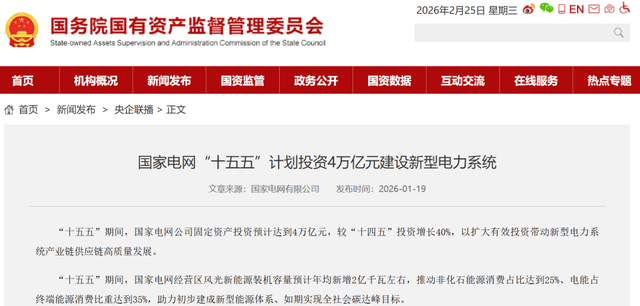
Core Insights - China is undergoing an unprecedented wave of power grid upgrades, with significant investments aimed at enhancing the efficiency and reliability of the electricity supply system [1][3] Investment Plans - The State Grid Corporation plans to invest 4 trillion yuan during the 14th Five-Year Plan period, representing a 40% increase compared to the previous plan, to drive the development of a new power system [2] - Over 5 trillion yuan will be allocated for building a new power system, marking a historical high in investment [3] Renewable Energy Integration - The installed capacity of wind and solar energy is expected to increase by approximately 200 million kilowatts annually during the 14th Five-Year Plan, with non-fossil energy consumption reaching 25% and electricity accounting for 35% of total energy consumption [2][3] High Voltage Infrastructure - The construction of ultra-high voltage (UHV) networks is a key focus, aiming to enhance cross-regional and cross-provincial transmission capacity by over 30% compared to the end of the previous plan [3] Urban and Rural Electrification - Urban areas are seeing upgrades to smart distribution and automation systems, targeting a power supply reliability rate exceeding 99.99%, while rural areas are focusing on strengthening weak grid segments [5] Technological Advancements - The integration of advanced technologies such as AI, digital twins, and drone inspections is transforming the power grid, enhancing real-time sensing and adaptive regulation capabilities [7] Industry Players and Innovations - Key companies in the sector include TBEA and XJ Electric, which are leading suppliers of UHV transformers and switchgear, and State Grid Corporation's subsidiaries focusing on automation and digital services [4][6][8][9] - The investment in smart grids and charging infrastructure is also supporting the transition to electric vehicles, with over 40 million charging stations anticipated [6][8] Environmental Goals - The investment in the power grid is directly contributing to China's carbon peak and carbon neutrality goals, with initiatives to create zero-carbon parks and factories being promoted globally [8][9]
中国电力普安发电新能源光伏板块单日发电量创历史新高
Xin Lang Cai Jing· 2026-02-27 10:42
2月21日,中国电力普安发电新能源光伏板块单日发电量达155.533万千瓦时,刷新自2017年并网投产以 来的单日发电量历史纪录,为新春伊始的绿色能源发展注入强劲动力。 春节假期期间,中国电力普安发电新能源项目团队坚守岗位、履职尽责,以"不松懈、不缺位"的责任担 当,全力保障项目高效运转。团队紧盯光伏组件、逆变器等核心设备运行状态,依托全域监测系统与无 人机巡检相结合的方式,精准排查组件隐裂、线路老化等隐性隐患,实现设备状态实时透明;优化调度 策略,结合光照变化动态调整运行参数,最大化挖掘发电潜力;强化安全管控,严格落实各项安全操作 规程,开展常态化安全隐患排查整治,构建起"监测-分析-决策-执行"的闭环运维体系,为单日发电量突 破奠定了坚实基础。此次发电量创新高,既是项目精益运维的成果,也是中国电力普安发电践行绿色发 展理念的生动实践。站在新起点,该公司将以此为契机,持续深化精益运维、加大技术创新、优化调度 策略,全力稳产增效,以更高标准保障项目安全稳定运行,奋力冲刺年度目标,为能源结构优化和"双 碳"目标实现贡献更大力量。 2月21日,中国电力普安发电新能源光伏板块单日发电量达155.533万千瓦时,刷新 ...
学法护网 守线保供 法治护航电网安全——《中国电力法》电力设施保护专题
Zhong Guo Neng Yuan Wang· 2026-02-27 08:39
Core Viewpoint - The State Grid Horgos Power Supply Company is implementing a training program focused on the "Electric Power Law" to enhance legal awareness and responsibilities among employees, ensuring the protection of electric facilities and the safe operation of the power grid [1][2][3] Group 1: Training Implementation - The company emphasizes the importance of legal education in power facility protection as a key task for the year, focusing on core provisions of the "Electric Power Law" [1] - The training employs a combination of methods including lectures, case analyses, on-site Q&A, and online resources to ensure comprehensive coverage for all employees [1] - Key topics include the protection of electric facilities, delineation of protection zones, prohibited actions, and legal responsibilities, clarifying the legal requirements for transmission and distribution facilities [1][2] Group 2: Practical Application and Case Studies - The training incorporates real-life case studies of violations and safety risks, educating employees on the legal consequences and economic losses associated with non-compliance [2] - Specific operational points and compliance processes are detailed for various roles, including safety protocols and evidence collection, to transform legal knowledge into practical standards [2] Group 3: Promotion of Legal Awareness - The company is fostering a strong legal learning environment through various initiatives, including distributing core provisions and educational materials via internal communication channels [3] - Group discussions and knowledge sharing sessions are conducted to integrate legal knowledge into daily operations and enhance employee engagement [3] - The company aims to extend legal awareness to the community, promoting public participation in safeguarding the power grid [3] Group 4: Future Plans and Collaboration - The company plans to strengthen the implementation of the "Electric Power Law" training, enhancing overall legal literacy and protective capabilities among employees [3] - A long-term mechanism for legal promotion, risk prevention, and collaborative protection of electric facilities is being established, with a focus on accountability across departments [3] - Collaboration with local authorities and law enforcement is emphasized to combat illegal activities that threaten electric facilities and to conduct regular inspections [3]