GM(GM)

Search documents
NHTSA Probes Nearly 600,000 GM Vehicles Over Engine Failure Complaints - General Motors (NYSE:GM)
Benzinga· 2026-01-20 08:23
Group 1 - The National Highway Traffic Safety Administration (NHTSA) has initiated a probe into nearly 600,000 General Motors Co. vehicles due to reports of engine failures [1] - The investigation focuses on the L87 6.2L V8 engines, affecting models such as the 2021-2024 Cadillac Escalade, Chevrolet Silverado, Suburban, Tahoe, GMC Sierra 1500, Yukon, and Yukon XL [2] - The NHTSA's Office of Defects Investigation (ODI) received 36 Vehicle Owner Questionnaires alleging engine damage or failure following a recall last year [3] Group 2 - General Motors has relocated to a new headquarters in Detroit, which is significantly smaller in square footage compared to the previous headquarters, the "Renaissance Center" [4] - CEO Mary Barra has reaffirmed GM's commitment to electric vehicles (EVs), describing them as the company's "North Star," despite recent layoffs of over 3,400 workers across multiple EV production facilities [5] - GM's stock price increased by 0.02% to $80.84 during after-hours trading on January 16 [6]


2026 中国新能源汽车与动力电池手册_从自动驾驶到人工智能-2026 China EV & EV Battery Handbook_ From Autonomous Driving to AI
2026-01-20 01:50
Summary of Key Points from the Conference Call Industry Overview: Greater China Auto, EV, and EV Battery Industry Forecasts - **China's Auto Industry**: Expected to face challenges in 2026 with a forecasted decline in auto wholesales by **1.6% YoY** compared to a **10% YoY** increase in 2025. This decline is attributed to front-loaded demand in 2025 [1] - **Domestic EV Sales**: Anticipated to grow only **7% YoY** in 2026 due to a **5% increase in purchase tax** and reduced trade-in subsidies [1] - **Export Sales**: Projected to increase by **12% YoY**, reaching **7.9 million units** in 2026, with EV exports expected to surge by **40% YoY** [1] - **Competition Dynamics**: Shift from price competition to configuration-based competition, necessitating more investment in autonomous driving (AD) and smart cabin technologies [1] Key Automotive/EV Themes for 2026 Theme 1: Export Growth - **Export Growth**: Companies like Chery and BYD are expected to benefit significantly from exports, especially with the EU's minimum EV price replacing tariffs [2] Theme 2: Autonomous Driving Development - **ADAS to AD Transition**: L3 permits issued to Changan and BAIC, with highway/city NOA penetration expected to exceed **40%** in 2026 and **85%** by 2030. L4/L5 penetration is projected to reach **8%** by 2030 [3] Theme 3: Cost Concerns - **Battery and Memory Costs**: Rising costs and supply stability of memory are key concerns for auto OEMs [3] Key Battery Themes for 2026 Theme 1: Energy Storage Systems (ESS) - **ESS Demand**: Global battery ESS installations expected to grow by **33% YoY** in 2026, with shipments increasing by **41% YoY** [4] Theme 2: Global Expansion - **Overseas Capacity Expansion**: Chinese battery manufacturers are accelerating their overseas capacity expansion, particularly in Europe and Southeast Asia, in response to rising tariffs and trade tensions [4] Theme 3: VAT Rebate Changes - **Export VAT Rebate Cut**: Anticipated to lead to a rush in battery production and shipment in Q1 2026, potentially increasing raw material prices and exerting cost pressure on battery makers and auto OEMs [5] Theme 4: Technological Innovation - **Sodium-Ion Battery**: Launch of Gen-2 sodium-ion battery expected, with ASSB (all-solid-state battery) small-batch production anticipated to start in 2027 and scale up significantly post-2029 [5] Investment Recommendations - **Top Picks**: - **XPeng**: Launch of Mona SUV and HR in 2H26, with a focus on AI-related businesses [6] - **CATL**: Growth driven by CEV, ESS, and overseas capacity despite short-term cost pressures [6] - **Tuopu**: Major supplier for humanoid robots with overseas expansion [6] - **Minth**: Resilient earnings growth supported by high overseas market exposure [6] - **Hesai**: Increased LiDAR adoption in China alongside L3 ADAS development [6] Additional Insights - **Market Dynamics**: The shift in competition and the focus on technological advancements highlight the evolving landscape of the automotive and EV sectors in China, emphasizing the need for companies to adapt to changing consumer preferences and regulatory environments [1][3][4][5]





NHTSA就发动机故障问题对通用汽车(GM.US)约60万辆车展开调查
智通财经网· 2026-01-19 13:37
Core Viewpoint - The National Highway Traffic Safety Administration (NHTSA) has initiated a recall investigation involving approximately 597,571 General Motors (GM) vehicles due to potential engine failure issues [1] Group 1: Recall Investigation - The investigation targets certain GM models equipped with the L87 6.2-liter V8 gasoline engine, which have reportedly experienced engine damage or failure [1] - NHTSA has received 36 owner complaints indicating that vehicles previously included in a recall still face engine failure issues [1] - The complaints suggest that prior recall repair measures were ineffective in resolving the engine problems [1] Group 2: Previous Recall - In April of the previous year, GM recalled 721,000 vehicles globally for similar engine issues, with nearly 600,000 of those in the U.S. market [1]
NHTSA opens probe into about 600,000 GM vehicles over engine failure issue
Reuters· 2026-01-19 12:33
Core Viewpoint - The U.S. National Highway Traffic Safety Administration has initiated a recall query involving approximately 597,571 vehicles from General Motors due to concerns over engine failure [1] Group 1 - The recall query affects a significant number of vehicles, indicating potential widespread issues within General Motors' engine systems [1] - The action taken by the National Highway Traffic Safety Administration highlights regulatory scrutiny in the automotive industry, particularly regarding vehicle safety and reliability [1]
Why Investors Should Stop Overlooking This Top Stock
Yahoo Finance· 2026-01-17 18:50
Core Viewpoint - Companies can return value to shareholders primarily through dividends and share buybacks, with both methods impacting shareholder value differently [1] Group 1: General Motors' Shareholder Value Strategy - General Motors announced a 25% increase in its quarterly dividend to $0.15 per share and initiated a $6 billion share repurchase program, reflecting a strong commitment to returning value to shareholders [4] - Since 2023, General Motors has announced $16 billion in share buyback programs, significantly reducing its shares outstanding and positively impacting its stock price [6][9] - General Motors' total yield, which includes dividends and share buybacks, reaches 11.3%, significantly higher than Ford's total yield of 5.6%, highlighting the effectiveness of its share repurchase strategy [8] Group 2: Market Perception and Comparison - Investors often overlook General Motors due to its lower dividend yield of less than 1%, compared to Ford's yield exceeding 4%, leading to a misperception of GM's value [7] - The trend of share buybacks at General Motors has been consistent, contrasting with Ford's focus on dividends, which may lead to a preference for Ford among yield-seeking investors [7][8] - General Motors' strategy of share repurchases has contributed to a significant increase in its stock price, as the reduction in shares outstanding typically leads to higher value for remaining shares [6][8]
超20款车光速调价,丰田“自杀式”反击,2026价格战再升级
3 6 Ke· 2026-01-16 12:53
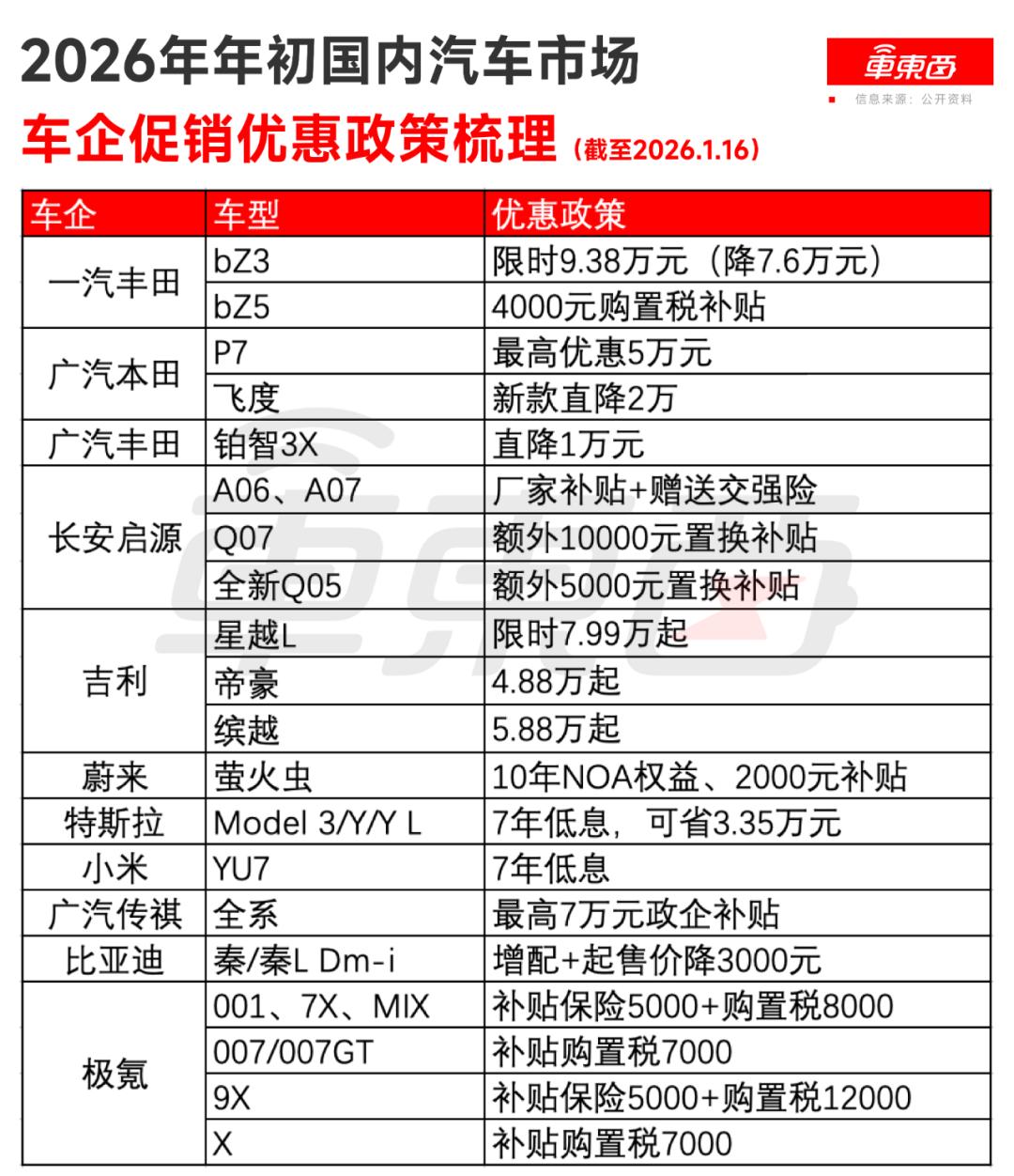
Core Viewpoint - The automotive industry is experiencing an intense price war initiated by luxury brands, leading to significant price reductions across various models from multiple manufacturers, creating a new wave of discounts in the market [1][6]. Group 1: Price Reductions and Promotions - BMW has initiated a price drop of up to 300,000 yuan, prompting over 10 automakers to follow suit with more than 20 mainstream models participating in the price reduction trend [1]. - Geely's Emgrand is now priced at 48,800 yuan, while the new Honda Fit has seen a price cut of 20,000 yuan, setting a new low at 66,800 yuan [1][13]. - Toyota's bZ3 electric sedan has been drastically reduced to 93,800 yuan, a decrease of 76,000 yuan, representing a nearly 45% drop from its previous price [9]. Group 2: Competitive Strategies - The competition has escalated with joint efforts from joint venture brands, particularly Japanese automakers, who are adopting aggressive pricing strategies to reclaim market share [7]. - Various automakers are employing a combination of subsidies, enhanced features, and financing options to attract buyers, rather than relying solely on price cuts [20][30]. - NIO's Firefly brand is offering cash subsidies along with a 10-year NOA (Navigation on Autopilot) free usage right, showcasing a strategic approach to enhance customer value [32]. Group 3: Market Dynamics and Consumer Impact - The price war has led to a significant reduction in the entry price for electric vehicles, making them more accessible to consumers [9][19]. - The automotive market is witnessing a shift where companies are not just competing on price but also on the value offered through financing and additional features, which may lead to a more sustainable competitive environment [37]. - The ongoing promotions and price adjustments are expected to drive sales ahead of the Chinese New Year, indicating a strategic push by manufacturers to maximize order volumes during this peak season [37].



既当裁判又当债主?特朗普披露5100万美元投资,含奈飞等“政策敏感型”债券
Zhi Tong Cai Jing· 2026-01-16 04:59
Group 1 - As of December 2025, Donald Trump's investments in municipal and corporate bonds include bonds from companies related to his government policies, totaling at least $51 million [1] - The bonds purchased include those from Netflix (NFLX.US), CoreWeave (CRWV.US), General Motors (GM.US), Boeing (BA.US), Occidental Petroleum (OXY.US), and United Rentals (URI.US), along with municipal bonds from various U.S. cities, school districts, utilities, and hospitals [1] - Trump completed 189 buy transactions and 2 sell transactions between November 14 and December 29, with the total value of sell transactions reaching at least $1.3 million [1] Group 2 - Since returning to the White House in January 2025, Trump has completed 690 transactions totaling at least $104 million, with further transactions in November and December amounting to $106 million, including three additional sell transactions worth $2 million [2] - A senior White House official stated that Trump and his family did not participate in investment decisions, and an independent financial manager used a recognized index replication investment strategy for bond purchases [2] Group 3 - Unlike previous presidents, Trump has not divested personal assets or placed them in a blind trust, with his business empire managed by his two sons, leading to potential conflicts of interest with presidential policies [3] - During foreign visits, Trump actively promoted Boeing aircraft and highlighted the company's successful sales to international airlines [3] - Trump emphasized General Motors' strategy to move production of popular models back to the U.S., claiming it demonstrates the effectiveness of his tariff policies in revitalizing American manufacturing [3]


既当裁判又当债主?特朗普披露5100万美元投资,含奈飞(NFLX.US)等“政策敏感型”债券
智通财经网· 2026-01-16 03:17
Group 1 - As of December 2025, Donald Trump's investments in municipal and corporate bonds include bonds from companies related to his government policies, totaling at least $51 million [1] - The bonds purchased include those from Netflix (NFLX.US), CoreWeave (CRWV.US), General Motors (GM.US), Boeing (BA.US), Occidental Petroleum (OXY.US), and United Rentals (URI.US), along with municipal bonds from various U.S. cities and utilities [1] - Trump's trading record shows 189 buy transactions and 2 sell transactions between November 14 and December 29, with the total value of sell transactions reaching at least $1.3 million [1] Group 2 - Since returning to the White House in January 2025, Trump has completed 690 transactions totaling at least $104 million, with additional transactions in November and December amounting to $106 million [2] - A senior White House official stated that Trump and his family did not participate in investment decisions, and an independent financial manager executed the bond purchases [2] - Unlike previous presidents, Trump has not divested personal assets or placed them in a blind trust, leading to potential conflicts of interest due to overlaps between his business empire and presidential policies [3] Group 3 - During foreign visits, Trump actively promoted Boeing aircraft, highlighting successful sales to international airlines [3] - Trump emphasized General Motors' decision to move production of popular models back to the U.S. as evidence of the effectiveness of his tariff policies in revitalizing American manufacturing [3] - Netflix is currently in a competitive struggle with Paramount Global (PSKY.US) for Warner Bros. (WBD.US), which poses significant antitrust challenges for Trump's administration [3]
特朗普为个人投资组合新增价值5100万美元的债券资产
Jin Rong Jie· 2026-01-16 00:04
Group 1 - The core point of the article highlights Donald Trump's investments in municipal and corporate bonds, totaling at least $51 million, influenced by his government's policies [1] - The bonds purchased by Trump include those from companies such as Netflix, CoreWeave Inc., General Motors, Boeing, Occidental Petroleum, and United Rentals Inc. [1] - Trump also invested in municipal bonds issued by various U.S. cities, local school districts, utility companies, and hospitals [1] Group 2 - The report indicates that Trump conducted 189 buy transactions and 2 sell transactions between November 14 and December 29 of the previous year, with the latter totaling at least $1.3 million [1] - The financial disclosure document does not specify exact transaction amounts or prices, only requiring reporting of ranges for stocks, bonds, commodities futures, and other securities [1]
GM recalls over 80,000 Chevy vehicles over defective pedestrian alert sound system citing serious risk
New York Post· 2026-01-15 23:08
Core Viewpoint - More than 80,000 Chevrolet vehicles are being recalled due to a defective pedestrian alert sound system that does not comply with federal safety laws [1][9]. Group 1: Recall Details - The recall affects certain 2025 to 2026 model year Chevrolet Equinox EV vehicles [1]. - The National Highway Traffic Safety Administration (NHTSA) indicated that the vehicles fail to meet minimum sound requirements for hybrid and electric vehicles [1]. - The recall was officially issued on December 11, and there have been no reported accidents or incidents related to this issue [9]. Group 2: Technical Findings - General Motors identified that the pedestrian alert sound system may have incorrect software calibration, preventing it from producing the required exterior sound at the necessary volume when the vehicle accelerates from stationary to 6.2 mph [2]. - Internal testing revealed that the 2025 Chevrolet Equinox EV did not meet the Federal Motor Vehicle Safety Standard No. 141, which governs the volume change when a vehicle moves from stationary to 10 km/h [4]. - An investigation confirmed that both the 2025 and 2026 model year software calibrations may not meet the required volume change standards [5]. Group 3: Remediation Plan - GM stated that resolving the issue will involve an update to the body control module software, which can be performed wirelessly over-the-air or by dealership service teams [9].