
Alphabet(GOOGL)

Search documents
贵金属风暴冲击市场情绪,美股三大指数集体收跌,中概股震荡走弱
Feng Huang Wang· 2025-12-29 22:52
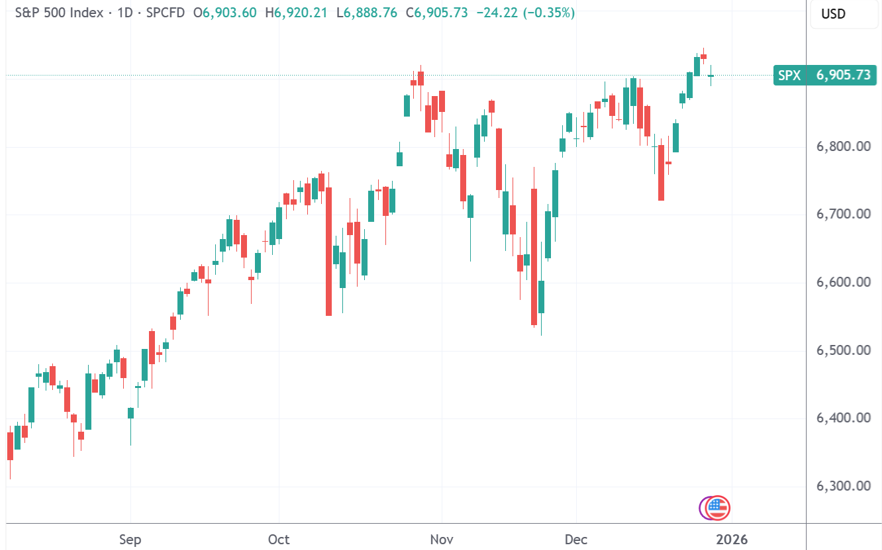
Market Performance - The U.S. stock market indices collectively declined due to heightened tensions from significant fluctuations in commodity prices, with the S&P 500 down 0.35% to 6905.74 points, the Nasdaq Composite down 0.5% to 23474.35 points, and the Dow Jones Industrial Average down 0.51% to 48461.93 points [1] - The mining sector experienced a collective drop, with First Majestic Silver down 4.13% and Newmont Mining down 5.64%, while lithium giant Albemarle fell by 3.62% [2] Commodity Market - Silver futures on Comex saw extreme volatility, reaching a high of $82 per ounce before plummeting to $71.6, marking a decrease of 7.20% [4] - Analysts suggest that precious metals have been severely overbought, and the recent declines may present a buying opportunity in the coming weeks [4] Company News - SoftBank Group announced a $4 billion acquisition of data center investment company DigitalBridge, marking a significant step in its artificial intelligence strategy [10] - Citigroup expects to record an after-tax loss of approximately $1.1 billion in Q4 related to the sale of its Russian business, with the transaction anticipated to complete next year [11] - Meta has acquired AI startup Manus, which was originally founded in China and later moved to Singapore, although financial terms of the deal were not disclosed [12] Sector-Specific Developments - Lululemon is facing a rare power struggle as founder Chip Wilson seeks to remove the current board, emphasizing the need for visionary leadership to drive the company's next phase of success [9] - Novo Nordisk has lowered the price of its weight loss drug semaglutide in China, following the impending expiration of its patent, with local companies preparing to introduce cheaper generic alternatives [8] Chinese Stocks - The Nasdaq Golden Dragon China Index fell by 0.67%, with notable declines in Alibaba (down 2.46%) and JD.com (down 0.44%), while NIO and NetEase saw gains of 4.71% and 0.92%, respectively [7]


Alphabet(GOOG.US,GOOGL.US)2025打赢“翻身战” 股价涨幅居“七巨头”之首
Zhi Tong Cai Jing· 2025-12-29 22:21
Core Viewpoint - 2025 is expected to be a "turnaround year" for Alphabet, with a strong stock price rebound despite facing antitrust lawsuits, increased search competition, and high AI investments [1] Group 1: Stock Performance - Alphabet's stock price rebounded approximately 116% from a 52-week low of $144.70, achieving a year-to-date increase of 65%, outperforming other major tech companies [1] - In comparison, Nvidia increased by 39%, Tesla by 16%, Microsoft by 15%, Meta Platforms by 12%, Apple by 9%, and Amazon by 5.5% during the same period [1] Group 2: Legal and Competitive Landscape - A federal judge ruled in August 2024 that Google maintained its monopoly in general search and text advertising, raising concerns about potential structural changes [2] - Subsequent limited remedial measures proposed by the judge alleviated investor fears regarding significant business disruptions [2] - Competition from companies like OpenAI and Microsoft in AI-driven search products is a key concern for investors [2] Group 3: AI Strategy and Investment - Alphabet is proactively advancing its AI search transformation, introducing features like "AI Overviews" to enhance user engagement [2] - Analysts noted that despite threats from AI chat tools, Alphabet's position is significantly better than a year ago, with Google Search remaining robust [2] - The company is increasing capital expenditures to strengthen its competitive edge in AI, despite investor concerns about rapid spending in the tech sector [3] Group 4: Analyst Outlook and Valuation - A majority of analysts remain optimistic about Alphabet, with 64 out of 76 covering analysts rating it as "buy" and an average target price of $334.50, indicating a potential upside of about 6.7% from the latest closing price of $313.51 [3] - The current expected price-to-earnings ratio for Alphabet is approximately 27.8, higher than the five-year average of 21.7 and significantly above the low of 15.5 reached in May [3] - The ability of Alphabet to sustain growth and profitability at elevated valuations is contingent on the successful conversion of AI investments into tangible results [3]

Buy Stock in the Mag 7 Hyperscalers or Are They Spending Too Much?
ZACKS· 2025-12-29 21:10
Core Insights - The Mag 7 hyperscalers, including Amazon, Alphabet, Meta, and Microsoft, are under scrutiny for their significant investments in AI infrastructure despite their strong profitability and balance sheets [1][2]. Capital Expenditures - All Mag 7 hyperscalers are projected to exceed $100 billion in annual capital expenditures for AI-related infrastructure by 2026, with Microsoft leading at an expected $80 billion in spending this year [4]. - Microsoft’s trailing twelve-month CapEx has risen to over $69 billion, raising concerns about capital efficiency [4]. Return on Invested Capital (ROIC) - Microsoft’s ROIC has stabilized at 23%, although it has declined in recent years, remaining above the 20% threshold considered favorable [5]. - In contrast, Meta, Alphabet, and Amazon have seen increases in ROIC, with Amazon approaching 20%, Meta at 29%, and Alphabet at 31%, suggesting that market concerns about their CapEx may be overstated [8]. Earnings Performance - Amazon has shown a notable increase in profitability, with FY25 and FY26 EPS estimates rising by over 4% and 2% respectively over the last 60 days [9]. - Alphabet has experienced a significant uptrend in EPS revisions, with its stock price increasing over 20% in the last three months [11]. - Microsoft’s CapEx concerns have overshadowed slight increases in its FY25 and FY26 EPS estimates, while Meta has seen an 18% drop in FY25 EPS estimates over the last 60 days [12]. Investment Outlook - Amazon is currently rated Zacks Rank 2 (Buy), while other Mag 7 hyperscalers hold a Zacks Rank 3 (Hold), indicating a favorable outlook for Amazon based on positive EPS revisions and increasing ROIC [14][15]. - Amazon is expected to benefit significantly from AI investments, enhancing both its AWS cloud services and core e-commerce operations [15].





AI spend is forcing a Mag 7 reckoning — and the gap could widen in 2026
Youtube· 2025-12-29 18:58
Core Insights - The market is increasingly punishing major AI spenders that lack clear returns, leading to a recommendation to reduce exposure to the "MAG seven" stocks due to rising capital expenditures and talent costs impacting margins and earnings [1] - Hyperscalers have issued $121 billion in new debt this year, which is four times the five-year average, indicating that their buildout is exceeding internally generated cash [2] - Meta is investing heavily in data centers and AI talent, but its AI model, Llama, holds only about a 10% share of the enterprise market, where significant AI revenue and margins are concentrated [3] Company-Specific Insights - Alphabet has seen a 65% increase in stock value, attributed to its comprehensive ownership of the tech stack, including chips, cloud, distribution, and a leading AI model, while Tesla's forward PE is significantly higher at 320 [4] - Apple, while currently lagging, has a vast distribution network with 2.3 billion active devices, which could position it competitively in the AI space by 2026 [5] - Microsoft is falling behind in chip development and competitive in-house large language models (LLMs), relying heavily on OpenAI's models and partnerships [7] Market Dynamics - The convergence of AI models is making distribution more critical than the quality of the models themselves, which could favor companies with strong distribution capabilities [3] - Concerns are rising regarding the reliance on single customers for revenue, as seen with Oracle's significant backlog tied to a deal with OpenAI worth $300 billion [11] - Microsoft has a $300 billion commitment from OpenAI for Azure services, but there are worries about OpenAI's ability to meet its commitments across multiple partners, totaling over $1.4 trillion in compute commitments [13]


Forget High‑Risk AI Penny Stocks: This Established AI Leader Is a Safer Long‑Term Bet
Yahoo Finance· 2025-12-29 18:05
Key Points Many new AI companies are making big promises without much progress to show for it. Alphabet's massive quantity of data from its businesses gives it an advantage in training AI. It also has nearly $99 billion in cash, cash equivalents, and marketable securities at its disposal. 10 stocks we like better than Alphabet › Artificial intelligence (AI) has been around for a while, but it has undoubtedly leaped into the mainstream with the popularity of generative AI tools like OpenAI's Chat ...
Alphabet Isn’t a Search and Ad Company Anymore. Now It’s Valued Like an AI Stock
Yahoo Finance· 2025-12-29 17:46
EV/EBIT is a valuation multiple that divides a company's enterprise value (EV) -- the market capitalization plus debt minus cash -- by its earnings before interest and taxes (EBIT, or operating income). It measures how many times operating earnings the market values the entire business, including debt. A higher multiple indicates investors expect stronger future growth or profitability, while lower multiples suggest caution or maturity.At current valuations, Alphabet's EV/EBIT multiple reached around 23x, u ...
We're adding this AI giant back to the portfolio, recognizing things have changed
CNBC· 2025-12-29 17:44
We are starting a position in former Club holding Alphabet , buying 95 shares at roughly $313. GOOGL will have a roughly 0.76% weighting in the portfolio. We've beaten ourselves up plenty over the exit of our long-held position in Alphabet earlier this year. At the time, Jim Cramer admitted to being "torn" on the stock — worried its Google search business was being cannibalized by Gemini and hurt by Grok and ChatGPT, even as YouTube and Waymo were doing well. We determined that Alphabet was late to the gene ...

Alphabet: Validation Flywheel Accelerating For Gemini (NASDAQ:GOOGL)
Seeking Alpha· 2025-12-29 15:40
Alphabet's [also known as Google] stock ( GOOGL ) ( GOOG ) boasts a robust 80% historical win-rate in January. This means that the stock usually delivers positive movement during the first month of a year, which isI am a highly experienced Chief Financial Officer (CFO) with a strong background in the oilfield and real estate industries. With over a decade of experience in finance, I have led numerous complex due diligence efforts and M&A transactions, both domestically and internationally.In recent years, I ...

US stocks : S&P 500, Dow, Nasdaq see slight dip in final week of 2025; AI valuation worries linger
The Times Of India· 2025-12-29 15:21
Market Overview - The S&P 500 slipped 0.2% in early trading, but is up more than 17% for the year and on track for its eighth consecutive monthly gain [2][4] - The Dow Jones Industrial Average fell 44 points, or 0.1%, while the Nasdaq composite declined 0.3% [2][4] - The Nasdaq has been the best-performing major index in 2025, driven by strong gains in shares of Nvidia, Google parent Alphabet, and other technology companies [2][4] Bond Market - Bond markets saw Treasury yields ease, indicating a mixed trading environment in European and Asian equities [2][4] Company-Specific News - Athletic wear maker Lululemon's stock rose 1.4% following news that founder Chip Wilson is advocating for the appointment of three new directors to the company's board through a proxy fight [3][4]

Why Alphabet Just Paid $4.75 Billion for Intersect -- and What It Means for the Future of Artificial Intelligence (AI)
Yahoo Finance· 2025-12-29 15:20
Core Insights - Alphabet has recently made significant moves, including a $4 billion investment from Berkshire Hathaway and the acquisition of Intersect for $4.75 billion, which has led to a surge in its stock price to all-time highs [1][2]. Group 1: Acquisition Details - Alphabet announced a definitive agreement to acquire Intersect, a company specializing in data center and energy infrastructure solutions, for $4.75 billion [2]. - The acquisition aligns with Alphabet's strategy to enhance its capabilities in artificial intelligence (AI) and energy management, which are critical for the future of its operations [2][8]. Group 2: Importance of Intersect - Intersect develops utility-scale renewable energy solutions for data centers, utilizing various power generation sources like wind, solar, and battery, which allows for efficient energy management [5][6]. - The rising costs of energy are a significant concern for AI developers, and Intersect's expertise in energy management can help Alphabet mitigate these costs as AI workloads increase [6][7]. Group 3: Strategic Implications - By acquiring Intersect, Alphabet aims to gain control over its future energy costs, improving efficiency in accessing data center capacity compared to relying on external utility providers [8]. - This move is consistent with Alphabet's vertically integrated business model across its various sectors, including search, cloud, advertising, and consumer electronics [9].