Information Services Group(III)

Search documents
European Firms Recast Networks with Managed Services
Businesswire· 2026-01-29 09:00
Core Insights - European enterprises are increasingly adopting managed network services (MNS) that integrate AI capabilities to enhance network design, operation, and governance [1][2] Group 1: Adoption of Managed Network Services - Historically, many organizations in Europe resisted MNS, relying on large internal IT teams and maintaining direct control over critical infrastructures [2][3] - The evolution of MNS has been driven by the need to support hybrid architectures and global operations as enterprise networks have expanded [2][3] Group 2: Security and Operational Demands - Enterprises face the challenge of maintaining strong security, minimizing downtime, and complying with regulations while supporting mobile and cloud-centric workforces [3][5] - The complexity of IT and network management has increased due to hybrid work environments, necessitating reliable access to applications from various locations [3][5] Group 3: Network as a Service (NaaS) - There is a growing trend among European enterprises to opt for network as a service (NaaS) solutions instead of managing complex networks internally [4] - Enterprises are prioritizing NaaS providers with advanced automation capabilities and specialized staffing to enhance efficiency and security [4] Group 4: Regulatory Compliance and Sustainability - MNS solutions assist enterprises in meeting regulatory and data sovereignty requirements while allowing for quick adaptation to changing business needs [5][6] - Organizations are aligning network strategies with sustainability goals, with MNS offerings helping to optimize resources and reduce carbon footprints [6] Group 5: Market Evaluation and Key Players - The 2025 ISG Provider Lens report evaluates 36 providers across three quadrants: Managed Network Services Evolution, Managed Enterprise Connectivity Solutions, and Network as a Service [8] - Notable leaders in all three quadrants include Accenture, Colt, Deutsche Telekom, GTT, NTT DATA, and Orange Business [9]


U.S. Enterprises Modernize Networks Through Managed Services
Businesswire· 2026-01-28 15:00
Core Insights - U.S. enterprises are increasingly adopting managed network services to address network complexity, security exposure, and regulatory pressures, which are essential for business continuity and growth [1][2] Network Management Trends - The 2025 ISG Provider Lens® report indicates that companies require coordinated management of underlay networks, cloud connectivity, software-defined networking, and security functions due to the rapid expansion of hybrid IT environments and distributed work modes [1] - Centralized orchestration and monitoring are becoming crucial for reducing outages and improving service consistency across core, cloud, and edge environments [1] Security and Compliance - Advanced network security architectures are being adopted to address security and regulatory compliance challenges, with enterprises implementing secure access approaches like SASE and SSE to protect users and data [1] - Regulatory requirements related to healthcare, consumer privacy, and data protection are increasing the urgency for stronger integrated controls [1] AI Integration - Enterprises are adopting AI-assisted network operations to manage scale and complexity, improving incident detection, performance optimization, and response times [1] - Automation and analytics are reducing reliance on manual processes, supporting more predictable performance while lowering operational risk [1] Provider Evaluation - The report evaluates 34 providers across three quadrants: Managed Network Services Evolution, Managed Enterprise Connectivity Solutions, and Network as a Service (NaaS) [1] - Accenture, Comcast Business, GTT, Kyndryl, NTT DATA, and Orange Business are recognized as Leaders in all three quadrants [1] - Tata Communications is highlighted as the global ISG CX Star Performer for 2025, achieving the highest customer satisfaction scores in ISG's Voice of the Customer survey [1]

Enterprises Advance Agentic Automation Across Europe
Businesswire· 2026-01-27 09:00
Core Insights - The intelligent automation landscape in Europe is evolving with increased technological sophistication, competition, and service development [1][2] Group 1: Intelligent Automation Trends - Enterprises are transitioning from basic robotic process automation (RPA) to integrated automation that combines AI and process management tools [2][3] - Organizations are utilizing data-driven discovery tools like process mining to identify inefficiencies before implementing automation [3] - The demand for intelligent enterprise automation (IEA) remains steady, with a focus on compliance, sustainability, and flexible pricing models [6] Group 2: AI and Automation Technologies - Providers are investing in AI-powered bots capable of executing complex workflows, with a growing number of use cases [3] - Agentic AI is facilitating advanced intelligent enterprise automation, with companies deploying AI agents that operate with contextual awareness across various functions [3] - There is a preference for small language models (SLMs) that enhance large language model (LLM) capabilities with domain-specific data [3] Group 3: Governance and Ethical Considerations - Responsible AI is becoming a central concern, with organizations focusing on decision-making accuracy and human oversight [4] - Emphasis is placed on governance frameworks, ethical AI practices, and compliance to manage risks associated with automation [4] Group 4: Human-Machine Collaboration - Human-machine collaboration is critical, with hybrid teams of humans and autonomous systems delivering business outcomes [5] - The integration of autonomous systems requires new roles, skills, and structured change management [5] Group 5: Market Evaluation and Key Players - The report evaluates 43 providers across three quadrants: Intelligent Enterprise Automation, AIOps, and Next-Gen Automation [8] - Accenture, Atos, Capgemini, Infosys, T-Systems, and Vivicta are recognized as Leaders in all three quadrants [9] - LTIMindtree is named the global ISG CX Star Performer for 2025, achieving the highest customer satisfaction scores [10]

U.S. Firms Adopt Agentic Automation for Integrated Operations
Businesswire· 2026-01-26 15:00
Core Insights - U.S. enterprises are leading the world in the strategic adoption of intelligent automation, integrating autonomous systems into core operations to enhance resilience, efficiency, and customer experience [1][2][3] Industry Trends - Organizations are transitioning from task-based automation to agentic models capable of making contextual decisions and managing exceptions, driven by the need for complex digital operations and reduced manual intervention [2][3] - Generative AI is becoming a fundamental component of automation, utilized for document processing and knowledge workflows, with a focus on privacy-sensitive applications through fine-tuned language models [4] Automation Architecture - Automation architectures are evolving into modular, AI-first platforms aimed at delivering measurable business outcomes, with a shift towards automation-as-a-service models and a focus on results rather than volume [5][6] - Observability and AIOps are increasingly important, with enterprises leveraging standardized telemetry data for predictive analytics and automated remediation [5] Provider Landscape - The 2025 ISG Provider Lens report evaluates 39 providers across three quadrants: Intelligent Enterprise Automation, AIOps, and Next-Gen Automation, identifying leaders such as Accenture, Capgemini, and Infosys [8][9] - Rising Stars in the report include Coforge, recognized for its promising portfolio and potential across multiple quadrants [10] Customer Experience - LTIMindtree has been named the global ISG CX Star Performer for 2025, achieving the highest customer satisfaction scores in ISG's Voice of the Customer survey [11]

Growing AI Needs Advance Hybrid Multicloud Maturity
Businesswire· 2026-01-23 16:00
Core Insights - Enterprises have transitioned from isolated AI pilots to mission-critical AI deployments in hybrid and multicloud environments, driving demand for new cloud infrastructure and services [1][2] - AI is now integrated into essential workflows, enhancing performance, reliability, security, and financial control across complex environments [2][3] Cloud Infrastructure and Architecture - Organizations are modernizing legacy systems and building cloud-native architectures to support AI applications, focusing on cloud infrastructure strength, operational governance, and cost management [2][3] - The adoption of Kubernetes management platforms is increasing, with organizations reporting improved DevOps integration and resource efficiency [3] Operational Complexity and Governance - The convergence of AI workloads, open-source components, and distributed systems is increasing operational complexity, prompting enterprises to prioritize integrated platforms for cloud security, observability, and governance [4] - Financial governance is critical as AI workloads pressure infrastructure budgets, leading enterprises to adopt advanced FinOps practices for better insight into resource consumption [5] Trends in Public Cloud Solutions - Kubernetes and cloud-native platforms are essential for scalable AI operations, with service providers playing a key role in operationalizing AI securely [6] - The report evaluates 77 providers across four quadrants: FinOps Platforms, Observability Platforms, Security Platforms, and Kubernetes Management Platforms [7] Provider Recognition - Broadcom is recognized as a Leader in three quadrants, while Dynatrace and IBM are Leaders in two quadrants each [8] - CoreStack and LogicMonitor are identified as Rising Stars, indicating promising portfolios and high future potential [9] - LTIMindtree is named the global ISG CX Star Performer for 2025, achieving the highest customer satisfaction scores [10]

Drilling at Mount Polley Intersects 11.0 Metres Grading 4.43% Copper, 1.53 g/t Gold and 41.7 g/t Silver
Globenewswire· 2026-01-23 02:00
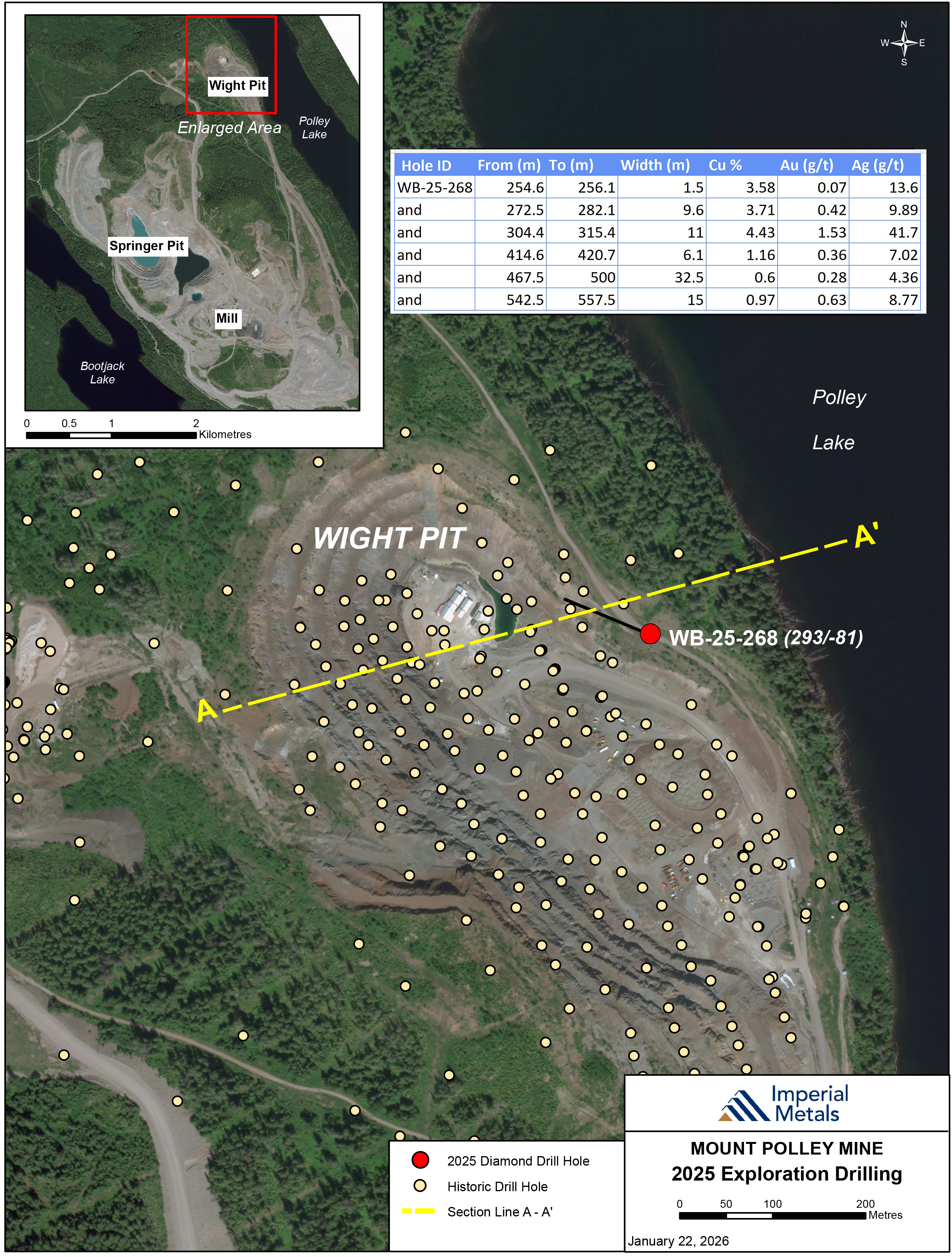
Core Insights - Imperial Metals Corporation has reported the results of the first diamond drill hole from the Mount Polley 2025 Phase 2 Diamond Drill Program, which includes significant mineralization with 11.0 metres grading 4.43% copper, 1.53 g/t gold, and 41.7 g/t silver [1][2]. Drill Program Overview - The Mount Polley 2025 Phase 2 program aims to achieve three objectives: testing a high-grade zone beneath the Wight Pit, expanding and determining the boundaries of higher gold grade mineralization in the C2 zone, and exploring beneath the previously mined Bell Pit using new targeting techniques [2]. - The Phase 2 program consists of nine holes totaling 3,718.3 metres [1]. Drill Hole Details - Drill hole WB-25-268 was targeted at a high-grade area in the Green zone, adjacent to the Martel zone, beneath the Wight Pit [5]. - The hole intercepted a hydrothermal fragmental potassic-altered breccia with significant mineralization, including additional higher-grade sections above and below the targeted area [8]. - The detailed results from hole WB-25-268 include: - 1.5 metres grading 3.58% copper, 0.07 g/t gold, and 13.6 g/t silver from 254.6 to 256.1 metres - 9.6 metres grading 3.71% copper, 0.42 g/t gold, and 9.89 g/t silver from 272.5 to 282.1 metres - 11.0 metres grading 4.43% copper, 1.53 g/t gold, and 41.7 g/t silver from 304.4 to 315.4 metres [9]. Mineralization Characteristics - The higher silver to copper ratio observed in this hole is typical for the northeast quadrant of the Mount Polley property, indicating potential for further exploration in this area in 2026 [10]. - The Martel zone has been previously defined as an underground resource, with an indicated resource of 2,272,000 tonnes grading 1.14% copper, 0.30 g/t gold, and 7.20 g/t silver as of January 1, 2025 [11]. Company Profile - Imperial Metals is based in Vancouver and is involved in exploration, mine development, and operations, holding the Mount Polley mine (100%), Huckleberry mine (100%), and Red Chris mine (30%), along with a portfolio of 23 exploration properties in British Columbia [12].
Sustainability Software Evolves to Meet Changing Demands, ISG Says
Businesswire· 2026-01-22 16:00
Core Insights - Sustainability software is becoming increasingly essential as regulators expect organizations to measure and disclose their environmental impacts [1] Industry Summary - The demand for sustainability software is driven by regulatory expectations for environmental impact measurement and disclosure [1]

Nordic Firms Seek Sovereign Clouds for Compliant Modernization
Businesswire· 2026-01-22 09:00
Core Insights - Enterprises in the Nordics are transitioning from selective use of public cloud services to comprehensive multicloud operating models, indicating a significant shift in cloud strategy [1] Group 1 - The shift towards multicloud operating models reflects a growing trend among Nordic enterprises to enhance flexibility and optimize their cloud infrastructure [1] - This transition is driven by the need for improved data management and operational efficiency across various cloud platforms [1] - The move to multicloud strategies is expected to provide businesses with better control over their resources and reduce dependency on a single cloud provider [1]

Swiss Firms Advance Regulated AI, Cloud Adoption
Businesswire· 2026-01-21 10:00
Core Insights - Digital transformation is becoming essential for Swiss companies, with increasing demand for cloud services to support AI applications [1][2] Group 1: AI and Cloud Infrastructure - Swiss enterprises view AI as a long-term capability reliant on scalable cloud infrastructure, which supports sustained growth in public cloud services [2][3] - Companies are cautious in adopting AI, often testing use cases before broader implementation due to high initial costs and ethical concerns [2][3] Group 2: Data Sovereignty and Compliance - Data sovereignty is a critical requirement for Swiss organizations, leading to a demand for locally controlled and legally secure cloud environments [3] Group 3: Sustainability Initiatives - Swiss enterprises are integrating sustainability into their cloud strategies, investing in green technologies to reduce carbon footprints and achieve climate goals [4] Group 4: Cost Optimization - Cloud cost optimization is a priority for Swiss companies as rising IT spending leads to complex billing procedures, prompting the application of FinOps principles for better resource management [5] Group 5: Strategic Partnerships - Swiss companies are forming strategic partnerships with major cloud platforms to enhance digital competitiveness while adhering to strict data protection regulations [6] Group 6: Market Trends and Provider Evaluation - The 2025 ISG Provider Lens report evaluates 65 providers across various service categories, naming Swisscom as a leader in all seven quadrants [9] - HCLTech is recognized as a Rising Star in two quadrants, indicating promising potential in the market [10]

German Enterprises Focus Public Cloud Strategies on AI
Businesswire· 2026-01-21 09:00
Core Insights - German enterprises are increasingly adopting cloud services tailored for AI workloads to support their growing AI deployments, focusing on features, computing power, and storage capacity [1][2] Cloud Adoption Trends - As companies transition AI from pilot projects to core operations, they are reevaluating the role of cloud platforms, emphasizing cost optimization, data protection, and industry-specific use cases [2][3] - The growth of public cloud services is now driven by the integration of AI technologies rather than just faster time to market or enhanced customer experience [2] Sovereign Cloud Expectations - There is a shift towards sovereign cloud capabilities, with German enterprises demanding stronger control over data, compliance, and legal certainty, leading to increased demand for local data residency solutions [3] - Hyperscalers are responding by expanding regional data centers and aligning their offerings with local regulations while enhancing security controls [3] Cost Optimization Focus - German companies are prioritizing cloud cost optimization due to budget constraints and economic uncertainty, leading to a demand for greater financial transparency and immediate savings [4] - Providers are offering structured cost-management approaches and optimization frameworks to help enterprises align cloud investments with business priorities [4] Integrated Solutions for SMEs - Small and midsize enterprises in Germany are increasingly seeking comprehensive cloud and IT solutions that encompass strategy, transformation, and ongoing operations [5] - There is a preference for integrated offerings from single providers that combine advisory capabilities with reliable managed services [5] Cybersecurity and Sustainability - German enterprises are focusing more on cybersecurity and sustainability as risk exposure and regulatory expectations rise, often partnering with providers to protect assets and meet climate goals [6] Provider Evaluation - The 2025 ISG Provider Lens Multi Public Cloud Services report evaluates 100 unique providers across various service categories, highlighting leaders and rising stars in the market [7][9] - Deutsche Telekom/T-Systems is recognized as a leader in seven quadrants, while other notable companies like Accenture and Microsoft lead in multiple categories [8] Customer Experience Recognition - LTIMindtree is named the global ISG CX Star Performer for 2025 among multi public cloud service providers, achieving the highest customer satisfaction scores in ISG's Voice of the Customer survey [10]