J&J(JNJ)

Search documents
Johnson & Johnson Stock Can Keep Rising as Strategy Pays Off
MarketBeat· 2025-10-15 16:16
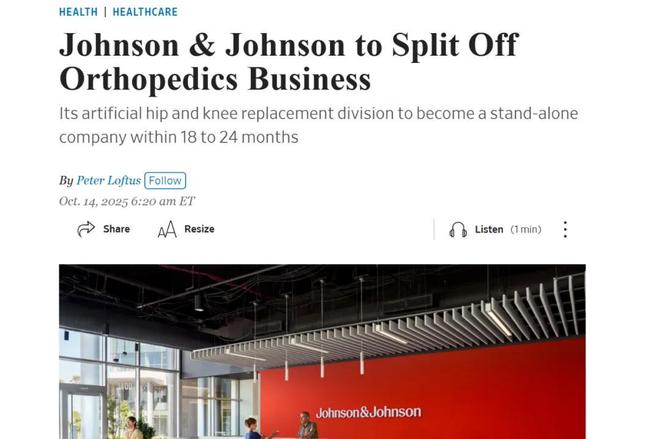
Johnson & Johnson TodayJNJJohnson & Johnson$190.65 -0.20 (-0.10%) 52-Week Range$140.68▼$194.40Dividend Yield2.73%P/E Ratio20.40Price Target$200.44Add to WatchlistJohnson & Johnson’s NYSE: JNJ stock price can continue to advance because its strategy to reinvigorate growth and widen margins is working. The plan centers on divesting underperforming healthcare businesses to focus on higher-margin, more potent growth markets. Among the details emerging from the Q3 release is the intention to spin off the orthop ...

Raymond James Maintains "Outperform" Rating for Johnson & Johnson (NYSE:JNJ)
Financial Modeling Prep· 2025-10-15 16:05
Core Viewpoint - Raymond James maintains an "Outperform" rating for Johnson & Johnson and raises its price target from $174 to $209, reflecting confidence in the company's future performance [1][5] Group 1: Financial Performance - Johnson & Johnson recently increased its 2025 sales forecast after a strong quarterly earnings report that exceeded Wall Street's expectations [2][5] - The company's stock is currently trading at $190.85, with a slight decrease of 0.05, reflecting a percentage change of approximately -0.03% [3] - Over the past year, JNJ has reached a high of $194.40 and a low of $140.68, showcasing its resilience in the market [3] Group 2: Market Position - Johnson & Johnson's market capitalization stands at approximately $459.63 billion, indicating its significant presence in the healthcare industry [4] - The stock has a trading volume of 11.27 million shares, reflecting investor interest and confidence in the company's future performance [4] Group 3: Strategic Moves - The company's strategic decision to spin off its orthopedics business into a standalone entity is expected to contribute to its growth prospects [2][5]

Jim Cramer's top 10 things to watch in the stock market Wednesday
CNBC· 2025-10-15 13:04
Group 1: Bank Earnings and Market Reactions - Bank of America reported better-than-expected earnings with an incredibly low level of charge-offs, while Wells Fargo also set aside less money for losses, raising questions about potential bad corporate loans in the sector [1] - Following strong quarterly results for Bank of America and Morgan Stanley, there is a shift in focus from net interest income to earnings growth, which could lead to higher price-to-earnings ratios for banks, with both stocks rising over 3% [2][3] Group 2: Company-Specific Developments - Salesforce's CEO indicated that Agentforce is now integral to the company, but concerns remain about its impact on earnings, despite notable clients like Williams-Sonoma and Dell using the tool [3] - Abbott Labs reported a solid quarter but narrowed its earnings per share guidance due to tariffs, resulting in a stock decline of over 3% [4] - Apollo Global has made another bid for Papa John's, suggesting that restaurant valuations are low, while Texas Roadhouse faces margin pressure from rising cattle prices [5] Group 3: Technology and Semiconductor Sector - ASML reported a strong quarter, highlighting its unique semiconductor equipment that Chinese companies cannot replicate, although it anticipates a decline in sales to China [6] Group 4: Investment Activity and Ratings - An investor group including BlackRock and Nvidia plans to acquire Aligned Data Centers for $40 billion, indicating ongoing activity in the data center sector [8] - Morgan Stanley raised its price target for Johnson & Johnson from $178 to $190, following a strong quarter and positive outlook, including plans to spin off its orthopedics business [9] - BTIG initiated coverage of Nike with a buy rating and a $100 price target, recognizing progress in its turnaround strategy [10]



Northrop Grumman, Greencastle And Valor Technologies Honored With 2025 Patriots In Business Award, Presented By Chief Executive Magazine And Thayer Leadership
PRWEB· 2025-10-15 12:00
"This year's honorees recognize that the values instilled through military service, such as integrity, teamwork, and mission focus, are the same values that drive exceptional business performance," said Karen Kuhla McClone, Ph.D., Co-President of Thayer Leadership. Post this The Patriots in Business Award—presented this year in the categories of large, medium and small organizations—recognizes outstanding businesses that lead our nation in supporting active-duty military members, veterans and their familie ...


Earnings live: Bank of America, LVMH, and ASML stocks jump on strong results
Yahoo Finance· 2025-10-15 11:30
Earnings Overview - The third quarter earnings season has commenced with major Wall Street banks reporting results, with analysts expecting a 7.9% increase in earnings per share for S&P 500 companies, marking the ninth consecutive quarter of positive earnings growth but a slowdown from the 12% growth in Q2 [1][21][22] Major Bank Results - JPMorgan Chase, Goldman Sachs, Wells Fargo, Citigroup, and BlackRock are among the first to report their earnings, with additional reports from Bank of America, Morgan Stanley, and others following [2][3] - Citigroup's Q3 results showed a 17% increase in dealmaking fees, with total revenue growing by 9% to $22.1 billion and net income rising to $3.8 billion, or $1.86 per diluted share [9][10] - Wells Fargo reported results that exceeded analysts' expectations, leading to a stock increase of over 2% in premarket trading [16] Sector Highlights - Bank of America noted strong fee improvements in Q3, contributing to overall profitability [5] - ASML's orders exceeded estimates due to an AI investment boom, although it warned of a significant drop in Chinese demand next year [7] - Johnson & Johnson raised its 2025 sales forecast by approximately $300 million, reporting adjusted earnings per share of $2.80, surpassing estimates [12][14] Market Trends - The earnings season is expected to show that most S&P 500 companies will likely report earnings that exceed estimates, with a potential actual growth rate of 13% anticipated [21][22][23] - The performance of major banks is closely tied to market conditions, with concerns about a potential market pullback impacting future earnings [15]


Earnings live: Bank of America, Morgan Stanley, LVMH, and ASML stocks jump on strong results
Yahoo Finance· 2025-10-15 11:30
Earnings Overview - The third quarter earnings season has commenced with major Wall Street banks reporting results, with analysts expecting a 7.9% increase in earnings per share for S&P 500 companies, marking the ninth consecutive quarter of positive growth but a slowdown from 12% in Q2 [1][28] - Major financial institutions including JPMorgan Chase, Goldman Sachs, Wells Fargo, Citigroup, and BlackRock are among the first to report their earnings [2][3] Company-Specific Highlights - Morgan Stanley reported a 45% surge in profits, driven by a 44% increase in dealmaking fees to $2.1 billion and a 24% rise in trading fees, totaling $6.28 billion [4][6][7] - Abbott's shares fell 1% after reporting diluted earnings per share of $0.94, below the expected $1.04, with revenue of $11.3 billion aligning with estimates [8][9] - Citigroup's net income rose to $3.8 billion, or $1.86 per diluted share, on revenue of $22.1 billion, reflecting a 9% increase in total revenue [13][14] - Johnson & Johnson announced plans to spin off its orthopedics unit while reporting adjusted earnings per share of $2.80, exceeding estimates of $2.76, and raised its 2025 sales forecast by approximately $300 million [18][19][20] - Domino's Pizza saw a nearly 5% increase in stock after reporting a 5.2% acceleration in US same-store sales, with earnings per share of $4.08 surpassing estimates [15][16] Market Trends - The earnings season is characterized by a boom in dealmaking and trading, significantly benefiting banks like Morgan Stanley and Citigroup [10][13] - ASML reported orders exceeding estimates due to an AI investment boom, although it warned of a significant drop in Chinese demand next year [12] - LVMH experienced a surprising return to sales growth, with shares rising as much as 14%, indicating a potential easing in luxury demand decline [11]

美国银行上调强生目标价至204美元
Ge Long Hui A P P· 2025-10-15 10:21
Group 1 - Bank of America raised Johnson & Johnson's target stock price from $198 to $204 [1]
强生拟分拆骨科业务,手术机器人技术迭代加速
Guo Ji Jin Rong Bao· 2025-10-15 10:16
Core Insights - The medical device industry is increasingly focusing on "spin-offs" as a strategic move to enhance operational efficiency and shareholder value [1][6]. Financial Performance - Johnson & Johnson reported Q3 revenue of $23.993 billion, a 6.8% year-over-year increase, with the innovative pharmaceuticals segment contributing $15.563 billion, also up 6.8% [3]. - The medical technology segment generated $8.430 billion in Q3, reflecting a 6.8% growth, while the orthopedic business grew only 3.8% due to transitional challenges [3]. - For the first three quarters of the year, Johnson & Johnson achieved total revenue of $69.629 billion, a 5% increase, with innovative pharmaceuticals and medical technology generating $44.64 billion and $23.67 billion, respectively [3]. Spin-off Announcement - Johnson & Johnson announced the spin-off of its orthopedic business, which will be named DePuy Synthes, as part of its ongoing strategy to optimize its business portfolio [4]. - The orthopedic business is projected to generate approximately $9.2 billion in sales in 2024, accounting for about 10% of Johnson & Johnson's total revenue [4]. Market Position and Strategy - DePuy Synthes is expected to become the largest and most comprehensive orthopedic company, maintaining leadership in key growth areas post-spin-off [5]. - Johnson & Johnson aims to explore various avenues for the spin-off, targeting completion within 18 to 24 months while continuing current operations during the transition [4]. Industry Trends - Major players in the medical device sector are increasingly engaging in spin-offs or divestitures to enhance competitiveness and focus on high-margin areas [6][7]. - The orthopedic market is seeing significant investments in surgical robotics, with companies like Johnson & Johnson and Zimmer Biomet expanding their portfolios through acquisitions and new product launches [7][8]. - The Chinese surgical robotics market is projected to grow rapidly, reaching $3.84 billion by 2026, with a growth rate of 44.3% [8].

This 2.7%-Yielding Dividend King Remains One of the Healthiest Income Stocks You Can Buy
The Motley Fool· 2025-10-15 09:20
Core Insights - Johnson & Johnson has a strong financial profile and growth prospects, highlighted by its status as a Dividend King with 63 consecutive years of dividend increases [1][2] - The company currently offers a dividend yield of 2.7%, significantly higher than the S&P 500 average [2] Financial Performance - In the third quarter, Johnson & Johnson reported $24 billion in sales, a nearly 7% increase year-over-year, and adjusted net income of over $6.8 billion, reflecting a 16% rise [4] - The company generated approximately $14.2 billion in free cash flow in the first nine months of the year, nearly matching the $14.5 billion from the same period last year, easily covering its dividend payments of $3.1 billion for the quarter and $9.3 billion year-to-date [5] - Johnson & Johnson ended the quarter with $19 billion in cash and $46 billion in debt, maintaining a AAA bond rating, which is among the best globally [6] Future Outlook - The company has raised its full-year sales outlook, now expecting a 5.7% growth to $93.7 billion, with adjusted earnings growth projected at 8.7% to $10.85 per share [7] - Johnson & Johnson plans to separate its orthopedics business to focus on six priority growth areas: oncology, immunology, neuroscience, cardiovascular, surgery, and vision, aiming for faster growth and higher margins post-separation [8][9] Strategic Initiatives - A key focus for Johnson & Johnson is its oncology business, with a target of $50 billion in sales by 2030, supported by over $10 billion in R&D investments [10] - The company has made strategic acquisitions, such as the $2 billion purchase of Ambrx, and is reportedly in talks to acquire Protagonist Therapeutics, enhancing its oncology pipeline [11] - Continued investments in oncology and other priority areas are expected to support ongoing dividend growth and reinforce the company's commitment to shareholder value [12] Investment Strength - Johnson & Johnson is characterized as a financial fortress with strong free cash flow, enabling it to sustain high dividend payouts while reinvesting in business growth, making it one of the safest high-yielding dividend stocks available [13]

最新!强生拟分拆骨科业务,又一百亿美元分拆案
Xin Lang Cai Jing· 2025-10-15 08:12
Core Viewpoint - Johnson & Johnson plans to spin off its orthopedic business into an independent company named "DePuy Synthes" while raising its 2025 revenue forecast, exceeding Wall Street expectations [1][3]. Financial Performance - Johnson & Johnson expects 2025 product revenue to reach between $93.5 billion and $93.9 billion, an increase of approximately $300 million from previous estimates and higher than analysts' expectations of $93.4 billion [3]. - The company reported global sales of $24 billion for Q3 2025, a year-over-year increase of 6.8%, slightly above Wall Street's expectation of $23.75 billion [7]. - The innovative pharmaceuticals segment generated $15.563 billion in Q3 2025, accounting for 64.8% of total sales, with a year-over-year growth of 6.8% [7][8]. Business Strategy - The orthopedic business, which generated approximately $9.2 billion in revenue last year, accounted for about 10% of Johnson & Johnson's total revenue [5]. - The company initiated a two-year restructuring plan for its orthopedic business in 2023, focusing on exiting certain markets and discontinuing non-core products, laying the groundwork for the spin-off [5]. - Post-spin-off, DePuy Synthes is expected to become the largest global company focused on orthopedics, holding a leading market position in key product categories [5][7]. Leadership Changes - Namal Nawana has been appointed as the global president of DePuy Synthes, returning to the company after a career that includes significant roles at Johnson & Johnson and other firms [5][7]. Market Focus - Johnson & Johnson aims to concentrate on high-growth, high-margin areas such as oncology, immunology, neuroscience, surgical care, vision care, and cardiovascular sectors following the spin-off [5][7].