LVMH(LVMUY)

Search documents
The biggest luxury deals in recent years
The Economic Times· 2025-10-20 06:50
Mergers and Acquisitions - In January 2017, Luxottica merged with Essilor in a deal valued at 46 billion euros ($49 billion), creating the world's largest eyewear group [11] - LVMH acquired Tiffany & Co. in November 2019 for $16.2 billion in an all-cash deal [11][12] - Bernard Arnault consolidated control over Christian Dior in April 2017 through a 12 billion euro transaction, acquiring the Christian Dior Couture brand for 6.5 billion euros [4][12] - JAB Holding increased its stake in Coty Inc. to 60% in February 2019, totaling about $9.4 billion [5][12] - L'Oreal repurchased 8% of its shares from Nestle for 6.5 billion euros in February 2014, making Nestle L'Oreal's second-largest shareholder with a 20.16% stake as of October 2025 [6][12] - LVMH acquired Bulgari for 3.7 billion euros in March 2011 [7][12] - Estee Lauder agreed to buy Tom Ford for $2.8 billion in November 2022 [8][12] - L'Oreal acquired Aesop for around $2.5 billion in April 2023, aiming for international expansion [9][12] - Coach purchased Kate Spade for $2.4 billion in May 2017 to leverage its popularity among millennials [10][12] - Prada announced a deal to buy Versace for an enterprise value of $1.375 billion in April 2025 [11]



Earnings live: American Express beats estimates, EssilorLuxottica stock surges as focus turns to regional bank earnings
Yahoo Finance· 2025-10-17 12:12
Core Insights - The third quarter earnings season has begun, with analysts expecting a 7.9% increase in earnings per share for S&P 500 companies, marking the ninth consecutive quarter of positive growth but a slowdown from the 12% growth in Q2 [1][2] Financial Institutions Performance - Major banks including JPMorgan Chase, Goldman Sachs, Wells Fargo, Citigroup, and BlackRock reported their quarterly results, with additional reports from Bank of America, Morgan Stanley, and others following [2][4] - Ally Financial reported earnings per share of $1.18, exceeding estimates of $0.96, with revenue of $2.17 billion surpassing expectations of $2.10 billion [7][8] - Truist's net income rose to $1.3 billion, or $1.04 per diluted share, beating analyst estimates of $0.99 per share, with noninterest income increasing 11% to $158 million [9][10] - Comerica's net interest income grew over 7% to $574 million, while noninterest income declined to $264 million due to slower capital markets activity [11][12] - Fifth Third reported net interest income of $1.52 billion, a 7% year-over-year increase, with earnings per share growing 17% to $0.91, surpassing estimates of $0.86 [14][15] - U.S. Bancorp reported net income of $2.00 billion, or $1.22 per share, beating estimates and achieving record revenue of $7.3 billion [22][23] - Charles Schwab's earnings were $1.26 per share, with record revenue of $6.13 billion, a 27% year-over-year increase [24][25] Technology Sector Insights - Taiwan Semiconductor Manufacturing Company (TSMC) reported a 39% year-over-year profit surge in Q3 and raised its 2025 revenue outlook, anticipating mid-30% annual sales growth [27][28] - TSMC's revenue reached approximately $32.2 billion, exceeding estimates, with earnings per share of $2.92 also beating expectations [28][29] Other Notable Earnings Reports - Morgan Stanley's profits surged 45% in Q3, driven by a 44% increase in deal-making fees to $2.1 billion and a 24% rise in trading fees [36][37][38] - Citigroup's net income for Q3 was $3.8 billion, or $1.86 per diluted share, with total revenue growing 9% to $22.1 billion, driven by increased deal-making and trading activities [46][47]




连跌三季!LVMH的时装与皮革制品业务持续承压
Guo Ji Jin Rong Bao· 2025-10-17 12:12
Core Insights - LVMH Group shows signs of performance stabilization with a 1% organic growth rate in Q3, despite challenges in the European market due to currency fluctuations [1][9] Financial Performance - In Q3, LVMH reported revenue of €18.28 billion, reflecting a 4% decline when accounting for a 5% negative currency impact [2] - The fashion and leather goods segment continued its decline, down 2% year-on-year, marking three consecutive quarters of decrease, although the decline rate has narrowed [2] - Wine and spirits revenue increased by 1% year-on-year, driven by restocking in the U.S. market and increased sales of rosé wine [2] - Other segments such as perfumes and cosmetics, watches and jewelry, and selective retailing saw revenue increases of 2%, 2%, and 7% respectively [2] Market Dynamics - The CFO highlighted strong local demand in key markets, particularly in the fashion and leather goods sector, with positive growth in mainland China and improvements in the U.S. market [4] - For the first nine months, LVMH achieved total revenue of €58.09 billion, with fashion and leather goods contributing €27.61 billion, approximately 47.5% of total revenue [5] - In terms of regional performance, the U.S. market saw a 3% year-on-year revenue increase, while Europe and Japan experienced declines of 2% and 13% respectively; Asia (excluding Japan) grew by 2% [6] China Market Insights - The company noted a recovery in the Chinese market, with local consumption showing mid-to-high single-digit positive growth, although overall consumer performance remains close to stable with low single-digit negative growth [9] - Despite challenges in the macroeconomic environment, demand in China is encouraging, although overseas spending by Chinese tourists is still experiencing double-digit declines [9] - The CFO indicated that the fourth quarter may present greater challenges due to base effects and anticipated stronger negative impacts from currency fluctuations compared to Q3 [9]

限制零售商降价打折,三大奢侈品牌被欧盟重罚1.57亿欧元
Nan Fang Du Shi Bao· 2025-10-17 05:44
Core Points - The European Commission has imposed a total fine of €157 million (approximately 1.3 billion RMB) on luxury brands Gucci, Chloé, and Loewe for anti-competitive practices related to price maintenance [1][2] - The investigation revealed that these companies engaged in resale price maintenance (RPM) by requiring retailers to adhere to suggested retail prices and maximum discount rates, which limited price competition among retailers [1][2] - The anti-competitive behavior has been identified as having occurred until April 2023, and the fines were determined based on the severity, duration, geographical scope, and cooperation of the companies during the investigation [2] Company Summaries - Gucci, part of the Kering Group, was fined €119 million for its role in the anti-competitive practices [2] - Chloé was fined €1.9 million and has stated that it takes the matter seriously, implementing measures to comply with EU competition law since the investigation began in 2023 [2] - Loewe, under the LVMH Group, was fined €1.8 million and has confirmed its commitment to strictly adhere to antitrust laws following the penalty [2] Industry Implications - The penalties serve as a strong signal to the luxury fashion industry against the implementation of RPM practices in both online and physical retail environments [2] - The European Commission emphasizes that all consumers in Europe should benefit from genuine price competition, regardless of where or how they purchase products [2]
X @Bloomberg
Bloomberg· 2025-10-16 11:56
Market Trends - The luxury sector's three-decade boom is over [1] Company Performance - Berenberg analysts downgraded LVMH [1] - LVMH experienced its biggest stock surge since 2001 [1]
LVMH sees 1% organic growth with €18.28bn revenue in Q3 2025
Yahoo Finance· 2025-10-16 10:10
Core Insights - LVMH reported Q3 2025 revenue of €18.28bn ($21.15bn), marking a 1% organic increase from Q3 2024, following a 4% decline in the previous quarter [1] - For the first nine months of 2025, LVMH generated €58.1bn in revenue, a 4% decrease compared to €60.75bn in the same period of 2024 [1] Revenue Performance - The company experienced noticeable improvement in Asia (excluding Japan) over the nine-month period, while Europe and the US remained stable year-over-year [2] - Japan's performance weakened due to reduced tourist activity linked to a stronger yen [2] - European revenue in Q3 was affected by reduced tourist spending and currency movements [2] Segment Analysis - Organic revenue growth in Q3 by segment: - Wines and spirits: 1% increase - Perfumes and cosmetics: 2% increase - Watches and jewellery: 2% increase - Selective retailing: 7% increase - Fashion and leather goods: 2% decline [3] - The wines and spirits division saw slight organic growth, supported by champagne and Provence rosé wines, while cognac sales were impacted by US-China trade tensions [3] Year-to-Date Performance - Fashion and leather goods revenue fell 6% organically over the first nine months but showed sequential improvement in Q3 [4] - Perfumes and cosmetics remained stable, supported by new product launches from Dior and Guerlain [4] - Watches and jewellery recorded 1% organic growth driven by Tiffany & Co and Bvlgari [5] - Selective retailing posted 3% organic growth, aided by gains at Sephora and recovery at DFS in Macao and Hong Kong [5] Strategic Outlook - LVMH demonstrated resilience and maintained innovative momentum despite geopolitical and economic disruptions [5] - The company remains committed to enhancing brand desirability through authenticity, quality, retail excellence, and an agile organization [5]
天猫“双11”预售首小时35个品牌成交破亿元
Zhong Guo Ji Jin Bao· 2025-10-16 07:34
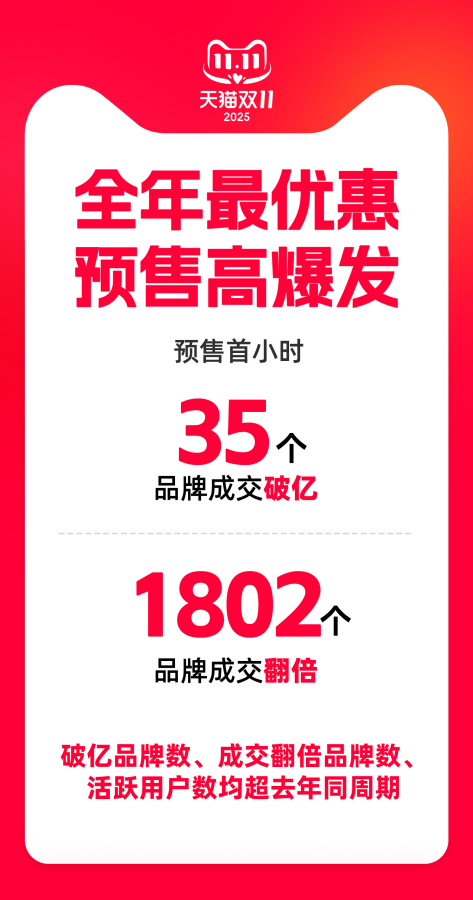
Core Insights - The 2025 Tmall "Double 11" pre-sale event commenced on October 15, with 35 brands achieving over 100 million yuan in sales within the first hour, surpassing last year's performance [1][3] - This year, platforms are focusing on simplifying discount rules and providing direct subsidies to consumers, rather than emphasizing absolute low prices, to enhance shopping experiences and accelerate purchase decisions [1][8] Sales Performance - In the first hour of the pre-sale, 1,802 brands saw sales double year-on-year, with the number of brands exceeding 100 million yuan and active user numbers also surpassing last year [3] - Notable brands that entered the "billion yuan club" include Fila, Proya, SK-II, and Nike [3] - The beauty category showed rapid growth, with several brands breaking the 100 million yuan mark within minutes of the pre-sale start [5] Live Streaming and Consumer Engagement - The number of users placing deposits through Taobao Live saw double-digit growth, with the number of live streaming rooms exceeding last year's figures [6] - Key live streaming hosts like Li Jiaqi experienced over 45% growth in visitor numbers during the first hour [6] Category Performance - Categories such as beauty, maternal and infant products, fashion, and food performed exceptionally well, with some categories seeing growth rates close to 80% [6] - The first day of Taobao Flash Sales recorded over 200% growth in night snack orders across 270 cities, with supermarket and convenience store orders increasing by 670% [6] AI Integration in E-commerce - This year's "Double 11" event features a significant integration of AI technology to enhance operational efficiency and user experience across platforms [8][9] - Platforms are offering free access to AI tools for merchants, covering various aspects of the e-commerce process, including content generation and customer service [9]



LVMH, Other Luxury Companies Are Still Cashing In on the U.S. Market
Investopedia· 2025-10-15 20:50
Core Insights - LVMH identified the U.S. as a strong market for luxury goods, with brands like Tiffany and BVLGARI gaining momentum despite a focus on value among consumers [2][4] - The company's U.S. revenue increased by 3% year-over-year in the third quarter, contrasting with negative sales in Europe and Asia [3][4] - Wealthy Americans, particularly the top 5%, are driving luxury spending due to significant gains from the stock market and rising incomes [5][8] Group 1: U.S. Market Performance - LVMH's brands performed well in the U.S. market, contributing positively to overall sales amid weaker performance in other regions [2][4] - The U.S. economy is increasingly reliant on affluent consumers, which is beneficial for luxury brands [3][5] Group 2: Consumer Behavior - Research indicates that wealthy Americans are spending more freely, significantly impacting the luxury goods market [5][8] - The top 5% of earners are experiencing income growth at a faster rate than middle and low-income households, further supporting luxury spending [5] Group 3: Market Trends - Despite a general trend towards value-seeking among consumers, luxury brands like LVMH are seeing increased sales, highlighting a divergence in consumer behavior based on income levels [2][8] - LVMH's CFO noted a rebound in consumption linked to recent political events, suggesting external factors can influence luxury spending patterns [9]