
Merck(MRK)

Search documents
Merck CEO Rob Davis on FDA approval of Keytruda injection, navigating new vaccine landscape
CNBC Television· 2025-09-24 13:13
The FDA has approved the injectable version of Merc's cancer therapy, Kruda. That drug accounts for nearly half of Merc's revenue. And joining us right now on set is Robert Davis.He is the chairman and CEO of Merc. Also our very own Angelica Peebles. And welcome.It's good to see both of you. Uh Robert, let's talk about this first of all, the injectable version. Why is this better. Why will patients want this.>> Yeah. Well, well, first, you know, we're we're very excited about this because I do think this is ...


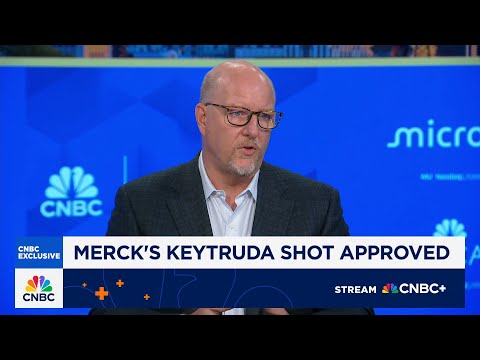
Merck CEO Rob Davis on FDA approval of Keytruda injection, navigating new vaccine landscape
Youtube· 2025-09-24 13:13
The FDA has approved the injectable version of Merc's cancer therapy, Kruda. That drug accounts for nearly half of Merc's revenue. And joining us right now on set is Robert Davis.He is the chairman and CEO of Merc. Also our very own Angelica Peebles. And welcome.It's good to see both of you. Uh Robert, let's talk about this first of all, the injectable version. Why is this better. Why will patients want this.>> Yeah. Well, well, first, you know, we're we're very excited about this because I do think this is ...
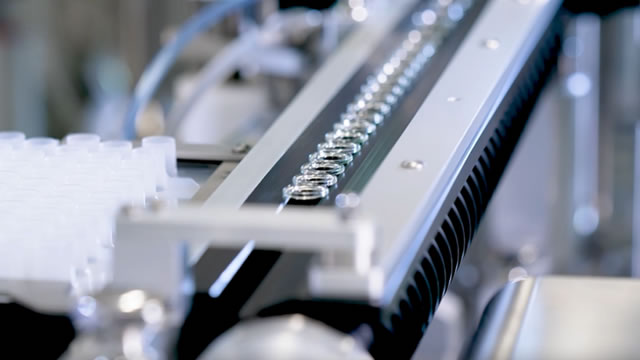
Merck Gains FDA Approval for KEYTRUDA QLEX and Supports Dividend Appeal
Yahoo Finance· 2025-09-23 23:41
Core Insights - Merck & Co., Inc. is recognized as one of the 13 best Fortune 500 dividend stocks to invest in, highlighting its appeal to income-focused investors [1] - The company received FDA approval for KEYTRUDA QLEX™ injection, which is expected to enhance its market position and attract further investor interest [3][4] Financial Performance - For Q2 2025, Merck reported an Adjusted EPS of $2.13, exceeding the consensus estimate of $2.03, indicating strong operational efficiency [2] - Worldwide sales reached $15.8 billion, reflecting a slight decline of 2% year-over-year, primarily due to decreased Gardasil sales in China [2] - Sales of KEYTRUDA increased by 9% to $8.0 billion, showcasing the drug's continued strong performance in the oncology market [2] Regulatory Developments - The FDA approval for KEYTRUDA QLEX™ allows for subcutaneous administration in adults for most solid tumor indications, marking a significant advancement in treatment options [3] - The approval is viewed positively by healthcare providers, emphasizing the importance of immunotherapies in cancer treatment [4] Dividend Appeal - Merck offers a dividend yield of 4%, which is attractive to investors seeking income-generating stocks [4]
Merck & Co., Inc. (MRK) Received FDA Approval For Keytruda Qlex, Cutting Infusion Time to 2 Minutes
Yahoo Finance· 2025-09-23 23:02
Core Insights - Merck & Co., Inc. is recognized as one of the top pharmaceutical stocks to buy, ranking fourth among selections by billionaires [1] - The company is enhancing its leadership in oncology and vaccines, particularly with the recent FDA approval of Keytruda Qlex, a subcutaneous version of the drug [2][4] Product Developments - The FDA approved Keytruda Qlex, which allows for administration in one to two minutes, significantly reducing the infusion time from 30 minutes [2][4] - Keytruda Qlex is expected to launch in the U.S. by late September 2025, improving patient and provider convenience and strengthening Merck's competitive position against biosimilars [2] - In Europe, the EMA's CHMP issued positive opinions for Keytruda, supporting its approval for the EU market and recommending its use in earlier-stage locally advanced head and neck cancer [3] Vaccine Advancements - Merck is advancing its vaccine portfolio, with a positive opinion from the CHMP for ENFLONSIA (clesrovimab), aimed at preventing respiratory syncytial virus (RSV) in infants [4] - If approved, ENFLONSIA would be the first uniform-dose preventive option for RSV in Europe, showcasing Merck's commitment to expanding its vaccine offerings [4] - The company is also making progress with new pneumococcal vaccines, which have shown promising trial results [4]
3.49亿美元!默沙东押注两款AI小分子新药合作
美股IPO· 2025-09-23 12:26
Core Insights - Variation AI has announced a collaboration with Merck to utilize its Enki™ platform for drug discovery targeting two undisclosed therapeutic targets [1][2] - The agreement allows Variation AI to use a fine-tuned version of its Enki™ platform, trained on Merck's proprietary data, to generate and optimize small molecule candidates [2] - Merck will hold exclusive rights to develop and commercialize the compounds, while Variation AI will receive an upfront payment and is eligible for milestone payments totaling up to $349 million [2] Company Overview - Variation AI is a venture-backed generative AI drug discovery company based in Vancouver, Canada, founded by researchers from MIT, Caltech, Google Research, Microsoft Research, and D-Wave Quantum [3] - The Enki™ platform employs advanced generative AI models to design and optimize novel small molecules, enhancing the success rate and accelerating the discovery and development of transformative therapies [3] - In the past year, Variation AI has formed partnerships with Rakovina Therapeutics, ImmVue Therapeutics, Oncorrhos, and Life Chemicals [3]

跨国药企重押Ab-LNP,百奥赛图站上核酸药物递送新风口
Xin Lang Zheng Quan· 2025-09-23 09:41
Group 1 - The core viewpoint of the news is the collaboration between Baiaosaitu and Merck to evaluate antibody-conjugated lipid nanoparticles (Ab-LNP) for new applications in nucleic acid drug delivery, highlighting the strong interest in "precise delivery" in the biopharmaceutical sector [1][5] - The nucleic acid drug market is rapidly growing, with mRNA therapies gaining mainstream acceptance, but the delivery of nucleic acids remains a significant bottleneck [2][5] - The global lipid nanoparticle (LNP) market is projected to grow from $1.1 billion in 2025 to $3.5 billion by 2034, with a compound annual growth rate (CAGR) of 13.3% [2] Group 2 - Antibody-modified LNPs have shown promising results in animal models, significantly improving delivery efficiency to non-liver tissues, which is crucial for treating various diseases [2][3] - The partnership between Baiaosaitu and Merck marks the third deepening of their collaboration, indicating a new phase in the "antibody × delivery" model [4] - The trend towards platform and modular design in LNP technology is emerging, with new molecular forms like antibodies and bispecific antibodies expanding delivery capabilities [4] Group 3 - The investment landscape is shifting towards antibody-conjugated LNPs as a potential solution to the delivery bottleneck in nucleic acid drugs, with significant capital being directed into this area [3][5] - The collaboration between Baiaosaitu and Merck reflects the increasing involvement of Chinese biotech companies in the global restructuring of drug delivery technologies [5]
FDA Grants Breakthrough Therapy Designation to Merck & Co., Inc. (MRK)’s Raludotatug Deruxtecan for Platinum-Resistant Ovarian
Yahoo Finance· 2025-09-22 21:32
Group 1 - Merck & Co., Inc. has received Breakthrough Therapy Designation from the FDA for raludotatug deruxtecan, targeting platinum-resistant ovarian, primary peritoneal, or fallopian tube cancers expressing CDH6 after bevacizumab treatment [2][3] - The designation is based on data from a phase 1 trial and the ongoing REJOICE-Ovarian01 phase 2/3 study, aimed at accelerating development for patients with significant unmet needs [3] - Approximately 65% of ovarian cancer patients express CDH6, and up to 80% experience relapse after standard therapies, highlighting the drug's potential impact [3] Group 2 - Merck & Co., Inc. is recognized as one of the best stocks to invest in for financial stability and is involved in developing pharmaceuticals, vaccines, biologics, and animal health products [1][4] - The collaboration between Merck and Daiichi Sankyo marks the second breakthrough designation for their oncology partnership, which began in October 2023 [3]
Will the FDA's Nod for Subcutaneous Keytruda Ease Merck's Headwinds?
ZACKS· 2025-09-22 15:26
Core Insights - Merck's Keytruda (pembrolizumab) has received FDA approval for a subcutaneous formulation, Keytruda Qlex, which is expected to launch commercially later this month [1][2] - The subcutaneous version offers improved patient convenience, reducing administration time from at least 30 minutes for the IV version to as little as one minute [2] - The approval is backed by pivotal studies showing that Keytruda Qlex is at least as effective as the IV formulation, with a regulatory filing for the SC version also under review in Europe [3] Group 1: Keytruda Qlex Approval and Market Impact - The approval of Keytruda Qlex is timely as Merck faces the potential loss of exclusivity for Keytruda IV in 2028, which currently accounts for over 48% of the company's revenue [4] - Keytruda IV generated over $15 billion in sales during the first half of 2025, reflecting an 8% year-over-year increase [4] - The new SC version comes with its own patents that extend protection beyond 2028, allowing Merck to manage Keytruda's lifecycle effectively [5] Group 2: Challenges and Competitive Landscape - Merck is experiencing a decline in sales of its second-largest product, Gardasil, which has dropped 48% year over year due to weak demand in China [6] - Competitive pressure for Keytruda may increase from dual PD-1/VEGF inhibitors like Summit Therapeutics' ivonescimab, which has shown potential to outperform Keytruda [9][10] - Merck is actively pursuing innovative combinations and partnerships, including a collaboration with Moderna to develop a personalized mRNA therapeutic cancer vaccine [8] Group 3: Financial Performance and Valuation - Merck's shares have underperformed the industry year to date, with a current price/earnings (P/E) ratio of 8.67, lower than the industry average of 14.88 and its 5-year mean of 12.70 [11][13] - Movements in EPS estimates for 2025 and 2026 have been mixed over the past 60 days, indicating uncertainty in future earnings [15] - Merck currently holds a Zacks Rank 3 (Hold), reflecting a cautious outlook [16]
Price Over Earnings Overview: Merck & Co - Merck & Co (NYSE:MRK)
Benzinga· 2025-09-22 15:00
Core Viewpoint - The P/E ratio is a significant metric for evaluating a company's market performance, indicating investor expectations about future performance and potential overvaluation [4][7]. Group 1: P/E Ratio Analysis - Merck & Co has a lower P/E ratio compared to the Pharmaceuticals industry average of 25.6, suggesting it may be undervalued despite potential concerns about performance [5]. - A higher P/E ratio typically indicates that investors expect better future performance, which can lead to optimism about rising dividends [4]. Group 2: Caution in Interpretation - While a low P/E ratio can signal undervaluation, it may also reflect weak growth prospects or financial instability, necessitating a cautious approach [7]. - The P/E ratio should be considered alongside other financial metrics, industry trends, and qualitative factors for a comprehensive analysis of a company's financial health [7].

3 Dirt-Cheap Stocks to Buy Right Now
Yahoo Finance· 2025-09-22 12:30
Group 1: Merck - Merck is considered a cheap stock with a market cap exceeding $200 billion, despite concerns over the loss of patent protection for its top-selling cancer drug, Keytruda, which will begin in 2028 and accounts for about 50% of its revenue [3][4]. - The company is launching a new injectable form of Keytruda and expanding its pipeline through in-house development and acquisitions, including the recent acquisition of Verona Pharma for $10 billion, which adds a potential blockbuster treatment for chronic obstructive pulmonary disease [4][5]. - Merck's stock has declined over 15% this year, trading at a forward price-to-earnings multiple of less than 9, compared to the S&P 500 average of over 21, indicating it may be a strong buy for long-term investors [7]. Group 2: Novo Nordisk - Novo Nordisk has faced significant challenges over the past 18 months, with financial results falling short of market expectations and clinical setbacks impacting its stock price [10]. - Despite the justified sell-off, it is argued that the decline has been excessive, with Novo Nordisk currently trading at 13.6 times forward earnings, below the healthcare sector average of 16.4 [10]. Group 3: Pfizer - Pfizer's current situation is perceived to be more favorable than it appears, suggesting potential undervaluation in the market [9].

