Navitas Semiconductor (NVTS)

Search documents
纳微半导体(NVTS.US)盘初大涨超12% 公司在为英伟达研发芯片方面取得进展
Zhi Tong Cai Jing· 2025-10-14 13:55
周二,纳微半导体(NVTS.US)盘初大涨超12%,创三年新高,月内累涨54%。消息面上,此前纳微半导 体宣布在研发先进的800伏直流(800VDC)氮化镓(GaN)和碳化硅(SiC)功率器件方面取得进展,以支持英 伟达(NVIDIA)最新发布的用于下一代人工智能(AI)计算平台的800高压直流(HVDC)架构。 根据该公司新闻稿,这种800伏直流配电系统可在数据中心内实现从公用电力到800伏直流的直接转换, 从而消除多个传统转换阶段。这种方法旨在最大化能效、减少能量损耗,并提升系统可靠性。 ...


美股异动丨800VDC功率器件研发取得进展,纳微半导体大涨约25%,创2022年初以来新高
Ge Long Hui· 2025-10-14 13:45
消息面上,纳微半导体宣布在研发先进的800伏直流(800 VDC)氮化镓(GaN)和碳化硅(SiC)功率器件方面 取得进展,以支持英伟达最新发布的用于下一代人工智能(AI)计算平台的800高压直流(HVDC)架构。 (格隆汇) 纳微半导体(NVTS.US)盘初一度大涨约25%,最高触及12.455美元,创2022年初以来新高。该股年内已 累计上涨近250%。 ...
Why this small Nvidia-backed stock is skyrocketing today
Invezz· 2025-10-14 13:20
Navitas Semiconductor stock (NASDAQ: NVTS), an Nvidia-backed company, is witnessing some big-ticket gains on Tuesday as its share price skyrocketed 33% in the pre-market trading. The company is known ... ...

美股异动丨纳微半导体盘前大涨超24%,800VDC氮化镓和碳化硅功率器件研发取得进展
Xin Lang Cai Jing· 2025-10-14 08:21
格隆汇10月14日|纳微半导体(NVTS.US)盘前大涨超24%,报12.4美元。消息面上,纳微半导体宣布在 研发先进的800伏直流(800 VDC)氮化镓(GaN)和碳化硅(SiC)功率器件方面取得进展,以支持英伟达最新 发布的用于下一代人工智能(AI)计算平台的800高压直流(HVDC)架构。(格隆汇) 来源:格隆汇APP ...
纳微半导体(NVTS.US)股价狂飙!功率器件研发取得进展 将赋能英伟达(NVDA.US)800V电力架构
Zhi Tong Cai Jing· 2025-10-14 01:49
Group 1 - Nanwei Semiconductor (NVTS.US) announced progress in developing advanced 800V DC GaN and SiC power devices to support NVIDIA's latest AI computing platform [1] - Following this announcement, Nanwei Semiconductor's stock surged by 21.14% on Monday, with an additional increase of over 30% in after-hours trading [1] - The company's stock price has skyrocketed over 350% in the past six months [1] Group 2 - The new 800V DC power distribution system allows for direct conversion from utility power to 800V DC within data centers, maximizing energy efficiency and reducing energy loss [2] - Nanwei Semiconductor introduced a new 100V GaN FET product line designed for low-voltage DC-DC conversion stages on GPU power boards, manufactured using a 200mm GaN-on-Si process [2] - The company positions its technology as a comprehensive power system supporting modern AI data centers from "grid to GPU" [2] Group 3 - Management changes were announced, with Chris Allexandre set to officially take over as President and CEO on September 1, 2025, succeeding co-founder Gene Sheridan [3] - Rosenblatt maintains a "buy" rating on Nanwei Semiconductor but has lowered the target price to $8.00 due to future guidance being below market consensus expectations [3]
盘后大涨31%!Navitas公司宣布为英伟达AI平台推进800V技术
美股IPO· 2025-10-14 00:17
Core Insights - Navitas Semiconductor Corp (NASDAQ:NVTS) experienced an 18.8% stock price increase following the announcement of advancements in developing advanced 800 VDC voltage GaN and SiC power devices for NVIDIA's next-generation AI computing platform [1] Group 1: Company Developments - The company is positioning itself to address the power challenges posed by NVIDIA's new AI architecture, as traditional 54V rack power distribution systems are inadequate for the megawatt-level rack density required by modern accelerated computing platforms [3] - The transition to an 800 VDC power distribution system is deemed necessary, as it enhances efficiency by reducing resistive losses and provides scalable infrastructure for megawatt-level rack power, simplifying power distribution through efficient thermal management [3] - Navitas has launched a new 100V GaN FET product line optimized for low-voltage DC-DC stages on GPU power boards, manufactured using a 200mm GaN-on-Si process in collaboration with Power Chip [3] Group 2: Technology and Innovation - The company has developed a series of high-power 650V GaN FETs featuring GaNSafe technology, which integrates control, drive, sensing, and protection functionalities [3] - Navitas's GeneSiC technology, based on over 20 years of SiC innovation, offers a voltage range from 650V to 6,500V and has been implemented in megawatt-scale energy storage and grid-tied inverter projects, including collaborations with the U.S. Department of Energy [4]
Navitas Semiconductor Stock Is Surging After The Bell: What's Going On?
Benzinga· 2025-10-13 21:22
Navitas Semiconductor Corp (NASDAQ:NVTS) shares are soaring in extended trading on Monday after the company provided a progress update on its development of advanced medium and high 800 VDC voltage GaN and SiC power devices.NVTS is poised for potential breakout. Track the latest developments here.What To Know: Navitas said its 800 VDC voltage GaN and SiC power devices are designed to enable the 800 VDC power architecture announced by NVIDIA Corp (NASDAQ:NVDA) for next-generation AI factory computing platfor ...
Navitas Supports 800 VDC Power Architecture for NVIDIA's Next-Generation AI Factory Computing Platforms
Globenewswire· 2025-10-13 20:36
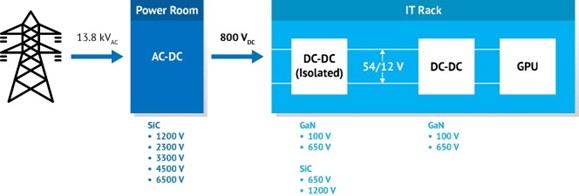
Core Insights - Navitas Semiconductor is advancing its development of 800 VDC GaN and SiC power devices to support NVIDIA's next-generation AI factory computing platforms [1][4][13] Industry Overview - The emergence of AI factories necessitates a shift from traditional 54V power distribution to 800 VDC to meet the high power density requirements of modern computing platforms [2][4] - The 800 VDC architecture allows for direct conversion from 13.8 kVAC utility power to 800 VDC, enhancing energy efficiency and system reliability by reducing conversion stages [3][4] Company Developments - Navitas is introducing a new 100V GaN FET portfolio designed for high efficiency and thermal performance, optimized for GPU power boards [7][8] - The company’s 650V GaN portfolio includes high-power GaN FETs and GaNSafe™ power ICs, which provide integrated control and protection features [10][11] - GeneSiC™ technology offers a broad voltage range from 650 V to 6,500 V, supporting high-reliability applications in energy storage and grid-tied projects [12] Strategic Partnerships - Navitas has formed a strategic partnership with Power Chip to enable scalable, high-volume manufacturing of its 100V GaN FETs [8] Market Position - Navitas Semiconductor is positioned as a leader in next-generation power semiconductors, focusing on GaN and SiC technologies to drive innovation across various sectors, including AI and data centers [15]

Navitas Supports 800 VDC Power Architecture for NVIDIA’s Next-Generation AI Factory Computing Platforms
Globenewswire· 2025-10-13 20:36
Core Insights - Navitas Semiconductor has introduced new 100 V GaN FETs, along with 650 V GaN and high voltage SiC devices, specifically designed for NVIDIA's 800 VDC AI factory architecture, achieving significant improvements in efficiency, power density, and performance [1][22]. Group 1: Product Development - The new 100 V GaN FETs are optimized for lower-voltage DC-DC stages on GPU power boards, focusing on ultra-high density and thermal management essential for next-generation AI compute platforms [8]. - The 650 V GaN portfolio includes high-power GaN FETs and advanced GaNSafe™ power ICs, which integrate various control and protection features to ensure robustness and reliability for AI infrastructure [10]. - GeneSiC™ technology offers a broad voltage range from 650 V to 6,500 V, demonstrating exceptional performance in high-power applications, including energy storage and grid-tied inverter projects [12]. Group 2: Industry Context - The emergence of AI factories necessitates a shift from traditional 54V power distribution to 800 VDC systems to meet the high power density requirements of modern computing platforms [3][5]. - The 800 VDC architecture allows for direct conversion from 13.8 kVAC utility power to 800 VDC, enhancing energy efficiency and system reliability by reducing conversion stages [4]. - The transition to 800 VDC is described as transformational, addressing the critical need for efficient, scalable, and reliable power delivery in next-generation data centers [13]. Group 3: Strategic Partnerships and Manufacturing - Navitas has established a strategic partnership with Power Chip to fabricate the new 100 V GaN FETs on a 200mm GaN-on-Si process, enabling scalable and high-volume manufacturing [9]. - The company emphasizes its commitment to innovation in wide bandgap technologies, with over 300 patents issued or pending, positioning itself as a leader in the semiconductor industry [18].
Think It's Too Late to Buy Navitas Semiconductor? Here's the 1 Reason Why There's Still Time.
The Motley Fool· 2025-10-11 11:20
Core Viewpoint - Navitas Semiconductor has seen significant stock growth, more than doubling in value over the past year, and there remains optimism for further growth due to its innovative technology and strategic partnerships [1][2][14] Company Overview - Navitas Semiconductor specializes in power semiconductors, particularly gallium nitride (GaN) and silicon carbide (SiC) components, which are utilized in various applications including data centers and mobile phone chargers [2][4] - The stock price has increased from a range of $2 to $3 per share last year to $7.78, representing over a 200% increase [2] Industry Context - Data centers are major energy consumers, using 10 to 50 times the energy of typical commercial buildings and up to 5 million gallons of water daily, highlighting the need for more efficient power solutions [6][7] - Technologies that can reduce energy and water consumption in data centers are highly valuable, and Navitas' GaN technology addresses these needs effectively [7] Technological Advantages - Navitas' GaN and SiC chips provide up to 40% higher energy efficiency compared to traditional silicon-based systems, enabling monolithic integration, space savings, and faster switching speeds, which reduce heat generation and cooling requirements [5][11] Strategic Partnerships - A significant partnership with Nvidia was announced, where Navitas will supply GaN and SiC semiconductors for a next-generation 800V high-voltage direct current architecture aimed at AI data centers [8][10] - The partnership is seen as a proof of concept that could lead to broader applications of GaN and SiC solutions across various markets [10][12] Market Potential - The market for GaN and SiC technologies is projected to reach $2.6 billion by 2030, with Navitas positioned to capture a substantial share due to its leading role in the industry [11] - Demand for GaN and SiC components is also rising in electric vehicle production, solar infrastructure, industrial applications, and energy storage systems, indicating multiple growth avenues for the company [11][12] Stock Performance - Navitas stock has shown volatility, trading between $1.52 and $9.48 over the past 52 weeks, with a beta of 3.03, suggesting it is likely to move three times as much as the S&P 500 [13] - Despite the high risk associated with the stock, the potential rewards are significant if the company continues to execute its growth strategy effectively [13]