
Willis Towers Watson(WTW)

Search documents
Gray-zone aggression now a material threat for businesses, according to new Willis report
Globenewswire· 2026-02-25 09:00
Core Insights - The report identifies a shift in global stability characterized by 'gray-zone aggression', which involves ambiguous tactics between peace and war [1] Industry Impact - Gray-zone aggression has evolved into a significant threat for businesses, disrupting markets and undermining confidence, which was previously not recognized as a major risk [2] - This challenge is now influencing geopolitical risk appetite and testing the resilience strategies of all major sectors [2] Recommendations for Corporate Risk Management - Companies must enhance their risk management programs to include strategic foresight and operational readiness against gray-zone attacks [3] - Organizations should treat gray-zone aggression as a material business risk rather than a temporary nuisance to avoid late reactions with severe consequences [3] Specific Actions for Risk and Insurance Leaders - Re-evaluate insurance policy language to ensure alignment with the current risk environment [5] - Elevate gray-zone aggression as an enterprise-level risk and continuously monitor geopolitical developments [5] - Stress test supply chain resilience to account for potential disruptions from geopolitical tensions [5] - Strengthen crisis management strategies to handle ambiguous events effectively [5] - Integrate scenario thinking into strategic planning to reveal unexpected exposures and test various operational assumptions [5]


Risk & Broking Segment Fuels Positive Momentum for Willis Towers Watson (WTW)
Yahoo Finance· 2026-02-19 05:08
Willis Towers Watson (NASDAQ:WTW) is one of the 12 oversold financial stocks to invest in according to hedge funds. On February 4, Elyse Greenspan from Wells Fargo maintained her Overweight rating on Willis Towers Watson (NASDAQ:WTW). She also raised the price target from $366 to $379, which now offers a revised upside potential of almost 32%. SFIO CRACHO/Shutterstock.com Greenspan highlighted the recent bullish trend in share price following quarterly results that showed impressive organic growth. She ...
Willis launches Reputational Risk Quantification Model for celebrity endorsement risk
Globenewswire· 2026-02-18 09:00
Core Insights - Willis, a WTW business, has launched a Reputational Risk Quantification Model specifically for celebrity endorsements, utilizing extensive datasets from Polecat to assess reputational risks associated with celebrity endorsers and brand ambassadors [1][3]. Industry Overview - The Global Reputational Risk Readiness Survey 2024/25 indicates that 99% of companies consider reputation among their top 10 risks, with notable sectors including Leisure and Hospitality (53%), Retail (43%), Manufacturing (51%), Transportation (34%), and NGOs/Charities (48%) ranking it in their top five [2]. Model Features - The new model employs advanced risk analytics and real-time intelligence from Polecat to evaluate the potential impact on sales and profits in scenarios where celebrity endorsers face reputational damage, providing brands with data-driven insights for better decision-making and proactive risk management [4]. Expert Commentary - James Gillespie, Head of Data & Analytics at Willis, emphasized that reputation is increasingly viewed as an asset class, and the model transforms subjective judgments into quantifiable insights, allowing clients to understand the financial implications of celebrity endorsements [5]. - James Lawn, CEO at Polecat, noted that the model enables organizations to quantify previously intangible reputational risks, enhancing their ability to manage these risks effectively [5]. Upcoming Events - Willis will host a Reputational Risk Roundtable event on February 26, 2026, aimed at senior executives and risk professionals, focusing on the new Celebrity endorsement feature and discussing various aspects of managing reputation risks [5].

Is Willis Towers Watson Public Limited Company (WTW) One of the Best Foreign Stocks to Buy Right Now?
Yahoo Finance· 2026-02-14 13:17
Core Insights - Willis Towers Watson Public Limited Company (NASDAQ: WTW) is highlighted as a strong foreign stock investment opportunity due to its recent product upgrades and positive earnings outlook [1][3]. Company Developments - On February 9, Willis Towers Watson launched an upgraded version of its RiskAgility FM U.S. Library models to comply with new VM-22 rules for non-variable annuities, enhancing insurers' ability to manage fixed annuities and related products [1][2]. - The new suite features improved asset-liability integration, faster projections, and support for VM-22 groups and investment strategies, incorporating AI tools and governance features for complex workloads [2]. Financial Performance - Following the Q4 earnings report, Mizuho raised the price target for Willis Towers Watson from $388 to $392, maintaining an Outperform rating [3]. - Mizuho also increased its earnings forecasts, raising the 2026 estimate by $0.40 to $19.65 per share and the 2027 estimate by $0.25 to $22.65 per share, citing a 50 basis point increase in expected consolidated organic growth to 5% and favorable foreign exchange impacts [4]. Company Overview - Willis Towers Watson is a UK-based company providing global advisory, broking, and solutions services aimed at managing risk, optimizing benefits, and driving growth across various sectors including health, wealth, career consulting, and insurance brokerage [5].
Willis: Rising threats, political evacuations and kidnap shaped the 2025 crisis management landscape
Globenewswire· 2026-02-12 09:00
Core Insights - Incidents involving threats to individuals or client assets increased by over a third in 2025, accounting for 37% of all incidents reported to Alert:24 [1] - Political repatriation was the second most common peril, making up 19% of all incidents in 2025 [1] Industry Overview - The global risk environment in 2025 was reshaped by geopolitical volatility, economic pressure, shifting alliances, and youth-led activism, creating sustained uncertainty for international organizations [2] - Businesses faced a complex risk environment requiring them to safeguard people and assets, maintain operations, and strengthen long-term resilience [2] Incident Trends - The overall volume of incidents remained consistent with previous years, but the nature of risks evolved, with rising threat alerts in regions of geopolitical risk driving increased demand for intelligence and support [3] - Political instability is expected to reshape global trade, leading to ongoing uncertainty where single events can trigger widespread commercial disruption [4] Client Support and Insights - Jo Holliday, global head of crisis management, noted that 2025 was a challenging year for clients, with the Crisis Management and Alert:24 teams assisting in navigating a complex threat landscape [5] - The report aims to provide leaders with clear, data-driven insights to interpret dynamics and make informed decisions [5] Threat Frequency and Regional Distribution - There was a 10% rise in the total number of clients assisted in the first 11 months of 2025 compared to the same period in 2024, with incident notification frequency remaining consistent [7] - Sub-Saharan Africa recorded the highest number of client notifications for the third consecutive year, accounting for over a quarter of incidents, with nearly half originating in the DRC [7]
美股下一个“AI受害者”已经出现,市场正在提前定价!
美股研究社· 2026-02-11 11:06
Core Viewpoint - The article discusses the recent internal rotation in the U.S. stock market, highlighting a shift from a few large-cap stocks leading the market to a broader participation across various sectors, while also addressing the impact of AI on traditional business models and the resulting market volatility [5][7][8]. Market Performance - On Tuesday, the S&P 500 fell by approximately 0.3%, while the Dow Jones Industrial Average rose by about 0.1%, reaching a new historical high [5]. - The equal-weighted S&P index also reached a record high, indicating a shift in market dynamics with around 300 stocks in the S&P 500 rising [7]. Retail Sales Data - The U.S. Commerce Department reported that December retail sales were flat month-over-month, significantly below the expected 0.4% growth, indicating a slowdown in consumer spending [9]. - Core retail sales, excluding autos and gas, even showed a decline, reflecting weakened consumer spending momentum during the holiday season [9]. Interest Rate Expectations - The weak retail data led to a rise in U.S. Treasury prices and a decline in yields, with the futures market increasing the probability of three rate cuts within the year, with two already priced in [9]. - Historical trends suggest that rate cut expectations typically support risk assets, but the current market shows a divergence where rates are falling but stocks are not rising, particularly in the tech sector [11]. AI Impact on Market Sentiment - Market participants are shifting their interpretation of AI's impact from a growth narrative to concerns about short-term disruptions, leading to a "sell first, think later" mentality [12]. - Investors are moving from an "AI is a panacea" mindset to a more pragmatic "performance realization" phase, anticipating greater differentiation between winners and losers in the market [12]. Institutional Perspectives - There is a noticeable divergence in institutional views on the tech sector, with Goldman Sachs warning about the risks of overestimating AI's growth potential and emphasizing the need for actual earnings and cash flow improvements to support tech valuations [13]. - UBS downgraded its rating on the U.S. tech sector from "overweight" to "neutral," citing key risks while still acknowledging the long-term potential of AI [14]. Wealth Management Sector - The wealth management sector has come under scrutiny following the launch of an AI tool by Altruist Corp., which automates tasks traditionally reliant on human expertise, raising concerns about the core revenue models of wealth management firms [17][18]. - The market reacted sharply, with significant declines in stocks of major wealth management firms, indicating fears about the long-term competitive structure of the industry under AI pressure [19][21]. Broader Market Reactions - The sell-off in the market has been attributed to fears that AI tools could undermine the intermediary value of insurance brokers, leading to a significant drop in the insurance brokerage sector [22]. - The recent downturn in the software sector has seen substantial market capitalization losses, with estimates indicating a combined loss of approximately $611 billion across software, financial services, and asset management sectors [26]. Conclusion - The current market environment reflects a transition from viewing AI as a beneficiary narrative to recognizing potential victims, with traditional software companies facing heightened scrutiny and volatility [27]. - The article suggests that this phase serves as a valuation and business model stress test, prompting a reevaluation of which revenue models are based on irreplaceable value versus those reliant on information asymmetry [34].






AI颠覆潮席卷金融业:Insurify新工具上线,美国保险经纪股遭遇“黑色星期一”
智通财经网· 2026-02-09 23:27
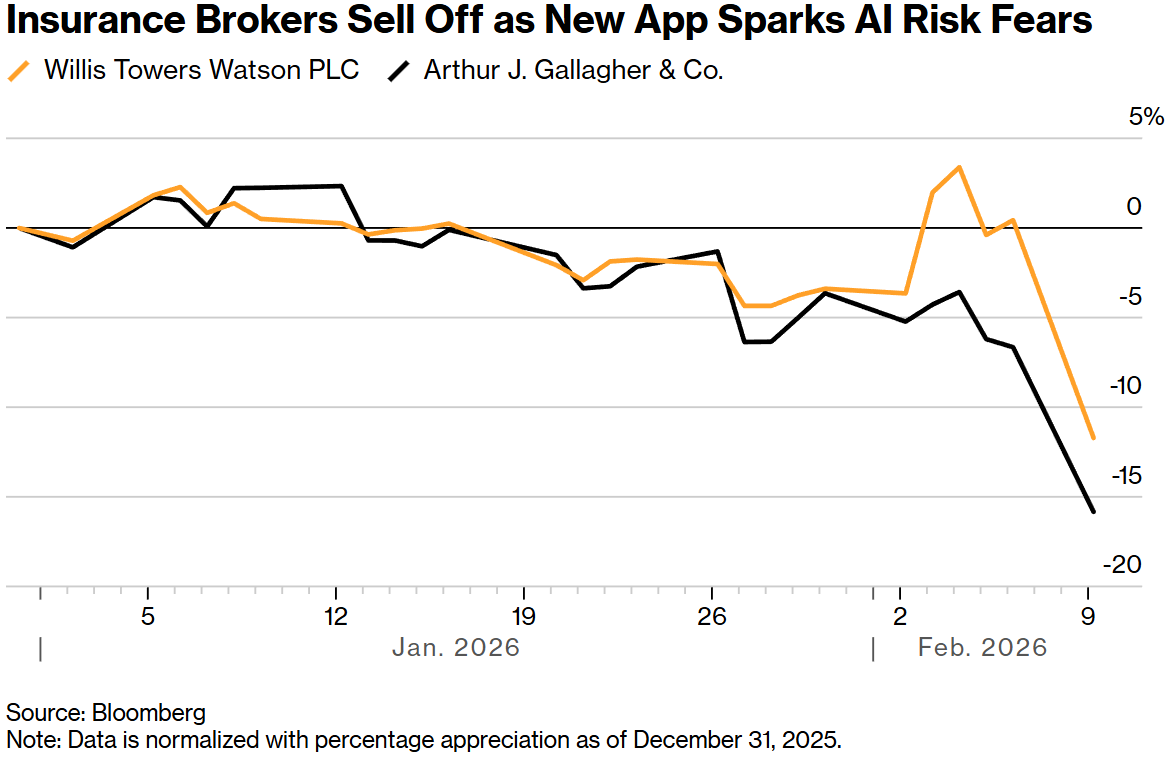
Group 1 - The core concern is the market's reaction to Insurify's launch of an AI tool, which has raised fears of disruption in the insurance industry, leading to significant stock sell-offs among U.S. insurance brokerage firms [1][4] - The S&P 500 insurance sector index closed down 3.9%, marking the largest decline since October of the previous year [1] - Willis Towers Watson PLC experienced the worst performance, with a closing drop of 12%, the most severe trading day since November 2008 [1] Group 2 - Following Willis Towers Watson, Arthur J Gallagher & Co. and Aon Group saw declines of 9.9% and 9.3%, respectively [1] - Analyst Matthew Palazola noted that while the new AI tools may pose a threat to some consulting aspects of insurance brokerage firms, they are more likely to act as "efficiency multipliers" rather than existential threats [4] - Insurify's application, which utilizes ChatGPT to compare auto insurance rates based on various inputs, was launched on February 3 [4]


Global pension assets rise by nearly 10%, reaching new high
Globenewswire· 2026-02-09 15:32
Core Insights - Global pension assets reached a record USD 68.3 trillion in 2025, marking a year-on-year increase of 9.6% driven by defined contribution (DC) savings [1] - The US remains the largest pensions market, accounting for 66% of the Top 22 globally, while Canada has overtaken Japan to become the second largest pensions market with a 12% year-on-year growth [4] - The UK pension market has experienced weak growth of only 1.4% per annum over the last decade, resulting in a drop from the second largest to the fourth largest pensions market [5] Global Market Performance - In 2025, global markets showed sustained recovery with strong investor sentiment, leading to the creation of USD 6.0 trillion in pension asset value [2] - The allocation to equities in the seven largest pensions markets has decreased by nine percentage points to 48% of total assets, while bonds and other asset classes have increased [7] - Most major asset classes delivered positive returns in 2025, with equities performing particularly well [8] Market Trends and Future Outlook - The UK pension market is undergoing a structural shift, with defined benefit (DB) schemes maturing and de-risking, while DC schemes are expanding, now representing around 40% of UK pension assets [6] - Looking ahead, the 2026 outlook will be influenced by policy decisions, technological innovation, and global dynamics, with fiscal support and AI-related investments expected to drive growth [9] - The adoption of a 'Total Portfolio Approach' is becoming increasingly important due to the uncertain and complex investment environment [10]
Global pension assets rise by nearly 10%, reaching new high
Globenewswire· 2026-02-09 15:32
Core Insights - Global pension assets reached a record USD 68.3 trillion in 2025, marking a 9.6% year-on-year increase driven by defined contribution (DC) savings [1] - The US remains the largest pensions market, constituting 66% of the Top 22 globally, while Canada has overtaken Japan to become the second largest pensions market with a 12% year-on-year growth [4] - The UK pension market has experienced weak growth of only 1.4% per annum over the last decade, resulting in a drop from the second largest to the fourth largest pensions market [5] Global Market Overview - In 2025, global markets showed sustained recovery with strong investor sentiment, leading to the creation of USD 6.0 trillion in pension asset value [2] - Among the top seven global pensions markets, DC assets now account for 63% of total assets, with Australia and the US having the highest allocations at 90% and 72% respectively [2] Growth Trends - Over the past decade, Australia, the US, and Canada have seen above-average growth rates in their predominantly DC markets, with annual growth rates of 6.6%, 7.7%, and 5.3% respectively [3] - South Korea, Switzerland, and Hong Kong also experienced growth rates exceeding 8% per annum over the last ten years [3] Structural Changes - The UK pension market is undergoing a structural shift, with defined benefit (DB) schemes maturing and de-risking, while DC schemes are expanding, now representing around 40% of UK pension assets, up from 18% in 2020 [6] Asset Allocation Trends - Over the last 20 years, the overall allocation to equities in the seven largest pensions markets has decreased by nine percentage points to 48%, while bonds and other asset classes have increased by three and six percentage points respectively [7] Market Performance - 2025 saw broad-based gains across global markets, with equities performing particularly well and fixed income also posting gains due to global rate cuts and narrowing credit spreads [8] Future Outlook - The outlook for 2026 is expected to be influenced by policy decisions, technological innovation, and shifting global dynamics, with fiscal support and AI-related investments identified as key growth drivers [9] - A 'Total Portfolio Approach' is becoming increasingly important in the current uncertain and complex investment environment, enabling faster and more coordinated decision-making [10]

WTW releases next-generation U.S. Library models in RiskAgility Financial Modeler, delivering full VM-22 capability for life insurers
Globenewswire· 2026-02-09 14:00
Core Insights - WTW has launched the next generation of its U.S. Library models within RiskAgility FM, which fully incorporates Valuation Manual 22 (VM-22) requirements for non-variable annuity products, providing insurers and reinsurers with a robust platform for compliance [1][2][3] Group 1: Product Features - The updated RiskAgility FM U.S. Library models offer an end-to-end modeling environment that aligns with VM-22, facilitating a smooth transition for companies [2][3] - The new model suite enhances asset and liability modeling capabilities, delivering comprehensive VM-22 reserving functionalities [3][8] - RiskAgility FM features an intuitive modeling environment, integrated AI assistance, and governance features such as version control and workflow automation [4] Group 2: Market Impact - The launch of the VM-22-ready model suite is positioned as a pivotal moment for the U.S. annuity market, enabling insurers to meet new standards with precision [3] - WTW's Insurance Consulting and Technology business aims to innovate and transform the insurance industry, providing solutions for risk and capital management [5][6] Group 3: Company Overview - WTW serves a global client base, including leading insurance groups, with over 1,000 client companies utilizing its specialist insurance software [6][7] - The company operates in 140 countries, leveraging local expertise to enhance organizational resilience and performance [7]