Motorola

Search documents
ANET Earnings Surge: AI Infrastructure Adds Muscle to Growth
Youtube· 2026-02-13 16:50
Core Insights - Arista Networks has reported strong earnings, leading to a significant increase in its stock price by 6% [1][2][4] - The company surpassed earnings expectations with an EPS of 82 cents compared to estimates of 76 cents, and revenue of approximately $2.5 billion, exceeding the consensus of $2.38 billion [4][5] - Analysts are overwhelmingly bullish on Arista Networks, with multiple price target increases following the earnings report and a raised revenue growth outlook for 2026 from 20% to 25% [5][7][8] Financial Performance - Arista Networks achieved a quarterly net income milestone of over $1 billion, which was highlighted by the CFO during the earnings call [4] - The company’s first-quarter revenue guidance is set at $2.6 billion, surpassing the consensus estimate of $2.44 billion [5] Analyst Reactions - Piper Sandler raised its price target for Arista Networks from $159 to $175, maintaining an overweight rating due to the larger-than-anticipated earnings beat and strong guidance [7] - Key Bank increased its target from $170 to $178, also keeping an overweight rating, citing the company's potential benefits from AI and expansion into new verticals [7] - Bank of America maintained a buy rating with a new price target of $185, suggesting that growth estimates may be conservative and indicating potential for higher growth in 2026 [8]



Unboxing Motorola’s $700 FIFA World Cup Edition Razr
CNET· 2026-02-12 14:00
Motorola’s special edition FIFA World Cup 26 Razr is now available for $700. The specs of the phone are pretty much the same as the company’s 2025 Razr released last May. Let’s unbox the FIFA foldable. #motorola #motorolarazr #fifa #fifaworldcup2026 #foldable ...

Motorola (MSI) Q4 Earnings and Revenues Beat Estimates
ZACKS· 2026-02-11 23:26
Core Insights - Motorola (MSI) reported quarterly earnings of $4.59 per share, exceeding the Zacks Consensus Estimate of $4.36 per share, and showing an increase from $4.04 per share a year ago, resulting in an earnings surprise of +5.40% [1] - The company achieved revenues of $3.38 billion for the quarter ended December 2025, surpassing the Zacks Consensus Estimate by 1.09% and up from $3.01 billion year-over-year [2] - Motorola has consistently outperformed consensus EPS and revenue estimates over the last four quarters [2] Earnings Outlook - The sustainability of Motorola's stock price movement will depend on management's commentary during the earnings call and future earnings expectations [3] - The current consensus EPS estimate for the upcoming quarter is $3.18 on revenues of $2.75 billion, and for the current fiscal year, it is $16.19 on revenues of $12.59 billion [7] Industry Context - The Wireless Equipment industry, to which Motorola belongs, is currently ranked in the top 32% of over 250 Zacks industries, indicating a favorable outlook compared to the bottom 50% [8] - Empirical research suggests a strong correlation between near-term stock movements and trends in earnings estimate revisions, which can be tracked using tools like the Zacks Rank [5][6]


Why Google is offering a 100-year bond
Youtube· 2026-02-11 00:16
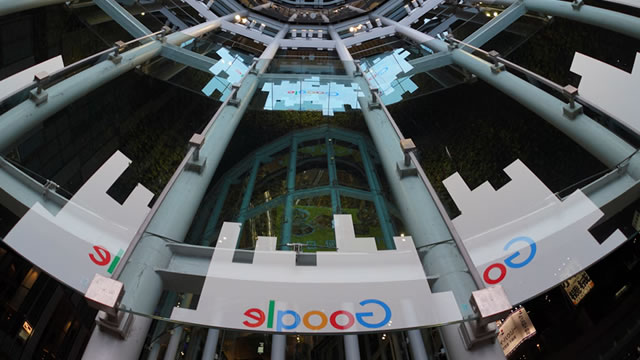
Core Viewpoint - Alphabet, Google's parent company, is entering the bond market with a 100-year bond, raising approximately $32 billion across multiple bond deals in various currencies, with a small portion of £1 billion dedicated to the century bond [1][2]. Group 1: Bond Characteristics - Century bonds are long-term debt instruments, with Alphabet's bond maturing in 2126, appealing to investors like pension funds and insurers who seek steady long-term payments [1][4]. - The bond market operates on the principle that bond prices and yields move inversely; as bond prices increase, yields decrease, and vice versa [8][9]. Group 2: Rationale for Borrowing - Despite having substantial cash reserves, Alphabet is opting to borrow due to the high costs associated with AI infrastructure development, taking advantage of historically low interest rates for flexible funding [5]. - Historical context shows that century bonds are not new, with previous issuances by companies like Coca-Cola and Motorola, indicating a trend in long-term financing strategies [6]. Group 3: Market Implications - Future observations should focus on demand for similar long-term tech bond offerings, pricing dynamics, and the narrative surrounding AI's transition from buildout to revenue generation, which could impact both stock and bond markets [10][11]. - The historical context of tech companies during the dot-com boom suggests that while cash-rich firms may not capture significant upside, they can experience prolonged downturns, a consideration for Alphabet's strategy [12].

All about century bonds and why analysts back Alphabet's 100-year bond
Invezz· 2026-02-10 12:57
Core Viewpoint - Alphabet Inc. is preparing to issue a rare 100-year bond, aiming to raise approximately $20 billion to support its significant investments in artificial intelligence and other technologies, marking a notable shift in how tech companies are perceived in the financial market [1][2] Group 1: Century Bonds Overview - Century bonds are unique financial instruments typically issued by companies with exceptional longevity and financial resilience, often associated with blue-chip industrial firms rather than technology companies [1] - If Alphabet proceeds with this bond issuance, it will join a select group of corporations that have issued 100-year debt, including Ford Motor Co. and Motorola [1] - The rarity of century bonds makes them attractive to life insurance companies and pension funds, which seek long-term assets to match their obligations [1][2] Group 2: Investor Demand and Market Perception - Analysts expect strong demand for Alphabet's 100-year bond, with reports indicating over $100 billion in demand across various currencies and maturities, reflecting a sustained appetite for high-grade corporate debt [1][2] - The willingness of investors to commit capital to a technology company for a century indicates a shift in perception, viewing hyperscale tech firms as critical infrastructure rather than cyclical entities [2] - The strategic choice to issue the bond in sterling is seen as beneficial, as the UK market has a deep pool of investors familiar with ultra-long maturities [2] Group 3: Alphabet's Funding Strategy - The century bond issuance is part of a broader multi-tranche offering, including a seven-part dollar transaction and potential issuance in Swiss francs, showcasing a diversified funding approach [2] - Alphabet's previous bond issuance in November raised $17.5 billion, attracting approximately $90 billion in orders, indicating strong market interest [2]

Alphabet Bets Big on 100 Years of Debt
Bloomberg Television· 2026-02-10 03:31
Alphabet. Even thinking about a 100 year bond sale. What's this about.Well, it was just last week that we got these staggering capital spending plans from the big tech giants. First, it was Alphabet saying it could spend as much as $185 billion this year on this air buildout that they are planning. Then Amazon the next day said that it could spend $200 billion on CapEx.So these are really staggering numbers. This is the most amount of money that any company has ever spent in terms of CapEx on something like ...

Alphabet Bets Big on 100 Years of Debt
Youtube· 2026-02-10 03:31
Core Viewpoint - Alphabet and Amazon are planning unprecedented capital expenditures, with Alphabet potentially spending up to $185 billion and Amazon $200 billion this year, raising questions about investor willingness to finance these investments [1][2]. Group 1: Capital Expenditure Plans - Alphabet's capital spending could reach $185 billion, while Amazon's may hit $200 billion, marking the highest CapEx in history for such initiatives [1][2]. - Both companies have substantial cash reserves but prefer to raise funds through the market rather than depleting their cash [3]. Group 2: Investor Demand and Bond Issuance - Alphabet initially aimed to raise $15 billion but increased the target to $20 billion due to high investor demand, also planning to issue bonds in British pounds and Swiss francs [3]. - The issuance of a 100-year bond by Alphabet is notable, as such long-term bonds are rare for corporations, typically issued by governments or universities [4]. Group 3: Competitive Landscape - Major tech companies are increasing spending to compete aggressively in the "air race," aiming to secure a leading position in future markets [7][8]. - The competition among Alphabet, Amazon, Microsoft, and Meta is intense, with each company striving to capture significant market share and profits [8]. Group 4: Historical Context and Risks - The rarity of 100-year bonds raises concerns about long-term viability, as seen in past examples like Motorola and J.C. Penney, which faced significant challenges after issuing such bonds [11][12]. - Despite the risks associated with long-term bonds, Alphabet is currently viewed as a strong company with robust growth and aggressive investment strategies [13].

X @Cassandra Unchained
Cassandra Unchained· 2026-02-09 16:06
Alphabet looking to issue a 100-year bond. Last time this happened was Motorola in 1997, which was the last year Motorola was considered a big deal.At the start of 1997, Motorola was a top 25 market cap and top 25 revenue corporation in America. Never again.The Motorola corporate brand in 1997 was ranked #1 in the US, ahead of Microsoft.In 1998, Nokia overtook Motorola in cell phones, and after the iPhone it fell out of the consumer eye.Today Motorola is the 232nd largest market cap with only $11 billion in ...
Apple Just Had The Biggest Quarter In iPhone History
Benzinga· 2026-02-04 10:17
Core Insights - Apple Inc. reported strong sales growth in Q4 2025, achieving a market share of 69%, up from 65% the previous year, despite overall U.S. smartphone sales increasing only 1% Y/Y [1][2] Group 1: Sales Performance - Apple achieved its best sales quarter, driven by strong sales of iPhone 16e and 17 models in mid-range and premium segments [2] - The iPhone segment led Apple's growth with sales rising to $85.27 billion, up from $69.14 billion last year [9] - AT&T recorded its highest share of Apple sales at 89%, with T-Mobile and Verizon also seeing increases [3] Group 2: Market Trends - The mid-range price band ($300-$600) grew by 27% Y/Y, as consumers opted for more affordable devices due to macroeconomic conditions [3] - The sub-$300 market segment declined by 7% Y/Y due to weak demand and consolidation in low-end smartphones [4] Group 3: Strategic Adjustments - Apple is shifting its focus to high-margin premium devices, prioritizing production of its top three devices, including a foldable iPhone [7] - Supply chain challenges are limiting Apple's ability to meet rising handset demand, with expectations of a more significant impact from rising memory prices in the coming quarters [8] Group 4: Future Outlook - Analysts are monitoring whether momentum in the $300 to $600 segment can be sustained beyond the holiday season, indicating potential consumer trading down amid economic uncertainty [6] - Rising memory prices are expected to pressure low-cost smartphone makers, with a projected increase in bills of materials by at least 15% over the next two quarters [5]


行业聚焦:全球智能运动追踪器行业头部生产商市场份额及排名调查(附核心企业名单)
QYResearch· 2026-01-29 03:47
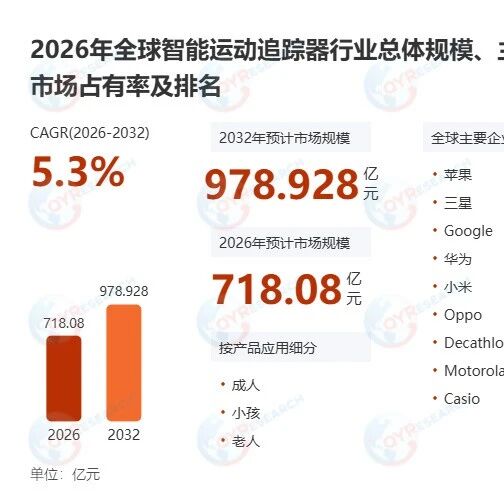
Core Viewpoint - The global smart fitness tracker market is projected to reach $14.4 billion by 2032, with a compound annual growth rate (CAGR) of 5.3% from 2026 to 2032 [3][19]. Global Market Overview - The smart fitness tracker market is expected to grow significantly, with a forecasted market size of $14.4 billion by 2032, reflecting a CAGR of 5.3% [3][19]. - Major manufacturers in the global market include Apple, Samsung, Google, Huawei, Xiaomi, Oppo, Decathlon, Motorola, and Casio, with a concentration of manufacturing in East Asia due to its robust supply chain and cost-effective production capabilities [5]. Industry Chain Analysis - The industry chain consists of upstream components such as sensors and core electronic parts, midstream brand owners and product engineering, and downstream consumers and enterprise applications [7]. - Upstream components include PPG optical heart rate modules, accelerometers, GPS, and various electronic parts [7]. - Midstream activities involve industrial design, firmware development, and product management [7]. - Downstream, consumers utilize fitness trackers for monitoring health metrics, while enterprises leverage aggregated data for health programs [7]. Regulatory Environment - The EU's AI Act classifies fitness trackers with clinical-grade monitoring functions as "high-risk AI systems," requiring third-party audits and transparency reports [8]. - The FDA is reclassifying fitness trackers with ECG or continuous blood pressure monitoring capabilities as Class II medical devices, necessitating pre-market approval [8]. - The EU Digital Product Passport initiative mandates manufacturers to provide lifecycle data for devices to enhance supply chain transparency [8]. Industry Development Trends - There is a shift towards clinical-grade health functionalities and medical validation, with manufacturers integrating advanced biometric sensors and seeking regulatory certifications [9]. - AI-driven personalized services are being embedded in trackers to provide tailored health insights and proactive health guidance [9]. - The industry is moving towards sustainable manufacturing practices, including the use of recyclable materials and modular designs [9]. - Fitness trackers are increasingly integrating into broader smart ecosystems, enhancing user experience through seamless data flow across devices [9]. Development Opportunities - Emerging markets in Southeast Asia, Africa, and Latin America present significant opportunities for localized innovations in affordable fitness trackers [10]. - The integration of clinical-grade fitness trackers into formal healthcare systems offers growth potential, particularly for chronic disease monitoring [10]. - B2B opportunities are expanding as companies invest in employee health management programs, creating demand for customized fitness tracker solutions [10]. - There is a notable unmet demand for inclusive products targeting underserved populations, such as the elderly and individuals with disabilities [10]. Industry Challenges - The industry faces regulatory complexities and fragmentation, with varying regional regulations impacting compliance costs and market entry [11]. - Data privacy and cybersecurity concerns are heightened as fitness trackers collect sensitive biometric data, necessitating robust security measures [11]. - Market saturation and commoditization pressures are leading to intense price competition and challenges in product differentiation [11]. - Limitations in accuracy and user trust regarding biometric tracking can hinder the adoption of fitness trackers in clinical applications [11].