
Lenovo

Search documents
投资者推介-TMT:半导体关税更新及关键股票思路-Investor Presentation Asia Pacific-Tuesday TMT Webcast Semis Tariff Updates and Key Stock Ideas
2025-08-12 02:34
Summary of Key Points from the Conference Call Industry Overview - **Industry Focus**: Greater China Technology Semiconductors and Technology Hardware [4][8] - **Market Sentiment**: The semiconductor industry in Greater China is viewed as attractive, with potential growth opportunities driven by new policies and technological advancements [4][8] Core Insights - **Semiconductor Tariffs**: Discussion on the implications of Section 232 tariffs and how they may impact companies within the semiconductor sector [6] - **Company Exposure**: - TSMC has a 75% revenue exposure to US customers and plans a US$165 billion capital expenditure for its US operations by 2030 [7] - GlobalWafers has a 30-40% exposure and has initiated operations in Texas with an additional US$4 billion investment planned [7] - ASE and UMC have varying levels of exposure, with ASE at 50% and UMC at 20% [7] - **Investment Plans**: Companies like ASE and its subsidiary SPIL are planning investments in the US, although details are yet to be announced [7] Financial Performance Highlights - **Lenovo's Financials**: - Projected net sales for FY-1Q26E are US$18.081 billion, reflecting a 6% quarter-over-quarter increase and a 17% year-over-year increase [15] - Operating income is expected to rise significantly by 97% year-over-year to US$653 million [15] - Net income is projected to increase by 327% year-over-year to US$384 million [15] - **Margins**: Lenovo's gross margin is expected to be 16.1%, with operating margin at 3.6% [15] Emerging Trends - **AI Demand**: There is a notable increase in demand for AI-related device testers, with firms like Advantest expecting continued growth in System on Chip (SoC) tester demand [10] - **E-Paper Growth**: E Ink is projected to experience a 19% revenue CAGR from 2024 to 2026, driven by opportunities in signage and consumer electronics [18][22] Risks and Considerations - **Market Risks**: - Potential oversupply issues in mature node foundries could impact companies like UMC and Powerchip [7] - The semiconductor market faces uncertainties due to fluctuating demand and geopolitical factors [35][38] - **Investment Risks**: Risks to upside include stronger-than-expected recovery in semiconductor demand, while risks to downside involve potential market share loss and declining gross margins [37][38] Additional Insights - **Strategic Acquisitions**: Lenovo is in the process of acquiring Infinidat Ltd., indicating a strategic move to enhance its capabilities [31] - **Buyback Programs**: Companies like Ushio are implementing share buyback programs, reflecting confidence in their financial health [11] This summary encapsulates the key points discussed in the conference call, highlighting the current state and future outlook of the semiconductor and technology hardware industries in Greater China.
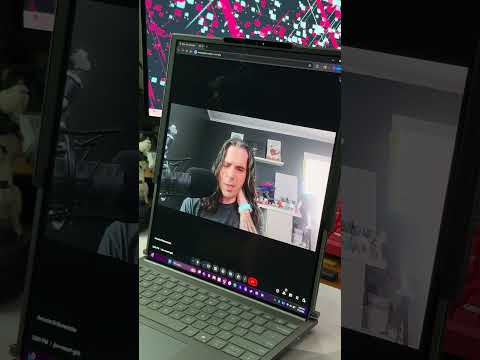
The sights, sounds, and hands-on experience of using Lenovo's rollable ThinkBook Plus Gen 6 laptop.
The Verge· 2025-08-04 13:32
I viewed a laptop that grows and shrinks at the push of a button. It's one of the coolest laptops I've ever used. Here's what I like about it and don't.Push a button and the squareish 14-in display turns into a 16.7% in tall boy. It's a 120 Hz flexible OLED display with punchy colors and crisp details. But you pay a big price for this screen.The ThinkBook Plus costs $3,300 where a non-rolling Lenovo with a similar specs is like $1,000 cheaper. It's awesome for multitasking, allowing you to work within two s ...

海通国际2025年8月金股



Haitong Securities International· 2025-08-01 14:34
Investment Focus - The report highlights Amazon (AMZN US) as a top pick due to its leading position in the cloud industry with a 30% global market share, stable margin improvements, and strong demand for its T3 inference capabilities [1] - Alphabet (GOOGL US) is favored for its AI and advertising synergy, expected margin improvements in IaaS cloud services, and strong self-developed capabilities, although its stock price upside is currently limited [1] - Arista (ANET US) is recognized for its leadership in high-speed data center switches and expected revenue contributions from AI backend switch business, with a significant growth visibility [1] - Meituan (3690 HK) is noted for its strong cash flow generation ability and competitive cost structure, positioning it well in the face of industry competition [1] - Lenovo (992 HK) is highlighted for its record revenue in AI server business and significant growth potential compared to peers like Dell [2] - NVIDIA (NVDA US) is recognized for its strong financial performance and technological leadership in data center business, with a focus on emerging applications driving growth [2] - Tencent (700 HK) is expected to benefit significantly from AI advancements, with an upward revision in revenue and profit expectations for 2025 [2] - New Oriental (EDU US) is noted for its diverse revenue sources and strong brand recognition, supporting its high profit margins [3] - AIA (1299 HK) is favored for its steady growth in new business value and strong operational metrics, particularly in the ASEAN market [3] - Futu (FUTU US) is expected to see significant growth in paid user numbers and total AUM, supported by its low commission model and quality customer service [3] - The report emphasizes the potential of Chinese pharmaceutical companies like China Biologic Products (1177 HK) and Innovent Biologics (1801 HK) in their innovative drug pipelines and market leadership [4]
WeRide Records Another Strong Quarter in Q2 2025: Revenue Hits US$17.8 Million, Robotaxi Revenue Increases 836.7% YoY to US$6.4 Million
Prnewswire· 2025-08-01 03:52
Financial Performance - WeRide reported Q2 2025 revenue of US$17.8 million, representing a 60.8% year-on-year increase [8] - Robotaxi revenue surged 836.7% year-on-year to US$6.4 million, contributing 36.1% of total revenue, the highest concentration since 2021 [2][8] - Gross profit increased by 40.6% year-on-year, indicating steady growth [2][8] Commercialization Progress - WeRide's Robotaxi fleet in Abu Dhabi has tripled since December 2024, maintaining the largest fleet outside the US and China [3][9] - The company has achieved over 2,200 days of safe Robotaxi operations, setting an industry safety benchmark [3] - Plans to expand the Robotaxi fleet to hundreds and extend operations into additional areas of Abu Dhabi in 2025 [9] Technology Breakthroughs - WeRide launched the HPC 3.0 high-performance computing platform, developed with Lenovo and powered by NVIDIA's DRIVE AGX Thor chips [15] - The Robotaxi GXR became the world's first mass-produced Level 4 autonomous vehicle built on NVIDIA DRIVE AGX Thor chips [16] - The automotive-grade HPC 3.0 platform reduces the cost of the autonomous driving suite by 50% [16] Management Commentary - The CEO highlighted the rapid growth of the Robotaxi business as a reflection of the company's strategic vision and strong partnerships [15] - The CFO noted that the strong topline performance is driven by the increasing contribution from the Robotaxi business, indicating improved unit economics and commercial viability [15]


WeRide Accelerates Global Growth, Robotaxi Revenue Grew 836.7%
GlobeNewswire News Room· 2025-07-31 08:00
Core Insights - WeRide Inc. reported a significant growth in total revenue, which increased by 60.8% year-over-year to RMB127.2 million (US$17.8 million) for the second quarter of 2025, compared to RMB79.1 million in the same period of 2024 [7] - The company achieved its highest-ever quarterly robotaxi revenue, which surged by 836.7% year-over-year to RMB45.9 million (US$6.4 million), accounting for 36.1% of total revenue in 2Q2025 [3][11] - WeRide launched its High-Performance Computing (HPC) 3.0 platform, powered by NVIDIA DRIVE AGX Thor chips, which reduces autonomous driving suite costs by 50% and is fully automotive-grade [3][6] Financial Performance - Total revenue for 2Q2025 was RMB127.2 million (US$17.8 million), a 60.8% increase from RMB79.1 million in 2Q2024 [7] - Gross profit rose by 40.6% year-over-year to RMB35.7 million (US$5.0 million), with a gross margin of 28.1% [3][9] - The net loss for the quarter was RMB406.4 million (US$56.7 million), slightly improved from a net loss of RMB413.6 million in the same period of 2024 [12][16] Business Developments - WeRide expanded its robotaxi operations, launching Saudi Arabia's first-ever robotaxi pilot in Riyadh and becoming the only technology company with autonomous driving permits in six countries [3][5] - The WeRide-Uber robotaxi fleet in Abu Dhabi has tripled in size since its launch in December 2024, now covering about 50% of the city's core area [3][4] - The company showcased its new generation robotaxi model, CER, during the World Artificial Intelligence Conference in Shanghai, featuring advanced safety systems and a spacious interior [3][5] Strategic Partnerships - WeRide partnered with Chery Group to develop the new generation robotaxi model, CER, which is built on WeRide's universal autonomous driving platform [3][5] - The company aims to grow its robotaxi fleet in Abu Dhabi to hundreds of vehicles, with plans to extend services to additional areas later this year [5][6] - WeRide's collaboration with Uber continues to expand, with plans for commercial robotaxi services in Saudi Arabia by the end of 2025 [5][6]

中国人工智能:H20 芯片供应助力巨头复兴-China's Emerging Frontiers-China – AI Reviving a giant with H20 chip
2025-07-22 01:59
Summary of Key Points from the Conference Call Industry Overview - **Industry**: Artificial Intelligence (AI) and Semiconductor Industry in China - **Key Players**: NVIDIA, AMD, Broadcom, TSMC, Samsung, Huawei, SMIC, Chinese Cloud Service Providers (CSPs) Core Insights and Arguments 1. **US Export Restrictions Lifted**: The lifting of US export restrictions on NVIDIA's H20 chips to China is a significant development, facilitating faster development of consumer and enterprise AI applications in China [1][2][3] 2. **China's AI Capex Projections**: Major Chinese CSPs are projected to have a capital expenditure (capex) of Rmb380 billion in 2025, closely aligning with NVIDIA's estimated US$50 billion revenue opportunity for AI accelerators in the same year [3][4][38] 3. **Impact on US Semiconductor Companies**: US companies like NVIDIA, AMD, and Broadcom are expected to receive licenses to ship to China, which is a positive indicator for their stock performance in 2026 [4][42] 4. **TSMC's Growth Potential**: TSMC is expected to meet or exceed its target of a 45% compound annual growth rate (CAGR) for AI semiconductor revenue over the next five years due to the resumption of H20 shipments [5][33] 5. **Samsung's Recovery**: Samsung is positioned to recover from a W1.5 trillion write-off in preliminary earnings due to the previous H20 shipment ban, benefiting from the resumption of H20 shipments [5][33] 6. **Chinese GPU Market Dynamics**: The resumption of H20 shipments may negatively impact local GPU makers like SMIC, as domestic vendors may lose market share to foreign suppliers [11][12][30] Additional Important Insights 1. **Self-Sufficiency in GPU Production**: Despite the resumption of H20 shipments, China's efforts towards self-sufficiency in GPU production are expected to continue, with local GPU self-sufficiency projected to reach only 39% by 2027 [12][30] 2. **Market Demand vs. Supply**: There is strong demand for AI computing in China, but hardware supply constraints are causing delays in the deployment of next-generation models [49][68] 3. **Potential Risks**: The timing of license grants for chip shipments remains uncertain, and there are concerns about the availability of H20 chips and the competitive positioning of RTX chips [42][50] 4. **AI Adoption Strategy**: China's strategy focuses on creating an ecosystem for AI adoption across industries rather than solely competing on advanced computing capabilities [53] Conclusion The developments surrounding the H20 chip availability and the lifting of export restrictions are pivotal for the growth of AI applications in China, impacting both local and international semiconductor companies. The projected capex from Chinese CSPs and the anticipated recovery of companies like Samsung and TSMC highlight the significant market opportunities ahead. However, challenges remain regarding local GPU production and the overall supply chain dynamics.
WeRide Teams Up With Lenovo to Launch 100% Automotive-Grade HPC 3.0 Platform Powered by NVIDIA DRIVE AGX Thor Chips
Globenewswire· 2025-07-21 11:58
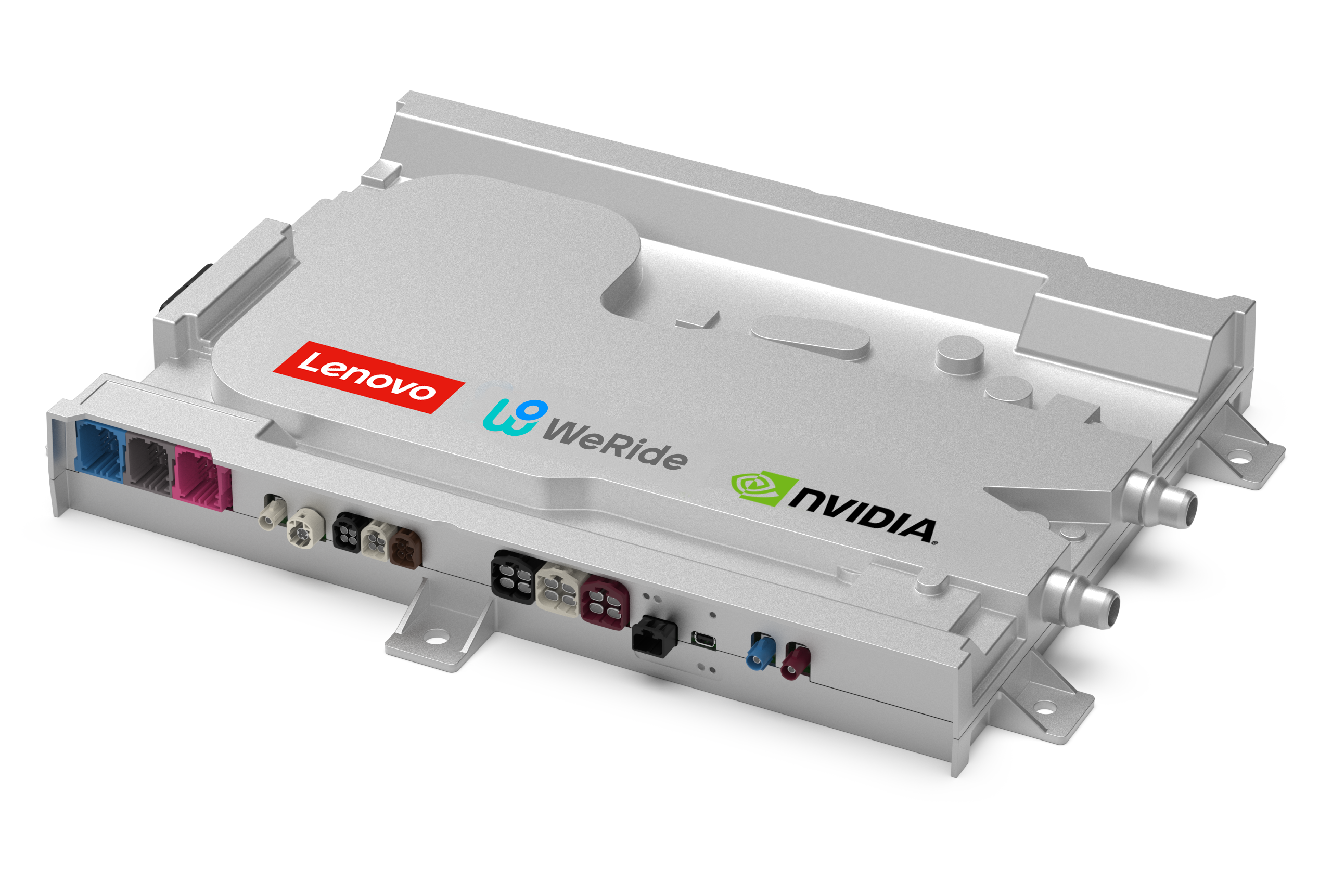
Core Viewpoint - WeRide has launched the HPC 3.0 high-performance computing platform, marking a significant advancement in autonomous driving technology and enabling the world's first mass-produced Level 4 autonomous vehicle, the Robotaxi GXR, powered by NVIDIA's DRIVE AGX Thor chips [1][4][10] Group 1: Product Development - The HPC 3.0 platform, developed in collaboration with Lenovo, features dual NVIDIA DRIVE AGX Thor chips and delivers up to 2,000 TOPS of AI compute, making it the most powerful computing platform for Level 4 autonomy [2][4] - The new platform reduces autonomous driving suite costs by 50% and cuts mass production costs to a quarter of its predecessor, HPC 2.0 [4][6] - HPC 3.0 consolidates key modules, which lowers the total cost of ownership (TCO) by 84% over its lifecycle compared to HPC 2.0 [4] Group 2: Safety and Compliance - HPC 3.0 is certified to AEC-Q100, ISO 26262, and IATF 16949 standards, with a failure rate below 50 FIT and a mean time between failures (MTBF) of 120,000 to 180,000 hours [5] - The platform is designed for 10 years or 300,000 km of use and can operate in extreme temperatures from -40°C to 85°C, meeting global VOCs environmental standards [5] Group 3: Strategic Partnerships - The collaboration with Lenovo and NVIDIA is highlighted as a major breakthrough in computing power and cost efficiency, enhancing vehicle reliability and responsiveness while significantly reducing deployment costs [6][7] - NVIDIA has been a strategic investor in WeRide since 2017, supporting the commercialization of autonomous driving solutions globally [8][9] Group 4: Market Position - WeRide is recognized as the world's first publicly listed Robotaxi company, having operated Robotaxis on public roads for over 2,000 days and tested its technology in over 30 cities across 10 countries [10][11] - The company has received autonomous driving permits in five markets: China, the UAE, Singapore, France, and the US, positioning itself as a leader in the autonomous driving industry [11]
因 ASIC 液冷趋势上升及机架级人工智能服务器增长,上调 2026 年预期;2026 年总可寻址市场(TAM)增长 66%-Global Tech_ Raising 2026E on ASIC rising liquid cooling trend and rack-level AI servers ramp up; +66% TAM growth in 2026E
2025-07-19 14:57
Summary of Global Tech Conference Call Industry Overview - The report focuses on the **Global Server Cooling** market, particularly the adoption of **liquid cooling** technologies in AI servers and ASIC servers [1][21][28]. Key Points Market Growth and Projections - The **Total Addressable Market (TAM)** for liquid cooling in AI training servers is projected to grow to **US$3.8 billion** in 2025 and **US$7.9 billion** in 2026, representing a **171%** and **106%** year-over-year growth respectively [1][15]. - The overall **Global Server Cooling TAM** is revised to **US$7.2 billion** in 2025 and **US$12.0 billion** in 2026, reflecting a **98%** and **66%** year-over-year growth [21][29]. Liquid Cooling Adoption Rates - Liquid cooling penetration for AI training servers is expected to rise from **15%** in 2024 to **45%** in 2025 and **74%** in 2026 [1][22]. - Full rack AI training servers will have a **100%** liquid cooling penetration rate, while baseboard-based AI training servers will see penetration rates of **27%** in 2025 and **52%** in 2026 [4][22]. Segment Analysis - For **general/HPC/AI inferencing servers**, liquid cooling penetration is anticipated to increase from **1%** in 2024 to **4%** in 2025 and **6%** in 2026 [23]. - The report indicates a potential upside from **ASIC servers**, with liquid cooling adoption driven by advancements in ASIC chips and improved ROI [28]. Component Breakdown - The TAM for liquid cooling components is detailed as follows: - **Cold plates**: US$1.1 billion in 2025, growing to US$2.2 billion in 2026 - **Manifold**: US$897 million in 2025, increasing to US$1.6 billion in 2026 - **Rear Door Heat Exchanger (RDHx)**: US$214 million in 2025, rising to US$283 million in 2026 - **Sidecar**: US$1.3 billion in 2025, reaching US$2.4 billion in 2026 - **CDU/RPU**: US$779 million in 2025, escalating to US$2.2 billion in 2026 [13][29]. Competitive Landscape - Key suppliers in the liquid cooling market include: - **Hon Hai**: Buy rating, market cap of US$77.1 billion - **Quanta**: Neutral rating, market cap of US$35.6 billion - **Wiwynn**: Buy rating, market cap of US$15.9 billion - **Lenovo**: Buy rating, market cap of US$15.9 billion - **Dell**: Buy rating, market cap of US$85.3 billion [32]. Additional Insights - The report highlights the importance of **liquid cooling** in meeting the increasing power demands of AI servers, particularly as computing power continues to rise [1][10]. - The adoption of liquid cooling technologies is expected to be a significant driver for the growth of the server cooling market, with major tech companies like Amazon, Microsoft, and Google investing in these solutions [28]. This summary encapsulates the critical insights from the conference call regarding the trends, projections, and competitive landscape of the global server cooling market, particularly focusing on liquid cooling technologies.
Lenovo - Mark Wallis (AMD at MWC 2025)
AMD· 2025-07-16 18:48
My name is Mark Wallis. I work for the ISG group at Lenovo, and I'm here to talk about how AMD and Lenovo work together to bring telco solutions. I have in front of me here, this is the latest 5th gen AMD server.It's called the SR645. It's a dual socket, Zen5C system. This has only just been released.We've released some 17 SKUs very recently on AMD. And we actually hold the world spec power record on AMD using one of these CPUs, the 9845 CPU, on this exact server. This is the dual socket server, and we're h ...

汇丰:ASIC服务器出货量将于 2025 年下半年加速
汇丰· 2025-07-14 00:36
Investment Rating - The report maintains a "Buy" rating for Wiwynn Corporation with a target price of TWD3,400, implying approximately 32.8% upside from the current price of TWD2,560 [4][21][22]. Core Insights - The report highlights stronger growth in ASIC servers compared to GPU servers, with expectations for continued momentum into the second half of 2025 [2][7]. - Major PC ODMs experienced a significant pull-in in notebook shipments in June 2025, with a 22% month-over-month increase and an 11% quarter-over-quarter rise, exceeding previous guidance [1][3]. - The overall outlook for notebook shipments in the second half of 2025 remains cautious due to unclear consumer demand, with a forecasted year-over-year growth of only 3% [3][4]. Summary by Sections ASIC Server Outlook - The demand for ASIC servers is expected to strengthen in the second half of 2025, particularly driven by AWS's Trainium 2 servers, with a forecast of sequential double-digit growth in rack shipments [2][4]. - The yield rate for GB200 server rack assembly is anticipated to improve from below 50% in the second quarter of 2025 to 60-70% in the second half of 2025 [2]. Notebook Market Analysis - The early pull-in of notebook shipments is largely completed, with a muted growth outlook for the second half of 2025 due to ongoing consumer demand uncertainty [3][4]. - The report estimates a 1% quarter-over-quarter increase in notebook shipments for the third quarter of 2025, which is below seasonal norms [3]. Stock Recommendations - Wiwynn is favored due to its strong revenue outlook supported by accelerating ASIC server shipments, with Oracle expected to contribute 7% to Wiwynn's revenue in 2025 [4][7]. - The report emphasizes the potential for additional upside from Oracle beyond 2025, driven by market share shifts and an expanding addressable market [4].