
Chipotle

Search documents
Why Investors Have Soured on Restaurant Stocks
The Motley Fool· 2025-08-19 15:34
Core Insights - Restaurant stocks are experiencing significant declines due to changing consumer preferences and economic pressures, with notable drops in companies like Cava and Chipotle [1][3][18] Company-Specific Analysis Cava - Cava's stock dropped 23% following a report of flat traffic and declining margins, with a lowered comparable sales growth guidance from 6% to 4-6% [3][4] - Despite a strong revenue growth of over 20% and restaurant-level profits also increasing by about 20% in Q2, same-store sales growth decelerated to 2.1%, significantly below analyst expectations [4][8] - Cava aims to expand from 398 locations to 1,000 by 2032, indicating a robust growth plan despite current challenges [8][4] Chipotle - Chipotle's stock is down 38% from its 2024 high, with same-store sales declining by 4% in Q2, primarily due to a 5% drop in transactions [9][11] - The departure of CEO Brian Niccol has raised questions about future performance, although the new CEO Scott Boatwright has a strong background in the industry [11][12] - Chipotle's same-store sales had previously outpaced the restaurant industry, and there are signs of recovery with positive trends noted in June [13][12] Industry Trends - The restaurant industry is facing a macroeconomic environment characterized by inflation, which is affecting both consumer behavior and operational costs [19][20] - Full-service restaurants are outperforming fast casual and fast food segments, suggesting a shift in consumer spending towards more sit-down dining experiences [20][21] - Consumers are becoming more selective with their discretionary spending, prioritizing value and experiences over quick-service options [21][22] Technology and Growth Opportunities - Toast, a restaurant technology company, is experiencing significant growth, adding 8,500 net new locations in Q2 and expanding its services beyond restaurants to include retail and grocery sectors [24][25] - Toast's strategic partnerships and broadening client base position it well for continued growth, despite the overall challenges in the restaurant sector [24][25]



Markets anticipate Fed's chair Powell's speech on Friday, retail earnings and the consumer
Yahoo Finance· 2025-08-18 15:48
I'm the finance executive editor Brian Saz and you're taking a look at a live shot of the opening bells on Wall Street on this Monday morning. Megaish ringing the bell at the New York Stock Exchange and CTW Cayman, a gaming platform company getting things popping over there at the NASDAQ. Now, there will be no shortage of market moving events this week.Ukraine President Vladimir Zalinski will be back in Washington after President Trump met with his Russian counterpart Vladimir Putin last week. Other Europea ...

Cava Stock Is Crashing. Is It Time to Buy?
The Motley Fool· 2025-08-15 10:55
Core Viewpoint - Cava Group's stock has significantly declined following a disappointing second-quarter report, with revenue and same-store sales falling short of analyst expectations [1] Group 1: Financial Performance - Cava's revenue for Q2 did not meet analyst expectations, with same-store sales growth at only 2.1% [1] - The company has revised its full-year same-store sales outlook down to a range of 4% to 6%, which is two percentage points lower than previous guidance [1] - Despite the slowdown, Cava's total revenue increased by 20.3% year over year [9] Group 2: Factors Impacting Performance - The introduction of steak to the menu last year created a tough comparison for same-store sales, contributing to the current slowdown [2] - Newly opened restaurants in 2024 experienced a "honeymoon effect," initially outperforming expectations but failing to sustain that growth [3] - Economic conditions are affecting Cava, although premium item attach rates remain unchanged; same-store guest traffic was roughly flat in Q2 [4] Group 3: Expansion Plans - Cava opened 16 new restaurants in Q2, bringing the total to 398, with plans to open 68 to 70 restaurants by the end of the year [5] - The company aims to operate 1,000 restaurants by 2032, requiring an average of 80 openings annually starting in 2026 [5] - At the current average unit volume (AUV) of $2.9 million, revenue could reach $2.9 billion with 1,000 restaurants, indicating potential for AUV growth [6] Group 4: Valuation and Market Position - Cava's stock was previously trading at around 18 times annual sales but has since decreased to approximately 7.3 times trailing-12-month sales, still above Chipotle's valuation of about 5 times [8] - Cava is expected to grow faster than Chipotle due to its smaller restaurant base, with the potential for significant revenue growth from new openings [9] - The company's model appears sustainable, with 2025 restaurant openings projected to achieve AUVs above $3 million, nearing Chipotle's levels [11]

PPI Surges
Benjamin Cowen· 2025-08-14 18:40
Inflation Analysis - The producer price index (PPI) increased significantly from approximately 23% to 33% year-over-year, a full percentage point increase, exceeding market expectations of 25% [3][4] - The consumer price index (CPI) saw a smaller increase, rising from 267% to about 273% [3] - PPI measures inflation upstream at the production or wholesale stage, while CPI measures it downstream at the consumer level [6][7] - While upstream prices are increasing, it remains to be seen if these costs will be passed on to consumers and reflected in CPI [8][9] - Food and beverage inflation remained relatively stable, while housing inflation decreased, masking increases in other categories such as medical care and recreation [17][18][19] - Housing inflation accounts for approximately two-thirds of overall CPI [20] Market Impact and Monetary Policy - The surge in PPI caused market sell-offs, particularly around 8:30 AM when the data was released [17][33] - Despite the PPI increase, the market still anticipates a rate cut in September, with approximately a 90% probability, although this was previously higher at 97% or 98% [23] - The report suggests that even with a rate cut, the long end of the yield curve may increase due to inflation concerns [24] - Cutting rates with rising inflation may not improve the housing market and could potentially worsen it [27] Consumer Behavior - Sales are declining at some stores like Chipotle, Cava, and Sweetgreen, indicating that consumers may be unwilling to pay higher prices [10][11][13][14] - Lower-end pizza chains are experiencing increased demand, suggesting consumers are seeking more affordable options [12][15]

The consumer is under more pressure now, says Bernstein's Danilo Gargiulo
CNBC Television· 2025-08-13 21:01
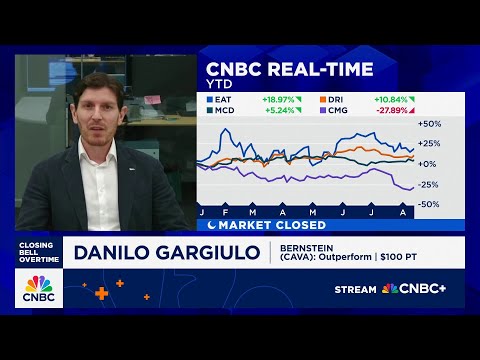
Market Trends & Consumer Behavior - A divergence exists between fast casual and full-service restaurants, potentially influenced by pricing [2][3] - Fast casual restaurants have historically taken less price increases compared to quick service restaurants, attracting incremental consumer spending and traffic [6] - A normalization of trends is occurring, with consumers recognizing that full dining settings may offer better value [6][7] - The consumer is leaning into value, but the perception of value has shifted as fast casual prices compete with dining-in options [7] - Higher-income consumers of quick service restaurants are trading up to fast casual for perceived better value for money [8] - Lower-income consumers are facing pressure, leading to some fading away from the entire restaurant sector [8][9] Pricing Strategies - For approximately $20, consumers can dine in a full-service restaurant, whereas the same amount might only buy a bowl in central Manhattan [3] - Quick service restaurants have taken even more price increases than fast casual restaurants [7] Impact on Restaurant Categories - Casual dining restaurants like Chili's and Olive Garden are bringing back value offerings [7] - The pressure on lower-income consumers is not being offset by the up-trading of higher-income consumers, resulting in a net negative impact on overall restaurant demand [8][9]
Cava cuts full-year outlook
CNBC Television· 2025-08-13 15:59
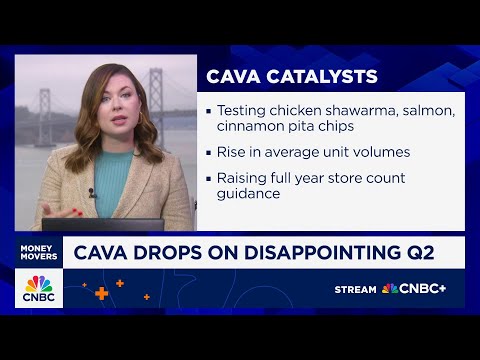
Company Performance - Cava's same-store sales increased by 21%, falling short of the expected 61% [1] - Traffic remained approximately flat during the quarter [2] - Cava reduced its full-year same-store sales forecast to a range of 4% to 6% growth [2] - Cava is testing new menu innovations like chicken schwarma, salmon, and cinnamon pita chips [3] - Cava increased its store count guidance for the full year [3] Industry Trends - The casual dining space is experiencing a "fluid macroeconomic environment" impacting consumer behavior [4] - Sweet Green also experienced a same-store sales miss and cut guidance due to consumer pullback [4][5] - Fast casual restaurants like Cava and Sweet Green, which were top performers in 2024 (up 162% and 183% respectively), are now facing pressure [5] - Fast food and casual dining names are performing better as diners seek more affordable options [6] - Chili's same-store sales are up 39% on a three-year stack [6] - Consumer spending varies significantly by company, influencing stock performance [8]
Market rally is in an unstoppable 'sugar high,' analyst says, plus CoreWeave tumbles after earnings
Yahoo Finance· 2025-08-13 15:40
Market Trends & Records - The market is betting on a September Fed rate cut, with the S&P 500, NASDAQ, Nvidia, Japan's topics exchange, and Taiwan's major stock index all at record highs [2][3] - The S&P 500 has reached its 16th record close this year, underperforming the 57 all-time highs seen in 2024 [5] - There is a 982% probability of a Fed rate cut at the next meeting, according to the CME Fed Watch tool [11] Company Performance & Earnings - Bullish rang the opening bell at the New York Stock Exchange on its IPO day, raising $11 billion with an initial valuation of approximately $56 billion [1][2] - Coreweave's stock is opening down 11% after missing earnings expectations and is not expected to be profitable until 2026 [6] - Cava's stock is opening down 20% after disappointing earnings, with revenue and same-store sales below expectations, leading to a cut in full-year guidance [8] - Starbucks is in turnaround mode, with the stock still valued as a growth stock and trading at a premium to the broader market [50] Investment Strategy & Risk - The market is not tolerant of companies falling short of earnings forecasts or retracting guidance, leading to significant penalties [14][15] - Diversification is key to profiting from the market, or holding tight through volatility in concentrated names like the MAG7 [15][16] - The market may be too top-heavy and priced for perfection, with the top 20 mega-cap stocks outperforming the S&P 500 since the April lows [30][31] - Geopolitical risks, such as Trump's China tariff extension and the Trump-Putin meeting, are potential near-term risks that the market may be overlooking [61][64] Consumer Behavior & Restaurant Industry - Consumer behavior patterns are shifting in the post-pandemic world, impacting the value proposition for some companies [9] - Restaurants are battling through consumer spending headwinds, as seen in Cava's stock crash [44] - Starbucks is focusing on improving the in-store experience to attract customers, especially with more people working hybrid or remotely [53][54]

Calls of the Day: Chipotle, Starbucks, Oklo, ConocoPhillips, KKR, Ulta and American Express
CNBC Television· 2025-08-12 17:24
Stock Upgrades and Downgrades - Chipotle was upgraded to overweight by Piper Sandler, but the price target was trimmed to $50 from $53, citing a favorable risk-reward profile [1] - Starbucks was upgraded to outperform at Bear, with high conviction in the effectiveness of turnaround strategies under new leadership [3] - Olo's price target was increased by $5 to $80 with an outperform rating at Wed Bush, driven by solid results and significant tailwinds [3] Company Performance and Outlook - Chipotle is expected to benefit from easy comparisons in the second half of the year, driven by new products and high single-digit unit growth [2] - Starbucks is estimated to be 50-60% through its turnaround, with another four to six quarters remaining [3] - KKR is Goldman Sachs' top pick in private equity, favored for its potential to see accelerating growth and reasonable multiples, despite being down 11% from its highs [5][6] - Ulta Beauty's price target was raised to $600 from $510 by Oppenheimer, indicating that the bull run is still in the early to middle stages [6][7] - American Express has been a strong performer, purchased in July 2023 at $168, consistently delivering on revenue growth, although momentum has flattened to 2% year-to-date [8][9] Investment Themes - The nuclear trade is favored, particularly small modular reactors being built with the help of open AAI in 2027, expected to generate strong recurring revenue [4] - Integrated oil companies like Chevron and Exxon are favored, with Kico Phillips also delivering strong performance as a dividend juggernaut [5]

Trade Tracker: Stephanie Link buys more Chipotle, Uber, Eaton and Rockwell Automation
CNBC Television· 2025-08-07 17:21
Investment Thesis on Chipotle (CMG) - Chipotle's same-store sales challenges are viewed as industry-wide, with potential resolution through growth drivers like new products and technology [2] - The company anticipates a strong June ending with improved traffic trends, a decent pricing strategy, and high single-digit percentage unit growth [3] - Despite a 29% year-to-date decrease, there's conviction in Chipotle's long-term growth due to a return to traffic growth, best-in-breed margins, and a reasonable valuation [3][5][16] - Chipotle holds only 3% market share in a $400 billion industry, suggesting significant growth potential [6] - The stock is considered a relative value, especially given its washed-out state and lack of discussion [18] Industrial Sector Insights - Industrial electrification is experiencing rapid growth [8] - Rockwell's core earnings increased by 51 cents, with margins expanding over 200 basis points [9] - Eaton saw 55% order growth in its electrical business, particularly in data centers, indicating strong visibility [9] Uber (UBER) Investment - Uber's stock experienced good earnings but bad price action, leading to increased investment [26] - The company reported all-time highs in frequencies, profitability, and customer count, with a $20 billion buyback program [26][27] - Despite solid results, the stock was down due to unmet expectations regarding the expansion of the Waymo partnership [28] Market Sentiment and Valuation - The consumer sentiment in April and May was challenging, impacting the restaurant industry [13] - Chipotle's valuation is around 30 times forward earnings, compared to a historical average of 40 times [3][21] - The current market favors AI stocks, making it harder for companies with decent but not exceptional valuations to attract investor dollars [19]

主题投资阿尔法-人工智能应用者已登场:参与方式 + 解析人工智能应用案例 Thematic Alpha-The AI Adopters Are Here Ways to Play + Breaking Down AI Adoption Use Cases
2025-08-05 03:15
Summary of AI Adoption and Investment Opportunities Industry Overview - The thematic report focuses on the rapid adoption of AI across various sectors, highlighting its role in enhancing operational efficiencies, customer experiences, and product offerings [1][2][11]. Key Insights on AI Adoption - AI is increasingly being utilized for automating supply chains, improving customer service, optimizing financial forecasting, and accelerating research and development [2][11]. - A survey indicates that 60% of CIOs expect to have GenAI-based workloads in production by the end of 2025, with primary objectives being internal productivity, labor savings, and customer-facing applications [3][12]. - Companies are customizing AI technologies through in-house development or partnerships, leading to immediate benefits such as time savings, improved accuracy, and enhanced customer engagement [4]. Investment Opportunities - A comprehensive screening of AI exposure across various companies has led to the identification of five categories for potential investment: 1. **High Materiality + High Pricing Power**: Companies where AI is core to the investment thesis and have significant pricing power [21]. 2. **Improving Rate of Change on AI Materiality**: Companies showing an increasing significance of AI in their operations [22]. 3. **Mispriced Adopters**: Companies where the options market is pricing in a low probability of meeting analyst expectations [25]. 4. **Combining Secular with Cyclical**: High-quality, large-cap stocks that are also AI adopters [28]. 5. **Stocks Appearing Across Multiple Screens**: Companies that appear in multiple investment categories, indicating strong potential [32]. Notable Companies and Their AI Initiatives - **Amazon (AMZN)**: - Over 1,000 AI applications in progress, utilizing one million robots for operational efficiency. AI applications include demand prediction, customer support automation, and personalized shopping experiences [35][36][40]. - **Microsoft (MSFT)**: - Implementing AI across various functions, including sales and customer service, with a focus on reducing operational costs and improving efficiency [47][51]. - **Shopify (SHOP)**: - Encouraging AI integration among employees, with tools like Shopify Magic for automated store management and customer engagement [56][60]. - **Walmart (WMT)**: - Utilizing AI for customer experience enhancements, inventory management, and supply chain optimization, including drone delivery services [65][72]. - **Chipotle (CMG)**: - Investing in AI for customer engagement and operational automation, including autonomous kitchen technologies [77][82]. Additional Considerations - The report emphasizes the importance of understanding the specific AI use cases and their impact on operational efficiency across different sectors [15][34]. - Companies are expected to continue evolving their AI strategies, which may lead to further investment opportunities as AI technologies mature and become more integrated into business operations [46][73]. This summary encapsulates the key points regarding AI adoption across industries, potential investment opportunities, and notable company initiatives, providing a comprehensive overview for stakeholders interested in the evolving landscape of AI in business.