Inditex

Search documents
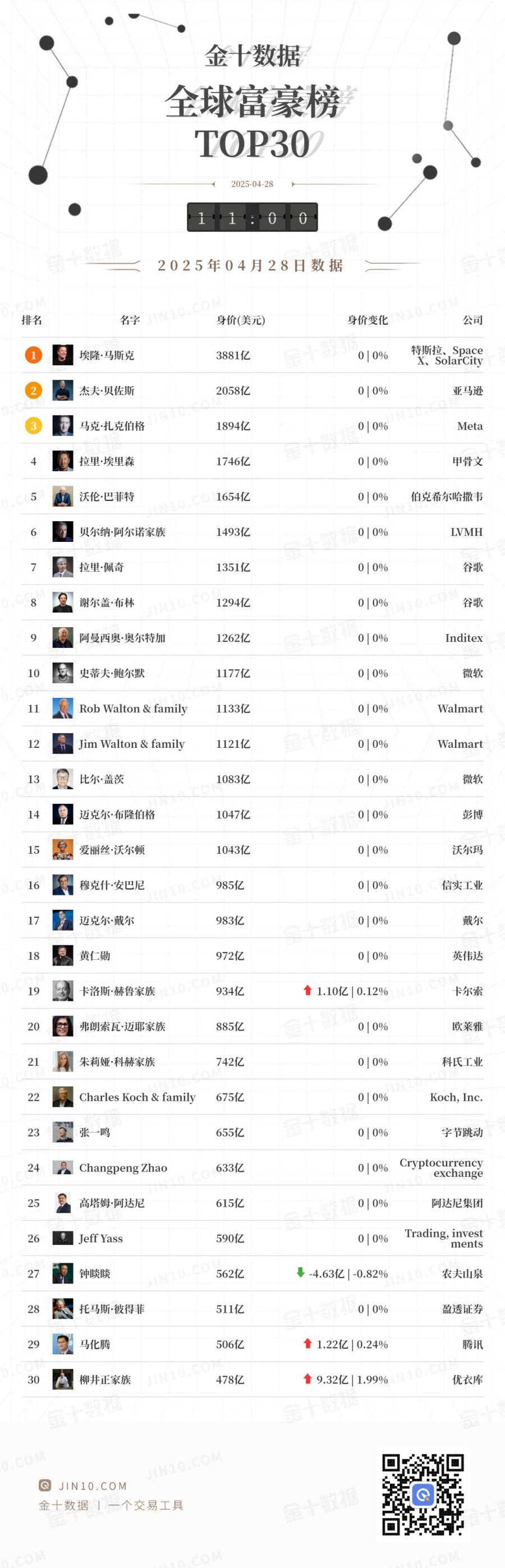
金十图示:2025年04月28日(周一)全球富豪榜





news flash· 2025-04-28 03:04
金十图示:2025年04月28日(周一)全球富豪榜 | 12 | Jim Walton & family | 1121亿 | 0 0% | Walmart | | --- | --- | --- | --- | --- | | 13 | 比尔·盖茨 | 1083亿 | 0 0% | 微软 | | 14 | 迈克尔·布隆伯格 | 1047亿 | 0 0% | 剪曲 | | 15 | 爱丽丝·沃尔顿 | 1043亿 | 0 0% | 沃尔玛 | | 16 | 穆克什·安巴尼 | 985亿 | 0 0% | 信实工业 | | 17 | 迈克尔·戴尔 | 983亿 | 0 0% | 戴尔 | | 18 | 黄仁勋 | 972亿 | 0 0% | 英伟达 | | 19 | 卡洛斯·赫鲁家族 | 934亿 | ↑ 1.10亿 0.12% | 卡尔索 | | 20 | 弗朗索瓦·迈耶家族 | 885亿 | 0 0% | 欧莱雅 | | 21 | 朱莉娅·科赫家族 | 742FL | 0 0% | 科氏工业 | | 22 | Charles Koch & family | 675亿 | 0 0% | Koch, Inc. | ...

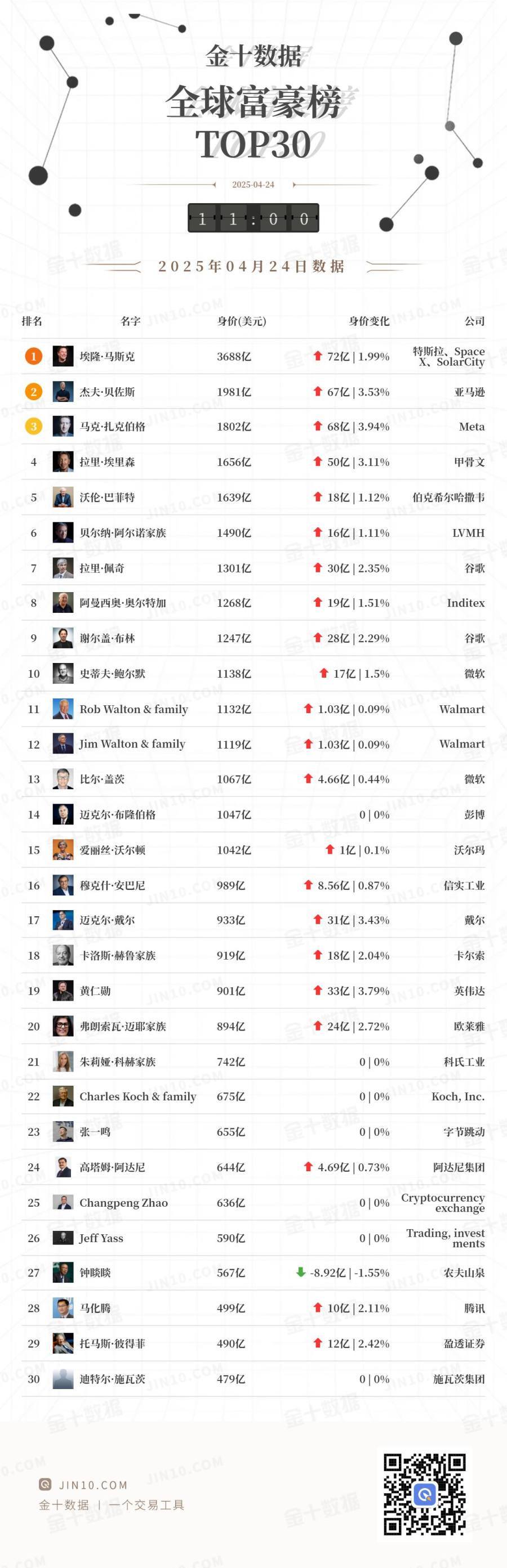
金十图示:2025年04月24日(周四)全球富豪榜
news flash· 2025-04-24 03:04
0. Cur @ JIN10.COM JIN10.COM 金十数据 | 一个交易工具 gan - coMerce of the come com | 排名 | 名字 | 身价(美元) | 身价变化 | 公司 | | --- | --- | --- | --- | --- | | | 埃隆·马斯克 | 3688亿 | ↑ 72亿 1.99% | | | 2 | 杰夫·贝佐斯 | 1981亿 | 1 67亿 3.53% | 亚马逊 | | | 马克·扎克伯格 | 1802亿 | 1 68亿 3.94% | Meta | | 4 | 拉里·埃里森 | 1656亿 | ↑ 50亿 3.11% | 甲骨文 | | 5 | 沃伦·巴菲特 | 0 1639亿 | ↑ 18亿 1.12% | 伯克希尔哈撒韦 | | 6 | 贝尔纳·阿尔诺家族 | 1490亿 | ↑ 16亿 1.11% | LVMH | | 7 | 拉里·佩奇 | 1301亿 | 1 30亿 2.35% | 谷歌 | | 8 | 阿曼西奥·奥尔特加 10.0 | 1268亿 | ↑ 19亿 1.51% | Inditex | | 9 | 谢尔盖·布林 | 1 ...
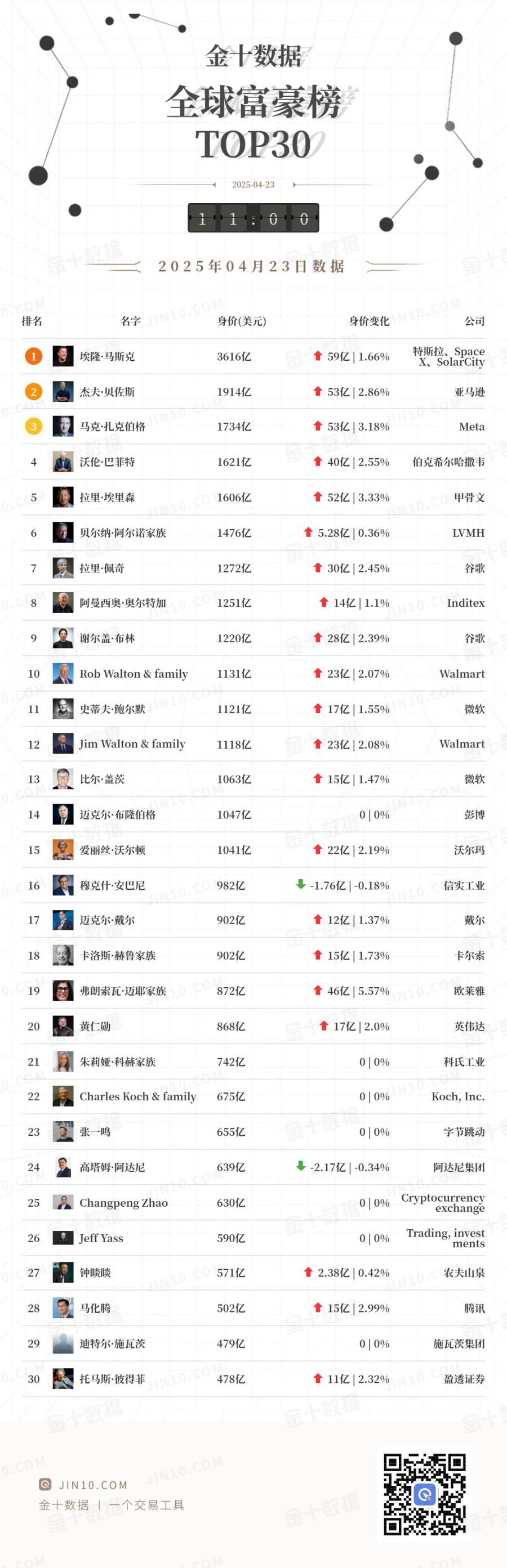
金十图示:2025年04月23日(周三)全球富豪榜


news flash· 2025-04-23 03:04
金十图示:2025年04月23日(周三)全球富豪榜 - com | 排名 | 名字 | 身价(美元) | 身价变化 | 公司 | | --- | --- | --- | --- | --- | | | 埃隆·马斯克 | 3616亿 | 1 59亿 1.66% | | | 2 | 杰夫·贝佐斯 | 1914亿 | 1 53亿 2.86% | 亚马逊 | | | 马克·扎克伯格 | 1734亿 | 1 53亿 3.18% | Meta | | 4 | 沃伦·巴菲特 | 1621亿 | 1 40亿 2.55% | 伯克希尔哈撒韦 | | 5 | 拉里·埃里森 | - 0 1606亿 | 1 52亿 3.33% | 甲骨文 | | 6 | 贝尔纳·阿尔诺家族 | 1476亿 | ↑ 5.28亿 0.36% | LVMH | | 7 | 拉里·佩奇 | 1272亿 | 1 30亿 2.45% | 谷歌 | | 8 | 阿曼西奥·奥尔特加 10. | 1251亿 | ↑ 14亿 1.1% | Inditex | | 9 | 谢尔盖·布林 | 1220亿 | 1 28亿 2.39% | 谷歌 | | 10 | Rob Wa ...
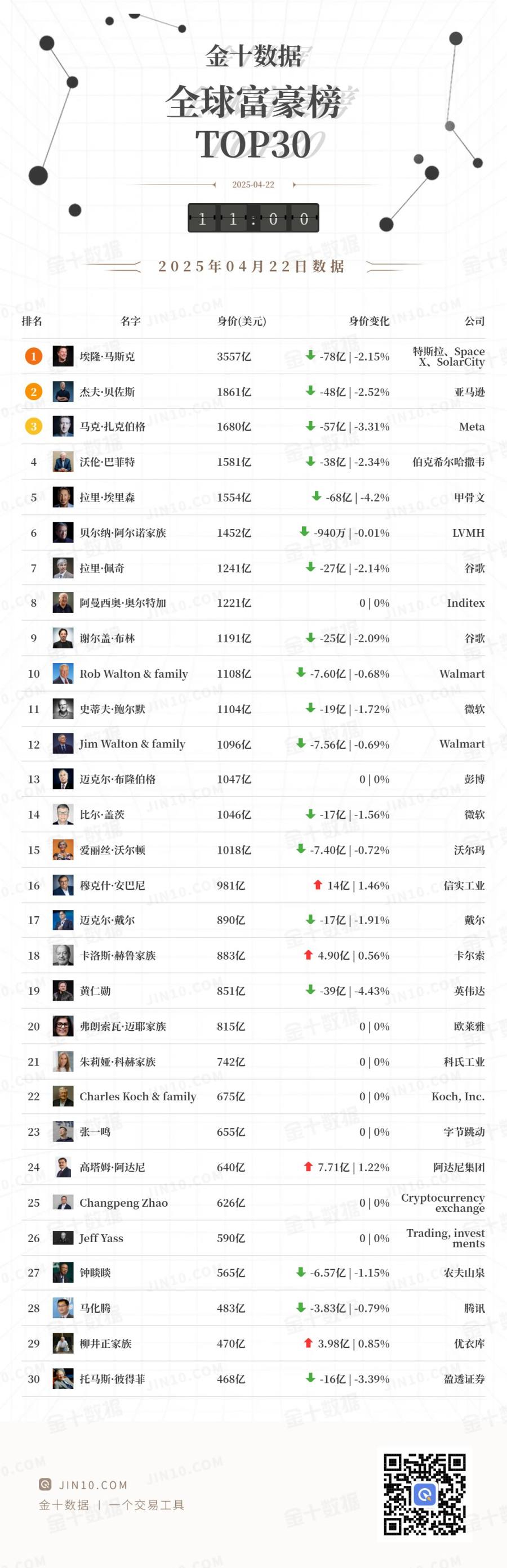
金十图示:2025年04月22日(周二)全球富豪榜
news flash· 2025-04-22 03:07
| 排名 | 名字 | 身价(美元) | 身价变化 | 公司 | | --- | --- | --- | --- | --- | | | 埃隆·马斯克 | 3557亿 | + -78亿 -2.15% | | | 2 | 杰夫·贝佐斯 | 1861亿 | + -48亿 -2.52% | 亚马斯 | | | 马克·扎克伯格 | 1680亿 | + -57亿 -3.31% | Meta | | 4 | 沃伦·巴菲特 | 1581亿 | + -38亿 -2.34% | 伯克希尔哈撒韦 | | 5 | 拉里·埃里森 | - 1554亿 | + -68亿 -4.2% | 甲骨文 | | 6 | 贝尔纳·阿尔诺家族 | 1452亿 | + -940万 -0.01% | LVMH | | 7 | 拉里·佩奇 | 1241亿 | + - 27亿 - 2.14% | 谷歌 | | 8 | 阿曼西奥·奥尔特加 | 10.6 1221亿 | 0 0% | Inditex | | 9 | 谢尔盖·布林 | 1191亿 | + - 25亿 - 2.09% | 谷歌 | | 10 | Rob Walton & family | 1108亿 ...
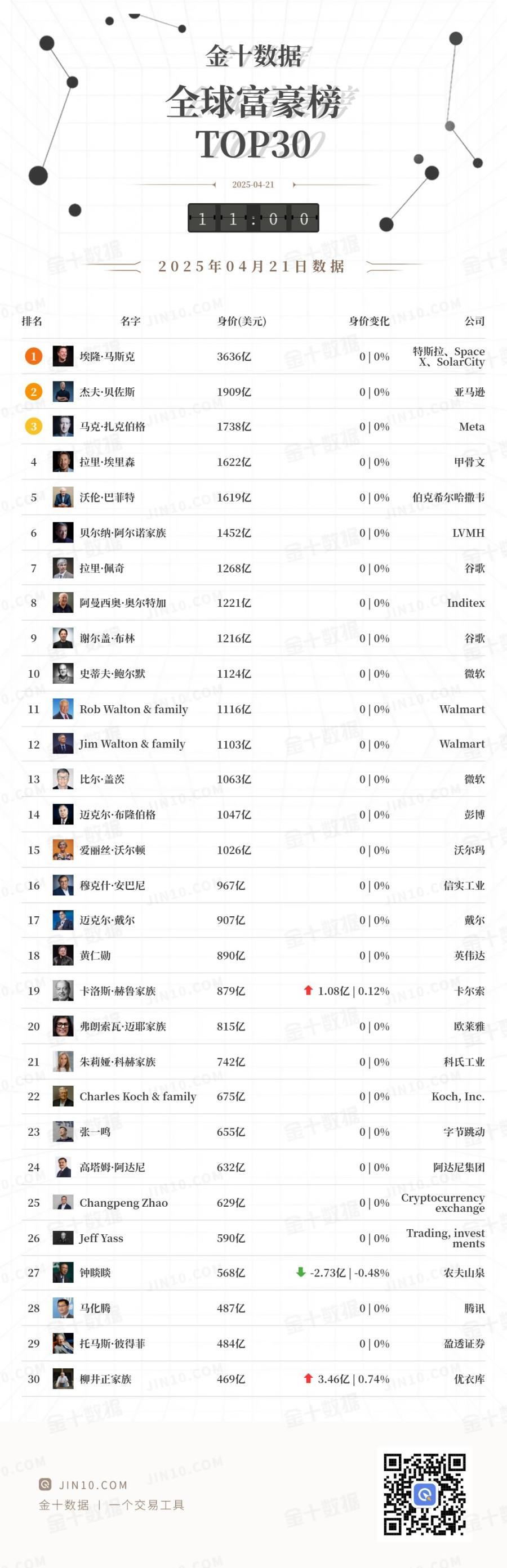
金十图示:2025年04月21日(周一)全球富豪榜
news flash· 2025-04-21 03:05
| 12 | | Jim Walton & family | 1103亿 | 0 0% | Walmart | | --- | --- | --- | --- | --- | --- | | 13 | | 比尔·盖茨 | 1063亿 | 0 0% | 微软 | | 14 | | 迈克尔·布隆伯格 | 1047亿 | 0 0% | 彭博 | | 15 | | 爱丽丝·沃尔顿 | 1026亿 | 0 0% | 沃尔玛 | | 16 | | 穆克什·安巴尼 | 967亿 | 0 0% | 信实工业 | | 17 | | 迈克尔·戴尔 | 907亿 | 0 0% | 戴尔 | | 18 | | 黄仁勋 | 890亿 | 0 0% | 英伟达 | | 19 | | 卡洛斯·赫鲁家族 | 879亿 | ↑ 1.08亿 0.12% | 卡尔索 | | 20 | | 弗朗索瓦·迈耶家族 | 815亿 | 0 0% | 欧莱雅 | | 21 | | 朱莉娅·科赫家族 | 742FL | 0 0% | 科氏工业 | | 22 | | Charles Koch & family | 675亿 | 0 0% | Koch, Inc. ...
关税战下,服饰巨头们出路在哪?
36氪· 2025-04-08 14:36
Core Viewpoint - The article discusses the impact of the U.S. government's tariff policies on the global fashion and textile industry, highlighting the shift in supply chains and production strategies among major brands in response to rising costs and geopolitical tensions [4][17]. Supply Chain Dynamics - The textile industry is undergoing a significant transformation, with companies relocating production to countries like Vietnam, Cambodia, and Bangladesh due to rising labor costs in China and stricter regulations [6][7]. - The COVID-19 pandemic accelerated this migration, prompting brands to diversify their supply chains and avoid over-reliance on a single country [7][8]. Regional Production Strategies - Many companies are adopting a "nearshoring" strategy, producing goods closer to key consumer markets to reduce shipping times and costs [8][9]. - Luxury brands like Hermès and Louis Vuitton are increasing local production in Europe and the U.S. to enhance brand image and maintain product quality [9][10]. Case Studies: Adidas and Zara - Adidas is focusing on a "market-oriented supply chain regionalization," aiming to mitigate tariff risks by increasing local production in China and sourcing from non-sensitive regions for the U.S. market [12][14]. - Zara's parent company, Inditex, maintains a high level of production in Europe, allowing for rapid response to market demands and optimizing inventory management [15][16]. Financial Implications - Zara's profit margins are significantly higher than industry averages, allowing for greater flexibility in pricing amidst rising costs due to tariffs [16]. - The shift towards supply chain resilience reflects a broader trend in the fashion industry, moving from a focus on low costs to balancing cost, speed, and risk [17].

耐克们,出路在哪?
36氪未来消费· 2025-04-08 03:03
Core Viewpoint - The article discusses the impact of the US-China tariff war on the fashion industry, highlighting the need for companies to adapt their supply chains and production strategies to mitigate risks and maintain competitiveness in a changing landscape [4][16]. Supply Chain Dynamics - The textile industry is experiencing a migration of production from China to countries like Vietnam, Cambodia, and Bangladesh, driven by rising labor costs and regulatory changes in China [5][6]. - The COVID-19 pandemic accelerated this shift, prompting brands to diversify their supply chains and avoid over-reliance on a single country [6][16]. - The concept of "China +1" has emerged, where companies maintain production in China while also establishing additional bases in other countries to enhance resilience [6][7]. Nearshoring Trends - Many companies are exploring "nearshoring," which involves relocating production closer to key consumer markets to reduce shipping times and costs [7][8]. - European luxury brands, such as Hermès and LVMH, are increasingly investing in local production to enhance brand image and maintain product quality [8]. Case Studies: Adidas and Zara - Adidas is shifting towards a "market-oriented supply chain regionalization," focusing on local production in China and other non-sensitive regions to mitigate tariff risks [10][12]. - Zara's parent company, Inditex, maintains a high level of in-house production in Europe, allowing for rapid response to market demands and higher profit margins compared to competitors [13][14]. Strategic Shifts in Fashion Retail - The fashion retail industry is transitioning from a focus on absolute low costs to building supply chain resilience, balancing cost, speed, and risk [14][16]. - Both Adidas and Zara exemplify different approaches to navigating the challenges posed by tariffs and changing consumer preferences, with Adidas focusing on regionalization and Zara on centralized production [14][15].



Zara在宜家里卖星巴克
创业邦· 2025-03-30 03:49
Core Viewpoint - Fashion brands are increasingly diversifying their business models by integrating food and beverage services to attract more customers and extend their in-store experience, reflecting challenges in the Chinese market [3][6][7]. Group 1: Zara's New Store Strategy - Zara opened a new flagship store in Nanjing, covering over 2500 square meters and featuring a unique collaboration with local coffee brand UNIUNI, introducing the first Zacaffè in Asia [4][13]. - The store design includes a blend of high-end fashion and local cultural elements, aiming to enhance customer experience and engagement [13][14]. - Despite the grand opening, Zara's performance in China has been declining, with a reduction in store numbers from around 183 to approximately 70 [14][17]. Group 2: Industry Trends and Challenges - The fashion industry is witnessing a trend of integrating dining experiences, with luxury brands like Prada and LV also exploring similar strategies to boost foot traffic and customer retention [6][7][8]. - The overall market for high-end fashion is under pressure, with a notable decline in core consumer groups and a shift towards more affordable alternatives [21][22]. - The Chinese luxury market is experiencing a downturn, with a reported 2% decrease in high-end consumption in 2024, leading brands to rethink their strategies [21][22]. Group 3: Brand Adaptation and Future Outlook - Brands are focusing on larger store formats and multi-functional spaces to attract customers, as seen with plans for LV's expansion in Hong Kong [23][24]. - The rise of local brands and changing consumer preferences are prompting international brands to adapt their strategies in China, emphasizing the importance of local relevance [22][30]. - Despite challenges, companies like Inditex remain committed to the Chinese market, planning further store renovations and expansions to align with local demands [30][31].

Industria de Diseño Textil, S.A. (IDEXY) H1 2023 Earnings Call Transcript
2023-09-13 10:21
Summary of Inditex H1 2023 Earnings Conference Call Company Overview - **Company**: Industria de Diseño Textil, S.A. (Inditex) - **Date of Call**: September 13, 2023 - **Key Participants**: - Oscar Garcia Maceiras - CEO - Ignacio Fernández - CFO - Marcos López - Capital Markets Director Core Industry Insights - **Industry**: Fashion Retail - **Market Presence**: Operates in 213 markets with low market penetration, indicating significant growth opportunities in a fragmented sector [7][10][26] Financial Performance - **Sales Growth**: - Total sales increased by 15.5% to €16.8 billion, with a constant currency growth of 16.5% [9] - Online and store sales grew by 14% from August 1 to September 11, 2023 [5][27] - **Net Income**: Increased by 40% to €2.5 billion [5][9] - **EBITDA**: Grew by 16% to €4.7 billion [8] - **Gross Margin**: Stable at 58.2%, with expectations of a +/- 50 basis points fluctuation for the fiscal year [10][37] - **Free Cash Flow**: Significant generation, leading to a net cash position of €10.5 billion [9][11] Operational Highlights - **Inventory Management**: Inventory as of July 31, 2023, was 7% lower than the previous year, indicating effective supply chain management [11][41] - **Store Expansion**: Opened stores in 20 different markets, with plans for further expansion [13][26] - **Customer Experience**: Focus on enhancing customer experience through innovative store designs and technology [16][19] Strategic Initiatives - **Sustainability Goals**: - New targets set for 2025 include circular IT services and inclusion of 3 million people in the supply chain [20][21] - Commitment to reduce emissions by over 50% by 2030 and achieve zero net emissions by 2040 [22] - **Fashion Proposition**: Emphasis on creativity and innovation, with successful collections launched [14][15] - **Technological Integration**: Implementation of new security technology in stores and enhancements in online operations [19][55] Market Outlook - **Growth Projections**: Anticipated gross space growth of around 3% in 2023, with positive contributions from existing stores [26][48] - **Long-term Strategy**: Focus on maintaining a differentiated business model and optimizing operations for sustained growth [51] Additional Insights - **Collaborations**: Notable collaborations with prominent talents to enhance fashion offerings [54] - **Online Sales Performance**: Strong growth in online sales, supported by an integrated store and online model [55][56] This summary encapsulates the key points from Inditex's H1 2023 earnings conference call, highlighting the company's robust financial performance, strategic initiatives, and market outlook.