
服饰

Search documents
纺织服装行业周报:阿迪指引26年中国区低双位数增长
HUAXI Securities· 2026-03-06 13:25
Investment Rating - The industry rating is "Recommended" [5] Core Insights - The report highlights significant growth in the textile and apparel industry, with major companies like On Running and Adidas reporting record sales and profits for 2025. On Running's net sales reached 3.014 billion Swiss Francs, a 30% increase year-on-year, while Adidas achieved a global revenue of 24.8 billion Euros, a 13% increase [2][3][4][16]. Summary by Sections Company Performance - On Running's net sales for 2025 reached 3.014 billion Swiss Francs, marking a 30% year-on-year growth, with a net profit of 203 million Swiss Francs, despite a 15.9% decline in profit [2][15]. - Adidas reported a record global revenue of 24.8 billion Euros, a 13% increase, with operating profit rising 54% to 2.06 billion Euros and net profit increasing over 70% to 1.34 billion Euros [3][16]. Regional Performance - On Running's sales in the Asia-Pacific region surged by 96.4% to 511 million Swiss Francs, while Adidas's Greater China revenue grew by 13% to 3.62 billion Euros, marking eleven consecutive quarters of growth [2][3][15][16]. Product Category Performance - On Running's apparel sales increased by 68.2% to 170 million Swiss Francs, while Adidas's footwear revenue rose by 12% to 1.423 billion Euros, with running business revenue exceeding 30% growth [2][3][16]. Financial Health - On Running maintained a cash reserve exceeding 1 billion Swiss Francs and an operating cash flow of 359.5 million Swiss Francs. Adidas improved its operating expense ratio from 34.2% to 31.4% and plans to return 1.5 billion Euros to shareholders in 2026 [2][3][16]. Future Guidance - On Running expects a minimum of 23% growth in net sales for 2026, with a gross margin not lower than 63% and an adjusted EBITDA margin of 18.5%-19% [2][15]. - Adidas anticipates close to double-digit growth in revenue for 2026, with a focus on key markets and product categories, aiming for a gross margin target of 50%-52% by 2028 [3][16].
2026年春节零售市场数据点评
Lian He Zi Xin· 2026-03-04 11:16
Retail Performance - During the 2026 Spring Festival holiday, retail consumption demand showed signs of recovery, with a 9-day holiday arrangement supporting pre-holiday purchases and holiday consumption[2] - Key retail and catering enterprises reported an average daily sales increase of 10.6% in the first two days of the holiday compared to the previous year[4] - The average daily sales of key retail and catering enterprises during the entire holiday increased by 5.7% compared to the 2025 Spring Festival, accelerating by 1.6 percentage points[4] Consumer Behavior - Offline retail saw significant growth, with foot traffic and sales in monitored shopping districts increasing by 6.7% and 7.5% respectively compared to last year[5] - Jewelry, food, and clothing categories experienced high growth rates, with jewelry sales up by 33.4%, food by 23.0%, and clothing by 17.3%[6] - Instant retail orders surged, with platforms like JD's 7Fresh seeing a 102% increase in online orders year-on-year[5] Policy Support - The "Happy New Year" promotional activities and various consumption subsidy policies provided crucial support for retail demand recovery[7] - Approximately 20.5 billion yuan was allocated for local consumption promotion funds during the holiday, directly supporting consumer spending[8] - The "old-for-new" policy benefited 31.12 million people, generating sales of 207.03 billion yuan, with a 21.7% increase in sales of specific home appliances and digital products compared to the previous year[8] Future Outlook - The sustained improvement in the retail sector will depend on macroeconomic factors such as household income and employment expectations, as well as the continuation of fiscal consumption policies[9] - The retail industry is expected to continue its moderate recovery, supported by improved service capabilities and the penetration of new business models[9]
工坊车间忙增收
Xin Lang Cai Jing· 2026-02-27 17:28
Core Insights - The establishment of the "Yuan Dream" Women's Prosperity Workshop in Qinhai County aims to address employment challenges faced by relocated residents, particularly women and the elderly, after the construction of the Qinhai Reservoir [1][2] - The workshop has become a local income-generating hub, allowing participants to earn an average monthly income of 3,000 to 4,000 yuan, with some individuals reporting daily earnings exceeding 100 yuan [1] - The local garment processing factory, which employs over 20 relocated residents, anticipates an increase in annual output value from 2 million yuan to 3 million yuan, reflecting the growing demand for local employment opportunities [2] Employment Initiatives - Qinhai County has focused on creating job opportunities for reservoir migrants by establishing workshops and attracting businesses, thereby facilitating "employment at the doorstep" for women and the elderly [2] - The "Yuan Dream" workshop can accommodate up to 40 workers simultaneously, contributing to the local economy and providing a sustainable income source for families [1] - The garment processing factory plans to expand its operations and invest in new equipment to meet increasing demand, highlighting the positive economic impact of local employment initiatives [2]
登上央视《焦点访谈》!三亚免税购物表现亮眼
Sou Hu Cai Jing· 2026-02-27 12:56
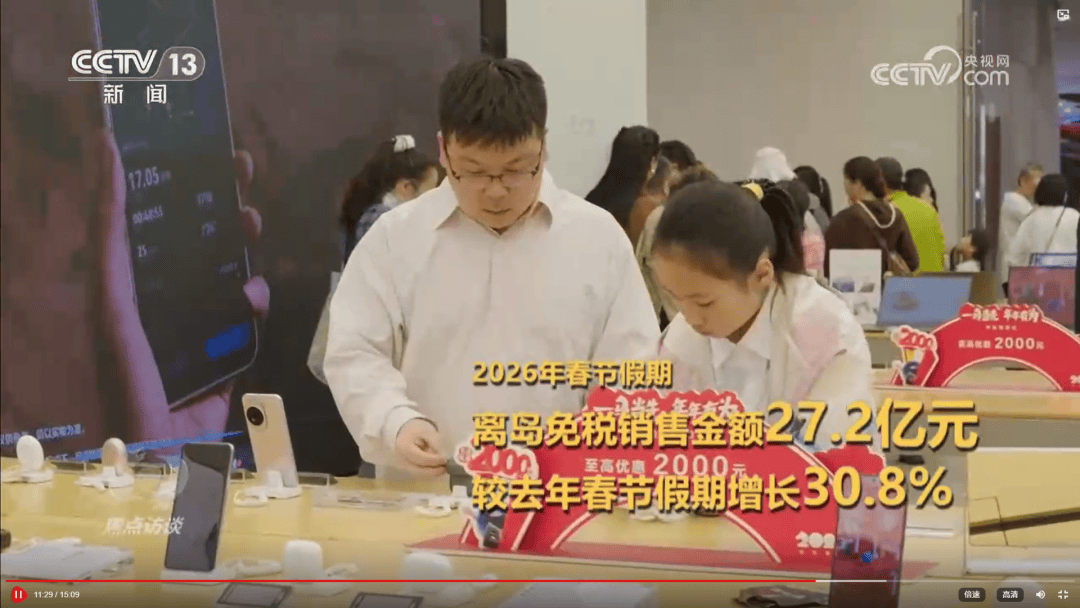
Core Viewpoint - The Spring Festival consumption in Hainan, particularly in Sanya, has shown remarkable growth, driven by the booming duty-free shopping market, highlighting the vitality of the local economy and the effectiveness of consumer policies [3][9]. Group 1: Duty-Free Shopping Performance - Sanya has become a focal point for duty-free shopping during the Spring Festival, with a significant increase in customer traffic and shopping activity [3]. - During the Spring Festival holiday, Hainan's offshore duty-free sales reached 2.72 billion yuan, marking a year-on-year growth of 30.8% [3]. - The sales performance of Sanya's duty-free stores was exceptional, with total sales of 2.04 billion yuan on February 17 (the first day of the Lunar New Year), setting a record for that day [11]. Group 2: Consumer Experience and Product Offerings - The enhanced shopping experience and diverse product offerings have attracted numerous visitors, with popular categories including bags, clothing, and perfumes [5]. - The launch of the first five daily consumer goods duty-free stores in Hainan has positively impacted local residents, offering 202 types of "zero tariff" products across various categories [7]. Group 3: Overall Market Dynamics - The national consumption market has shown robust performance during the Spring Festival, supported by targeted consumer policies that effectively stimulated spending [9]. - The combination of festive atmosphere and strong consumer activity has painted a prosperous picture of the Spring Festival consumption market in Hainan [9].

云南云纽服饰有限公司成立,注册资本300万人民币
Sou Hu Cai Jing· 2026-02-25 16:50
Group 1 - Yunnan Yunniu Clothing Co., Ltd. has been established with a registered capital of 3 million RMB, fully owned by Shanghai Yunniu Textile Technology Co., Ltd. [1][2] - The legal representative of Yunnan Yunniu Clothing Co., Ltd. is Qiu Yutao [1][2]. - The company operates in the manufacturing industry, specifically in textile and clothing, with a focus on clothing manufacturing and related services [2]. Group 2 - The business scope includes clothing manufacturing, textile processing, and various technical services related to the textile industry [2]. - The company is located in the Ruili City, Dehong Dai and Jingpo Autonomous Prefecture, Yunnan Province, within an industrial park designated for import and export processing [2]. - The company is registered as a limited liability company with an indefinite business term [2].
解析Keep(03650.HK)首次年度盈利:AI价值创造,消费品韧性回归,盈利具可持续性
Ge Long Hui· 2026-02-25 10:08
Core Viewpoint - Keep's earnings forecast indicates a significant reduction in losses for the fiscal year 2025, with a projected loss of approximately 72 million RMB, a substantial decrease of 87% compared to the previous year's loss of 535 million RMB. The company expects to achieve an adjusted net profit of around 25 million RMB, a turnaround from an adjusted net loss of 470 million RMB in the same period last year. This performance is seen as a pivotal moment for the internet fitness sector, which has faced skepticism regarding its "burning cash for growth" strategy. The improvement in profitability is attributed to two strategic pillars: a focus on AI development and optimization of business structure [1][2]. Group 1: Improvement Paths - The first path to improvement is the transformation of AI technology from a "cost center" to a "profit engine." The announcement highlights that through refined operations across all business lines, the operational efficiency of each segment has improved, with high-margin business contributions increasing. This implies that AI technology not only enhances user experience but also reconstructs the operational leverage curve of content. The application of AI-generated content (AIGC) and AI coaches allows Keep to provide personalized guidance to users at near-zero marginal costs, thus driving overall gross margin upward [2][4]. - The second path involves the "active slimming" and "precise focus" of the consumer goods business. The announcement mentions that the company has achieved effective cost control through marketing optimization, supply chain improvements, and enhanced administrative efficiency. This reflects Keep's strategic choice to abandon low-efficiency, low-margin product categories in favor of focusing on advantageous and high-potential categories, developing deeply around core user groups and high-frequency exercise scenarios. The rebound growth of core self-branded categories in the second half of 2025 validates this focus strategy [2][5]. Group 2: Sustainable Profitability and Market Dynamics - Keep's profitability in 2025 is seen as an initial result of strategic adjustments, but the market needs to focus on the sustainability of this profitability. The announcement reveals that Keep's earnings are not solely reliant on cost-cutting but rather on a genuine operational model upgrade achieved through AI technology, converting technological investments into sustainable profit outputs [3][6]. - The traditional fitness industry has long faced a fundamental pain point: the high cost of one-on-one services versus the personalized needs of users. Keep is breaking this "cost wall" with AI technology, evolving from a "content recommendation platform" to an "intelligent generation platform." This evolution allows for the complete release of scale effects, where the marginal cost of content supply approaches zero, and personalized services can be scaled to serve millions of users simultaneously, enhancing operational leverage and gross margins [4][5]. Group 3: User Growth and ARPU Potential - The effects of the strategic transformation are already reflected in operational data. In the first half of 2025, Keep initiated a critical strategic shift by deploying AI infrastructure and restructuring its system platform into an AI coach service system. This adjustment not only changes the technical architecture but also fundamentally reconstructs the business model. The penetration rate of AI features is rapidly increasing, with daily active users (DAU) of AI features reaching approximately 150,000 to 200,000 by July 2025, which is expected to significantly enhance user stickiness and usage duration [6][7]. - The growth of user scale is driven by three factors: a temporary reduction in growth investment to focus on attracting long-term high-value users, the maturity of AI Coach functions allowing for a reasonable growth budget to be reinstated, and the introduction of new content categories through AIGC that will attract a broader audience [7][8]. Group 4: Valuation and Market Perception - The current market valuation of Keep is still largely based on the framework of an "internet fitness platform" or "sports consumer goods company." However, as the AI strategy deepens, the valuation logic is undergoing a qualitative change. The transition from PE (price-to-earnings) valuation to PS (price-to-sales) valuation, and then to PEG (price-to-earnings growth) and comprehensive pricing based on AI user value, represents a typical path for technology companies' valuation leaps. Keep is at the starting point of this leap [7][8]. - The establishment of a profitability turning point in 2025, with adjusted net profit turning positive, signifies that the company has escaped the "bleeding growth" phase. This profitability was achieved during a strategic contraction period focused on core users. Once AI functions mature and growth investments are resumed, both user scale and ARPU are expected to experience a "Davis Double-Click," driving accelerated revenue and profit growth [8][9].

春节跟踪系列:免税行业
2026-02-25 04:13
Summary of the Conference Call on the Duty-Free Industry Industry Overview - The discussion focused on the duty-free industry, specifically the sales performance during the Spring Festival period in Hainan's offshore duty-free market [1][2]. Key Points and Arguments - **Sales Performance**: The sales during the Spring Festival reached 2.72 billion yuan, with an average daily sales exceeding 300 million yuan, marking a nearly 30% increase compared to the previous year [3]. - **Visitor Growth**: The growth in visitor numbers was around 8%, which was lower than expected, leading to a slight decrease in average spending per customer to approximately 8,400 yuan [3]. - **Sales Structure**: The sales distribution remained skewed, with southern regions accounting for 70% of sales, while northern regions only contributed 30% [4]. - **Future Projections**: The sales growth forecast for 2026 has been revised upwards, with expectations of surpassing a 20% average growth rate, compared to earlier conservative estimates of around 15% [4]. - **Conversion Rates**: The conversion rates varied significantly between regions, with Sanya showing a conversion rate of 17-18%, while Haikou was at 12-13% [6]. - **Comparison with Previous Years**: When excluding the first day of the holiday, the average daily sales for 2026 were comparable to the peak sales of 2024, indicating a significant recovery in the market [8]. - **Product Categories**: The sales structure shifted during the Spring Festival, with cosmetics rising to 37% of sales, while the combined sales of gold and mobile phones dropped to 12-13% [14]. - **Consumer Behavior**: There was a noted shift towards more rational consumer spending, influenced by a narrowing price gap between tax-free and taxable gold [18]. - **Government Incentives**: The government issued approximately 45 million yuan in consumer vouchers during the Spring Festival, with significant amounts allocated to Sanya and Haikou [24]. - **New Policies**: The introduction of zero-tariff policies for island residents is still in its early stages, with limited product variety and competition from cross-border e-commerce [29][30]. Additional Important Insights - **Market Dynamics**: The leading player in the duty-free market, China Duty Free Group (CDFG), has maintained a dominant market share of around 90%, with other competitors struggling to keep pace [36]. - **Future Policy Expectations**: There are expectations for further policy optimizations in 2026, particularly regarding the categories available for island residents and the potential easing of restrictions on mobile phone purchases [39][40]. - **Visitor Demographics**: The profile of inbound tourists is changing, with increasing numbers from high-spending regions like South Korea and Southeast Asia, which could positively impact future sales [45]. This summary encapsulates the key discussions and insights from the conference call regarding the duty-free industry, highlighting both current performance and future expectations.

商洛市春节市场年味浓郁购销两旺
Sou Hu Cai Jing· 2026-02-24 12:12
Core Insights - The consumption market in Shanzhou City showed a strong performance during the Spring Festival, with total sales reaching 53.229 million yuan, a year-on-year increase of 24.7%, ranking second in the province [1] - Retail sales increased by 25.6% year-on-year, while catering revenue grew by 11.5% [1] Group 1: Promotional Activities - The city organized 24 promotional events under the theme "Buy in China · Flavor of Shanzhou" to stimulate consumption, including various local food and specialty product showcases [3] - Notable events included the first Maiya Year Goods Festival in Shanzhou and multiple New Year shopping festivals across different towns, effectively activating the holiday consumption market [3] - Major shopping centers and supermarkets launched promotional activities, leading to a significant increase in foot traffic and sales [3] Group 2: Trade-in Programs - The city increased the issuance of consumption vouchers for trade-in programs, distributing 800 vouchers daily for home appliances and digital products, and 85 weekly for automobiles [5] - A total of over 5 million yuan in trade-in subsidies benefited more than 10,000 consumers, driving significant spending in large consumer goods [5] - The program included training sessions for businesses to ensure adequate supply and promote participation in rural areas [5] Group 3: Market Supply and Stability - The city ensured a stable supply of essential goods by releasing 450 tons of winter-spring vegetables to meet consumer demand during the holiday [7] - Continuous monitoring of the market was implemented to maintain a steady supply of 11 categories of essential goods, with prices remaining stable throughout the festival [7] - Safety inspections were conducted in commercial and dining establishments to eliminate hazards, ensuring a safe and orderly market environment during the holiday [7]
未知机构:春节假期服务消费跟踪反馈持续更多更新-20260224
未知机构· 2026-02-24 03:20
Summary of Key Points Industry Overview - The report focuses on the duty-free and jewelry sectors, particularly during the Chinese New Year holiday period, highlighting consumer behavior and sales performance trends [1][2]. Duty-Free Sector - Duty-free sales during the Chinese New Year period (up to the sixth day) increased by approximately 22% year-on-year, aligning with expectations [1][2]. - Although the growth rate slowed compared to January, there was an improvement in the product mix, with notable declines in gold and mobile phone sales due to fluctuations in gold prices and purchase restrictions on phones [1][2]. - Categories such as cosmetics, apparel, and luxury goods saw an increase in growth rates, performing better than in December and January, with stable gross margins showing slight improvement [1][2]. Jewelry Sector - In the jewelry market, data from the East China region indicated a decline of over 15% in overall sales during the Chinese New Year, with brands like Chow Tai Fook and Chow Sang Sang achieving low double-digit growth [2]. - Other brands experienced declines exceeding 20%, attributed to weak consumer demand in third- and fourth-tier cities, with average transaction values and wedding-related demand performing relatively poorly [2]. - First- and second-tier cities outperformed third- and fourth-tier markets, indicating a disparity in consumer spending [2]. - Sample franchisees reported a slight increase in Chow Tai Fook store openings for 2026, while other brands saw minor closures or optimization of their stores [2]. Tea Beverage Sector - The tea beverage brand, Gu Ming, maintained a double-digit growth rate per store in February, while another brand, Mi Xue, also reported positive growth during the Chinese New Year period [2].
雄安新区新春消费“热”起来
Xin Lang Cai Jing· 2026-02-19 23:02
Core Insights - Xiong'an New Area has seen a significant increase in consumer activity during the Spring Festival, with promotional activities leading to a total subsidy usage of approximately 17 million yuan, directly stimulating consumption by about 140 million yuan [1] Group 1: Consumer Activities - Various street performances and a wide range of products, including fashion, footwear, and handicrafts, attracted large crowds to Xiong'an Outlets during the Spring Festival [1] - The introduction of 20 new brand stores at Xiong'an Outlets, offering substantial discounts combined with consumer vouchers, has made shopping more appealing [1] Group 2: Promotional Measures - The "Happy Shopping Spring Festival" initiative involved collaboration with financial institutions and various sectors, including dining, supermarkets, and cultural tourism, to provide benefits to consumers [1] - Consumer vouchers and digital RMB red envelopes were distributed across key supermarkets, core business districts, and specialty streets, effectively enhancing consumer enthusiasm [1] Group 3: Supply and Demand - Major supermarkets, farmers' markets, and convenience stores in the area ensured ample stock of essential goods, implementing discounts and promotional offers to meet holiday demand [2] - The restaurant market experienced high demand, with meal vouchers making family gatherings more affordable, leading to a surge in reservations for New Year's Eve and reunion dinners [2] Group 4: Cultural and Recreational Activities - The integration of cultural and tourism activities provided residents and visitors with enjoyable experiences, including various festive events at Xiong'an Outlets and Xiong'an Business Service Center [2] - Traditional performances such as dragon dances, lion dances, and puppet shows were popular, alongside attractions like the dazzling lantern festival at Qianfang Beach, drawing large numbers of visitors [2] Group 5: Future Outlook - The Xiong'an New Area's Business and Investment Promotion Bureau plans to continue implementing consumer promotion measures to sustain the momentum of Spring Festival consumption, contributing to the area's high-quality development [2]