Goldman Sachs

Search documents
Mews' AI-Powered Smart Tips Top 5 Million Weekly Views, Revolutionizing Guest Personalization
Prnewswire· 2025-06-03 12:41
Core Insights - Mews has launched AI Smart Tips, a feature that centralizes guest insights in real-time, enabling hoteliers to provide personalized service at scale, with over 5 million views weekly by hotel staff globally [1][2]. Group 1: AI Smart Tips Functionality - AI Smart Tips compiles and summarizes essential guest data, including reservation details and past stay behavior, allowing hotel teams to access actionable insights quickly [2][6]. - The feature is integrated into the guest profile and reservation calendar, streamlining daily workflows and saving time for hotel staff [5][6]. Group 2: Impact on Guest Experience - At Boardwalk Boutique Hotel Aruba, AI Smart Tips has significantly improved operations, allowing staff to remember and act on small details that enhance guest satisfaction [4]. - Auberge St Pol in Belgium reports that AI Smart Tips has transformed the guest welcome experience, adding a personal touch to interactions and improving service delivery [5]. Group 3: Company Overview - Mews serves 12,500 customers across over 85 countries, focusing on streamlining operations and enhancing guest experiences in the hospitality industry [7]. - The company has raised $410 million from notable investors, including Goldman Sachs Alternatives and Tiger Global Management, to further its mission in transforming hospitality [7].



Goldman Sachs President John Waldron: Dealmaking Outlook Is Still ‘Quite Good'
PYMNTS.com· 2025-05-29 18:57
Group 1: Market Outlook - Goldman Sachs maintains confidence in its dealmaking pipeline despite tariff-related uncertainties, with a strong investment banking business and a positive outlook [1] - Corporate clients remain optimistic about transactions, with ongoing discussions about mergers and acquisitions (M&A) and capital raising [2] - A 30% increase in large deals valued over $500 million this year indicates market resilience, despite a general slump in M&A activity [2] Group 2: M&A Activity Trends - M&A activity has slowed in the second quarter compared to the first, but significant transactions are still being worked on [3] - From the start of the year until April 21, the number of M&A deals decreased by 19%, with no deals over $10 billion announced in February, marking a two-year low [4] - Tariff-related uncertainties are affecting companies' planning and production across various sectors, including consumer electronics and clothing [4] Group 3: Product Development Impact - Research indicates that 25% of product leaders have altered their product designs, pricing, or go-to-market strategies due to tariffs [5] - Additionally, 14% of product leaders have delayed or canceled product development, reflecting disruptions to strategic growth initiatives [6] - All executives surveyed reported some impact from tariffs, highlighting the broader implications for operational stability [6]

The Goldman Sachs Group, Inc. (GS) Bernstein's 41th Annual Strategic Decisions Conference (Transcript)
Seeking Alpha· 2025-05-29 17:48
Group 1 - The current operating environment is experiencing significant disruption due to changes in U.S. policy, particularly under the Trump administration [3] - The trade policy has shifted from a maximalist approach to a more manageable framework, although higher tariff levels remain [3] - The transition from a maximalist to a more manageable trade policy is expected to involve volatility, including individual tweets on tariffs and potential legal challenges [3]

Goldman Sachs(GS) - 2025 FY - Earnings Call Transcript
2025-05-29 14:00
Financial Data and Key Metrics Changes - The company is experiencing a shift towards a more manageable tariff framework, with effective tariff rates increasing from 2% to between 10% and 15% since the Trump administration began, leading to expectations of slower growth and higher inflation, termed "slowflation" [6][10][12] - The company anticipates larger budget deficits and increased US Treasury borrowing, which may impact the cost of capital and economic growth [10][11] Business Line Data and Key Metrics Changes - Investment banking engagement levels remain strong despite macro uncertainties, with a resilient M&A market showing pent-up demand [25][42] - Capital markets activity has slowed in April but has seen a recent pickup in equity capital markets and high-yield capital markets [26][48] - The asset and wealth management segment is positioned for growth, with management fees exceeding $10 billion and private banking revenues growing at a 13% CAGR [65][66] Market Data and Key Metrics Changes - The M&A market for transactions above $500 million is up 30% year-to-date, indicating resilience despite recent volatility [43] - The global private capital AUM is projected to grow from $13 trillion to $23 trillion over the next five years, creating significant financing opportunities [80] Company Strategy and Development Direction - The company maintains a consistent strategy focused on "One Goldman Sachs," emphasizing client-centricity, holistic service, and long-term relationships [30][31][32] - The Capital Solutions Group has been established to unify wholesale financing businesses, enhancing origination and risk management capabilities [69][70] Management's Comments on Operating Environment and Future Outlook - Management expresses confidence in the resilience of the US economy and consumer despite the challenging macro backdrop, with a focus on execution and growth opportunities [9][14] - The company is cautiously optimistic about the investment banking pipeline and sees potential for increased activity as market conditions stabilize [41][49] Other Important Information - The company is focused on risk management, maintaining heavy liquidity and significant capital buffers in response to elevated market volatility [21][22] - The firm is actively monitoring leverage in the public sector as a potential risk area, particularly in light of increased government borrowing [23][24] Q&A Session Summary Question: How is Goldman Sachs managing risk in the current environment? - The company emphasizes a strong risk management culture, with experienced risk managers and a focus on preparation before risk events occur [17][18] Question: What is the outlook for investment banking activity? - Despite a slower second quarter, the investment banking pipeline remains strong, with resilience in the M&A market and a positive bias for transactional activity [25][42] Question: How does Goldman Sachs view its competitive position in the markets business? - The markets business has shown significant resilience and growth, with a strong financing footprint and improved client relationships contributing to higher wallet share [51][52] Question: What are the growth opportunities in asset and wealth management? - The firm sees substantial growth potential in alternatives, ultra-high-net-worth wealth management, and third-party wealth solutions, with a focus on integrated service offerings [58][60][63]
Shareholders Of Goldman Sachs Should Consider Hedging Rate Risk With Goldman Preferred Shares
Seeking Alpha· 2025-05-27 16:22
Core Insights - Goldman Sachs (GS) has experienced a significant sell-off in its shares due to market volatility, but has since recovered to approximately 10% below its 52-week lows [1] Company Performance - The shares of Goldman Sachs have been affected by market conditions, indicating a volatile trading environment [1] - The current share price is around 10% lower than the 52-week lows, suggesting some recovery from the recent sell-off [1] Analyst Background - The analysis is conducted by a professional with a background in history, political science, and an MBA specializing in Finance and Economics, indicating a strong analytical foundation [1]

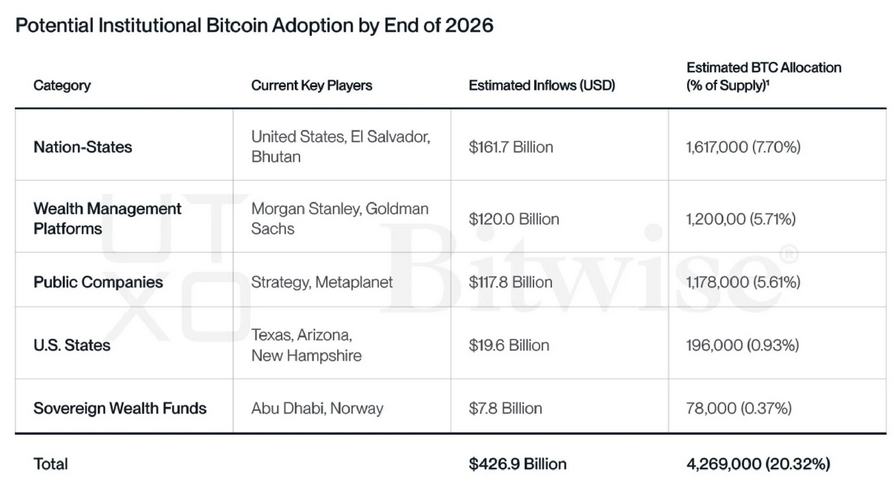
比特币“机构时代”来临?报告预测:到2026年机构持仓将超420万枚
智通财经网· 2025-05-26 06:36
Core Insights - Bitwise Asset Management and UTXO Management predict that institutions could hold over 4.2 million bitcoins by 2026 due to significant capital inflows, sovereign adoption, and yield strategies [1] - The report outlines a phased allocation transformation driven by macroeconomic conditions, legislative trends, and the performance of spot Bitcoin ETFs [1] Category: Current Key Players - Key players include the United States, El Salvador, Bhutan, Morgan Stanley, Goldman Sachs, Strategy, Metaplanet, Texas, Arizona, New Hampshire, Abu Dhabi, and Norway [1] Category: Estimated Inflows (USD) - Estimated institutional inflows are projected to reach approximately $1.2 billion by the end of 2025 and around $3 billion by 2026, totaling over 4.2 million bitcoins held by a diverse group of investors [1] - The report categorizes inflows into different tiers: Bear ($58.9 billion), Base ($117.8 billion), and Bull ($235.6 billion) [2] Category: Estimated DTC Allocation (% of Supply) - Nation-States are expected to hold 1,617,000 bitcoins (7.70% of supply), Wealth Management Platforms 1,200,000 bitcoins (5.71%), Public Companies 1,178,000 bitcoins (5.61%), U.S. States 196,000 bitcoins (0.93%), and Sovereign Wealth Funds 78,000 bitcoins (0.37%) [1] Category: Market Dynamics - The report highlights the rise of Bitcoin-native yield infrastructure, indicating a growing demand for yield strategies that allow companies to expand their Bitcoin holdings without selling assets [2] - The emergence of a new market opportunity worth $100 billion is anticipated due to the development of second-layer scaling solutions and decentralized protocols [2] Category: Price Movements - Bitcoin reached a price of $109,700, with a peak of $111,000, driven by supportive regulatory attitudes from the Trump administration and significant institutional capital inflows [3] - Concerns over increasing U.S. fiscal deficits and global bond market dynamics have contributed to Bitcoin's rise as a "new safe haven" asset [3]
全球视角下主动权益逆袭案例分析:份额之争:先发优势与逆袭经验
Guoxin Securities· 2025-05-25 11:49
Group 1 - The report highlights the increasing trend of passive investment globally, with passive fund management size surpassing active funds by the end of 2023, and this gap is expected to widen in 2024 [1][13][14] - In developed markets like the US, Japan, Europe, and Australia, the proportion of active funds outperforming their respective indices is generally below 40%, with long-term success rates even lower [1][14] - The report identifies key strategies for leading firms in the US, emphasizing reliance on large-cap growth and mixed funds, overall product performance, and the ability of top products to outperform market averages [1][20][44] Group 2 - In Europe, the trend of passive investment has led to a diversification of leading firms, with some actively seeking change to break through, while others see their advantages diminish [2][10] - Successful firms in Europe have demonstrated that high-quality flagship products yield better long-term returns, and the issuance of active ESG products has been beneficial [2][10] - The report notes that during bull markets, firms like Nordea have significantly outperformed, and timely strategy adjustments can help recover from short-term scale fluctuations [2][10] Group 3 - In Australia, the report indicates a clear trend of diversification in active equity, with new leading platforms like Mercer and Magellan Group emerging [3][11] - The growth of firms like Macquarie and Pendal is attributed to their focus on local and global large-cap growth strategies, with stable overall performance [3][11] - The report highlights that Magellan Group has rapidly scaled through currency-hedged products and global infrastructure strategies, while Mercer has a first-mover advantage in strategies facing scale bottlenecks [3][11] Group 4 - The report discusses Japan's unique situation where the expansion of active equity is largely driven by the growth of foreign active products, which is a distinctive feature of the Japanese market [4][12] - It attributes the success of firms like Alliance Bernstein to their alignment with local investor preferences and the performance of domestic products [4][12] - The report emphasizes that companies with better performance in local products can capture market share more effectively, with Daiwa and Sumitomo showing significant annualized returns compared to competitors [4][12]
Goldman Sachs (GS) Increases Despite Market Slip: Here's What You Need to Know
ZACKS· 2025-05-23 22:46
Core Insights - Goldman Sachs (GS) stock closed at $598.54, showing a slight increase of +0.05% compared to the previous day, outperforming the S&P 500's decline of 0.67% [1] - Over the past month, GS shares have risen by 9.69%, surpassing the Finance sector's growth of 6.27% but lagging behind the S&P 500's increase of 10.65% [1] Earnings Forecast - Goldman Sachs is set to release its earnings report on July 16, 2025, with projected earnings of $9.82 per share, reflecting a year-over-year growth of 13.92% [2] - The consensus estimate for revenue is $13.71 billion, indicating a growth of 7.69% compared to the same quarter last year [2] Annual Estimates - For the entire year, Zacks Consensus Estimates predict earnings of $44.41 per share and revenue of $55.52 billion, representing increases of +9.55% and +3.76% respectively from the previous year [3] - Recent changes in analyst estimates suggest a positive outlook for Goldman Sachs' business trends [3] Valuation Metrics - Goldman Sachs has a Forward P/E ratio of 13.47, which is lower than the industry's average Forward P/E of 14.72, indicating a valuation discount [5] - The company currently has a PEG ratio of 0.81, compared to the Financial - Investment Bank industry's average PEG ratio of 1.2 [6] Industry Ranking - The Financial - Investment Bank industry is currently ranked 204 in the Zacks Industry Rank, placing it in the bottom 18% of over 250 industries [6] - The Zacks Rank system, which evaluates stocks based on estimate changes, shows that the top 50% rated industries outperform the bottom half by a factor of 2 to 1 [7]

SAP SE (SAP) Annual Financial Analyst Conference (Transcript)
Seeking Alpha· 2025-05-22 19:36
Group 1 - The conference serves as a platform for the executive team to share updates on strategy, product roadmap, and financial performance [3][5] - The company aims to accelerate revenue growth while maintaining operating leverage, despite a challenging macroeconomic environment [4] - Recent innovations, such as the launch of BDC in February, highlight the company's commitment to efficiency and innovation across its portfolio [4] Group 2 - The event is attended by various financial analysts from major investment firms, indicating strong interest in the company's performance and strategy [2] - The conference is part of a broader initiative to engage with investors and showcase technological advancements [3] - The company emphasizes the importance of direct communication with stakeholders to better understand opportunities within its portfolio [3]


Goldman Consolidates Asia IB Businesses, Boosts Regional Synergy
ZACKS· 2025-05-22 16:36
Core Viewpoint - Goldman Sachs is consolidating its three separate investment banking businesses in Asia into a single unit to enhance regional deal advisory and capital market capabilities [1] Group 1: Details of the Restructuring - Iain Drayto will lead the newly unified Asia Pacific investment banking division, collaborating with executives in Japan, Australia, and New Zealand for seamless operations [2] - The new structure aims to enable holistic client engagement, effective deployment of expertise, and increased career opportunities for employees [3] Group 2: Strategic Focus - Goldman Sachs is refocusing on its core strengths in investment banking and trading while scaling back its consumer banking business [4] - The firm has finalized an agreement to transfer its GM credit card business to Barclays and completed the sale of GreenSky, reallocating capital towards higher-margin businesses [4] Group 3: Market Performance - Over the last six months, shares of Goldman Sachs have decreased by 0.2%, contrasting with the industry's growth of 0.8% [7] Group 4: Industry Trends - Other major banks, such as HSBC and Barclays, are also restructuring to optimize operations and enhance efficiency, with HSBC focusing on boosting its investment banking operations in Asia and the Middle East [9][10] - Barclays plans to reduce capital allocation to its investment bank as part of a three-year plan to save £2 billion and redeploy capital towards more profitable domestic businesses [11]