
Equinor ASA

Search documents
美国页岩业高管匿名吐槽特朗普:全是乱的,谁愿意在这种环境下做商业决定
Sou Hu Cai Jing· 2025-09-25 18:03
Core Viewpoint - The U.S. shale oil industry is experiencing unprecedented anxiety due to the Trump administration's energy and trade policies, which are perceived as detrimental to the sector's economic viability [1][3]. Group 1: Industry Sentiment - Executives from U.S. shale oil companies express frustration over the Trump administration's lack of understanding of shale oil economics, claiming that policies are effectively aligning with OPEC to suppress oil prices below sustainable levels [1][3]. - A significant decline in drilling activity is reported, with a 6.5% decrease in shale drilling in the Southwest U.S. during Q3, although this is an improvement from an 8.1% drop in the previous quarter [3][4]. - The proportion of companies with negative outlooks has nearly tripled, indicating a sharp decline in confidence within the industry [4]. Group 2: Price and Economic Impact - Executives indicate that their businesses will incur losses if oil prices fall below $60 per barrel, with expectations of WTI prices stabilizing at $63 by year-end and reaching $67 by 2027 [3]. - Concerns are raised about the Trump administration's goal to lower oil prices to $40 per barrel, which could lead to a cessation of drilling activities [3][4]. - The imposition of a 50% tariff on steel and aluminum since June has increased operational costs for the industry, compounding existing challenges [3][4]. Group 3: Renewable Energy Concerns - Executives worry that the Trump administration's attacks on renewable energy could have negative repercussions for the shale industry, particularly regarding future regulations on methane emissions and environmental reviews [4]. - The administration's rollback of tax incentives for clean energy and halting major renewable projects raises concerns about the long-term sustainability of the energy sector [4].

Smackover Lithium Releases Maiden Inferred Resource for its Franklin Project Comprising a Portion of Significant Brine Position in East Texas
Globenewswire· 2025-09-24 12:30
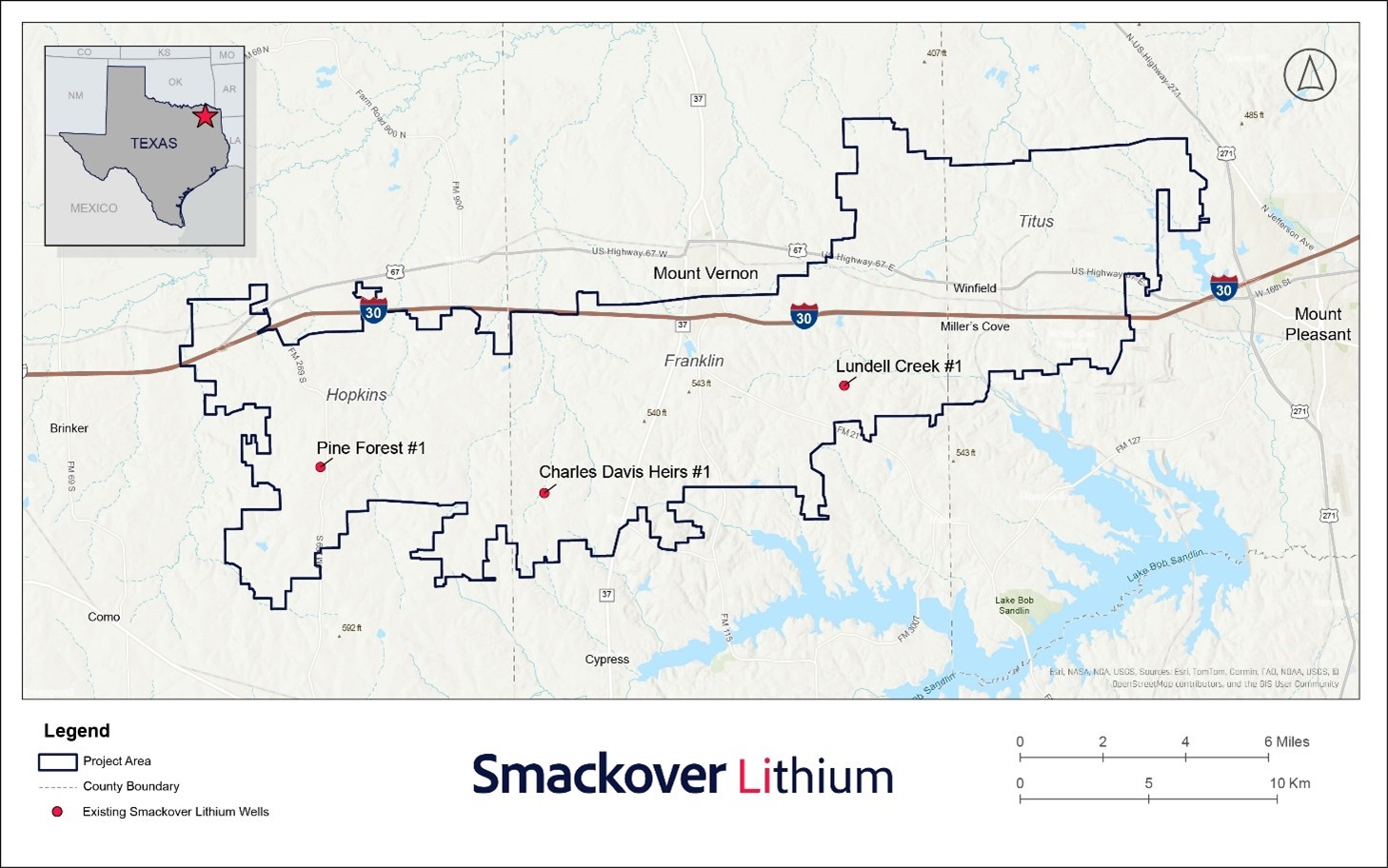
Core Insights - Smackover Lithium, a joint venture between Standard Lithium and Equinor, announced a maiden inferred resource for its Franklin Project in Texas, highlighting the project's significant lithium brine potential and aiming for over 100,000 tonnes of lithium chemicals production annually [1][3][20] Resource Highlights - The maiden inferred resource includes 2,159,000 metric tonnes of lithium carbonate equivalent (LCE), 15,414,000 tonnes of potash, and 2,638,000 tonnes of bromide, contained within 0.61 km³ of brine volume [5][7] - The highest reported lithium brine concentration in North America of 806 mg/L was measured from the Pine Forest 1 well [5][7] Project Development - The Franklin Project covers approximately 80,000 acres, with over 46,000 acres leased to support the inferred resource [5][10] - Exploration activities included 2D seismic surveys and the completion of three exploration wells in 2023 to assess aquifer characteristics and brine chemistry [5][11] Future Plans - The joint venture plans to develop two additional projects in East Texas, which will significantly expand the portfolio area [1][3] - Recommendations from the inferred resource assessment include further drilling and characterization of the Upper and Middle Smackover Formation aquifers [15][16]


Smackover Lithium Releases Maiden Inferred Resource for its Franklin Project Comprising a Portion of Significant Brine Position in East Texas
Globenewswire· 2025-09-24 12:30
Core Insights - Smackover Lithium, a joint venture between Standard Lithium and Equinor, announced a maiden inferred resource for its Franklin Project in Texas, highlighting significant lithium, potash, and bromide resources [1][3] - The project contains 2.2 million tonnes of Lithium Carbonate Equivalent (LCE) at an average lithium grade of 668 mg/L, along with 15.4 million tonnes of potash and 2.6 million tonnes of bromide [1][5] - The inferred resource marks a critical step towards achieving a production goal of over 100,000 tonnes of lithium chemicals annually through multiple phases [1][3] Company Overview - Standard Lithium is focused on sustainable lithium development, prioritizing high-grade resources and efficient permitting processes [20] - The company aims to achieve commercial-scale lithium production using a scalable direct lithium extraction (DLE) process [20] - Equinor, a partner in the joint venture, is committed to long-term value creation in a low-carbon future, with a diverse portfolio including oil, gas, and renewable energy projects [22] Project Details - The Franklin Project covers approximately 80,000 acres, with over 46,000 acres leased to support the inferred resource [5][9] - Exploration activities included 2D seismic surveys and the completion of three exploration wells in 2023, which confirmed high lithium brine concentrations [5][12] - The maiden resource report indicates a total inferred resource of 2,159,000 metric tonnes of LCE, 15,414,000 tonnes of potash, and 2,638,000 tonnes of bromide [5][7] Future Plans - The joint venture plans to further characterize the resource through additional drilling and seismic testing, aiming to refine the understanding of the aquifers and brine chemistry [14][15] - Direct lithium extraction testing will be conducted to leverage insights from Standard Lithium's existing demonstration plant [15]
Equinor戴莫斯探井未获商业油气
Zhong Guo Hua Gong Bao· 2025-09-24 02:57
Core Insights - Equinor announced that the Demos exploration well drilled in the Barents Sea did not find commercially viable oil and gas resources, confirming it as a dry well [1] - The well is the first exploration well in the 1238 production license block, which became effective in March 2024, with Equinor as the operator and partners including Vår Energi and the Norwegian Petroleum Asset Management Company [1] - The semi-submersible drilling platform used for this operation has a maximum operational water depth of 1500 meters and a maximum drilling depth of 7500 meters, with a long-term agreement in place for drilling services until 2026 [1] - Equinor stated that the geological data obtained from this exploration is valuable for understanding the hydrocarbon accumulation patterns in the Barents Sea and will support future exploration decisions [1]
国际石油巨头削减清洁能源投资
Zhong Guo Hua Gong Bao· 2025-09-24 02:57
Group 1 - The United States has become the global center of the anti-ESG movement, with a significant increase in anti-ESG legislation proposed across 40 states from 2021 to 2024, totaling 370 bills [1][2] - The passage rate of anti-ESG bills in 2024 is notably higher than in previous years, indicating improved legislative drafting capabilities among proponents [1][2] - The Trump administration has further fueled the anti-ESG sentiment by revoking climate action policies and signing an executive order banning ESG investments [2] Group 2 - Since Trump's re-election, an estimated $28 billion worth of wind, solar, electric vehicle, and battery projects have been delayed or canceled, affecting approximately 19,000 jobs [2] - International oil giants are reducing their clean energy investments, with ExxonMobil announcing plans to abandon a major low-carbon hydrogen project unless federal tax incentives are provided [3] - BP has adopted a more conservative decarbonization strategy, focusing on higher-margin hydrogen, biofuels, and offshore wind, while abandoning its hydrogen development goals [3][4] Group 3 - Shell has canceled plans for a low-carbon hydrogen plant in Norway, citing insufficient demand, a sentiment echoed by Equinor shortly after [4]


Energy and Financials Dominate This Week’s Value Screen
Acquirersmultiple· 2025-09-24 00:31
Group 1: Energy Sector Insights - Energy companies such as Petrobras (PBR), Equinor (EQNR), Shell (SHEL), TotalEnergies (TTE), and Ecopetrol (EC) exhibit strong cash generation capabilities, with Petrobras showing an Acquirer's Multiple (AM) of 4.1 and a free cash flow (FCF) yield of approximately 35.4% [1][2] - Equinor has an AM of 2.6 and an FCF yield of around 11.8%, while Shell and TotalEnergies have AMs of 7.6–7.8 with FCF yields of approximately 12.7% and 8.5%, respectively [2][3] - Ecopetrol rounds out the energy group with an AM of about 8.0 and an FCF yield of approximately 14.0%, indicating a market perception of declining demand [3] Group 2: Financial Sector Insights - In the financial sector, Synchrony Financial (SYF) leads with an AM of 2.4 and an FCF yield of around 35.1%, reflecting concerns over the credit cycle [3] - Bank of New York Mellon (BK) also has an AM of 2.4 with an FCF yield of approximately 3.1%, while Prudential PLC (PUK) shows an AM of 3.7 and an FCF yield of about 3.8% [3] Group 3: Broader Market Trends - The clustering of high cash returns in energy and financial sectors suggests that these industries are undervalued despite strong fundamentals, with energy being perceived as a sunset industry [4] - The current market environment, characterized by concentrated fear, may provide opportunities for patient investors seeking high cash returns, buybacks, and dividends [4][5] - The analysis indicates that energy continues to lead in deep-value opportunities, with financials closely following, presenting a favorable scenario for long-horizon investors [5]



Petrobras to Surrender Block ES-M-596 in Espirito Santo Basin
ZACKS· 2025-09-23 14:56
Core Insights - Petrobras is returning the ultra-deepwater block ES-M-596 in the Espírito Santo basin to the National Agency of Petroleum, Natural Gas and Biofuels (ANP), marking a significant shift in its exploration strategy [1][12] - The decision to relinquish the block is driven by ongoing challenges and suboptimal results from exploratory efforts [2][12] - Petrobras continues to operate three other blocks in the Espírito Santo basin, maintaining a focus on maximizing resource potential in areas with stronger prospects [7][12] Exploration History and Challenges - The ES-M-596 block was initially promising due to its location in a hydrocarbon-rich area, but drilling efforts revealed geomechanical difficulties and non-commercially viable results [3][4][6] - The consortium, initially including Equinor ASA, faced disappointing outcomes, leading to a reassessment of the block's future [4][5] - Equinor opted not to extend the exploration period, resulting in its exit from the consortium and Petrobras assuming full control of the block [5][6] Strategic Focus and Future Plans - Despite relinquishing ES-M-596, Petrobras is actively pursuing exploration in three other blocks (ES-M-669, ES-M-671, and ES-M-743) within the Espírito Santo basin, each with 100% ownership [7][11] - The ES-M-669 block is currently under a Discovery Evaluation Plan to assess the commercial viability of discoveries [8][12] - The return of ES-M-596 aligns with Petrobras' broader portfolio optimization strategy, allowing the company to focus on assets with confirmed discoveries and ongoing appraisal activities [13][15] Implications for the Industry - Petrobras remains a dominant player in Brazil's offshore sector, adapting its exploration and production portfolio to meet energy demands and market dynamics [14][15] - The company's selective management of its portfolio and adherence to stringent exploration criteria position it to capitalize on future discoveries while managing associated risks [15][16] - The return of ES-M-596 underscores Petrobras' commitment to responsible asset management and strategic flexibility in a challenging market environment [12][15][16]

Equinor Wins Approval to Launch Verdande at Norne Field
Yahoo Finance· 2025-09-23 14:00
Core Insights - Equinor has received approval from the Norwegian Ocean Industry Authority to proceed with the Verdande development at the Norne field in the Norwegian Sea [1][2] - The Verdande project is expected to start production in the fourth quarter of 2025, with an initial investment of approximately NOK 5 billion (around $448 million) [3][4] Project Details - The Verdande development integrates the Cape Vulture and Alve North-East discoveries, located about 300 kilometers southwest of Bodø [4][5] - The recoverable resources for the project are estimated at 36 million barrels of oil equivalent, with a low CO₂ intensity of 1.6 kg per barrel of oil equivalent [5] Strategic Importance - The development is part of Equinor's strategy to extend the life of the Norne FPSO and enhance Norway's offshore production capabilities [6] - Equinor operates Verdande with a 59.3% stake, alongside partners Petoro (22.4%), Vår Energi (10.5%), Aker BP (7%), and PGNiG Upstream Norway (0.8%) [5][6]
Equinor's Orsted Investment Is Intelligent (NYSE:EQNR)
Seeking Alpha· 2025-09-19 19:03
Group 1 - Equinor ASA is a major oil company that has made significant investments in renewable power [2] - The company has experienced an increase in its share price since being recommended for investment [2] - The Value Portfolio focuses on building retirement portfolios using a fact-based research strategy, which includes analyzing 10Ks, analyst commentary, market reports, and investor presentations [2] Group 2 - The analyst has a beneficial long position in Equinor ASA shares through stock ownership, options, or other derivatives [3] - The article expresses the analyst's own opinions and is not compensated for it, aside from Seeking Alpha [3]
Fed Rate Cut Fails to Lift Oil as Inventories Weigh
Yahoo Finance· 2025-09-19 15:09
Group 1: Oil Prices and Market Dynamics - Oil prices ended the week slightly lower, with ICE Brent closing around $67 per barrel, reflecting a minor week-over-week decline [6] - The anticipated U.S. Federal Reserve interest rate cut did not provide a bullish boost to oil prices, as it was overshadowed by larger-than-usual U.S. inventory builds and concerns about OPEC+ policies leading to oversupply next year [6] - Pricing in September has remained rangebound, fluctuating between $65.5 and $69.0 per barrel throughout the month [6] Group 2: OPEC+ and Production Capacity - OPEC+ delegates met in Vienna to discuss the methodology for assessing members' crude oil production capacities, aiming to use these assessments as references for 2027 production baselines to adjust quotas for countries experiencing declines [7] Group 3: Global Oil Developments - Namibia is preparing for a significant oil boom, with an estimated 20 billion barrels offshore and a success rate comparable to Guyana's oil boom, potentially positioning Namibia among the world's top 10 oil producers by 2035 [10] - U.S. oil major ExxonMobil denied rumors regarding a return to Russia's Sakhalin-I project, clarifying that discussions with Russian officials were focused on recouping a lost investment of $4.6 billion [11] - A fatal accident at Norway's Mongstad refinery led Equinor to halt all non-essential activities at the site, which had previously experienced a power outage that forced a halt in output [12]