Fannie Mae

Search documents
President Trump Just Made a Big Move That Could Benefit 1 of My Top Stock Picks for 2026
Yahoo Finance· 2026-01-12 13:20
Group 1 - The U.S. Federal Reserve concluded an aggressive interest rate hike campaign in August 2023, resulting in mortgage costs reaching the highest level in two decades, aimed at controlling inflation [1] - President Trump has called for quicker interest rate cuts and has instructed representatives to purchase $200 billion worth of mortgage-backed securities (MBSes) to help homeowners [2][4] - The purchase of MBSes is expected to increase their prices and decrease yields, potentially leading to lower mortgage interest rates [3] Group 2 - Existing home sales in the U.S. are near a five-year low, with 529,770 more sellers than buyers reported in November, largely due to elevated interest rates affecting first-time home buyers [6] - Many existing homeowners are locked into lower-rate 30-year mortgages, making it financially unwise for them to move, further reducing market activity [7] - Douglas Elliman, a major real estate brokerage, is positioned to benefit from potential market changes if Trump's plan to lower mortgage rates succeeds, with its stock expected to rise in 2026 [8][9]
Mortgage bonds return to spotlight as White House targets housing relief
The Economic Times· 2026-01-12 05:10
Core Viewpoint - The Trump administration plans to purchase mortgage-backed securities to stabilize the mortgage market and counteract the Federal Reserve's reduction of bond holdings [1] Group 1: Government Actions - The Federal Housing Finance Agency will be responsible for purchasing bonds from Fannie Mae and Freddie Mac [1] - This initiative is aimed at easing housing affordability pressures in the market [1]


Bond Traders’ Big Bet for 2026 Vindicated by Soft US Job Growth
Yahoo Finance· 2026-01-11 20:00
Group 1 - The employment report indicated job growth was below forecasts, maintaining expectations for additional Fed interest-rate cuts to support the economy [2] - The steepener trade, a popular bond strategy, has been successful, with the gap between 2- and 10-year Treasury yields reaching its largest in almost nine months [3] - The strategy is expected to continue performing well over the next 12 to 24 months, according to fixed-income portfolio managers [3] Group 2 - The upcoming consumer-price figures are projected to show elevated inflation, which may influence the Fed's decision to pause rate cuts [5] - Despite the positive job report, which showed a decrease in the jobless rate, there are indications that the curve wager may unwind due to fewer expected rate cuts [7] - The momentum for the steepener trade is waning, as a stable labor market and persistent inflation suggest fewer cuts may be necessary [6][7]
Is This Once-Hyped Stock Finally Worth a Second Look?
The Motley Fool· 2026-01-11 16:15
Core Viewpoint - Recent developments in the housing market, particularly announcements from President Trump, may lead to a resurgence in popularity for Opendoor Technologies and other housing stocks [2][4]. Group 1: Market Reaction - Following Trump's announcement to repurchase $200 billion worth of mortgage securities, Opendoor's shares surged approximately 5% on the day of the announcement [5]. - The stock has maintained an upward trend since the announcement, indicating positive market sentiment [5]. Group 2: Future Prospects - The Trump administration is expected to introduce additional measures to stimulate the sluggish housing market, with estimates of "between 30 and 50" ideas to increase housing demand [7]. - Positive macroeconomic news regarding inflation and interest rates could further drive a rally in housing stocks, including Opendoor [8]. Group 3: Investment Considerations - Current shareholders of Opendoor may consider holding their positions longer due to potential short-term gains, while new investors should approach with caution [9]. - Despite the potential for a housing market rebound, analysts project that Opendoor will continue to report net losses through 2027, suggesting a disconnect between stock performance and valuation [10].


Nearly 70% of US homebuyers don't shop around for the best mortgage rate, and it could be costing them thousands
Yahoo Finance· 2026-01-11 12:00
Core Insights - Many homebuyers make the mistake of submitting only one mortgage application, which can lead to significant financial losses [1] - High mortgage rates have persisted since the pandemic, with the average 30-year fixed-rate mortgage remaining above 6% since 2022 [2] - Home prices have dramatically increased since the pandemic, with the average home price rising from $246,326 in early 2020 to $359,241 by November 2025 [3] Mortgage Rate Trends - The average 30-year fixed mortgage rate is projected to drop to 5.9% by the end of 2026, but rates will likely remain high compared to pre-pandemic levels [2][3] - A 2023 Freddie Mac study indicates that the variability in mortgage rates offered to buyers has increased since 2010, with significant dispersion noted in 2022 [5] Home Affordability and Market Conditions - Home affordability has improved recently due to a dip in mortgage rates and better inventory, yet many Americans still face overall cost-of-living challenges [4] - The increase in rate dispersion means consumers with similar profiles may receive a wide range of mortgage rates, highlighting the importance of shopping around for the best deal [6]
Mortgage and refinance interest rates today, January 11, 2026: Dipping below 6%
Yahoo Finance· 2026-01-11 11:00
Core Viewpoint - National average mortgage rates have decreased, influenced by President Trump's proposed initiatives to enhance affordable housing, with the average 30-year fixed mortgage rate at 5.91% and the 15-year fixed rate at 5.36% [1] Current Mortgage Rates - The current national average mortgage rates are as follows: - 30-year fixed: 5.91% - 20-year fixed: 5.83% - 15-year fixed: 5.36% - 5/1 ARM: 6.17% - 7/1 ARM: 6.36% - 30-year VA: 5.57% - 15-year VA: 5.21% - 5/1 VA: 5.36% [4] Mortgage Refinance Rates - Today's national average mortgage refinance rates are typically higher than purchase rates, although this is not always the case [3] Comparison of Fixed and Adjustable-Rate Mortgages - Fixed-rate mortgages lock in the interest rate for the entire loan term, while adjustable-rate mortgages (ARMs) have a fixed rate for a predetermined period before adjusting based on market conditions [9][10] - ARMs generally start with lower rates than fixed rates, but rates may increase after the initial period [11] Factors Influencing Mortgage Rates - Lenders offer lower mortgage rates to borrowers with higher down payments, excellent credit scores, and low debt-to-income ratios [12] - It is suggested that focusing on personal finances is a more effective strategy for obtaining lower rates than waiting for rates to drop [13] Choosing a Mortgage Lender - To find the best mortgage lender, it is recommended to apply for preapproval with multiple companies within a short time frame to minimize the impact on credit scores [14] - When comparing lenders, the annual percentage rate (APR) should be considered as it reflects the true annual cost of borrowing, including interest rates and fees [15] Future Mortgage Rate Expectations - The Mortgage Bankers Association (MBA) forecasts that the 30-year mortgage rate will remain near 6.4% through 2026, while Fannie Mae predicts rates above 6% for the next year, potentially dipping to 5.9% in Q4 2026 [18]
ThinkCareBelieve: Week 51 of Trump’s America Leaps Forward
Globenewswire· 2026-01-10 23:32
Group 1 - The article discusses major developments under the Trump Administration, including the capture of Venezuelan President Nicolas Maduro and the U.S. support for oppressed peoples globally [1] - The U.S. is actively supporting the Iranian people's fight for freedom, indicating a broader strategy of promoting democracy and human rights [1] - The article highlights the economic benefits of Greenland joining the U.S., suggesting potential positive impacts on both regions [1] Group 2 - Riots occurred in Portland and Minneapolis after military withdrawal, emphasizing the ongoing challenges in law enforcement and public safety [2] - The establishment of a new Department of Justice Division for National Fraud Enforcement aims to tackle fraud, with cash rewards announced for whistleblower information [2] - The article outlines the government's efforts to dismantle trafficking networks and arrest members of terrorist gangs and cartels [2] Group 3 - The Food Pyramid has been revamped to promote real, nutrient-dense food, reflecting a shift towards healthier eating habits [3] - President Trump has implemented a 10% cap on credit card interest rates and authorized $200 billion investment in mortgage bonds, contributing to lower mortgage rates [3] - The DOW Jones reached record highs, closing at a 2.3% increase, which is beneficial for American investors [3] - Gas prices in Des Moines, Iowa, were reported at $1.89 per gallon, contributing to overall affordability for consumers [3] - Intel launched the first Sub 2 Nanometer CPU Processor, which is expected to generate significant economic benefits for American shareholders [3]

Mortgage and refinance interest rates today, January 10, 2026: Trump proposals push rates below 6%
Yahoo Finance· 2026-01-10 11:00
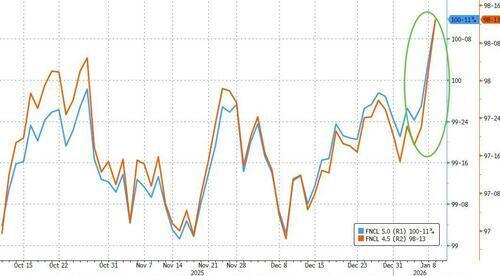
Core Insights - Mortgage rates have fallen below 6% again, with the average 30-year fixed mortgage rate at 5.91% and the 15-year fixed rate at 5.36% [1] - President Trump proposed measures to lower mortgage rates, including a ban on institutional buyers of single-family homes and Fannie Mae and Freddie Mac purchasing billions in mortgage bonds, which positively impacted rates [1] Current Mortgage Rates - The current national average mortgage rates are as follows: 30-year fixed at 5.91%, 20-year fixed at 5.83%, 15-year fixed at 5.36%, 5/1 ARM at 6.17%, and 7/1 ARM at 6.36% [5] - Refinance rates are generally higher than purchase rates, with the latest averages showing a 30-year fixed at 5.99% and a 15-year fixed at 5.43% [6][3] Market Trends - Mortgage rates have been gradually decreasing since the end of May, with the 30-year fixed rate peaking over 7% in January and starting to decline from 6.89% on May 29 [20] - The Mortgage Bankers Association (MBA) forecasts the 30-year mortgage rate to remain near 6.4% through 2026, while Fannie Mae predicts rates above 6% for the next year, potentially dropping to 5.9% in Q4 2026 [19] Buying Considerations - The current housing market is considered relatively favorable for buyers compared to the previous years, as home prices are not spiking like during the COVID-19 pandemic [16] - The best time to buy a house is when it aligns with personal circumstances rather than trying to time the market [17]
Freddie, Fannie $200 billion mortgage bond buy underway with $3 billion purchase, FHFA's Pulte says
The Economic Times· 2026-01-10 10:43
Core Viewpoint - The Federal Housing Finance Agency is actively involved in a significant mortgage bond purchase initiative aimed at reducing housing costs, with a total of $200 billion planned for investment [1]. Group 1: Mortgage Bond Purchase - A $3 billion mortgage bond buy has already been executed following President Trump's directive for a $200 billion investment in mortgage bonds [1]. - The objective of this initiative is to lower housing costs for consumers [1]. Group 2: Privatization of Housing Agencies - The Director of the Federal Housing Finance Agency, Bill Pulte, indicated that the privatization of Freddie Mac and Fannie Mae remains a viable option [1]. - Specific timelines for the completion of the $200 billion mortgage bond purchase were not disclosed by Pulte [1].
特朗普要代美联储“管房贷利率”?贝森特表态:“特朗普QE”目标是匹配美联储“缩表”
Hua Er Jie Jian Wen· 2026-01-10 01:50
Core Viewpoint - The Trump administration is intervening in the mortgage market to lower mortgage rates by directing Fannie Mae and Freddie Mac to purchase mortgage-backed securities (MBS), countering the Federal Reserve's balance sheet reduction [1][2][5]. Group 1: Government Intervention - The U.S. Treasury Secretary, Mnuchin, announced that the government has instructed the Federal Housing Finance Agency (FHFA) to purchase $200 billion in MBS, marking a significant intervention in the housing affordability crisis [2]. - The initial phase of this plan involves a $30 billion purchase, which is seen as an aggressive move by the White House to address housing costs [2]. Group 2: Market Impact - Following the announcement, MBS prices surged, leading to a potential decrease in mortgage rates by approximately 0.25 percentage points [3][5]. - The risk premium of MBS relative to U.S. Treasuries narrowed by about 0.18 percentage points, indicating a positive market response to the intervention [5]. Group 3: Concerns Over Federal Reserve Independence - The intervention has raised concerns about the independence of the Federal Reserve, as traditionally, interest rate adjustments are within the Fed's purview [6][7]. - Analysts warn that this action blurs the line between market-driven effects and political manipulation, potentially reintroducing political risks into the financial markets [6]. Group 4: Future of Fannie Mae and Freddie Mac - The policy complicates the future privatization of Fannie Mae and Freddie Mac, as the government now views these entities as essential policy tools [8]. - There are conflicting expectations between the government's use of these government-sponsored enterprises (GSEs) as policy levers and the traditional expectations of private investors regarding their profitability [8].