IonQ

Search documents
Top 3 quantum computing stocks for 2026
Finbold· 2025-12-16 12:00
Industry Overview - Quantum computing is entering a significant phase as the industry shifts focus towards scalability, real-world applications, and national strategic priorities by 2026 [1] - Governments are increasing funding for quantum technology, recognizing its importance for national security and AI sovereignty, while enterprises are testing quantum tools for complex optimization problems [2] Company Insights IonQ (NYSE: IONQ) - IonQ is positioned with a strong growth profile, advancing high-fidelity trapped-ion systems beyond 64 qubits through its acquisition of Oxford Ionics [3] - The company's revenue is increasingly derived from direct enterprise and government contracts, with Q3 2025 revenue reported at $39.9 million, a 222% increase year-over-year, despite a $1.1 billion net loss due to aggressive investments [4] - IonQ raised its 2025 revenue forecast to $106 million–$110 million, maintaining an adjusted EBITDA loss midpoint of about $211 million, with shares trading at $46, up over 6% year-to-date [4] D-Wave Quantum (NYSE: QBTS) - D-Wave focuses on application-driven strategies, enhancing the complexity of optimization problems with its Advantage2 system, which supports existing customers using quantum tools [6] - The company's deeper integration into enterprise workflows is leading to recurring usage and higher switching costs, with international expansion reducing reliance on U.S. government demand [7] - QBTS shares are up nearly 150% year-to-date, closing at $23.74 [7] Rigetti Computing (NASDAQ: RGTI) - Rigetti represents an asymmetric investment opportunity, with progress towards higher-fidelity modular superconducting systems potentially rebuilding investor confidence [10] - Recent government contracts, including a $5.8 million deal with the Air Force Research Lab for quantum networking, indicate growing confidence in Rigetti's technologies [10] - RGTI shares are up 17% in 2025, trading at $23, with expectations for positive developments that could lead to a sharp re-rating [11]





全球量子企业对比:美国显著领先,中国第一梯队
Sou Hu Cai Jing· 2025-12-16 02:53
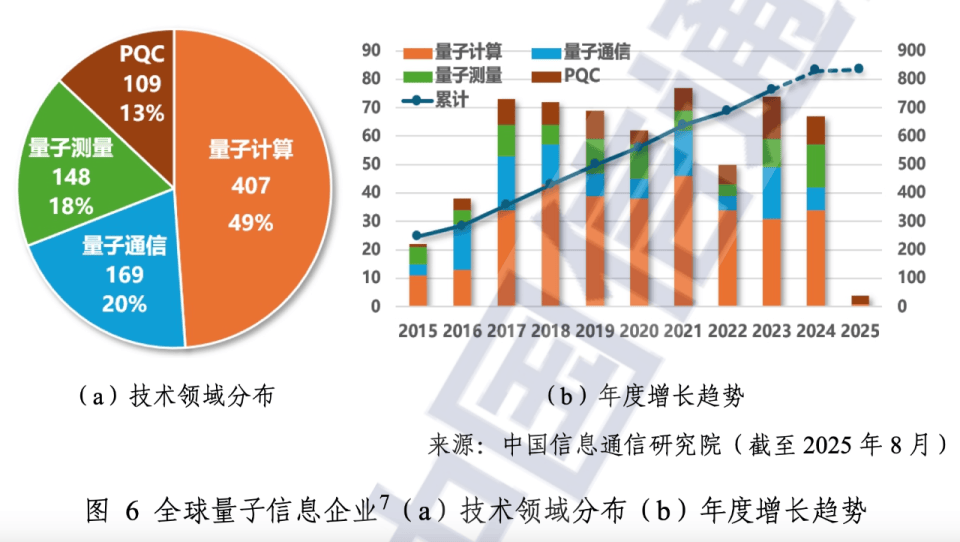
Core Insights - The report on quantum information technology indicates that the number of global quantum-related companies has surpassed 800, with quantum computing dominating the field at approximately 50% [1] - The growth of quantum information companies has been stable, averaging about 60 new companies per year over the past five years, despite a slight decline in 2022 [1] Company Distribution - The European Union has over 230 quantum companies, accounting for 29%, with Germany having more than 70 [4] - The United States has over 210 quantum companies, making up 26%, while China has around 140, representing 17% [4] - The concentration of quantum computing companies in Europe and the U.S. is nearly six times that of China, while China leads in quantum communication [4] Market Performance - There are currently 11 quantum companies listed on capital markets, with an average market value of $2.9 billion, significantly higher than the previous year [4] - The average market value of U.S. quantum companies is $6.7 billion, with IonQ being the first to exceed $13.3 billion [4] Unicorns and Valuations - There are 12 quantum unicorns, with an average valuation of $4.1 billion in the U.S. and $1.4 billion in China, indicating a substantial valuation gap [5] - PsiQuantum leads with a valuation of $6.75 billion, while the highest-valued quantum startup in France is Alice&Bob at $400 million [5] Investment Trends - The U.S. maintains a significant lead in investment, with major funding rounds such as PsiQuantum's $750 million and IonQ's $1 billion [7] - Eight out of the top ten funding events in quantum computing are dominated by U.S. and European companies, reflecting strong market confidence [7] Technological and Industrial Development - China's quantum information technology and industry development is positioned in the global first tier, supported by comprehensive planning and policy frameworks since the 14th Five-Year Plan [8] - Major scientific projects and facilities, such as the Anhui National Laboratory and the Greater Bay Area Quantum Science Center, are pivotal for innovation [8] Talent Development - Seventeen universities in China have established undergraduate programs in quantum information science, with institutions like Tsinghua and Peking University leading in talent cultivation [9]
Can Quantum Computing Stocks IonQ, Rigetti Computing, and D-Wave Quantum Become the Next Nvidia? History Offers Some Big Clues.
The Motley Fool· 2025-12-15 08:51
Core Insights - Quantum computing stocks have shown significant potential, with some stocks rallying as much as 5,400% over a trailing 12-month basis, indicating strong investor interest in the technology [4] - Historical trends suggest that early-stage technologies often experience a bubble-bursting event, leading to skepticism about the sustainability of current valuations in the quantum computing sector [6][7] - The current price-to-sales (P/S) ratios for quantum computing stocks are alarmingly high, with IonQ at 163, Rigetti Computing at 1,029, D-Wave Quantum at 337, and Quantum Computing Inc. at 3,346, indicating they are well beyond historical bubble territory [17] Industry Overview - The rise of artificial intelligence (AI) has been a significant driver for companies like Nvidia, which has seen its shares increase by over 21,800% in the past decade, setting a high benchmark for future technologies [2] - Quantum computing is still in its early commercialization phase, with major companies like Amazon and Microsoft providing access to quantum-cloud services, but broad-based commercialization is still years away [8] - The barrier to entry in quantum computing may be lower than perceived, as major tech companies like Alphabet and Microsoft are entering the space with their own quantum processing units [19] Company Analysis - IonQ raised $2 billion by selling 16.5 million shares at $93 per share, a common practice among early-stage companies that often leads to shareholder dilution [10][11] - Rigetti Computing, D-Wave Quantum, and Quantum Computing Inc. are expected to follow similar capital-raising strategies, which could negatively impact their stock prices [12] - The financial health of quantum computing companies is concerning, with IonQ reporting a gross margin of -747.41% and Rigetti Computing at -6849.48%, highlighting ongoing operational losses [9][20] Competitive Landscape - The "Magnificent Seven" tech giants have the financial resources to dominate the quantum computing space, posing a significant threat to smaller players like IonQ and Rigetti Computing [21][22] - The potential economic value of quantum computing is estimated to reach $850 billion by 2040, attracting interest from well-capitalized companies that can outspend smaller competitors [21]


1 Quantum Computing Stock That Could Make a Monstrous Comeback in 2026
The Motley Fool· 2025-12-14 10:00
Core Viewpoint - IonQ's stock has experienced significant volatility, peaking in October 2024 and then declining sharply at the start of 2025, reflecting the broader instability in the quantum computing sector, which is still in its early stages of commercial viability [2][3]. Company Overview - IonQ is a prominent player in the quantum computing space, utilizing a trapped ion technology that offers higher accuracy compared to competitors using superconducting methods. IonQ has achieved a 99.99% 2-qubit gate fidelity, which is a critical measure of accuracy [5][8]. - Despite a 30% increase in stock value in 2025, IonQ's stock was previously up 96%, indicating substantial fluctuations [3]. Market Position and Competition - IonQ holds a competitive edge with its accuracy, as most rivals struggle to achieve 99.9% 2-qubit gate fidelity. However, the commercial application of quantum computing is projected to be several years away, with 2030 being a target year for broader availability [8][11]. - Competitors using superconducting technology may not match IonQ's accuracy but have faster processing speeds, which could become advantageous if they close the accuracy gap [9][10]. Future Outlook - IonQ's success in 2026 hinges on two main factors: the market's risk appetite and IonQ's ability to maintain or enhance its accuracy lead over competitors. A shift towards risk aversion in the market could negatively impact IonQ's stock performance [11]. - If IonQ can further improve its accuracy and establish a first-mover advantage, it could position itself favorably in the market, potentially leading to significant investment returns [11][12].

ChatGPT picks 2 stocks to turn $10 into $100 in 2026
Finbold· 2025-12-14 09:39
Group 1: IonQ - IonQ is a quantum computing company positioned in an early-stage market with growing interest from enterprises and governments seeking alternatives to classical computing [2] - The company offers commercially accessible quantum hardware through a cloud-based "quantum as a service" model, lowering adoption barriers for customers [3] - Analysts expect rapid revenue growth through 2026 as pilot projects convert into long-term commercial contracts, supported by partnerships with major cloud platforms like Microsoft Azure [3] - If quantum computing transitions from experimentation to practical applications, even modest adoption could significantly impact IonQ's financial profile and lead to a valuation re-rating [4] - Key risks include ongoing losses, share price volatility, and uncertainty regarding the timing of widespread quantum adoption [4] Group 2: Roku - Roku has transitioned from a streaming hardware business to a connected TV platform primarily driven by advertising and subscription revenue [7] - The platform revenue has outpaced overall growth due to increased streaming engagement and improved ad monetization [8] - The shift of advertising budgets from traditional television to streaming is a central tailwind, supported by Roku's large user base and expanding relationships with major advertisers [8] - Connected TV is one of the fastest-growing segments in digital advertising, and Roku's scale positions it to capture a growing share of that spend [9] - Improvements in ad technology and potential political advertising related to the U.S. midterm elections in 2026 could further enhance revenue and margins [9] - Risks include competition, uneven hardware performance, and exposure to cyclical advertising demand [9]

Will Quantum Computing Inc. Stock Rebound in 2026?
The Motley Fool· 2025-12-13 17:15
Core Viewpoint - Quantum Computing Inc. has experienced a significant decline in stock value, with shares down 23% this year and nearly 50% below all-time highs, raising questions about its future performance in 2026 [2][9]. Company Performance - Quantum Computing Inc. has generated only about $500,000 in revenue over the past year, while its outstanding share count has nearly doubled, indicating a lack of business traction at the enterprise level [6]. - The company has a market capitalization of $2.8 billion, which translates to an extremely high price-to-sales (P/S) ratio of nearly 3,300, the largest premium among its peers despite being the smallest in terms of revenue [10]. Market Potential - The total addressable market (TAM) for Quantum Computing Inc.'s focus area, photonic integrated circuits, is projected to be worth $66 billion by 2032, with applications across various critical industries such as healthcare, financial services, and energy management [3]. Investor Sentiment - The current sell-off in Quantum Computing stock is attributed to investor fatigue over dilution and a demand for tangible growth from commercial adoption of its technology [7]. - The stock is viewed as a potential value trap, with the suggestion that buying shares now may not reflect the company's underlying valuation [12]. Competitive Landscape - Compared to its peers, Quantum Computing Inc. is seen as a speculative investment, with investors looking towards larger tech companies like Amazon, Alphabet, Microsoft, IBM, and Nvidia for more stable exposure to the quantum computing movement [14][15].

IonQ: Remaining Bullish Even After Recent Pullback
Seeking Alpha· 2025-12-13 11:39
Core Insights - IonQ is a prominent player in the quantum computing sector, characterized by high stock volatility, providing investors with a pure-play opportunity in this emerging market [1] Company Overview - IonQ offers direct exposure to quantum computing, which is considered a hotly debated area in the investment landscape [1]

Forget IonQ: This Quantum Computing Stock Is a Better Buy
The Motley Fool· 2025-12-13 04:00
Core Insights - The quantum computing sector is experiencing significant interest, with the Defiance Quantum ETF up 40% year-to-date, yet IonQ's stock is facing challenges [1][2] Company Performance - IonQ's stock price nearly tripled from January 2025 to mid-October but has since dropped by one-third, closing at approximately $52 on December 5 [2] - IonQ has transitioned from single-digit million revenue four years ago to nearly $80 million today, but its net losses have increased dramatically from just over $100 million to nearly $1.5 billion in the last 12 months [6][7] - Analysts predict IonQ will not achieve profitability until at least 2030, with the company burning through nearly $260 million annually and having $1.1 billion in cash reserves [7] Technology and Business Model - IonQ is recognized for its advanced trapped-ion quantum computing technology, achieving a world-record gate fidelity of 99.99%, but it remains primarily a research and development entity [4][5] - The current business model is deemed ineffective, as the company is unable to convert technological advancements into profitable revenue streams [8] Competitive Landscape - Alphabet, the parent company of Google, is highlighted as a more viable investment in quantum computing, possessing nearly $100 billion in cash and $73.5 billion in annual free cash flow, which positions it well to fund quantum research [11][12] - Alphabet's Willow quantum computing chip has demonstrated exceptional performance, completing complex computations in a fraction of the time required by traditional supercomputers [10][11]


IonQ Vs. Rigetti: The Quantum Pair Trade Hiding In Plain Sight
Seeking Alpha· 2025-12-12 14:09
Group 1 - The article discusses the challenges in quantum computing regarding narratives and valuations, making it difficult to identify absolute valuation-fundamentals gaps and time entries [1] - QTUM is favored as it reduces idiosyncratic risks within traded quantum stocks, indicating a strategic choice in investment [1] - The author has extensive experience in quantitative research, financial modeling, and risk management, focusing on equity valuation, market trends, and portfolio optimization [1] Group 2 - The research approach combines rigorous risk management with a long-term perspective on value creation, emphasizing macroeconomic trends, corporate earnings, and financial statement analysis [1] - The goal is to provide actionable ideas for investors seeking to outperform the market, highlighting a commitment to delivering high-quality, data-driven insights [1]

Will This Quantum Computing Stock Be a Must-Own in 2026?
The Motley Fool· 2025-12-12 10:00
Core Viewpoint - IonQ's stock has experienced a significant decline since October, dropping approximately 35% from its peak, raising questions about its potential recovery by 2026 [1][11]. Group 1: Technology and Competitive Advantage - IonQ employs a trapped ion technique, distinguishing itself from competitors that primarily use superconducting methods, which require extreme cooling [3][5]. - IonQ has achieved a two-qubit gate fidelity of 99.99%, significantly outperforming competitors who have not yet reached 99.9% fidelity, indicating a lower error rate in calculations [5][4]. - While IonQ's accuracy is superior, its processing speeds are slower compared to its peers, which may pose a disadvantage as the industry evolves [7][5]. Group 2: Market Position and Financial Performance - IonQ's market capitalization stands at $19 billion, with a current stock price of $0.88, reflecting a recent increase of 1.70% [6]. - In Q3, IonQ reported nearly $40 million in revenue but incurred losses exceeding $1 billion, primarily due to changes in stock warrants' fair value [12]. - Over the past year, IonQ has spent over $260 million in cash, leaving it with approximately $1 billion in the bank, necessitating a transition to a viable business model or additional capital raising [14]. Group 3: Future Outlook and Industry Context - The timeline for commercially viable quantum computing is projected to extend until around 2030, indicating a long wait for significant advancements [9][10]. - IonQ's stock performance is likely to be influenced by market risk appetite, with potential struggles if the market adopts a more conservative stance in 2026 [11]. - Investors should be prepared for a lengthy wait, potentially up to five years, for returns driven by business performance rather than market fluctuations [15].