
欣旺达

Search documents
欣旺达(300207) - 关于2022年限制性股票与股票期权激励计划限制性股票首次授予部分第三个归属期及预留授予部分第二个归属期归属结果暨股份上市的公告
2025-09-12 09:02
证券代码:300207 证券简称:欣旺达 公告编号:<欣>2025-073 欣旺达电子股份有限公司 关于2022年限制性股票与股票期权激励计划限制性股票首次授予部 3、本次归属限制性股票总人数:1,006 名激励对象。 4、本次首次及预留第二类限制性股票归属上市流通安排:上市流通日为 2025 年 9 月 17 日。 欣旺达电子股份有限公司(以下简称"公司")于 2025 年 8 月 26 日分别召 开第六届董事会第十九次会议及第六届监事会第十九次会议,审议通过了《关于 2022 年限制性股票与股票期权激励计划限制性股票首次授予部分第三个归属期 及预留授予部分第二个归属期归属条件成就的议案》。近日,公司办理了 2022 年限制性股票与股票期权激励计划限制性股票首次授予部分第三个归属期及预 留授予部分第二个归属期股份归属的登记工作,现将相关情况公告如下: 一、本激励计划简述 (一)2022 年限制性股票与股票期权激励计划简述 分第三个归属期及预留授予部分第二个归属期 归属结果暨股份上市的公告 本公司及董事会全体成员保证信息披露内容的真实、准确和完整,没有虚假 记载、误导性陈述或重大遗漏。 重要内容提示: 1、本 ...

欣旺达684Ah储能电芯正式量产!
鑫椤锂电· 2025-09-12 08:38
Core Viewpoint - The article highlights the launch of the 684Ah energy storage cell by XINWANDA at its Deyang base, emphasizing the company's commitment to innovation and the development of high-capacity energy storage solutions for various applications [1]. Group 1 - XINWANDA officially commenced mass production of the 684Ah energy storage cell on September 10 [1]. - The new product line aims to provide more efficient and reliable energy storage solutions for generation, grid, and user-side applications [1]. - The introduction of the 684Ah and 588Ah energy storage cells reflects XINWANDA's ongoing innovation and advancement in high-capacity storage technology [1].

欣旺达(300207) - 关于2022年限制性股票与股票期权激励计划股票期权首次授予部分第三个行权期及预留授予部分第二个行权期采用自主行权模式的提示性公告
2025-09-12 08:32
欣旺达电子股份有限公司 关于2022年限制性股票与股票期权激励计划股票期权首次授予部分 证券代码:300207 证券简称:欣旺达 公告编号:<欣>2025-072 第三个行权期及预留授予部分第二个行权期采用自主行权 模式的提示性公告 本公司及董事会全体成员保证信息披露内容的真实、准确和完整,没有虚假 记载、误导性陈述或重大遗漏。 重要内容提示: 1、欣旺达电子股份有限公司(以下简称"公司")2022 年限制性股票与股 票期权激励计划首次授予股票期权代码:036485;期权简称:欣旺 JLC1。预留 授予股票期权代码:036525;期权简称:欣旺 JLC2。 2、本次首次及预留股票期权拟行权数量:499.28 万份(其中首次授予第三 个行权期可行权数量 474.28 万份,预留部分第二个行权期可行权数量 25.00 万 份)。 3、本次符合行权条件的激励对象:共计 689 名,其中首次授予的激励对象 688 名,预留授予的激励对象 3 名(其中 2 名激励对象同时拥有首次授予部分第 三个行权期的股票期权和预留授予部分第二个行权期的股票期权)。 4、本次首次及预留股票期权行权价格:38.77 元/份。 5、股票来 ...
孚能科技上市5年累亏45亿 实控人变更后营收下滑存货上升
Xin Lang Cai Jing· 2025-09-12 06:28
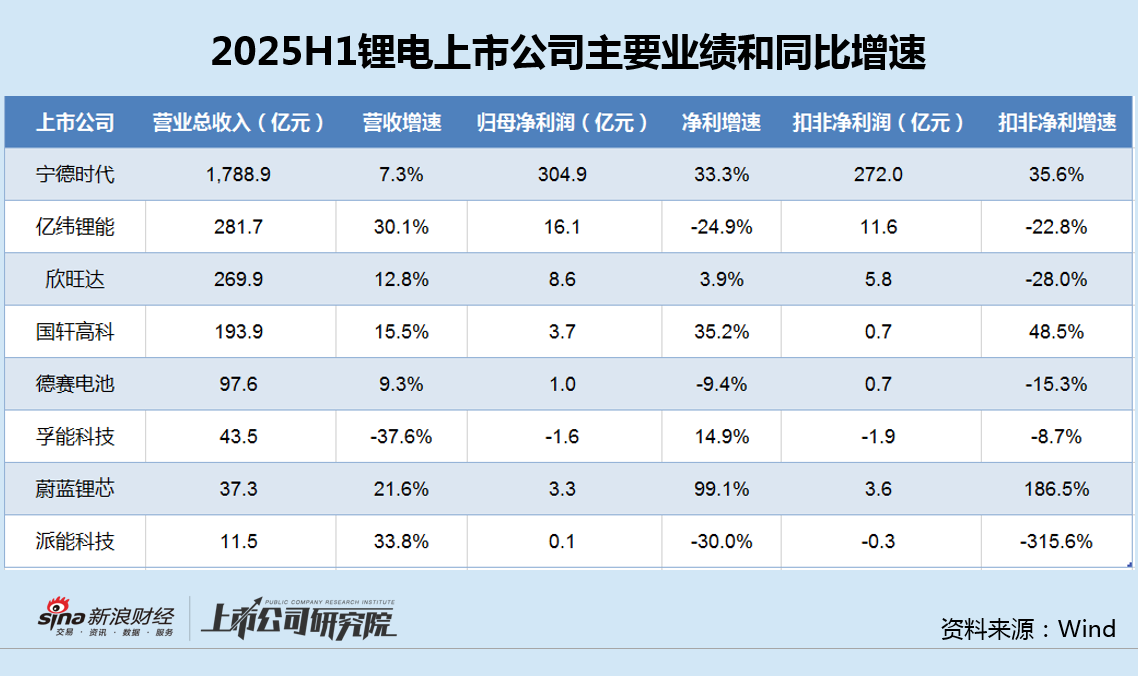
Core Viewpoint - The performance of lithium battery companies listed on the A-share market shows a significant divergence in net profits, with most companies experiencing revenue growth while net profits reveal a stark contrast, particularly for Funeng Technology, which continues to face operational challenges [1][4]. Group 1: Company Performance - Funeng Technology reported a revenue of 4.35 billion yuan in the first half of the year, a year-on-year decline of 37.6%, making it the only major lithium battery company to experience a revenue drop [1][3]. - The company's net profit attributable to shareholders was -160 million yuan, although this loss was reduced by 14.92% compared to the previous year, marking the fifth consecutive year of losses [1][4]. - In contrast, other companies like CATL and EVE Energy showed positive revenue growth, with CATL achieving 178.89 billion yuan in revenue, a 7.3% increase, and a net profit of 30.49 billion yuan, up 33.3% [3]. Group 2: Inventory and Production Issues - Funeng Technology's inventory increased to 3.565 billion yuan, a 58% year-on-year rise, with inventory turnover days extending to 149.27 days, up 71% [4][7]. - Despite the inventory buildup, the company is expanding production capacity, with a projected output of 20 GWh for 2023 and a capacity of 55 GWh by the end of the year [7]. - The company acknowledged that its new production capacity is still in the ramp-up phase, indicating potential underutilization of capacity [7]. Group 3: Ownership and Strategic Changes - In January 2023, Funeng Technology underwent a significant change in control, with the major shareholder shifting to Guangzhou Industrial Investment Holding Group, which is now the actual controller [7][8]. - Following this change, the company received support in terms of funding, financial coordination, and research collaboration, but faces challenges in balancing technological investment with profitability [8]. - The new shareholders have plans to reduce their stakes, indicating a potential shift in strategic focus as the company navigates its financial and operational hurdles [8].

锂电中报|欣旺达核心业务利润下滑回款情况继续恶化欲赴港再融资
Xin Lang Cai Jing· 2025-09-12 06:07
Core Viewpoint - The lithium battery company, XINWANDA, has reported mixed financial results for the first half of 2025, with revenue growth but significant declines in net profit, indicating a bifurcation in performance among leading firms in the industry [1][2]. Financial Performance - XINWANDA achieved a revenue of 26.99 billion yuan, a year-on-year increase of 12.8%, while the net profit attributable to shareholders was 860 million yuan, up 3.9% [1]. - The company's non-recurring net profit fell by 28.0% year-on-year to 580 million yuan, highlighting challenges in its core business profitability [1]. - The revenue from energy storage batteries was 7.6 billion yuan, with a unit price of approximately 0.5 yuan per Wh and a gross margin of 9.8%, down 1.9 percentage points year-on-year [1]. Cash Flow and Financial Health - Operating cash flow decreased by 39.8% to 1.04 billion yuan, with a significant drop in the second quarter to -490 million yuan, reflecting severe cash flow issues [2]. - Capital expenditures rose by 27.5% to 4.16 billion yuan, indicating increased investment despite cash flow challenges [2]. - Accounts receivable reached 16.4 billion yuan, a 20.6% increase year-on-year, with collection pressure evident as the accounts receivable turnover days increased to 107 days [2]. Debt and Financial Strategy - The asset-liability ratio increased to 65.46%, up 5.18 percentage points year-on-year, with interest-bearing liabilities at 25.81 billion yuan, a 26.25% increase [2]. - Plans for a spin-off listing of XINWANDA Power were halted due to cumulative losses exceeding 5 billion yuan, which impacted the parent company's profits [2]. - XINWANDA has submitted an application for a dual listing on the Hong Kong Stock Exchange, aiming to become the third lithium battery company to achieve an "A+H" listing [2]. Production Capacity and Market Conditions - The overall capacity utilization rate for XINWANDA has declined, with consumer battery utilization dropping from 94.2% in 2022 to 84.3% in Q1 2025, and power battery utilization falling from 83.5% to 53.6% [3]. - The mismatch between production capacity and demand has led to resource wastage, compounded by increasing competition and ongoing losses in the power battery segment [3].
锂电中报|孚能科技上市5年累亏45亿 实控人变更后营收下滑存货上升
Xin Lang Zheng Quan· 2025-09-12 05:46
Core Viewpoint - The lithium battery listed companies in A-shares have reported their mid-year results, showing overall revenue growth but significant divergence in net profits among companies, with some facing substantial losses [1][3]. Group 1: Company Performance - Contemporary Amperex Technology Co., Ltd. (CATL) achieved a revenue of 178.89 billion yuan, a growth of 7.3%, and a net profit of 30.49 billion yuan, increasing by 33.3% [3]. - EVE Energy Co., Ltd. reported a revenue of 28.17 billion yuan, a growth of 30.1%, but a net profit decline of 24.9% to 1.61 billion yuan [3]. - Affected by market conditions, Funeng Technology Co., Ltd. saw its revenue drop to 4.35 billion yuan, a decrease of 37.6%, and a net loss of 160 million yuan, although the loss narrowed by 14.92% year-on-year [1][3]. Group 2: Inventory and Production Capacity - Funeng Technology's inventory increased to 3.565 billion yuan, up 58% year-on-year, with inventory turnover days rising to 149.27 days, an increase of 71% [4]. - Despite the revenue decline, Funeng Technology is expanding production capacity, with a projected output of 20 GWh for 2023 and a capacity of 55 GWh by the end of 2023 [7]. - The company acknowledged that its new production capacity is currently in the ramp-up phase, indicating potential underutilization of capacity [7]. Group 3: Ownership and Strategic Changes - In January 2023, Funeng Technology underwent a significant change in control, with Guangzhou Industrial Investment Holding Group becoming the new controlling shareholder [7]. - Following the change in control, Funeng Technology received support in funding, financial coordination, and R&D collaboration, but faces challenges in balancing technological investment with profitability [8]. - Shareholders, including the previous controlling entity, have announced plans to reduce their stakes in the company, indicating a shift in investment strategy [8].
锂电中报|欣旺达核心业务利润下滑 回款情况继续恶化欲赴港再融资
Xin Lang Zheng Quan· 2025-09-12 05:40
Core Viewpoint - The lithium battery companies listed in A-shares have shown revenue growth in the first half of the year, but there is a significant divergence in net profit performance among them [1]. Group 1: Financial Performance - A majority of companies reported revenue growth, with CATL achieving revenue of 1,788.9 billion yuan, a year-on-year increase of 7.3%, and a net profit of 304.9 billion yuan, up 33.3% [3]. - In contrast, companies like EVE Energy and Xinwangda experienced declines in net profit, with EVE's net profit down 24.9% and Xinwangda's down 28.0% [3][4]. - Xinwangda's revenue reached 269.9 billion yuan, a 12.8% increase, but its net profit was only 8.6 billion yuan, reflecting a modest growth of 3.9% [3]. Group 2: Profitability Challenges - Xinwangda's non-recurring net profit fell by 28.0% year-on-year, indicating a significant decline in core business profitability [4]. - The company's gross margin decreased to 15.79%, down 4.77 percentage points, and its net margin dropped to 0.91%, a substantial decline of 46.81% [4]. - The decline in profitability is attributed to the drop in revenue from energy storage batteries, which generated 76 billion yuan with a gross margin of only 9.8% [4]. Group 3: Cash Flow and Debt Situation - Xinwangda's operating cash flow decreased by 39.8% to 10.4 billion yuan, with a negative cash flow of 4.9 billion yuan in the second quarter [4]. - The company's accounts receivable reached 164 billion yuan, a 20.6% increase, with a collection period of 107 days, indicating significant cash flow pressure [5][8]. - The asset-liability ratio rose to 65.46%, up 5.18 percentage points, with interest-bearing debt increasing by 26.25% to 258.1 billion yuan [8]. Group 4: Strategic Moves and Market Position - Xinwangda has submitted an application for an IPO on the Hong Kong Stock Exchange, aiming to become the third lithium battery company to achieve dual listing [8]. - The company faced challenges with its previous plans to spin off its power battery segment due to significant losses exceeding 50 billion yuan [8]. - The overall capacity utilization rate for Xinwangda has declined, with consumer battery utilization dropping from 94.2% in 2022 to 84.3% in the first quarter of 2025 [8].
锂电中报|派能科技核心业务利润转亏:毛利率与研发投入持续背离 主要股东大比例质押后连续减持
Xin Lang Zheng Quan· 2025-09-12 05:36
Core Viewpoint - The lithium battery companies listed in A-shares have shown revenue growth in the first half of the year, but net profits exhibit a significant divergence, with some companies facing substantial profitability pressures [1][3]. Group 1: Company Performance - Pioneering Technology achieved a revenue of 1.15 billion yuan, a year-on-year increase of 33.8%, but its net profit dropped to 10 million yuan, a decline of 30.0% [1][3]. - The sales gross margin for Pioneering Technology was 18.44%, down from 37.28% in the same period last year, and the net profit margin was only 0.88%, continuing to decline [3][4]. - The company’s R&D expenses were 159 million yuan, a decrease of 17.25%, raising questions about the effectiveness of its R&D investments as gross margins have been declining [4]. Group 2: Financial Health - As of June 2025, Pioneering Technology's accounts receivable stood at 951 million yuan, with a concerning ratio of accounts receivable to profit at 2164.36%, indicating potential bad debt risks [7]. - The company's inventory reached 1.094 billion yuan, a 51.94% increase compared to the beginning of the period, significantly outpacing the revenue growth of 33.75% [7]. - Operating cash flow for the first half was 298 million yuan, a decline of 35.87%, with a continuous downward trend observed in recent periods [7]. Group 3: Shareholder Actions - The second-largest shareholder, Paili (Ningbo) Venture Capital Partnership, has pledged 90.34% of its shares and has repeatedly reduced its holdings, raising concerns about the company's future amid increasing competition and declining product prices [7]. - In early August, Paili Venture Capital announced plans to further reduce its stake in Pioneering Technology, potentially cashing out approximately 106 million yuan based on the stock price at that time [7].

深圳上市公司上半年研发投入突破千亿元 比亚迪蝉联A股“研发王”
Ge Long Hui A P P· 2025-09-12 04:50
Core Insights - Shenzhen's 424 listed companies collectively reported significant R&D investments, with BYD leading at 30.8 billion yuan, maintaining its title as the "R&D King" in A-shares [1] - The total R&D expenditure of Shenzhen's listed companies exceeded 100 billion yuan in the first half of the year, reflecting a strong commitment to technological development [1] - The R&D intensity of Shenzhen companies, measured as R&D expenditure as a percentage of total revenue, reached 4.39%, more than double the overall A-share average of 2.13% [1] Company Highlights - BYD's R&D investment amounted to 30.8 billion yuan, reinforcing its leadership position in the industry [1] - ZTE Corporation ranked second with R&D spending of 13.54 billion yuan, while Industrial Fulian secured the third position with nearly 5.1 billion yuan [1] - Ten other listed companies, including Luxshare Precision, Huichuan Technology, Xinwangda, and Mindray Medical, reported R&D investments exceeding 1 billion yuan in the first half of the year [1]

深圳上市公司上半年研发投入突破千亿元 比亚迪、中兴通讯、工业富联研发投入位居前三
Xin Lang Cai Jing· 2025-09-12 04:44
Core Insights - Shenzhen's 424 listed companies collectively reported significant R&D investments, with BYD leading at 30.8 billion yuan, reaffirming its title as the "R&D King" of A-shares [1] - The total R&D expenditure of Shenzhen-listed companies exceeded 100 billion yuan in the first half of the year, reflecting a strong commitment to technological development [1] - The R&D intensity, defined as R&D expenditure as a percentage of total revenue, for Shenzhen companies reached 4.39%, more than double the overall A-share average of 2.13% [1] Company Highlights - BYD topped the list with an R&D investment of 30.8 billion yuan [1] - ZTE Corporation ranked second with an R&D expenditure of 13.54 billion yuan [1] - Industrial Fulian secured the third position with nearly 5.1 billion yuan in R&D investment [1] - Ten other companies, including Luxshare Precision, Huichuan Technology, Xinwangda, and Mindray Medical, each invested over 1 billion yuan in R&D during the same period [1]

