
GE HealthCare Technologies Inc.

Search documents
电子证件(Digital ID)的全球信任度全景:亚洲、中东与非洲领先,欧美市场滞后
Jin Tou Wang· 2025-08-21 07:41
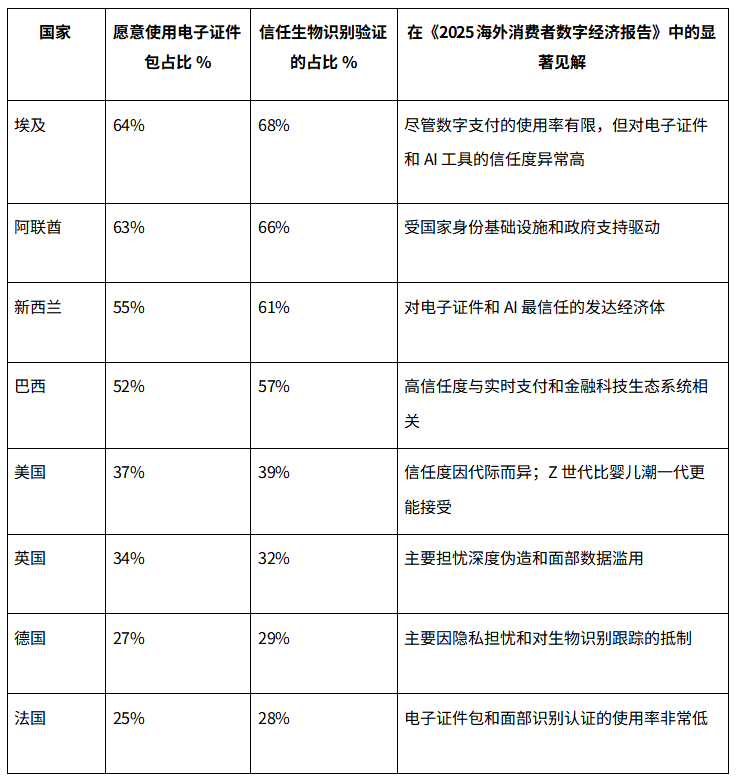
Core Insights - Checkout.com's global survey highlights significant regional differences in the acceptance of digital IDs, emphasizing the need for building trust [1][2] - Consumers in Asia, the Middle East, and Africa show high trust in digital IDs and biometric authentication, while Europe and North America exhibit lower acceptance [1][2] - The rise of AI-driven e-commerce agents underscores the importance of digital identity systems in maintaining transaction trust [1][2] Regional Analysis - In Egypt, 68% of consumers view digital IDs as a secure payment method, with 74% trusting AI-assisted transactions [2][3] - In the UAE, 63% of consumers are willing to use digital ID packages, driven by national identity infrastructure and government support [5] - New Zealand leads developed economies with 55% of consumers open to digital ID packages and 61% trusting biometric technology [3][5] - Brazil shows similar trends with 52% and 57% trust levels, attributed to a thriving fintech ecosystem and a tech-savvy population [3][5] - In contrast, only 32% of UK consumers trust digital IDs, with concerns over deepfakes and facial recognition being major barriers [3][5] - Trust levels in Germany and France remain below 30%, reflecting a cautious attitude towards centralized personal data storage [3][5] Generational Perspectives - 60% of Generation Z consumers believe digital IDs will soon become the primary method for online payments, indicating a more optimistic outlook compared to older generations [3][4]

4年赋能中小科技企业超6600家,浦东这个首创计划再升级
Di Yi Cai Jing· 2025-08-21 02:02
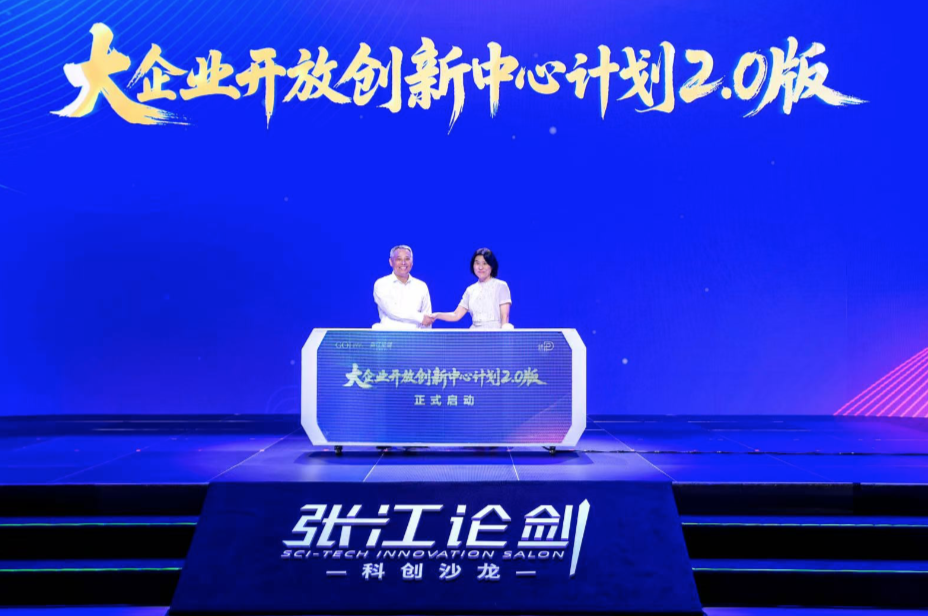
Core Insights - The GOI Plan 2.0, launched in Pudong, aims to enhance collaboration between large enterprises and SMEs, marking a new phase in open innovation [1][3] - The initiative has been recognized as a "best practice case" by the Ministry of Commerce, with over 107 GOI centers established across 12 countries and 750+ tech companies supported since its inception in 2021 [1][3] Group 1: GOI Plan 2.0 Highlights - The new version of the GOI Plan emphasizes three interconnected systems: element circulation, ecological evolution, and institutional innovation [3] - It introduces "four major empowerments" in element circulation, focusing on technology, incubation, business, and investment [3] - The plan encourages large enterprises to participate in the Pudong Natural Science Fund and supports the establishment of high-level platforms for technology transfer and application [3][4] Group 2: Policy Framework - The policy framework of GOI Plan 2.0 targets five areas: incubation, technology, industry, finance, and talent, to foster collaboration between large and small enterprises [4] - Pudong aims to strengthen open cooperation in basic research, encouraging large companies to propose challenges while universities and research institutions provide solutions [4] - Special funds are allocated to support the development of key industries such as integrated circuits, biomedicine, artificial intelligence, and high-end equipment [4] Group 3: Talent Development - The GOI enterprises are included in a priority support list to attract strategic scientists and leading technology talents [5] - The "Youth Innovation Fifteen Measures" policy offers support for young talents in housing and entrepreneurship, with up to 1 million yuan in annual subsidies for high-growth projects [5] Group 4: Open Innovation Ecosystem - The GOI initiative has created an open innovation ecosystem through collaboration with large enterprises, industry chain synergy, and global resource integration [6] - Companies like Plug and Play China have successfully connected large enterprises with startups, resulting in investments in over 100 startups, including three unicorns valued over 1 billion dollars [6] Group 5: Case Studies - The collaboration between Siemens and local company Heihu Technology exemplifies successful open innovation, where both parties leverage each other's strengths for market expansion [6] - Various GOI representatives have announced key demands and quality platform functions to accelerate the growth of SMEs [6]
美股异动 | 美敦力(MDT.US)涨逾4% 2026财年Q1业绩超预期并上调全年利润指引
智通财经网· 2025-08-20 15:07
Core Insights - Medtronic (MDT.US) shares rose over 4% to $94.04 following the release of its Q1 fiscal year 2026 earnings report, which showed revenue of $8.6 billion, exceeding market expectations of $8.4 billion, driven primarily by growth in the cardiovascular products segment [1] - The company's adjusted earnings per share increased by 2% to $1.26, surpassing the market forecast of $1.23 [1] - Medtronic, along with peers such as Stryker (SYK.US), Boston Scientific (BSX.US), and GE HealthCare Technologies (GEHC.US), revised its tariff cost forecast downwards, now expecting a loss of $185 million compared to the previous estimate of $200 million to $350 million [1] - The company has updated its fiscal year 2026 adjusted earnings per share guidance to a range of $5.60 to $5.66, higher than the prior forecast of $5.50 to $5.60 [1]

美敦力(MDT.US)Q1业绩超预期 将扩大董事会
智通财经网· 2025-08-19 12:20
Group 1 - Medtronic reported Q1 FY2026 revenue of $8.6 billion, exceeding market expectations of $8.4 billion, driven by growth in the cardiovascular products segment, with cardiac ablation product revenue increasing nearly 50% [1] - Adjusted EPS grew by 2% to $1.26, surpassing the market forecast of $1.23 [1] - Medtronic lowered its tariff cost forecast to $185 million from a previous estimate of $200 million to $350 million [1] Group 2 - Medtronic raised its FY2026 adjusted EPS guidance to a range of $5.60 to $5.66, up from the prior forecast of $5.50 to $5.60 [1] - The company continues to expect an organic revenue growth rate of 5% for FY2026 [1] - Following the investment from Elliott Investment Management, Medtronic plans to expand its board and appoint experienced individuals in the medical technology field as independent directors [2]
全球及中国医用核素产品行业研究及十五五规划分析报告
QYResearch· 2025-08-19 08:42
Core Viewpoint - The medical radionuclide products market is experiencing significant growth, driven by advancements in precision medicine and the integration of diagnostic and therapeutic applications, with a projected compound annual growth rate (CAGR) of 19.16% from 2020 to 2024 and 9.23% from 2025 to 2031 [1][3]. Market Size and Forecast - In 2020, the global medical radionuclide products market was valued at $473.9 million, and it is expected to reach $955.2 million by 2024, indicating a CAGR of 19.16% during this period [1]. - By 2031, the market is projected to grow to $1.8932 billion, with a CAGR of 9.23% from 2025 to 2031 [1]. Industry Development Characteristics - The industry is evolving towards a dual focus on diagnosis and treatment, with new radiopharmaceuticals like ¹⁷⁷Lu and ²²³Ra leading the transition from diagnostic tools to core therapeutic methods [3]. - The trend of "Theranostics" is becoming prominent, promoting the paired use of diagnostic and therapeutic radionuclides to enhance accuracy and safety in treatment [3]. Favorable Factors for Industry Development - The growing demand for precision medicine is driving the need for targeted and effective treatment options, particularly in oncology [6]. - Technological advancements in nuclear imaging and radiation therapy, such as PET and SPECT, are providing a solid foundation for the development and application of medical radionuclide products [6]. - Increased government support through policies that facilitate faster approvals and funding for research is promoting industry growth [6]. - The high prevalence of diseases like cancer and cardiovascular conditions is creating a stable and expanding market for medical radionuclide products [6]. Unfavorable Factors for Industry Development - The complexity of production technology and high entry barriers due to the need for specialized knowledge in nuclear physics and radiochemistry limit market competition [8]. - The supply chain for key radionuclides is unstable, with production concentrated in a few countries, making it vulnerable to geopolitical and operational risks [8]. - Clinical promotion is hindered by strict radiation management regulations and a shortage of qualified professionals in nuclear medicine [8]. - The lengthy and complex regulatory approval processes for medical radionuclide products can delay market entry and affect profitability [8]. Barriers to Entry in the Industry - High technical barriers exist due to the need for interdisciplinary expertise in nuclear physics, radiochemistry, and pharmacology [10]. - Strict regulations governing the production and use of radionuclide products increase the complexity and cost of compliance [10]. - Significant investment is required for production equipment, such as nuclear reactors and cyclotrons, which raises the financial barrier for new entrants [10]. - The regulatory landscape is complicated by varying standards across countries, making international market entry challenging [10]. Talent Shortage - There is a notable shortage of specialized professionals in nuclear medicine, which affects the industry's ability to develop, produce, and promote medical radionuclide products effectively [11].
第八届进博会招商路演走进辽宁
Liao Ning Ri Bao· 2025-08-15 01:12
Core Insights - The event aims to create an open platform for Liaoning enterprises and exhibitors at the China International Import Expo (CIIE) to deepen connections and promote practical cooperation [1] Group 1: Event Overview - The 8th China International Import Expo招商路演 (Liaoning) was held on August 14 in Shenyang, co-hosted by the China International Import Expo Bureau, Liaoning Provincial Department of Commerce, and the National Exhibition and Convention Center (Shanghai) [1] - The event highlighted the services for professional audience participation and the unique features of the business exhibition areas at the upcoming CIIE [1] Group 2: Participation and Engagement - 35 exhibitors from various sectors, including Merck, Johnson & Johnson, GE Healthcare, IKEA, and others, participated in the event [1] - Over 140 local procurement companies from various cities in Liaoning engaged in discussions with exhibitors, establishing preliminary business connections [1] Group 3: Strategic Partnerships - Important procurement companies, including Shenyang Jierun Trading Co., Shenyang Deshi Cold Drink Food Co., Shenyang Grain and Oil Group Co., and others, signed significant procurement cooperation memorandums with the China International Import Expo Bureau [1]
迈瑞医疗股价微涨0.93% 将亮相服贸会健康卫生专题展
Sou Hu Cai Jing· 2025-08-13 16:50
Company Overview - Mindray Medical's latest stock price is 236.49 CNY, an increase of 2.19 CNY from the previous trading day [1] - The opening price for the day was 234.50 CNY, with a high of 236.70 CNY and a low of 232.53 CNY [1] - The trading volume was 73,986 hands, with a total transaction amount of 1.738 billion CNY [1] Industry Participation - Mindray Medical will participate in the 2025 China International Fair for Trade in Services, focusing on health and hygiene services from September 10 to 14 [1] - The theme of the exhibition is "Innovation, Intelligence, Development, and Benefit to the People" [1] - Mindray Medical will showcase its latest achievements alongside international companies such as GE Healthcare and Siemens Healthineers [1] Financial Flow - On the day of the report, the net outflow of main funds for Mindray Medical was 9.7791 million CNY [1] - Over the past five trading days, the cumulative net inflow was 265 million CNY [1]

Hologic Eyes Organic Growth Rebound in 2026 on Breast Health Strength
ZACKS· 2025-08-13 13:26
Core Insights - Hologic (HOLX) anticipates a return to mid-single-digit organic revenue growth in 2026, driven by a recovery in its Breast Health business [1][8] - The company has restructured its sales teams to enhance focus on capital and disposable product segments, which is expected to improve performance [2][8] - Hologic is launching innovative products, including Genius AI Detection PRO and the next-generation Envision gantry, aimed at improving imaging capabilities and operational efficiency [4][8] Financial Performance - In the third quarter, Hologic's Breast Health revenues declined compared to the previous year but showed sequential improvement, slightly exceeding company expectations [1] - Interventional organic sales grew by 6% in the third quarter, with reported sales increasing by 31.8%, aided by the contribution from Endomagnetics [3] - Hologic's stock has increased by 7.4% over the past six months, contrasting with a 14.9% decline in the industry [7] Competitive Landscape - GE Healthcare reported strong revenue growth across all segments, with adjusted EPS rising to 93 cents from 13 cents year-over-year, driven by demand for radiopharmaceutical products [5] - Merit Medical Systems exceeded financial expectations in the second quarter, achieving a record operating margin of 21.2% [6] Valuation Metrics - Hologic is currently trading at a forward three-year price-to-earnings ratio of 15.28X, which is below the industry average of 28.00X [9] - Analyst estimates for Hologic's EPS show a mixed trend for fiscal years 2025 and 2026, with current estimates at 4.22 for 2025 and 4.48 for 2026 [10][11]

SRDX Stock Up Following Q3 Earnings Beat, Gross Margin Contracts
ZACKS· 2025-08-12 18:06
Core Insights - Surmodics, Inc. (SRDX) reported adjusted earnings per share (EPS) of 6 cents for Q3 fiscal 2025, a significant improvement from a loss of 27 cents in the same quarter last year and better than the Zacks Consensus Estimate of a loss of 21 cents [1] - The company’s total revenues for the quarter were $29.6 million, reflecting a year-over-year decline of 2.6%, but exceeding the Zacks Consensus Estimate by 4.3% [2][4] - Surmodics has revised its fiscal 2025 revenue guidance, now expecting total revenues between $116.5 million and $118.5 million, which indicates a decrease of 8-6% compared to the previous fiscal year [12][13] Revenue Analysis - Total revenues included $0.0 million from SurVeil drug-coated balloon (DCB) license fees, down from $1.1 million in Q3 fiscal 2024, attributed to the completion of the TRANSCEND clinical trial [2][4] - Excluding SurVeil DCB license fees, total revenues increased by 1% year-over-year to $29.6 million [3] - The Medical Device segment reported sales of $22.2 million, a decrease of 4.9% from the previous year, while In Vitro Diagnostics (IVD) sales improved by 5.7% to $7.4 million [5][6] Segment Performance - Product sales were $16.8 million, down 4.6% year-over-year, while royalties and license fees totaled $9.7 million, a decline of 7.7% [7] - Research, development, and other revenues increased by 35.7% to $3.1 million [8] - The decrease in SurVeil DCB product sales revenues was $1.7 million year-over-year, primarily due to lower demand from Abbott, Surmodics' exclusive distribution partner [4] Margin and Expense Trends - Gross profit decreased by 4.1% year-over-year to $20.9 million, with a gross margin contraction of 116 basis points to 70.9% [9] - Selling, general, and administrative expenses rose by 6.8% to $17.8 million, while research and development expenses fell by 22.4% to $7.6 million [10] Financial Position - Surmodics ended Q3 fiscal 2025 with cash and cash equivalents of $26.3 million, down from $29.2 million at the end of the previous quarter [11] - Total long-term debt slightly increased to $29.67 million from $29.63 million [11] Future Guidance - The company anticipates a decrease of $3.6 million in SurVeil DCB license fee revenues for fiscal 2025, with no further recognition of these revenues after March 31, 2025 [14] - Adjusted loss per share for fiscal 2025 is now projected to be between 35 and 20 cents, an improvement from the previous outlook of 62 to 42 cents [15]


收获“盛夏果实”!第三届链博会签署合作协议、达成合作意向超6000项
Xin Hua Wang· 2025-08-12 06:30
在当天举行的第四届链博会参展签约仪式上,霍尼韦尔、GE医疗、西门子、康宁、住友电工、中兴通 讯、阿里巴巴、赛力斯、稳健医疗等102家中外企业和机构签署参展意向,比去年现场签约数量增加 50%。 【纠错】 【责任编辑:王佳宁】 李兴乾介绍,本届链博会,参展的美国企业和机构数量比上届增长15%,继续位列境外参展商数量之 首。 中国贸促会产业促进部部长杨晓军表示,本届链博会参展商综合满意度达到95%,很多参展商提出明年 希望扩大规模,携手全球更多的供应商和客户前来参展。 新华社北京7月20日电(记者邹多为、熊琳)"硬核"展会收获"盛夏果实"!第三届中国国际供应链促进 博览会20日在北京闭幕。记者从闭幕新闻发布会上获悉,本届链博会中外参展企业和机构达到1200家, 参展商与4.2万家上下游企业建立合作联系。据不完全统计,现场共签署合作协议、达成合作意向超过 6000项。 "本届链博会层次更高、人气更旺、交流更广、成果更实。"中国贸促会副会长李兴乾说,多国政要、40 多位世界500强跨国企业领导人以及国际组织主要负责人专程参会,172个境外团组观展参会,是上届的 2.2倍,线上线下观众人数超过21万人次,比上届增长5% ...