
Ares Management

Search documents
US software stocks hit by Anthropic wake-up call on AI disruption
Yahoo Finance· 2026-02-04 15:42
Core Viewpoint - U.S. software stocks are experiencing a significant decline due to fears of disruption from artificial intelligence, with analysts warning of potential volatility as the sector assesses the existential threat posed by AI [1][5]. Group 1: Market Performance - The S&P 500 software and services index has dropped nearly 13% over five consecutive sessions and is down 26% from its peak in October, while the S&P 500 reached an all-time high recently [5]. - Nasdaq-listed Thomson Reuters saw a decline of about 2% following a record 16% drop, driven by concerns that AI could threaten its core legal division [7]. - Other companies such as Salesforce, CrowdStrike, Adobe, and Intuit experienced declines ranging from 2% to 6.6% [7]. Group 2: Industry Disruption Concerns - The push of AI into various industries, including finance, law, and coding, has raised fears of disruption, particularly for startups like OpenAI and Anthropic, which are under pressure to validate their high valuations [2][3]. - Analysts express skepticism about the success of AI startups, citing their lack of specialized data crucial for businesses in these industries [3]. - Concerns exist that the expectation for companies to develop bespoke products to replace existing enterprise software may be unrealistic [4]. Group 3: Broader Impact - The volatility in the software sector is affecting private credit firms that lend to software companies, with notable declines in firms like Blue Owl Capital (down 9.8%), Ares Management (down 10.2%), and KKR (down 9.7%) [6]. - Analysts suggest that during volatile periods, market reactions can be hasty, indicating that further volatility is likely [6].

X @Bloomberg
Bloomberg· 2026-02-03 21:17
RT Bloomberg Live (@BloombergLive)As a leading architect of the private credit boom, @ares_management continues to scale rapidly. At #BloombergInvest, CEO Michael Arougheti shares a frontline view of the credit cycle and the firm’s path toward $750B in AUM.Live 3/3 at 11:05 AM ET!https://t.co/eeTrczfbKe https://t.co/53k7rhLMiK ...
刚募了170亿美元的顶级机构,卖身了
投中网· 2026-02-03 07:40
Core Insights - The article highlights the resurgence of merger and acquisition (M&A) activities, with global M&A transaction volume projected to reach $4.5 trillion in 2025, marking a nearly 50% increase from 2024 and the second-highest level in over 40 years, only behind the peak in 2021 [3]. Group 1: M&A Trends and Strategic Moves - The recent acquisition of Coller Capital by EQT for up to $3.7 billion signifies a shift in focus from traditional industry targets to peer firms within the private equity (PE) sector [4][5]. - The importance of secondary transactions (S transactions) is growing, evolving from a liquidity tool to a core component of diversified investment strategies for large institutions [5][16]. - EQT's acquisition aims to strategically complete its presence in the S market, which is experiencing unprecedented growth, with a reported 41.7% year-on-year increase in global S fund investments in the first half of 2025 [15][16]. Group 2: Company Profiles and Financials - Coller Capital, founded in 1990, is a pioneer in the S fund business and recently closed its largest fund, Coller International Partners IX, with a total size of $14.2 billion, bringing its total assets under management to $50 billion [8][10]. - EQT, established in 1994 and backed by the wealthy Wallenberg family, has a total asset management scale of €267 billion (approximately ¥2.21 trillion) and is the second-largest private equity group globally [9][10]. - Post-acquisition, the combined asset management scale of EQT and Coller Capital will exceed ¥2.55 trillion [11]. Group 3: Future Outlook and Strategic Goals - Following the acquisition, Coller Capital will operate as "Coller EQT," establishing a new independent business platform within EQT, with plans to double its business size within four years and launch a new fund targeting $6-8 billion by mid-2027 [18]. - The merger reflects a strategic response to increasing competition and market concentration in the S transaction space, where the top 20 firms hold 62% of the market share [17]. Group 4: Broader M&A Landscape - EQT's acquisition of Coller Capital is part of a broader trend where leading investment firms are using M&A to rapidly scale their capabilities, as seen in EQT's previous acquisition of Baring Asia for approximately ¥478 billion [21]. - Other firms, such as CVC Capital and Ares Management, have also pursued similar strategies to establish S transaction platforms through acquisitions [22]. Group 5: Challenges and Considerations - The article notes that while M&A can be a powerful tool for growth and transformation, it requires significant financial strength and operational capabilities, making it primarily a "game for giants" in the investment landscape [22].


X @Bloomberg
Bloomberg· 2026-01-29 16:57
Ares Management credit funds have led a $1.6 billion private debt financing to support the merger of Suave Brands Company and Elida Beauty, according to a statement Thursday https://t.co/rgnCJaYk1g ...
2500万美元,伯克希尔接班人年薪曝光,是巴菲特250倍
Zheng Quan Shi Bao· 2026-01-07 12:18
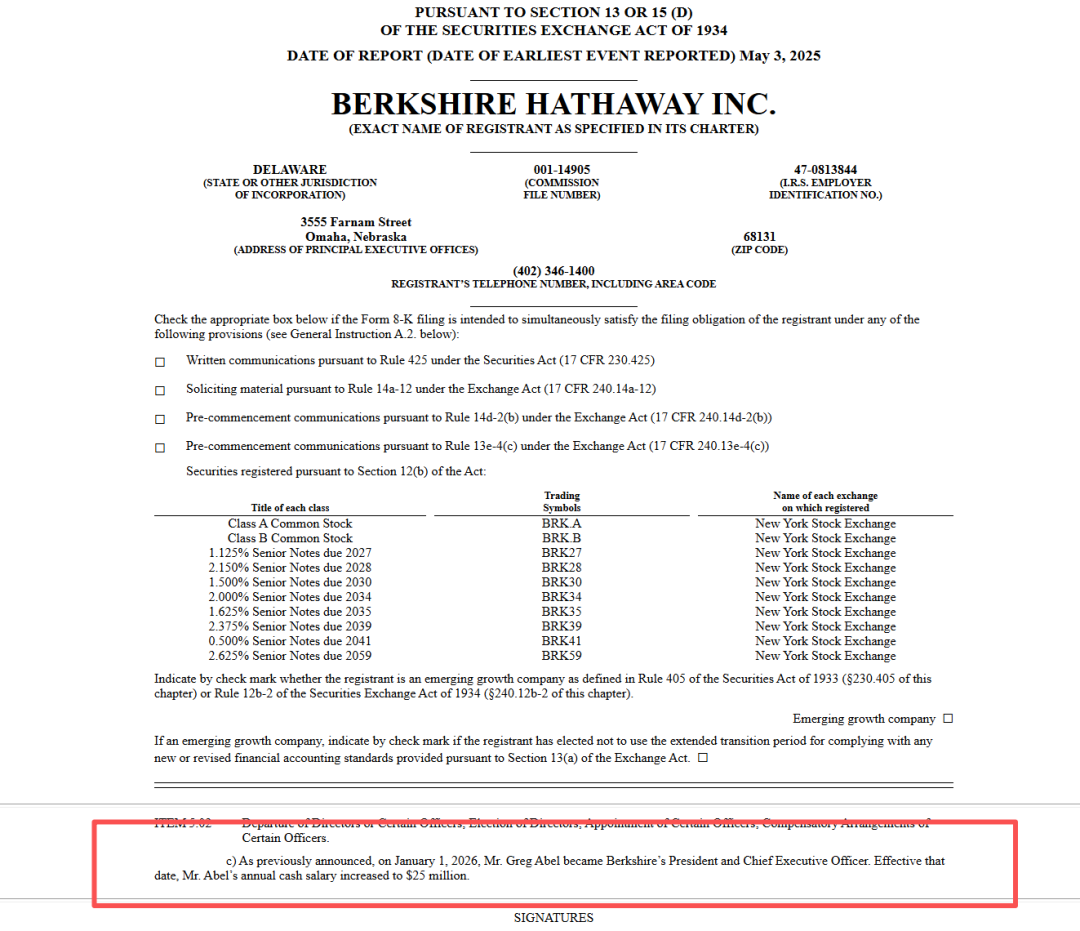
Core Viewpoint - The new CEO of Berkshire Hathaway, Greg Abel, will receive an annual cash salary of $25 million, significantly higher than Warren Buffett's long-standing salary of $100,000 [1][6]. Group 1: CEO Compensation - Greg Abel's new salary represents a 19% increase from his previous salary of $21 million for 2024 [6]. - Warren Buffett's 2024 salary was $100,000, with an additional $305,000 in "other compensation" [6]. - Despite Abel's salary being much higher than Buffett's, it is still modest compared to the compensation packages of tech executives [6][7]. Group 2: Executive Comparisons - The highest-paid CEO in 2024 is Rick Smith of Axon, with total compensation of $164.5 million [7]. - Other notable high earners include Jim Anderson of Coherent at $101.5 million, and Brian Niccol of Starbucks at $95.8 million [7]. Group 3: Investment Challenges - Abel faces the challenge of effectively investing Berkshire's substantial cash reserves, which amount to $382 billion [9]. - Suggestions for utilizing the cash include stock buybacks, acquisitions, or paying dividends, although Buffett has not pursued these options effectively in recent years [10]. - The company has not repurchased stock in the past five quarters and has rarely issued dividends under Buffett's leadership [10].

2500万美元!伯克希尔接班人年薪曝光,是巴菲特250倍!
Zheng Quan Shi Bao· 2026-01-07 11:57
Core Viewpoint - The new CEO of Berkshire Hathaway, Greg Abel, will receive an annual cash salary of $25 million, significantly higher than Warren Buffett's long-standing salary of $100,000, raising questions about executive compensation in the company [1][5]. Group 1: Executive Compensation - Greg Abel's new salary of $25 million represents a 19% increase from his previous salary of $21 million for 2024 [5]. - Warren Buffett's 2024 salary was $100,000, with an additional $305,000 in "other compensation," while he holds approximately 206,400 shares of Berkshire, valued at around $150 billion [5]. - Abel currently holds 228 shares of Class A and 2,263 shares of Class B stock, with a total market value of about $150 million [5]. Group 2: Comparison with Industry Peers - In comparison to other CEOs of large U.S. companies, the highest-paid CEO is Rick Smith of Axon, with total compensation of $164.5 million, followed by Jim Anderson of Coherent at $101.5 million [6]. - Other notable high earners include Starbucks CEO Brian Niccol at $95.8 million and GE Aerospace CEO Larry Culp at $87.4 million [6]. - Apple's CEO Tim Cook earned $74.6 million, slightly less than Microsoft's CEO Satya Nadella at $79.1 million [6]. Group 3: Investment Challenges - As Buffett's chosen successor, Abel faces the challenge of effectively investing Berkshire's substantial cash reserves, which amount to $382 billion [7]. - Alex Morris, an investment researcher, suggests that Abel could consider stock buybacks, acquisitions, or special dividends, but notes that Buffett's past strategies have not yielded significant results [8]. - Morris emphasizes that finding a solution for cash allocation will be more challenging for Abel than it was for Buffett, who had greater leeway from Wall Street and shareholders [8].
2500万美元!伯克希尔接班人年薪曝光,是巴菲特250倍!
证券时报· 2026-01-07 11:54
Core Viewpoint - The article discusses the significant salary increase for Greg Abel, the new CEO of Berkshire Hathaway, compared to his predecessor Warren Buffett, highlighting the challenges Abel faces in managing the company's substantial cash reserves. Group 1: CEO Salary Comparison - Greg Abel's annual cash salary as CEO is set at $25 million, a stark contrast to Warren Buffett's long-standing salary of $100,000 per year [2][5] - Buffett's total compensation in 2024 included $305,000 in other compensation, while he holds approximately 206,400 shares of Berkshire, valued at around $150 billion [5] - Abel currently holds 228 shares of Class A stock and 2,263 shares of Class B stock, with a total market value of about $150 million [5] Group 2: Executive Compensation Context - Despite Abel's high salary, it is still modest compared to the compensation packages of CEOs in the tech sector, where top executives earn significantly more [6] - The highest-paid CEO in 2024 is Rick Smith of Axon, with total compensation of $164.5 million, followed by other notable CEOs with earnings exceeding $90 million [6] Group 3: Investment Challenges - Abel faces the challenge of effectively investing Berkshire's cash reserves, which amount to $382 billion [10] - Potential strategies for utilizing the cash include stock buybacks, acquisitions, or special dividends, but Buffett's previous approaches have not yielded significant results [10] - The article notes that Buffett enjoyed a higher tolerance from Wall Street and shareholders regarding cash accumulation than Abel is likely to receive [10]
Better Dividend Stock: Ares Capital vs. Main Street Capital
Yahoo Finance· 2026-01-02 15:50
Core Insights - Business development companies (BDCs) are attractive for dividend stock investments due to their requirement to distribute 90% of taxable income to shareholders to avoid corporate-level taxes, resulting in appealing dividends [1] Ares Capital - Ares Capital is the largest BDC, having invested $28.7 billion across 587 portfolio companies as of the end of Q3, with 71% of its portfolio in senior secured loans [3][4] - The company primarily targets middle-market companies with annual revenues between $100 million and $1 billion, but also invests in larger firms [3] - Ares Capital is part of Ares Management, which has nearly $600 billion in assets under management, providing competitive advantages such as strong relationships with credit providers and increased deal flow [4] - Ares Capital currently pays a quarterly dividend of $0.48 per share, yielding 9.4% at recent share prices, and has maintained or increased its dividend for 16 years [5][7] - The BDC has sufficient income to cover its dividend payments, reporting $0.57 per share of GAAP net income and $0.50 per share of core earnings in Q3, along with $1.26 per share of excess taxable income carried forward from 2024 [5] - In Q3, Ares secured $3.9 billion in new investment commitments across 80 companies, significantly outpacing $2.6 billion in exited commitments, and raised over $1 billion in new debt capital [6]


X @Bloomberg
Bloomberg· 2025-12-19 14:36
Related Ross, the South Florida real estate development firm founded by billionaire Stephen Ross, secured a $772 million loan led by Ares Management to finance the completion of a pair of office towers in West Palm Beach https://t.co/JlLEVfWlKN ...
Ares Management CEO: We're not in an AI bubble
CNBC Television· 2025-12-10 20:45
Yeah, back to your private credit question, there's a similar type of anxiety about the data center build and and capex and I I again I don't really see it. So if you zoom out and you look at the demand for data and the demand for data centers, it makes perfect sense just given the digitization of everything and we are years away from the demand overwhelming supply. When we think about this business, you can just look at the large hyperscalers alone and you have $300 billion dollars of capex demand this yea ...
