
CBRE

Search documents
Trucking and real estate stocks struggle to gain momentum in premarket after becoming latest victims of AI fears
CNBC· 2026-02-13 12:37
Logistics Sector - Logistics stocks experienced significant declines due to AI-related fears, particularly after the introduction of a new tool called SemiCab from Algorhythm Holdings, which is marketed as a leading transportation platform [2][3] - C.H. Robinson and RXO saw their stock prices drop by as much as 20% on Thursday, with C.H. Robinson rebounding slightly by 0.7% in premarket trading, while RXO continued to decline by 1.5% [2] - Expeditors International of Washington fell over 16% on Thursday but was trading flat in premarket, while J.B. Hunt Transportation Services lost an additional 0.6% after a 9% drop the previous day [3] Real Estate Sector - The commercial real estate sector faced a continued sell-off, with CBRE among the hardest hit, extending its losses with a 0.6% decline in premarket trading [4] - Jones Lang LaSalle and Hudson Pacific Properties also saw marginal declines, while SL Green Realty rebounded slightly by 0.4% after a 5% drop on Thursday [4] Software Sector - Software stocks were affected by the broader market sell-off, with Palantir Technologies down 1.5% and Autodesk and Salesforce both down 0.1% in premarket trading [5] - The iShares Expanded Tech-Software Sector ETF (IGV) lost around 3% on Thursday and is down approximately 23% year-to-date, indicating a bear market [6] - Notably, all "Magnificent Seven" tech stocks ended Thursday in negative territory, with Tesla leading the losses at 0.8% [6] Analyst Insights - UBS strategists noted that the recent developments validate AI's monetization potential and emphasize its transformative nature, suggesting that investors should diversify across sectors and geographies rather than focusing solely on the U.S. information technology sector [7] - Dan Ives from Wedbush Securities acknowledged that while some software companies may struggle due to AI advancements, the entire sector should not be discounted, highlighting that companies like Salesforce and ServiceNow will remain integral to the AI revolution [9][10]


美股极其脆弱!从SaaS、PE到保险、物业甚至物流“轮流大跌”,高盛交易员“疲惫且震惊”
Hua Er Jie Jian Wen· 2026-02-13 00:48
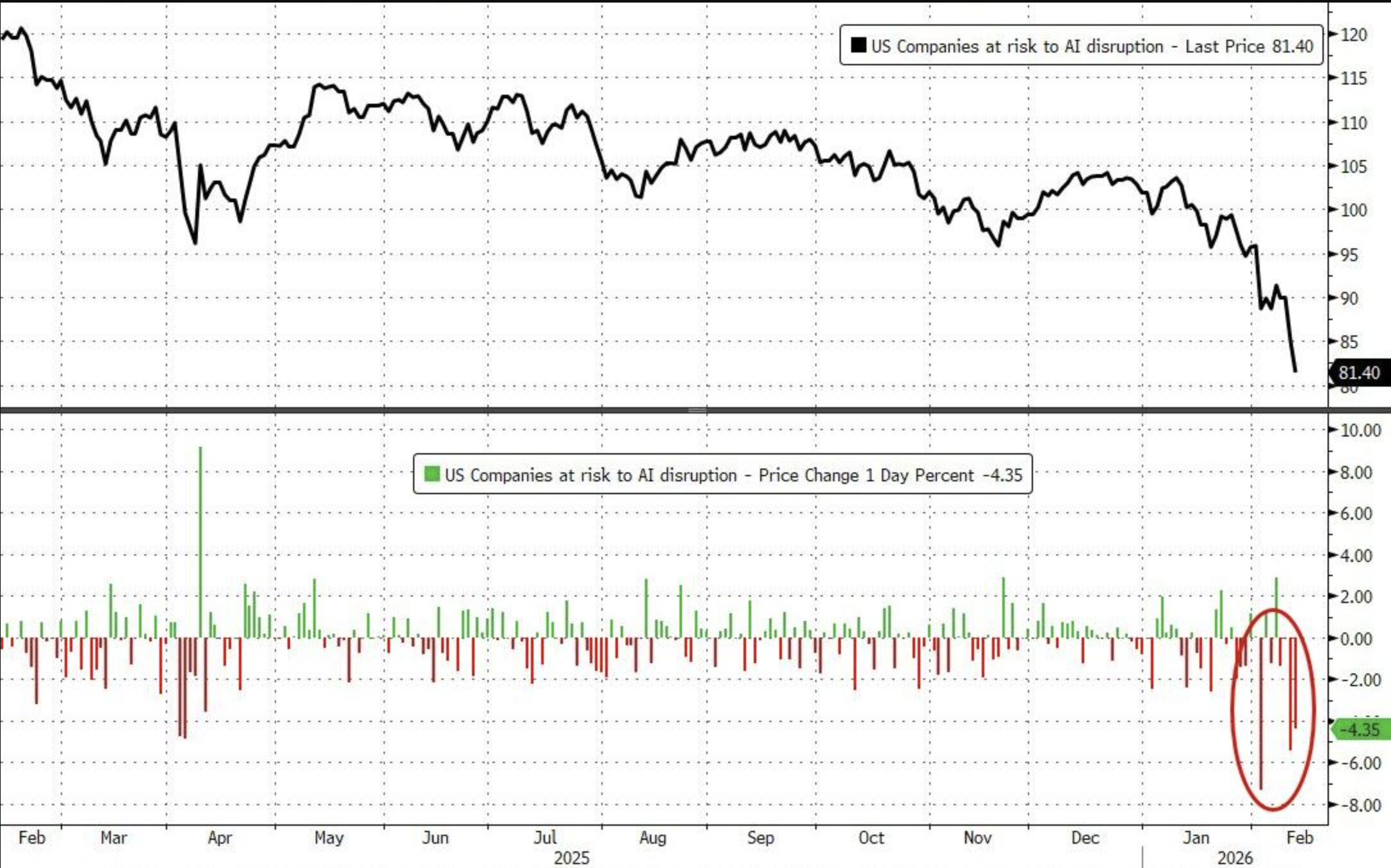
Core Viewpoint - The U.S. stock market is experiencing a rare and widespread panic sell-off, driven by concerns over AI's disruptive potential across various sectors [1][3] Market Behavior - Over 40 S&P 500 stocks exhibited abnormal volatility exceeding three standard deviations, marking the highest level observed by Goldman Sachs trader Ryan Shakey [1] - Defensive sectors such as utilities, consumer staples, REITs, and healthcare are leading the market, while technology, media, and telecommunications are facing significant declines [1] - The Goldman Sachs AI risk exposure basket (GSTMTAIR) saw a sharp drop of 510 basis points in a single day, indicating heightened market sensitivity to AI-related risks [1] Investor Sentiment - Investor sentiment has shifted dramatically, with a notable loss of appetite for bottom-fishing, as hedge funds and long institutions are selling off but at smaller scales, indicating a growing sense of fatigue [4] - The market breadth has deteriorated sharply, with 350 S&P 500 stocks declining, and major tech companies like Apple, Amazon, Microsoft, Meta, and Cisco dragging down the index [5] Sector-Specific Impacts - The logistics sector has become a recent focal point, with CH Robinson experiencing an eight-standard deviation drop, reflecting the spread of AI panic from tech to traditional industries [6] - Financial stocks, previously seen as safe havens, are also under pressure, with regional banks losing their appeal as attractive investments [6] - The healthcare sector has seen a 32% drop in contract research organizations (CROs) this month, following Pfizer's announcement to utilize AI for most clinical trials [6] Reassessment of AI Winners - The technology, media, and telecommunications sectors, excluding storage chips, are facing widespread declines, as previously regarded "winners" are being sold off amid risk-averse sentiment [7] - Investors are confused about the underlying issues in earnings reports, as fundamental analysis appears to be overlooked in the current panic environment [7]

CBRE(CBRE) - 2025 Q4 - Annual Report
2026-02-12 22:24
Company Overview - CBRE is the world's largest commercial real estate services firm, serving nearly 90% of Fortune 100 companies and many large institutional investors in 2025[13]. - The company has $155.5 billion in assets under management as of December 31, 2025, making it a leading investment platform for global real assets[26]. - CBRE's in-process portfolio and pipeline totaled over $29.5 billion as of December 31, 2025, spanning all major asset classes[27]. - The company employs approximately 155,000 employees across over 100 countries, highlighting the scale of its operations[81]. Financial Performance - In 2025, CBRE generated revenue of $40.6 billion, reflecting a 13.4% increase compared to 2024[151]. - GAAP net income for 2025 was $1.2 billion, representing a 19.5% increase year-over-year[151]. - Core EBITDA reached $3.3 billion in 2025, up 22.3% from the previous year[151]. - GAAP earnings per share (EPS) was $3.85, a 22.6% increase compared to 2024[151]. - Core EPS increased by 25.1% to $6.38 in 2025[151]. - Consolidated net income for the year ended December 31, 2025, was $1.2 billion on revenue of $40.6 billion, compared to net income of $968 million on revenue of $35.8 billion for 2024, reflecting a revenue increase of 13.4%[154]. Business Segments and Growth - The Building Operations & Experience segment was established in 2025 to unify various property management capabilities, benefiting from increased demand for outsourcing real estate services[21]. - CBRE's Project Management segment, through Turner & Townsend, oversees projects globally, ensuring they are completed on schedule and within budget, with a focus on large-scale infrastructure projects[24]. - Revenue from resilient businesses grew by 13.4%, while transactional businesses saw a 13.6% increase in revenue[151]. - Advisory Services segment revenue increased by 14.4% in 2025, with property sales revenue rising by 20.0% and global leasing revenue increasing by 15.5%[173]. Capital and Investments - Approximately $2.7 billion of capital was deployed in 2025, including $1.2 billion for the acquisition of Pearce and $468 million for the remaining 60% equity interest in Industrious[150]. - The company has a net investment of approximately $375 million in co-investments and has committed $216 million for future funding, with $70 million expected to be funded during 2026[69]. - The company incurred $366 million in capital expenditures during the year ended December 31, 2025, with anticipated capital expenditures for 2026 expected to reach up to $500 million[206]. Debt and Financial Obligations - As of December 31, 2025, the company's total debt was $6.0 billion, with an interest expense of $490 million for the year[87]. - The company is required to maintain a maximum leverage ratio of total debt to consolidated EBITDA, which may be affected by events beyond its control[88]. - A breach of restrictive covenants could result in a default under the company's debt instruments, leading to immediate repayment of borrowings[89]. - The company issued $750 million in senior notes due 2033 on November 13, 2025, generating net proceeds of approximately $742 million for debt repayment and corporate purposes[208]. Market Conditions and Challenges - In 2023 and early 2024, the commercial real estate capital markets experienced significant pressure, leading to a slowdown in property sales and debt financing activity[50]. - The company faced challenges in attracting capital and achieving returns sufficient to earn incentive fees due to less available and more expensive debt capital[55]. - Economic downturns may reduce the volume of loans originated and serviced by the capital markets business, impacting overall revenue[51]. Risk Management - The company is exposed to risks associated with international operations, including political, legal, and economic uncertainties in various jurisdictions[57]. - The company must effectively manage organizational challenges associated with its size to retain and attract key personnel[46]. - The company faces significant costs and potential liabilities from cybersecurity incidents, including regulatory investigations and fines[104]. - Legal and regulatory risks could lead to substantial financial liabilities, particularly in the valuations business, which may not be fully covered by insurance[106]. Compliance and Regulatory Environment - Compliance with complex and evolving data protection laws, including GDPR, increases operational costs and compliance risks[100]. - The company is subject to evolving corporate governance and public disclosure regulations, particularly regarding sustainability, which could impact its reputation and financial condition[111]. - Changes in tax laws and regulations, including the OECD's proposed minimum global corporate tax rate of 15%, could increase tax uncertainty and affect the company's effective tax rate[115]. Shareholder Returns - CBRE repurchased 7,052,481 shares for a total of $956 million in 2025[150]. - The Board authorized an additional $5.0 billion to the existing share repurchase program, bringing the total to $9.0 billion[138].

AI Disruption Fears Slam Real Estate Brokers
Benzinga· 2026-02-12 21:57
Group 1 - The core viewpoint of the articles highlights concerns over the impact of artificial intelligence on the commercial real estate services sector, leading to a sell-off in stocks of major firms like CBRE Group, Jones Lang LaSalle, and Cushman & Wakefield [1][3] - CBRE Group, Jones Lang LaSalle, and Cushman & Wakefield operate as "picks-and-shovels" firms in the commercial property market, generating revenue through advisory services tied to transaction volumes [2] - The potential for AI to reduce the need for large teams and high-margin advisory fees raises questions about the sustainability of current business models in the real estate services industry [3] Group 2 - CBRE Group reported a fourth-quarter adjusted EPS of $2.73, exceeding the consensus estimate of $2.67, although revenue of approximately $11.63 billion fell slightly short of expectations [4] - The company provided FY2026 adjusted EPS guidance of $7.30 to $7.60, with the midpoint surpassing Wall Street estimates, which initially supported the stock before it closed down about 8% at $136.28 [5] - Rising legal costs and uncertainties related to private listing networks are identified as near-term challenges for the industry [6]



AI 'Scare Trade' Hits Real Estate Stocks
Bloomberg Television· 2026-02-12 21:09
Very much feels like the market is just taking a look around at any possible sector that could be disrupted by. Selling first, asking questions later. It's wild.I think that's the perfect context to talk about them. It's like a wrecking ball. Every day is pointed out a new sector and some commonalities between them all.It's that, you know, sort of high cost intermediary business. You know, in the case of CBRE, you know, part of their business, a big part of their business, ABC's managing the properties but ...

CBRE Group Q4 Earnings Beat Estimates, Revenues Rise Y/Y
ZACKS· 2026-02-12 18:16
Core Insights - CBRE Group Inc. reported fourth-quarter 2025 core earnings per share (EPS) of $2.73, exceeding the Zacks Consensus Estimate of $2.66, and reflecting a year-over-year increase of 17.7% [1][9] - Quarterly revenues rose 11.8% year over year to $11.63 billion, surpassing the Zacks Consensus Estimate of $11.51 billion [2][9] - For the full year 2025, core EPS was $6.38, up from $5.10 in the prior year, and also above the Zacks Consensus Estimate of $6.32, supported by a 13.4% revenue increase to $40.55 billion [2] Revenue Breakdown - The Advisory Services segment saw a 13.1% year-over-year revenue increase to $2.92 billion [3] - Global leasing revenue increased by 14%, driven by strong performance in Continental Europe and the U.K., with a 12% rise in the U.S. [3] - Global property sales revenues grew 19%, with the U.S. contributing a significant 27% growth [4] - Mortgage origination revenues rose 18%, attributed to higher origination fees from debt funds and CMBS lenders [4] - The Building Operations & Experience segment reported a 14.6% revenue increase to $6.31 billion [4] - Facilities management revenues increased by 13%, while property management revenues surged 28% due to contributions from the acquired company, Industrious [5] - Project Management segment revenues grew 8.3% to $2.21 billion, supported by new projects for hyperscaler clients in the U.S. and infrastructure mandates in the U.K. [6] - The Real Estate Investments segment experienced a revenue decline of 20% to $220 million [6] Asset Management and Financial Position - Assets under management increased by over $9 billion to $155 billion since the end of 2024, aided by a capital raise of $11 billion for the year [7] - As of the end of Q4 2025, cash and cash equivalents stood at $1.86 billion, up from $1.67 billion at the end of Q3 2025 [8] - Total liquidity increased to $5.68 billion, comprising $1.86 billion in cash and approximately $3.82 billion available under revolving credit facilities [8] - The net leverage ratio was reported at 1.24X, significantly below the primary debt covenant of 4.25X [10] Future Outlook - For 2026, CBRE issued core EPS guidance in the range of $7.30-$7.60, with the Zacks Consensus Estimate currently at $7.26, below the guided range [11]

CBRE targets $2B data center revenue and 17% EPS growth in 2026 while expanding AI-driven efficiencies (NYSE:CBRE)
Seeking Alpha· 2026-02-12 15:25
Group 1 - The article does not provide any relevant content regarding the company or industry [1]

CBRE Group, Inc. 2025 Q4 - Results - Earnings Call Presentation (NYSE:CBRE) 2026-02-12
Seeking Alpha· 2026-02-12 15:02
Group 1 - The article does not provide any relevant content regarding the company or industry [1]
CBRE(CBRE) - 2025 Q4 - Earnings Call Transcript
2026-02-12 14:32
Financial Data and Key Metrics Changes - Fourth quarter revenue increased by 12%, with core EPS rising by 18%, both reaching record levels for the company [5][12] - Core EBITDA rose by 19% for the quarter, indicating strong operational performance [12] - The company expects core EPS for 2026 to be in the range of $7.30-$7.60, reflecting a 17% growth at the midpoint [7][19] Business Line Data and Key Metrics Changes - Advisory services saw double-digit growth in leasing and sales, with global leasing revenue growing by 14% [12] - The building operations and experience segment experienced revenue growth driven by local facilities management and data center solutions, with data center solutions revenue growing by over 20% [15][22] - Project management delivered solid revenue growth, supported by new real estate projects for hyperscalers [16] Market Data and Key Metrics Changes - In the U.S., leasing revenue grew by 12%, with significant contributions from data centers and industrial sectors [12] - EMEA led leasing growth with Continental Europe up 29% and the UK up 16% [12] - Capital markets saw U.S. sales revenue increase by 27%, driven by office and multifamily sectors [12] Company Strategy and Development Direction - The company is focused on building businesses that benefit from secular tailwinds, such as the acquisition of Pearce Services to enhance technical services capabilities in the digital infrastructure market [5][6] - There is a strong emphasis on integrating AI to improve operational efficiency and create a knowledge advantage [8][9] - The company plans to continue investing in its functional platform and products to support sustained growth [21] Management's Comments on Operating Environment and Future Outlook - Management expressed optimism about the growth trajectory, citing a strong start to 2026 and continued demand across various sectors [19][23] - The company acknowledges potential long-term impacts of AI on office space demand but currently sees robust demand for office leasing [40] - Management is confident in the resilience of its brokerage business against AI disruption due to the complexity of transactions [33] Other Important Information - The company generated nearly $1.7 billion of free cash flow in 2025, reflecting an 86% conversion on core net income [18] - There were one-time expenses that impacted project management margins, but these are expected to reverse in the first quarter of 2026 [29] - The company raised over $11 billion in capital in 2025, with AUM ending the year at $155 billion [17] Q&A Session Summary Question: Can you provide more detail on the capital markets pipeline and guidance for 2027? - Management does not expect the business to be driven by interest rate cuts, noting a balance between asking and offering prices and strong buyer and seller activity [26] Question: Can you elaborate on the one-time expenses affecting project management margins? - Management believes these expenses will be entirely reversed in the first quarter, leading to margin expansion [29] Question: What are the risks of AI impacting the brokerage business? - Management believes the brokerage business is protected from AI disruption due to the complexity and strategic nature of transactions [33] Question: How do you see the long-term demand for office space in relation to AI? - While AI may reduce some office worker needs, current demand for office space remains strong as companies use it to attract talent [40] Question: What is the outlook for margins in the BOE and project management business? - Management expects BOE margins to be flat in 2026 due to investments, while project management is anticipated to see margin expansion [69]
CBRE(CBRE) - 2025 Q4 - Earnings Call Transcript
2026-02-12 14:32
Financial Data and Key Metrics Changes - Fourth quarter revenue increased by 12%, with core EPS rising by 18%, both reaching record levels for the company [5][12] - Core EBITDA rose by 19% for the quarter, reflecting strong performance across various business segments [12] - The company expects core EPS for 2026 to be in the range of $7.30-$7.60, indicating a 17% growth at the midpoint [7][19] Business Line Data and Key Metrics Changes - Advisory services saw double-digit growth in leasing and sales, with global leasing revenue growing by 14% [12] - U.S. leasing revenue grew by 12%, supported by significant increases in data centers and industrial sectors [12][14] - The building operations and experience segment experienced revenue growth driven by local facilities management and data center solutions, with data center solutions revenue growing by over 20% [15][22] Market Data and Key Metrics Changes - EMEA leasing revenue led growth with Continental Europe up 29% and the U.K. up 16% [12] - U.S. sales revenue increased by 27%, driven by office and multifamily sectors, although still below prior peak levels [14] - Mortgage origination fees grew over 20%, supported by a 23% rise in loan volume [14] Company Strategy and Development Direction - The company is focused on building businesses that benefit from secular tailwinds, such as the acquisition of Pearce Services to enhance technical services capabilities in the digital infrastructure market [5][6] - There is a strong emphasis on integrating AI into operations to improve efficiency and create a knowledge advantage [8][9] - The company plans to continue investing in its functional platform and products, including launching a finance transformation [21] Management's Comments on Operating Environment and Future Outlook - Management expressed optimism about sustained growth, particularly in the data center and digital infrastructure sectors, despite potential risks associated with AI [11][57] - The company anticipates a slow, steady recovery in capital markets, with no reliance on interest rate cuts for growth [26] - Management noted that while there may be long-term changes in office space demand due to AI, current trends show strong demand for office space [40] Other Important Information - The company raised over $11 billion in capital in 2025, with assets under management (AUM) ending the year at $155 billion [17] - Free cash flow generated in 2025 was nearly $1.7 billion, reflecting an 86% conversion on core net income [18] - The company has embedded gains of about $900 million in its development portfolio [16] Q&A Session Summary Question: Can you provide more detail on the pipeline in capital markets and the impact of interest rates? - Management indicated that they do not expect capital markets to be driven by interest rate cuts, noting a balance between asking and offering prices [26] Question: Can you elaborate on the one-time expenses affecting project management margins? - Management stated that these expenses are expected to be reversed in the first quarter, leading to margin expansion [29] Question: What are the risks of AI impacting the brokerage business? - Management believes the brokerage business is protected from AI disruption due to the complexity and strategic nature of transactions [33] Question: How do you see the long-term demand for office space in relation to AI? - Management acknowledged potential long-term reductions in office space demand due to AI but noted current strong demand across various markets [40] Question: What are the expectations for margins in the BOE and project management businesses? - Management expects BOE margins to remain flat in 2026, with some margin expansion anticipated in project management [69]