
郑州银行

Search documents
郑州银行(002936) - H股公告 - 截至二零二五年十一月三十日止月份之股份发行人的证券变动月报表
2025-12-03 10:15
股份發行人及根據《上市規則》第十九B章上市的香港預託證券發行人的證券變動月報表 截至月份: 2025年11月30日 狀態: 新提交 致:香港交易及結算所有限公司 公司名稱: 鄭州銀行股份有限公司 (於中華人民共和國註冊成立的股份有限公司) 呈交日期: 2025年12月3日 I. 法定/註冊股本變動 | 1. 股份分類 | 普通股 | 股份類別 | H | | 於香港聯交所上市 (註1) | | 是 | | | --- | --- | --- | --- | --- | --- | --- | --- | --- | | 證券代號 (如上市) | 06196 | 說明 | H股 | | | | | | | | | 法定/註冊股份數目 | | | 面值 | | 法定/註冊股本 | | | 上月底結存 | | | 2,020,458,000 | RMB | | 1 RMB | | 2,020,458,000 | | 增加 / 減少 (-) | | | 0 | | | RMB | | 0 | | 本月底結存 | | | 2,020,458,000 | RMB | | 1 RMB | | 2,020,458,000 | ...
郑州银行(06196) - 截至二零二五年十一月三十日止月份之股份发行人的证券变动月报表
2025-12-03 08:31
股份發行人及根據《上市規則》第十九B章上市的香港預託證券發行人的證券變動月報表 截至月份: 2025年11月30日 狀態: 新提交 致:香港交易及結算所有限公司 公司名稱: 鄭州銀行股份有限公司 (於中華人民共和國註冊成立的股份有限公司) 呈交日期: 2025年12月3日 I. 法定/註冊股本變動 | 1. 股份分類 | 普通股 | 股份類別 | H | | 於香港聯交所上市 (註1) | | 是 | | | --- | --- | --- | --- | --- | --- | --- | --- | --- | | 證券代號 (如上市) | 06196 | 說明 | H股 | | | | | | | | | 法定/註冊股份數目 | | | 面值 | | 法定/註冊股本 | | | 上月底結存 | | | 2,020,458,000 | RMB | | 1 RMB | | 2,020,458,000 | | 增加 / 減少 (-) | | | 0 | | | RMB | | 0 | | 本月底結存 | | | 2,020,458,000 | RMB | | 1 RMB | | 2,020,458,000 | ...
金融活水润泽区域经济,郑州银行深耕本土助力城市能级跃升
Sou Hu Cai Jing· 2025-12-03 01:15
今年以来,郑州市经济运行稳中提质,前三季度地区生产总值突破11189.8亿元,同比增长5.4%,外贸 进出口总额达4332.5亿元,增速高达25.3%,以新能源汽车、智能手机为代表产业出口表现亮眼,"一带 一路"枢纽功能持续增强。在这片充满活力的发展热土上,郑州银行始终与地方经济同呼吸、共成长, 以精准、多元的金融服务全面融入区域发展战略,成为推动产业转型、城市建设和民生改善的重要金融 力量。 规模持续增长,夯实金融服务实体根基。依托区域经济稳健增长的良好环境,郑州银行资产规模实现显 著提升,总额突破7435.52亿元,较上年末增长9.93%,为地方经济发展注入充裕资金动能。信贷资源精 准投向城市发展关键领域,发放贷款及垫款总额达4067.17亿元,增幅4.91%,重点支持"7+28+N"产业 链群打造和"三个一批"重大项目建设,强化对先进制造、城市更新、外贸龙头等领域的融资服务,围绕 新能源汽车、智能手机等区域优势产业定制综合金融方案,助力产业集群高质量发展。 聚焦实体经济,提升市场主体获得感。作为地方法人银行,郑州银行充分发挥本土化服务优势,深入推 进小微企业融资协调机制,持续开展"千企万户大走访",实施 ...
活水润科创——金融支持实体经济一线调研
Shang Hai Zheng Quan Bao· 2025-12-02 18:09
Core Insights - The financial industry is facing a transformative opportunity to support technological innovation and local economic development, moving beyond traditional credit models to embrace a more integrated approach to financing [1][2][3] Group 1: 华夏银行 (Huaxia Bank) - Huaxia Bank is implementing a comprehensive initiative to address the inherent conflict between high-risk, long-cycle technology innovation and traditional banking's focus on safety and profitability, utilizing innovative financial tools and internal reforms [3][4] - The bank has successfully launched various financial products, such as "研发贷" (R&D loans) and "并购贷" (merger loans), to meet the specific needs of technology companies, including a notable 13 million yuan R&D loan for a biotechnology firm [4][6] - As of October, Huaxia Bank's loans to technology enterprises reached nearly 240 billion yuan, with a growth rate of approximately 50%, indicating a strong commitment to supporting the tech sector [9] Group 2: 北京农商银行 (Beijing Rural Commercial Bank) - Beijing Rural Commercial Bank has evolved from a local credit cooperative to a major financial institution, with assets growing to 1.3 trillion yuan and maintaining a non-performing loan rate of around 1% [11][12] - The bank focuses on rural revitalization and small and micro enterprises, offering tailored financial products like "优农快贷" (Fast Agricultural Loans) to support local agricultural initiatives [12][14] - As of October, the bank's inclusive small and micro loans reached 20.048 billion yuan, reflecting its commitment to serving diverse customer needs [14] Group 3: 郑州银行 (Zhengzhou Bank) - Zhengzhou Bank is strategically aligned with the national goals of high-quality development and efficient governance, focusing on providing financial support to key industries and local economies [21][23] - The bank has established a "产业链金融" (industry chain finance) model to support local industries, particularly in manufacturing and agriculture, and has signed strategic agreements to provide targeted credit support [24][25] - As of June, the bank's agricultural loan balance was 48.094 billion yuan, demonstrating its commitment to rural financial services [25] Group 4: 中关村银行 (Zhongguancun Bank) - Zhongguancun Bank, as the first private bank focused on technology innovation, aims to build a comprehensive ecosystem for tech enterprises, shifting from merely providing financial services to becoming a key player in the tech finance ecosystem [32][33] - The bank emphasizes early-stage support for startups, particularly in hard technology sectors, and has developed customized financial solutions to meet the unique needs of these companies [34][35] - By collaborating with over 400 venture capital and industry partners, Zhongguancun Bank is creating a robust network to support tech companies throughout their lifecycle [36][37]

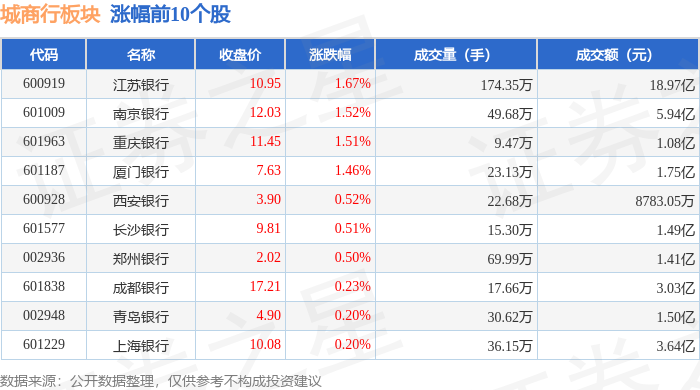
城商行板块12月2日涨0.43%,江苏银行领涨,主力资金净流出3.16亿元
Zheng Xing Xing Ye Ri Bao· 2025-12-02 09:05
Group 1 - The city commercial bank sector increased by 0.43% on December 2, with Jiangsu Bank leading the gains [1] - The Shanghai Composite Index closed at 3897.71, down 0.42%, while the Shenzhen Component Index closed at 13056.7, down 0.68% [1] - Jiangsu Bank's closing price was 10.95, reflecting a 1.67% increase, with a trading volume of 1.7435 million shares and a transaction value of 1.897 billion [1] Group 2 - The city commercial bank sector experienced a net outflow of 316 million from institutional funds, while retail investors saw a net inflow of 421 million [2][3] - The trading data for various banks showed mixed performance, with Ningbo Bank declining by 0.69% and Guizhou Bank remaining unchanged [2] - Shanghai Bank had a net outflow of 46.6477 million from institutional funds, while retail investors contributed a net inflow of 2.33839 million [3]






银行股“破净”七年之痛
Shang Hai Zheng Quan Bao· 2025-12-01 19:23
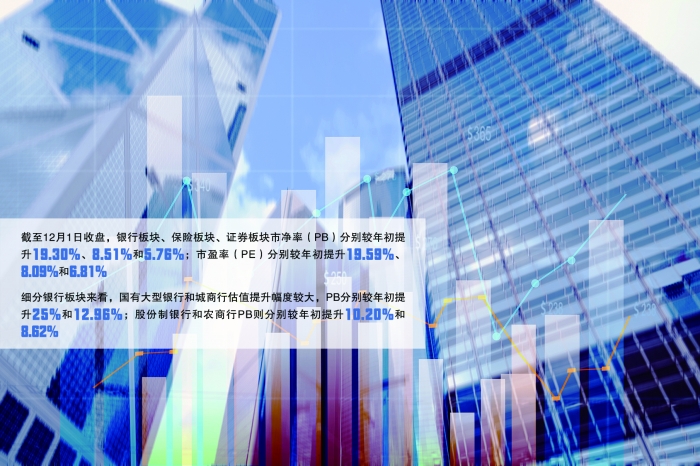
Core Viewpoint - The financial sector in the A-share market has been a key driver of the index's performance since 2025, despite facing complex domestic and international challenges. The sector's stock price performance has been counter-cyclical, supported by a recovering capital market and improved earnings [2][3]. Financial Sector Performance - Agricultural Bank of China has seen a remarkable stock price increase of 56% this year, breaking free from the "price-to-book" constraint, which opens up new valuation possibilities for bank stocks [3][10]. - Despite the strong performance of some banks, the overall banking sector remains trapped in a "price-to-book" dilemma, reflecting valuation challenges and limiting its ability to serve the real economy [3][4]. Valuation Challenges - The banking sector has experienced a continuous "price-to-book" ratio below 1 for seven consecutive years, with the current ratio at 0.56 compared to the broader A-share index at 1.79 [4]. - Factors contributing to this prolonged "price-to-book" issue include external economic downturns, insufficient growth, narrowing net interest margins, and concerns over asset quality [4][5]. Profitability and Regulatory Environment - The net interest margin for commercial banks is at a historical low of 1.42%, down 11 basis points year-on-year, which constrains profitability [5]. - Regulatory pressures on intermediary income sources and a trend of declining interest margins further limit banks' profit potential [5][6]. Impact of "Price-to-Book" on Operations - The "price-to-book" situation has created a "cascading effect," restricting banks' capital replenishment channels, limiting credit expansion, and leading to declining profitability [6]. - Banks face challenges in refinancing due to restrictions on companies that are "broken" or "underwater," making it difficult to raise capital through equity markets [6]. Strategic Shifts in Banking - Some banks have shifted to conservative operational strategies, leading to a contraction in business development and, in some cases, a "balance sheet shrinkage" [7]. - The focus on supporting the real economy and achieving financial goals requires banks to enhance their credit offerings and service capabilities [7][9]. Future Outlook and Valuation Recovery - The banking sector may be entering a long-term trend of valuation recovery, with major state-owned banks showing strong stock performance and several banks achieving historical highs [8][9]. - Analysts predict that the competitive landscape will lead to a "Matthew effect," where larger banks benefit more from policy support, while smaller banks struggle to improve valuations [9]. Stock Performance Data - As of December 1, 2025, the stock performance of various banks shows significant gains, with Agricultural Bank leading at 56.35%, followed by Xiamen Bank and Qingdao Bank with over 30% increases [10][11].

金融赋能发展新篇——郑州银行以高质量经营助力地方经济跃升
Sou Hu Cai Jing· 2025-12-01 13:20
Core Viewpoint - Zhengzhou Bank focuses on balancing its development with local economic empowerment amidst narrowing interest margins and intensified market competition in the banking industry [1] Group 1: Financial Performance - As of the third quarter, Zhengzhou Bank's total assets exceeded 740 billion yuan, reaching 743.55 billion yuan, representing a steady growth of 9.93% compared to the end of the previous year [1] - The total amount of deposits reached 459.52 billion yuan, an increase of 13.59% from the end of the previous year, with personal deposits growing by 22.44% year-on-year to 267.14 billion yuan [1] - Net interest income was 7.816 billion yuan, up 5.83% year-on-year, while non-interest income rose to 1.579 billion yuan, contributing to a diversified profit structure [2] Group 2: Credit and Investment Strategy - The total amount of loans and advances reached 406.72 billion yuan, a growth of 4.91% from the end of the previous year, with a focus on advanced manufacturing, urban renewal, and green low-carbon sectors [3] - The bank implemented a "one enterprise, one policy" approach to address financing difficulties for small and micro enterprises, enhancing support for local economic stability [3] Group 3: Service Ecosystem and Community Impact - Zhengzhou Bank has developed four service systems: "Citizen Manager," "Financing Manager," "Wealth Manager," and "Rural Manager," integrating financial services into various social scenarios [4] - Personal loan balances reached 96.31 billion yuan, reflecting a growth of 5.88% from the end of the previous year, catering to diverse needs such as housing, entrepreneurship, and consumption [4] Group 4: Risk Management - The bank maintained a provision coverage ratio of 186.17%, an increase of 19.94 percentage points year-on-year, while the non-performing loan ratio was 1.76%, a decrease of 0.1 percentage points [4] - Zhengzhou Bank emphasizes risk prevention as a core aspect of its operations, combining internal capital accumulation with external capital supplementation to enhance its risk resilience [4] Group 5: Future Outlook - Zhengzhou Bank aims to continue enhancing its comprehensive financial service capabilities and deepen its integration into local economic development, contributing to the rise of the Central Plains and the revitalization of Henan [5]
城商行板块12月1日涨1.5%,厦门银行领涨,主力资金净流出2.78亿元
Zheng Xing Xing Ye Ri Bao· 2025-12-01 09:10
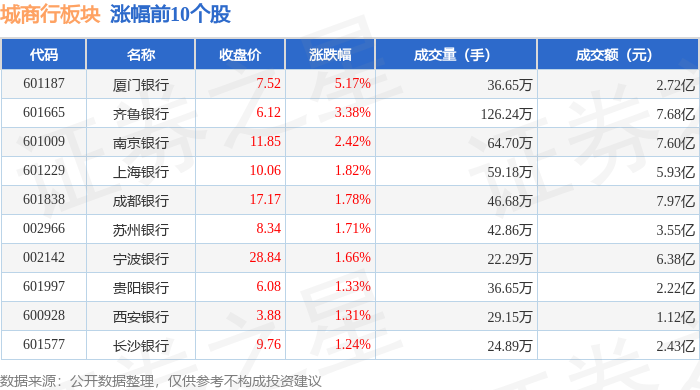
Market Performance - The city commercial bank sector increased by 1.5% on December 1, with Xiamen Bank leading the gains [1] - The Shanghai Composite Index closed at 3914.01, up 0.65%, while the Shenzhen Component Index closed at 13146.72, up 1.25% [1] Individual Bank Performance - Xiamen Bank's closing price was 7.52, with a rise of 5.17% and a trading volume of 366,500 shares, amounting to 272 million yuan [1] - Qilu Bank closed at 6.12, up 3.38%, with a trading volume of 1.26 million shares, totaling 768 million yuan [1] - Nanjing Bank's closing price was 11.85, increasing by 2.42%, with a trading volume of 647,000 shares, amounting to 760 million yuan [1] - Shanghai Bank closed at 10.06, up 1.82%, with a trading volume of 591,800 shares, totaling 593 million yuan [1] - Chengdu Bank's closing price was 17.17, increasing by 1.78%, with a trading volume of 466,800 shares, amounting to 797 million yuan [1] Fund Flow Analysis - The city commercial bank sector experienced a net outflow of 278 million yuan from institutional investors, while retail investors saw a net inflow of 240 million yuan [1] - The table shows various banks' net fund flows, indicating mixed results among different institutions [2]

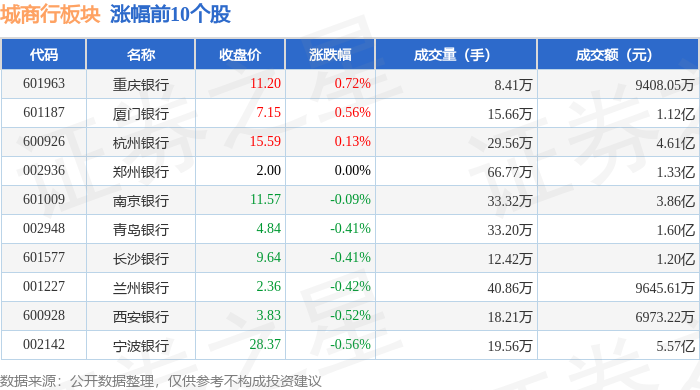
城商行板块11月28日跌0.62%,上海银行领跌,主力资金净流出3.79亿元
Zheng Xing Xing Ye Ri Bao· 2025-11-28 09:05
Core Viewpoint - The city commercial bank sector experienced a decline of 0.62% on November 28, with Shanghai Bank leading the drop, while the overall stock market showed slight gains [1][2]. Market Performance - The Shanghai Composite Index closed at 3888.6, up 0.34% - The Shenzhen Component Index closed at 12984.08, up 0.85% [1]. Individual Stock Performance - Chongqing Bank: Closed at 11.20, up 0.72%, with a trading volume of 84,100 shares and a turnover of 94.08 million yuan - Xiamen Bank: Closed at 7.15, up 0.56%, with a trading volume of 156,600 shares and a turnover of 112 million yuan - Hangzhou Bank: Closed at 15.59, up 0.13%, with a trading volume of 295,600 shares and a turnover of 461 million yuan - Zhengzhou Bank: Closed at 2.00, unchanged, with a trading volume of 667,700 shares and a turnover of 13.3 million yuan - Nanjing Bank: Closed at 11.57, down 0.09%, with a trading volume of 333,200 shares and a turnover of 38.6 million yuan - Qingdao Bank: Closed at 4.84, down 0.41%, with a trading volume of 332,000 shares and a turnover of 16 million yuan - Changsha Bank: Closed at 9.64, down 0.41%, with a trading volume of 124,200 shares and a turnover of 12 million yuan - Lanzhou Bank: Closed at 2.36, down 0.42%, with a trading volume of 408,600 shares and a turnover of 96.46 million yuan - Xi'an Bank: Closed at 3.83, down 0.52%, with a trading volume of 182,100 shares and a turnover of 6.97 million yuan - Ningbo Bank: Closed at 28.37, down 0.56%, with a trading volume of 195,600 shares and a turnover of 557 million yuan [1][2]. Capital Flow Analysis - The city commercial bank sector saw a net outflow of 379 million yuan from institutional investors, while retail investors contributed a net inflow of 86.74 million yuan [2][3]. - The following stocks had notable capital flows: - Hangzhou Bank: Net inflow of 9.48 million yuan from institutional investors - Qilu Bank: Net inflow of 6.55 million yuan from institutional investors - Suzhou Bank: Net inflow of 6.07 million yuan from institutional investors - Qingdao Bank: Net inflow of 3.22 million yuan from institutional investors - Lanzhou Bank: Net inflow of 2.34 million yuan from institutional investors - Zhengzhou Bank: Net outflow of 0.96 million yuan from institutional investors - Guizhou Bank: Net outflow of 1.41 million yuan from institutional investors - Xi'an Bank: Net outflow of 2.69 million yuan from institutional investors - Nanjing Bank: Net outflow of 9.30 million yuan from institutional investors - Chongqing Bank: Net outflow of 9.87 million yuan from institutional investors [3].

“规模、效益、质量”协同进阶,郑州银行的高质量发展答卷
Huan Qiu Lao Hu Cai Jing· 2025-11-28 02:46
Core Insights - Zhengzhou Bank has achieved rapid asset growth, with total assets reaching 743.55 billion yuan by the end of September 2025, marking a 9.93% increase from the beginning of the year, the fastest growth rate for the same period in history [1] - The bank's deposit base remains strong, with total deposits amounting to 459.52 billion yuan, a 13.59% increase year-to-date, particularly driven by a 22.44% rise in personal deposits [1] - The bank's net profit for the first three quarters of 2025 reached 2.279 billion yuan, reflecting a 1.56% year-on-year growth, amidst industry challenges [2] Asset and Liability Management - Total liabilities increased to 685.94 billion yuan, up 10.62% from the start of the year, indicating a balanced growth in both assets and liabilities [1] - The bank's loan and advance total reached 406.72 billion yuan, a 4.91% increase year-to-date, with a focus on key industries and projects [1] Revenue and Profitability - Operating income for the first three quarters was 9.395 billion yuan, a 3.91% increase year-on-year, with net interest income contributing 7.816 billion yuan, up 5.83% [2] - Non-interest income reached 1.579 billion yuan, with investment income significantly increasing by 42.87% to 1.463 billion yuan, highlighting a shift in revenue structure [2] - The bank has effectively controlled costs, with business and management expenses decreasing by 2.45% to 2.243 billion yuan [2] Retail Strategy and Service Enhancement - Retail banking has become a key growth driver, with personal loans reaching 96.306 billion yuan, a 5.88% increase from the beginning of the year [3] - The bank has developed a comprehensive service system called "Four Housekeepers," focusing on various customer needs, including healthcare, small business financing, personalized wealth management, and rural services [4] Asset Quality and Capital Management - The bank's non-performing loan ratio improved to 1.76%, a decrease of 0.1 percentage points year-on-year, while the provision coverage ratio increased to 186.17% [6] - The core tier one capital adequacy ratio stands at 8.97%, positioning the bank in the mid-range among A-share listed city commercial banks [6] Conclusion - Zhengzhou Bank's third-quarter report demonstrates its strategic resilience and development potential as a regional bank, focusing on market depth and contributing to local economic growth [8]