
银行股破净

Search documents
招行本周五“发红包” 超半数A股银行进行2025年度中期分红
Mei Ri Jing Ji Xin Wen· 2026-01-13 12:30
Core Viewpoint - The number of A-share listed banks implementing mid-term dividends is increasing, with several banks announcing their dividend plans for 2025, reflecting a commitment to shareholder returns and financial stability [1][4]. Group 1: Dividend Announcements - China Merchants Bank announced a cash dividend of approximately RMB 20.897 billion (including tax) for the first half of 2025, with a per-share dividend of RMB 1.013 (including tax) [1][2]. - As of now, over half of the 42 A-share listed banks have disclosed their mid-term dividend plans for 2025, with three banks, including China Merchants Bank, Postal Savings Bank, and Jiangsu Bank, announcing dividends this week [1][2][4]. - Postal Savings Bank distributed a cash dividend of RMB 0.123 per share (including tax) on January 12, 2026, while Jiangsu Bank announced a cash dividend of RMB 0.3309 per share (including tax) on January 14, 2026 [2]. Group 2: Regulatory Environment - The Chinese government has introduced guidelines to enhance cash dividend regulations for listed companies, encouraging multiple dividend distributions within a year and promoting higher dividend yields [3][4]. Group 3: Industry Trends - The mid-term dividend distribution among A-share listed banks has been growing, with 23 banks confirming their mid-term profit distribution plans for 2025, some of which are initiating mid-term dividends for the first time [4]. - Analysts note that the increase in the number of banks planning mid-term dividends and the stability of dividend rates indicate the banking sector's robust dividend value, which is attractive to long-term investors [5]. Group 4: Market Conditions - Despite a strong overall performance in 2025, many listed banks remain in a state of net asset value decline, primarily due to concerns over net interest margins and asset quality amid economic pressures [6]. - The average dividend yield for bank stocks is above 3%, with most banks expected to maintain a dividend yield of over 2% for their mid-term dividends in 2025 [6].

“他们有英伟达,我们有银伟达!”所以真的“伟达”吗?
Mei Ri Jing Ji Xin Wen· 2025-12-02 11:28
Core Viewpoint - The A-share market has been strong recently, with the financial sector, particularly the major banks, driving this momentum. However, many banks are trading below their net asset value, indicating a potential undervaluation in the market [1][2]. Financial Sector Performance - The banking sector's price-to-book ratio (PB) is currently at 0.56, meaning investors are only willing to pay 0.56 yuan for every 1 yuan of net assets, leading to a "broken net" situation for most banks since 2018 [1][2]. - As of December 1, 2023, 38 A-share listed banks have seen positive stock performance this year, with some banks experiencing over 30% gains [2][3]. Reasons for Underestimation - Several factors contribute to the long-term undervaluation of banks: - Profitability pressure, with the net interest margin at a historical low of 1.42% as of Q3 2025 [2]. - Lack of growth potential due to the large and cyclical nature of the banking industry [2]. - Concerns over asset quality, particularly in the real estate sector, which suppresses valuation [2]. Impact of "Broken Net" Situation - The long-term "broken net" status affects market confidence and constrains banks' operations. Banks typically rely on retained earnings to supplement core tier one capital, which is essential for expanding credit and supporting economic growth [2]. - Regulatory restrictions on refinancing for "broken net" companies further complicate capital replenishment, limiting banks' ability to expand credit and impacting profitability [2]. Future Outlook - The valuation recovery for banks is expected to be accompanied by significant differentiation. Banks with solid customer bases, stable asset quality, and strong positions in inclusive finance, green finance, and digital transformation are likely to gain market recognition [3]. - The current environment suggests that the time window for reallocating investments in bank stocks has opened, with a focus on larger banks likely to see greater valuation increases compared to smaller banks [3][4]. Investment Strategy - Investors may consider index-based investment tools to mitigate risks, as the top 10 constituents of the CSI Bank Index account for 65.30% of the total weight, allowing for risk diversification while maintaining concentrated exposure [3].

银行股“破净”七年之痛
Shang Hai Zheng Quan Bao· 2025-12-01 19:23
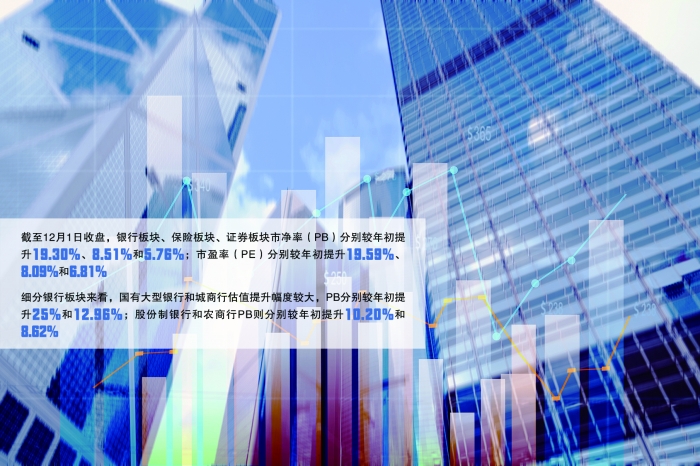
Core Viewpoint - The financial sector in the A-share market has been a key driver of the index's performance since 2025, despite facing complex domestic and international challenges. The sector's stock price performance has been counter-cyclical, supported by a recovering capital market and improved earnings [2][3]. Financial Sector Performance - Agricultural Bank of China has seen a remarkable stock price increase of 56% this year, breaking free from the "price-to-book" constraint, which opens up new valuation possibilities for bank stocks [3][10]. - Despite the strong performance of some banks, the overall banking sector remains trapped in a "price-to-book" dilemma, reflecting valuation challenges and limiting its ability to serve the real economy [3][4]. Valuation Challenges - The banking sector has experienced a continuous "price-to-book" ratio below 1 for seven consecutive years, with the current ratio at 0.56 compared to the broader A-share index at 1.79 [4]. - Factors contributing to this prolonged "price-to-book" issue include external economic downturns, insufficient growth, narrowing net interest margins, and concerns over asset quality [4][5]. Profitability and Regulatory Environment - The net interest margin for commercial banks is at a historical low of 1.42%, down 11 basis points year-on-year, which constrains profitability [5]. - Regulatory pressures on intermediary income sources and a trend of declining interest margins further limit banks' profit potential [5][6]. Impact of "Price-to-Book" on Operations - The "price-to-book" situation has created a "cascading effect," restricting banks' capital replenishment channels, limiting credit expansion, and leading to declining profitability [6]. - Banks face challenges in refinancing due to restrictions on companies that are "broken" or "underwater," making it difficult to raise capital through equity markets [6]. Strategic Shifts in Banking - Some banks have shifted to conservative operational strategies, leading to a contraction in business development and, in some cases, a "balance sheet shrinkage" [7]. - The focus on supporting the real economy and achieving financial goals requires banks to enhance their credit offerings and service capabilities [7][9]. Future Outlook and Valuation Recovery - The banking sector may be entering a long-term trend of valuation recovery, with major state-owned banks showing strong stock performance and several banks achieving historical highs [8][9]. - Analysts predict that the competitive landscape will lead to a "Matthew effect," where larger banks benefit more from policy support, while smaller banks struggle to improve valuations [9]. Stock Performance Data - As of December 1, 2025, the stock performance of various banks shows significant gains, with Agricultural Bank leading at 56.35%, followed by Xiamen Bank and Qingdao Bank with over 30% increases [10][11].


这家银行又涨了!
Zhong Guo Jing Ying Bao· 2025-10-22 06:34
Core Viewpoint - The A-share banking sector is experiencing a significant rally, with Agricultural Bank of China (ABC) breaking the "price-to-book" (PB) ratio barrier, indicating a re-evaluation of bank stock values by investors [2][3][4] Group 1: Agricultural Bank of China Performance - As of October 21, ABC's stock price reached 7.88 CNY per share, surpassing its net asset value of 7.65 CNY per share, marking a historical high [3][4] - ABC's stock has shown a continuous upward trend, achieving 13 consecutive days of gains, which is a rare occurrence among the four major state-owned banks since 2018 [2][3] Group 2: Market Dynamics and Investor Sentiment - The recent performance of ABC is seen as a signal of renewed investor interest in undervalued bank stocks, particularly during market adjustments when stable returns are sought [3][4] - Other banks such as China Merchants Bank, Chengdu Bank, Changshu Bank, and Hangzhou Bank are also nearing their net asset values, suggesting a potential trend of breaking the "price-to-book" barrier [5] Group 3: Factors Influencing Bank Stock Recovery - Factors contributing to ABC's stock performance include its unique advantages in rural revitalization and inclusive finance, strong policy support, and improving asset quality with a low non-performing loan ratio [4][5] - Analysts predict that the banking sector is entering a bottoming phase, with expectations of improved performance as economic recovery progresses and regulatory support enhances market confidence [6]

13连阳!7年来四大国有行首次摆脱“破净”
Zhong Guo Jing Ying Bao· 2025-10-21 11:53
Core Viewpoint - The A-share banking sector is experiencing a significant rally, with Agricultural Bank of China (ABC) breaking the "price-to-book" (PB) ratio barrier, marking a shift in market perception towards bank valuations [1][2][3] Summary by Sections Agricultural Bank of China Performance - As of October 21, ABC's stock price reached 7.88 CNY per share, surpassing its net asset value of 7.65 CNY per share, a first among the four major state-owned banks since 2018 [2][3] - ABC's stock has shown a 13-day consecutive rise, indicating strong market interest and a potential shift in investor sentiment towards bank stocks [1][2] Market Dynamics and Investor Sentiment - The recent performance of ABC is seen as a signal of renewed investor interest in undervalued bank stocks, particularly during market adjustments when stable returns are sought [2][3] - Analysts suggest that the banking sector is entering a bottoming phase, with expectations of a recovery in valuations as economic conditions improve [5] Other Banks Approaching Net Asset Value - Other banks such as China Merchants Bank, Chengdu Bank, Changshu Bank, and Hangzhou Bank are also nearing their respective net asset values, with stock prices at 41.98 CNY, 18.40 CNY, 7.08 CNY, and 16.39 CNY, compared to their net asset values of 42.1 CNY, 19.47 CNY, 8.79 CNY, and 18.02 CNY [4] - The trend of banks breaking the "price-to-book" barrier is expected to continue, driven by stable earnings and high dividend yields appealing to investors [4] Future Outlook for the Banking Sector - Analysts predict that banks with strong asset quality and stable profitability are more likely to break the "price-to-book" barrier in the future, supported by regulatory policies and market confidence [4] - The focus will be on whether the valuation recovery in the banking sector can be sustained, as it is influenced by policy, capital flow, and fundamental performance [4]
银行估值研究系列之一:为何银行长期破净?
Tianfeng Securities· 2025-08-21 11:13
Investment Rating - Industry Rating: Outperform the Market (Maintained Rating) [5] Core Insights - The banking sector has been persistently trading below book value since 2018, with a significant valuation gap compared to other sectors. As of July 12, 2024, the dividend yield reached 7.26%, the highest in a decade, exceeding the 10Y government bond yield by 5.00 percentage points [12][8]. - As of August 18, 2025, the CITIC secondary banking sector saw a valuation increase of 32.53% over the past year, with a price-to-book (PB) ratio of 0.72 and a return on equity (ROE) of 8.92%. However, this remains below the overall PB-ROE trend of other secondary sectors [12][8]. - The report identifies three main reasons for the long-term trading below book value: asset quality exposure risks, declining profitability, and asset expansion rates significantly outpacing other industries, which depresses valuations [2][16]. Summary by Sections 1. Long-term Trading Below Book Value - The banking sector has been trading below book value for seven consecutive years since March 23, 2018. Despite multiple rounds of valuation recovery, it remains significantly lower than other sectors in terms of PB-ROE valuation logic [12][8]. 2. Main Reasons for Trading Below Book Value 2.1 Asset Quality Exposure Risks - Historical data shows that the growth rate of non-performing loans (NPLs) and credit scale growth have experienced "inversion" periods, indicating that NPL growth outpaced credit growth. This has led to market concerns about the actual value of bank assets [3][17]. 2.2 Declining Profitability - The report suggests that the current ROE corresponds to a theoretical PB of approximately 0.63. To return to a PB of 1, the ROE would need to reach about 14.15% [39][9]. 2.3 High Growth Rate of Book Value - The growth rate of banks' book value has significantly outpaced other sectors, which, under current operational pressures, has a dampening effect on the PB valuation denominator [9][16]. 3. Future Outlook - There is potential for marginal improvement in the fundamentals of bank stocks this year, which could theoretically support further valuation recovery [10][12].