Tencent

Search documents
Asian Markets Surge On US Rate Hopes, Tech Fired By Chip Deal
International Business Times· 2025-10-02 03:06
Market Overview - Asian equities experienced a significant increase, driven by optimism for potential interest rate cuts following job losses in the US private sector [1][2] - The tech sector led the rally, particularly due to a deal between South Korea's major chip firms and OpenAI, which contributed to an AI-driven market surge [1][6] Employment Data - ADP reported that US companies shed 32,000 jobs last month, contrary to expectations of a gain of over 50,000, indicating a slowdown in the labor market [2][3] - This data is expected to influence the Federal Reserve's decision to implement two more rate cuts by the end of the year [3] Sector Performance - The professional and business services sector is anticipated to see continued layoffs, particularly due to the rapid adoption of AI technologies [4][5] - Economists noted that goods-producing sectors have been losing jobs since May, partly due to tariff uncertainties [4] Regional Market Reactions - Major Asian markets, including Tokyo, Sydney, and Hong Kong, saw gains, with Seoul and Taipei leading the charge due to the chip firms' performance [6][7] - SK hynix's stock surged approximately 12% and Samsung's by around 5%, contributing to a record high for the Kospi index [7] Tech Sector Investment - The tech industry has been a focal point for investment, with significant capital flowing into AI-related companies, amounting to hundreds of billions [8]


3 Underrated AI ETFs With Multi-Million Dollar Potential
Yahoo Finance· 2025-10-01 08:00
Core Insights - The Invesco S&P 500 Top 50 ETF is heavily concentrated in the top 10% of S&P 500 companies, with 62% of its investments in the "Ten Titans" which include major tech firms like Nvidia, Microsoft, and Apple [2][4] - The fund's expense ratio of 0.55% is significantly higher than the Vanguard S&P 500 ETF's 0.03%, but still reasonable for investors focused on AI and growth [1][6] - The performance of major tech stocks has rebounded significantly in 2023, with Nvidia up over 1,100% and Meta up over 500% since the start of the year [4] Fund Characteristics - The Invesco S&P 500 Top 50 ETF targets the largest companies by market cap, making it suitable for investors who believe these firms will benefit from AI advancements [2][3] - The Global X Artificial Intelligence & Technology ETF offers a diversified approach, with 31% of its investments in non-U.S. companies, including Alibaba and Samsung [8][10] - The iShares A.I. Innovation and Tech Active ETF has a concentrated portfolio, with over a third of its assets in just five stocks, contrasting with the Global X ETF's more balanced approach [9][10] Investment Considerations - Active ETFs, while generally more expensive, can align with specific investment strategies and objectives, particularly in the AI sector [6][11] - Investors should be aware of the volatility associated with concentrated ETFs and the need for a high risk tolerance [5][14] - The long-term potential of AI investments is significant, but companies must convert capital expenditures into returns to sustain growth [11][13]




How You Should Invest Through Different Life Stages
The Smart Investor· 2025-10-01 03:30
Core Insights - Investing is essential not only for protecting against inflation but also for wealth growth, with portfolio adjustments necessary throughout different life stages [1][2] Group 1: Investment Strategies by Age - In the 20s to 30s, a focus on aggressive growth stocks is recommended, with a significant allocation towards equities, as this age group has a long investment horizon [5][6][7] - For individuals in their 40s to 50s, a balanced portfolio that includes both growth and dividend-paying stocks is advised, as financial responsibilities increase [11][12][13] - Those aged 60 and above should prioritize passive income through dividend stocks and REITs, reducing exposure to growth stocks to avoid potential losses during market downturns [15][16] Group 2: Specific Stock Recommendations - Growth stocks from markets like the US, Singapore, and Hong Kong are highlighted, including companies like Microsoft, Meta Platforms, Apple, Tencent, and Alibaba, which are expected to provide strong capital appreciation [7][8][9] - Dividend-paying stocks, particularly in the REIT sector, are recommended for stable income, with examples including CapitaLand Integrated Commercial Trust and Mapletree Industrial Trust [13][14] - US "dividend kings" such as PepsiCo, Procter & Gamble, and Kimberly-Clark are noted for their reliability in providing long-term income [14]


Trump fails to reach a deal to avert a shutdown, gold and silver power to fresh highs
Youtube· 2025-09-30 13:37
[Music] Welcome to Morning Brief Market Sunrise. I'm Raman Karamali live from Yahoo Finance Studios in London. It's Tuesday, 30th September.Coming up on the show, the vice president signals that a government shutdown looks like it will kick in from tomorrow. We'll look into whether China can threaten the US's dominance in the world of artificial intelligence. and I'll tell you all about a stock that surged over 1,700% in less than 24 hours.So, grab your coffee and let's own the morning. [Music] I think we'r ...
Alibaba Stock Breaks Past 52-Week High As AI Frenzy Heats Up
Benzinga· 2025-09-30 10:45
Core Viewpoint - Alibaba Group's stock has surged approximately 5% due to increased investor confidence in its cloud computing and artificial intelligence initiatives, making it the best-performing Chinese tech stock in September [1] Group 1: Stock Performance - Alibaba's year-to-date stock gain exceeds 112%, significantly outperforming the NYSE Composite index's 13% returns, with the stock trading above its 52-week high of $181.34 [2] - The stock is on track for its best monthly performance since its 2019 Hong Kong listing, coinciding with triple-digit growth in AI-related products and exceeding sales expectations in its cloud unit [8] Group 2: AI and Cloud Computing Initiatives - Alibaba's Qwen3-Omni multimodal AI system has achieved the top rank on Hugging Face's trending model list, outperforming both its predecessor and competitors like OpenAI's GPT-4o and Google's Gemini-2.5-Flash in various recognition tasks [3][4] - The Qwen3-Omni series is described as the first native end-to-end model that integrates text, images, audio, and video, showcasing Alibaba's advancements in AI technology [4] Group 3: Market Position and Analyst Sentiment - Alibaba's open-source models dominate Hugging Face rankings, with half of the top 10 models being from Alibaba, surpassing Meta Platforms' Llama [5] - Analysts have revised their ratings upward, with Morningstar calling Alibaba undervalued due to increased spending on data centers, adoption of AI models, and rising cloud revenues [6] - Morgan Stanley has raised its cloud growth estimates to 32% for fiscal 2026 and 40% for fiscal 2027, citing increased capital expenditures and new partnerships [7] Group 4: Strategic Partnerships and Future Outlook - Alibaba has announced a partnership with Nvidia to enhance its AI capabilities, further solidifying its commitment to AI investment [7] - Analysts believe that Alibaba's full-stack cloud-AI integration could strengthen the position of Chinese equity markets in the global AI narrative [9]

Appetite for emerging markets has returned, says EMQQ founder
CNBC Television· 2025-09-29 17:56
Investors have been moving around the globe looking for opportunity, but they've largely been ignoring two of the largest markets. Our next guest says you can't simply have emerging markets back in favor without China and certainly not without India. Joining me now, Kevin Carter, founder and CIO of EMQQ.Okay, so if they fell out of favor because of geopolitics, what's fueling the resurgence in investor interest. Well, if you're talking about China stocks in particular, it's u I think it was deepseek and the ...
Futures Jump As Meltup Returns, Gold Soars To New Record High Ahead Of Govt Shutdown
ZeroHedge· 2025-09-29 12:32
Market Overview - US equity futures are up sharply, led by tech and small caps, with the S&P 500 on track for its best September since at least 2013, despite the month typically being difficult for stocks [1] - Gold prices have reached a record high of $3,820, pushing the market value of US gold reserves above $1 trillion [9] - A potential US government shutdown could complicate a heavy data week, impacting labor market data releases [1][3] Company-Specific Developments - Mag 7 stocks are mostly higher in premarket trading, with notable gains for Amazon (+1%), Alphabet (+0.8%), and Nvidia (+0.8%) [3] - Genmab's acquisition of Merus for $8 billion has led to a 37% surge in Merus shares [5] - Occidental Petroleum is in talks to sell its OxyChem petrochemical unit for at least $10 billion, resulting in a 1.5% gain in its shares [5] - MoonLake Immunotherapeutics shares plummeted 88% following disappointing clinical trial results [5] - Tilray shares rose 16% after President Trump promoted the medical benefits of hemp-derived CBD [5] Economic Indicators - The US economy is expected to add 50,000 jobs in September, with the unemployment rate projected to remain steady at 4.3% [4] - The JOLTS report is anticipated to show a decline in job openings, while company hiring data is likely to confirm a slowdown [4] - Fed policymakers are scheduled to speak throughout the week, influencing market expectations regarding interest rates [4][3] Global Market Trends - Global stocks are expected to continue their rally through year-end, supported by a resilient US economy and a dovish Fed stance [5][6] - European stocks are experiencing gains, with the Stoxx 600 climbing 0.4%, driven by optimism around economic growth and AI advancements [7] - Asian equities are mostly advancing, particularly Chinese tech stocks, with the Hang Seng index climbing for the first time in three sessions [8] Commodity Market Insights - WTI crude futures are trading around $65.30 amid expectations of OPEC+ output hikes, while precious metals continue their upward trend [1][13] - The Bloomberg Dollar Spot Index has fallen 0.2% as fears of a government shutdown emerge, impacting currency valuations [12]



Klarna IPO: BNPL Stock or Something Bigger?
MarketBeat· 2025-09-28 15:44
Core Viewpoint - Klarna Group, a global payment provider specializing in buy now, pay later (BNPL) solutions, began trading publicly on September 10, 2023, and has experienced significant stock volatility since its IPO [3][4]. Company Overview - Klarna's stock closed its first trading day at $49.48 but has since dropped approximately 13%, currently trading at $39.96, reflecting a decline of 3.71% [3][4]. - The company aims to position itself as more than just a BNPL lender, aspiring to become a multi-service consumer platform akin to popular technology stocks [12]. Market Context - The BNPL market has seen strong growth since the pandemic, with increased competition from companies like Affirm, Block, and PayPal [7]. - As of September 16, 2023, there have been approximately 224 IPOs in the U.S., a significant increase from 136 IPOs during the same period in 2024 [4]. Financial Performance - Klarna posted its first quarterly profit in 2023, two years prior to its public offering, which supports its bullish case for investors [12]. - The company is expected to report its quarterly earnings for the first time as a public entity later this year, which will be crucial for demonstrating its growth potential [13]. Strategic Positioning - Klarna is integrating artificial intelligence into its platform, offering shopping, price comparison tools, personal recommendations, and loyalty integration [10]. - The company's ambitions are compared to China's Ant Group and Tencent's WeChat, which evolved from core services into super apps that combine shopping, payments, and financial services [11]. Analyst Ratings - Klarna currently holds a Moderate Buy rating among analysts, with a 12-month stock price forecast of $53.00, indicating a potential upside of 32.63% from its current price [12].

Alibaba Surges 107% After Boosting AI Budget Beyond $50 Billion And Reporting Strong Cloud Growth
Benzinga· 2025-09-25 14:50
Group 1 - Alibaba Group's stock reached its highest level in nearly four years, driven by an announcement to increase AI spending beyond the previously disclosed target of over $50 billion [1] - The incoming CEO, Eddie Wu, projected that global AI investment could reach $4 trillion within five years and confirmed an additional investment of 380 billion yuan (approximately $53 billion) over three years for AI models and infrastructure [2] - The company reported triple-digit growth in AI-related products and a 26% increase in cloud business sales in its fiscal first quarter [4] Group 2 - Alibaba's cloud division will expand with new data centers in Brazil, France, and the Netherlands, while launching Qwen large language models and full-stack AI services [3] - Co-founder Jack Ma has reasserted his role in steering the company's strategy, focusing on AI and cloud investments under the slogan "Make Alibaba Great Again" [4] - Competitors such as Tencent, Baidu, and JD.com are projected to collectively spend over $32 billion on AI infrastructure by 2025, a significant increase from 2023 [5] Group 3 - In response to U.S. chip export restrictions, Alibaba is developing its own semiconductors through its T-Head unit and has secured China Unicom as a customer for its Pingtouge AI accelerators [6] - The company is also integrating Nvidia's AI development tools into its cloud services [6]
On The One Year Anniversary Of China's Stealthy But Stunning Stock Market Rally
ZeroHedge· 2025-09-25 01:02
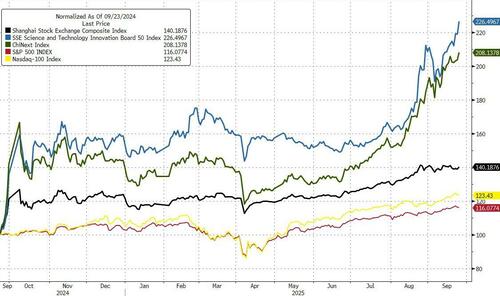
Core Viewpoint - China's financial markets have experienced a significant rally over the past year, driven by stimulus measures and positive investor sentiment, particularly in the technology sector [1][3][4]. Market Performance - The total market capitalization of China A-shares surpassed 100 trillion yuan, marking a 45% increase from 70 trillion yuan [4]. - The Shanghai Composite Index (SHCOMP) rose from 2700 to 3900, while tech-focused benchmarks like STAR50 and ChiNEXT saw increases of 115% and 110%, respectively [4]. - Over 3000 A-shares gained more than 50% in the past year, with nearly 1500 stocks more than doubling in value, particularly in the tech sector [5]. Investor Sentiment - David Tepper's bullish stance on Chinese assets, including ETFs and futures, was validated as the market rallied significantly [3]. - Despite adverse weather conditions in Hong Kong, the equity market posted solid gains, indicating strong momentum [6]. Sector Highlights - Alibaba's stock gained nearly 10%, with a month-to-date increase of 50%, supported by consistent net buying from Southbound flows [7]. - Other major players like Meituan and JD also saw stock price increases, attributed to regulatory changes aimed at stabilizing the food delivery market [9]. - The semiconductor sector showed positive momentum, with Goldman's China Semis basket rising by 4.6% following favorable earnings from Micron and strategic plans from Huawei [10]. Future Outlook - The current market setup suggests the potential for a "slow bull" market in A-shares, with elevated activity levels since early August [12][13]. - Chinese households hold only 11% of their assets in equities, indicating substantial cash reserves available for potential market inflows [17]. - Additional equity inflows could arise from wealth management products and new money seeking deployment amid a weaker property market [18]. Institutional Participation - Domestic and foreign institutions currently represent a small portion of the overall market, with potential for significant institutional buying in the future [20][23]. - Recent inflows into China-dedicated equity funds reached $5.4 billion, the largest weekly inflow since April [25].