中国移动

Search documents
中国移动(00941.HK):何飚辞任执行董事兼首席执行官
Ge Long Hui· 2026-02-12 08:42
Core Viewpoint - China Mobile announced the resignation of He Biao from his positions as Executive Director, CEO, and member of the Sustainability Committee due to work relocation, effective from February 12, 2026 [1] Group 1 - He Biao's resignation is attributed to work relocation reasons [1] - The effective date of the resignation is set for February 12, 2026 [1]
中国移动(00941):何飚辞任执行董事
智通财经网· 2026-02-12 08:39
智通财经APP讯,中国移动(00941)发布公告,何飚先生因工作调动原因辞任本公司执行董事、首席执行 官和可持续发展委员会委员的职务,自2026年2月12日起生效。 ...
中国移动(00941) - 执行董事兼首席执行官辞任
2026-02-12 08:30
香港交易及結算所有限公司及香港聯合交易所有限公司對本公告之內容概不 負 責,對 其 準 確 性 或 完 整 性 亦 不 發 表 任 何 聲 明,並 明 確 表 示 概 不 就 因 本 公 告 全 部或任何部分內容而產生或因倚賴該等內容而引致之任何損失承擔任何責任。 董 事 會 謹 就 何 先 生 對 本 公 司 作 出 的 突 出 貢 獻 給 予 高 度 評 價 並 深 表 謝 意。 承董事會命 中國移動有限公司 陳忠岳 董事長 CHINA MOBILE LIMITED 中國移動有限公司 (根據公司條例在香港註冊成立之有限公司) 股份代號:941(港幣櫃台)及 80941(人民幣櫃台) 執行董事兼首席執行官辭任 中國移動有限公司(「本公司」)董事會(「董事會」)宣 佈,何 飈 先 生 因 工 作 調 動 原 因 辭 任 本 公 司 執 行 董 事、首 席 執 行 官 和 可 持 續 發 展 委 員 會 委 員 的 職 務,自 2026年2月12日起生效。何先生已確認與董事會並無不同意見,而就其辭任一事, 亦 無 任 何 事 項 需 要 通 知 本 公 司 股 東。 香 港,2026年2月12日 於 本 公 告 ...
中国移动(00941) - 董事名单与其角色和职能
2026-02-12 08:30
CHINA MOBILE LIMITED 中國移動有限公司 (根據公司條例在香港註冊成立之有限公司) 股份代號:941(港幣櫃台)及 80941(人民幣櫃台) 董事名單與其角色和職能 中國移動有限公司董事會(「董事會」)成 員 載 列 如 下: 執行董事 陳忠岳先生(董 事 長) 王利民先生 李榮華先生(財 務 總 監) 獨立非執行董事 姚建華先生 楊强博士 李嘉士先生 梁高美懿女士 – 1 – 董 事 會 設 有 四 個 董 事 委 員 會。董 事 委 員 會 的 組 成 如 下: 審核委員會 姚建華先生(主 席) 楊强博士 李嘉士先生 梁高美懿女士 薪酬委員會 姚建華先生(主 席) 楊强博士 李嘉士先生 梁高美懿女士 提名委員會 楊强博士(主 席) 姚建華先生 李嘉士先生 梁高美懿女士 可持續發展委員會 梁高美懿女士(主 席) 李榮華先生 李嘉士先生 香 港,2026年2月12日 – 2 – ...
2026年上海市重大工程项目清单公布,基本建成22项
Xin Lang Cai Jing· 2026-02-12 08:17
Core Viewpoint - The Shanghai Municipal Development and Reform Commission has announced a list of major engineering projects for 2026, which includes 184 officially planned projects across various sectors, with a total investment target of 255 billion yuan, marking a historical high [1] Group 1: Project Categories - The 184 major projects are categorized into several sectors: 62 in technology and industry, 29 in social welfare, 13 in ecological civilization, 68 in urban infrastructure, and 12 in rural integration and revitalization [1] - There are also 14 planned preparatory projects for 2026 [1] Group 2: Project Status - Among the 184 projects, 16 are planned to commence construction, 22 are expected to be completed, and 168 are currently under construction [1] - Notable projects include the establishment of a national deep-sea long-term scientific observation system and various research and development bases in the technology sector [1] Group 3: Investment Details - The annual investment plan for 2026 is set at 255 billion yuan, which is a record high for the city [1] - The technology sector projects include significant initiatives such as the Shanghai hard X-ray free electron laser facility and key physical technology projects for magnetic-inertial confinement fusion energy systems [1]
怡亚通跌0.39%,成交额2.60亿元,近3日主力净流入-4576.43万
Xin Lang Cai Jing· 2026-02-12 07:14
Core Viewpoint - The company Yiatong is focusing on the semiconductor industry and has established a strong supply chain for storage products, while also being involved in the mobile communication solutions sector through its investment in Junzhi Group. Group 1: Company Overview - Yiatong is a supply chain management service provider based in Shenzhen, China, with its main business revenue composition being 76.73% from distribution and marketing, 20.25% from cross-border and logistics services, and 3.27% from brand operation [9]. - The company was founded on November 10, 1997, and was listed on November 13, 2007 [9]. Group 2: Financial Performance - For the period from January to September 2025, Yiatong achieved operating revenue of 52.263 billion yuan, a year-on-year decrease of 10.57%, and a net profit attributable to shareholders of 35.1949 million yuan, down 42.56% year-on-year [9]. - The company has distributed a total of 1.286 billion yuan in dividends since its A-share listing, with 109 million yuan distributed in the last three years [9]. Group 3: Industry Position and Partnerships - Yiatong's investment in Junzhi Group, a leading mobile communication transmission solution provider, allows it to offer products applicable to various communication technologies including 2G, 3G, 4G, 5G, and NBIOT [2]. - The company has built a comprehensive supply chain system for storage products, collaborating with major semiconductor manufacturers such as Micron, Kioxia, and Toshiba, providing various storage solutions including SSDs and DRAM [2][3]. Group 4: Market Activity - On February 12, Yiatong's stock price fell by 0.39%, with a trading volume of 260 million yuan and a turnover rate of 1.94%, resulting in a total market capitalization of 13.349 billion yuan [1]. - The stock has seen a net outflow of 12.7408 million yuan from main funds, indicating a trend of reduced investment over the past three days [5][6].

科大讯飞申请超级制图商标
Xin Lang Cai Jing· 2026-02-12 07:11
天眼查知识产权信息显示,近日,科大讯飞股份有限公司申请注册一枚"超级制图"商标,国际分类为科 学仪器,当前商标状态为等待实质审查。科大讯飞股份有限公司成立于1999年12月,法定代表人为刘庆 峰,注册资本约23.1亿人民币,经营范围含增值电信业务,专业技术人员培训,系统工程、信息服务 等。股东信息显示,该公司由中国移动通信有限公司、刘庆峰、中科大资产经营有限责任公司等共同持 股。 ...

DeepAgent与DeepSearch双双霸榜,答案指向openJiuwen这一新兴开源项目
3 6 Ke· 2026-02-12 07:06
Core Insights - The article highlights the emergence of advanced AI agents, particularly focusing on DeepAgent and DeepSearch, which have achieved top rankings in the GAIA and BrowseComp-Plus benchmarks respectively, indicating a significant leap in AI capabilities [1][20]. Group 1: GAIA Benchmark Insights - DeepAgent, built on the openJiuwen platform, achieved a score of 91.69%, surpassing competitors like NVIDIA's Nemotron, showcasing its superior capabilities in general agent tasks [2][10]. - GAIA is a rigorous benchmark designed to evaluate AI agents on 12 core competencies, including long-term task planning and multi-modal understanding, with a scoring system that emphasizes real-world task execution [6][4]. - The average success rate for human participants in GAIA is around 92%, while leading AI models like GPT-4 only achieve about 15%, highlighting the benchmark's challenging nature [6][10]. Group 2: DeepAgent's Capabilities - DeepAgent's design allows it to dynamically adjust plans based on real-time feedback, ensuring task completion even in changing environments [12][13]. - It features a multi-layered context engine that maintains cognitive consistency and traceability throughout complex tasks, enhancing the reliability of its outputs [15]. - The agent employs an asynchronous tool orchestration system, enabling efficient and reliable execution of diverse tasks by coordinating various external tools [16][17]. Group 3: BrowseComp-Plus Benchmark Insights - DeepSearch, also based on openJiuwen, achieved an accuracy of 80% in the BrowseComp-Plus benchmark, demonstrating its strength in deep search and web interaction capabilities [20][24]. - BrowseComp-Plus evaluates agents on their ability to perform multi-hop retrieval and cross-source information integration, making it a critical measure of an agent's practical capabilities [23][24]. - The benchmark employs a fixed human-validated corpus to ensure fairness and reproducibility in its assessments, avoiding biases from real-time web dynamics [23]. Group 4: Technological Foundation - Both DeepAgent and DeepSearch leverage the openJiuwen platform, which provides a comprehensive framework for developing high-precision, high-efficiency AI agents [30][31]. - openJiuwen supports multi-agent collaboration and self-evolution, allowing agents to continuously improve their performance through a closed-loop optimization process [31][32]. - The platform has already been commercialized in various sectors, including finance and manufacturing, indicating its broad applicability and potential for future growth [31].

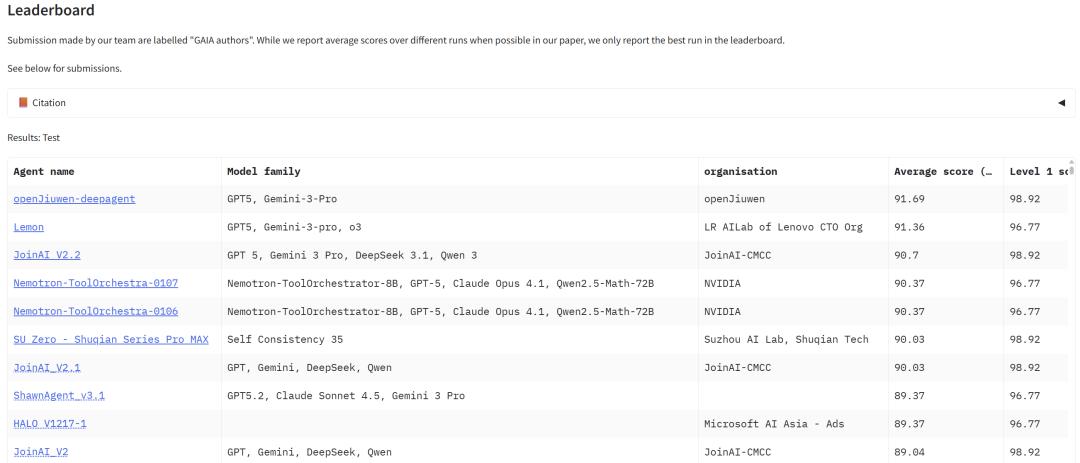
DeepAgent与DeepSearch双双霸榜!答案指向openJiuwen这一新兴开源项目
机器之心· 2026-02-12 05:16
Core Insights - The article highlights the emergence of advanced AI agents, particularly focusing on Clawdbot and its evolution into OpenClaw, reflecting a global desire for more sophisticated and reliable AI systems [1] - The year 2025 is referred to as the "Year of AI Agents," with numerous agents being developed and evaluated against rigorous benchmarks like GAIA and BrowseComp-Plus [1][2] - DeepAgent and DeepSearch, built on the openJiuwen platform, have achieved top rankings in the GAIA and BrowseComp-Plus benchmarks, respectively, showcasing their advanced capabilities [2][25] GAIA Benchmark Insights - DeepAgent achieved a score of 91.69%, surpassing competitors like NVIDIA's Nemotron, indicating its strong performance in general agent capabilities [4][13] - GAIA evaluates agents on 12 core abilities, including long-term task planning and multi-modal understanding, with a scoring system that emphasizes real-world task difficulty [8][10] - The average success rate for human participants in GAIA is around 92%, while leading AI models like GPT-4 perform significantly lower, highlighting the challenge faced by AI agents [9] DeepAgent's Capabilities - DeepAgent's design allows it to dynamically adjust plans based on real-time feedback, ensuring task completion even in changing environments [17] - It features a multi-layered context engine that maintains consistency and traceability in reasoning, crucial for complex tasks [19][21] - The agent's ability to execute tasks, such as analyzing YouTube cooking videos and purchasing ingredients, demonstrates its practical application in real-world scenarios [15] BrowseComp-Plus Benchmark Insights - DeepSearch achieved an accuracy of 80%, leading the BrowseComp-Plus ranking, which assesses deep search and web browsing capabilities [26][29] - The BrowseComp-Plus benchmark focuses on multi-hop retrieval and cross-source information integration, emphasizing the agent's ability to extract relevant information from vast datasets [29][30] - The scoring mechanism is designed to ensure fairness and reproducibility, using a fixed human-validated corpus to avoid biases from real-time web dynamics [30] DeepSearch's Capabilities - DeepSearch employs a multi-branch reasoning approach, allowing it to explore various potential solutions simultaneously, enhancing search efficiency [35] - It features an intelligent action exploration system that balances the depth of search with the diversity of paths taken, addressing the challenges of noise and misinformation [37][39] - The system's design mimics human expert reasoning, enabling it to adaptively prioritize search actions based on real-time evaluations [39][40] openJiuwen Platform Insights - Both DeepAgent and DeepSearch leverage the openJiuwen platform, which provides a comprehensive framework for developing high-precision, controllable AI agents [41][42] - The platform supports multi-agent collaboration and self-evolution, allowing for continuous improvement and adaptability in task execution [43] - openJiuwen has been commercialized in various sectors, including finance and manufacturing, indicating its broad applicability and potential for industry transformation [43] Conclusion - The article concludes that the AI agent landscape is at a pivotal point, distinguishing between basic language-interactive agents and advanced systems capable of planning, resource scheduling, and self-repair [46] - The success of DeepAgent and DeepSearch underscores the importance of robust architectural design in achieving high performance in stringent evaluations [46][48]

观众不只在电视上看冬奥,平台和赞助商的赚钱思路也变了
Xin Lang Cai Jing· 2026-02-12 03:52
Core Viewpoint - The traditional centralized model of Olympic broadcasting is evolving, with viewers shifting from television to mobile and interactive platforms, leading to changes in sponsorship and content delivery strategies [1][2][17]. Broadcasting Rights and Revenue - Broadcasting rights remain a crucial revenue source for the Olympics, with the Central Broadcasting Television Station (CCTV) and China Mobile Migu as the official broadcasters for the 2026 Winter Olympics [1][2]. - The partnership between CCTV and Migu highlights a clear copyright authorization chain, fostering competition in the market [5]. Content Delivery and User Engagement - Platforms like Migu are enhancing viewer experience by offering differentiated services such as smart viewing companions, real-time data visualization, and interactive features to attract audiences [5][6]. - Migu's business model includes ad-supported viewing options, with a subscription model allowing users to watch without ads for a fee [6][12]. Changes in Viewer Behavior - Non-rights holders like Kuaishou and Douyin are engaging audiences through social media interactions and content creation, despite lacking official broadcasting rights [13][14]. - The shift towards a multi-platform ecosystem indicates that Olympic viewership is no longer confined to traditional broadcasting, as attention is fragmented across various digital platforms [14][15]. Future Directions - The industry is moving beyond simple copyright competition to focus on building comprehensive content service systems that enhance user engagement and retention [14][17]. - The integration of AI technology is transforming viewer experiences from passive watching to immersive participation, suggesting a trend that may continue in future events [17].