
青岛银行

Search documents
青岛银行(03866) - 海外监管公告 - (1) 青岛银行股份有限公司首次公开发行A股前已发行股...
2026-01-14 11:00
Bank of Qingdao Co., Ltd.* 青 島 銀 行 股 份 有 限 公 司 * ( 於 中 華 人 民 共 和 國 註 冊 成 立 的 股 份 有 限 公 司 ) (H股股份代號:3866) 海外監管公告 香港交易及結算所有限公司及香港聯合交易所有限公司對本公告的內容概不負責,對其準確性 或完整性亦不發表任何聲明,並明確表示,概不對因本公告全部或任何部份內容而產生或因倚 賴該等內容而引致的任何損失承擔任何責任。 本公告乃根據《香港聯合交易所有限公司證券上市規則》第13.10B條作出。 如下公告已於深圳證券交易所網站刊登,僅供參閱。 (1) 青島銀行股份有限公司首次公開發行A股前已發行股份上市流通提示性公告; (2) 關於青島銀行股份有限公司首次公開發行A股前已發行股份部分 解除限售並上市流通的核查意見 特此公告。 承董事會命 青島銀行股份有限公司* 景在倫 董事長 中國山東省青島市 2026年1月14日 於本公告日期,董事會包括執行董事景在倫先生、吳顯明先生、陳霜女士及劉 鵬先生;非執行董事周雲傑先生、Rosario Strano先生、譚麗霞女士、Giamberto Giraldo先生及鄧友 ...
青岛银行(002948) - 首次公开发行A股前已发行股份上市流通提示性公告
2026-01-14 10:47
证券代码:002948 证券简称:青岛银行 公告编号:2026-001 青岛银行股份有限公司 一、首次公开发行A股前已发行股份概况 1.首次公开发行A股情况 根据中国证券监督管理委员会《关于核准青岛银行股份有限公司首次公开发行 股票的批复》(证监许可﹝2018﹞1727号),本行首次公开发行人民币普通股(A 股)450,977,251股。根据深圳证券交易所《关于青岛银行股份有限公司人民币普通 股股票上市的通知》(深证上﹝2019﹞26号),本行于2019年1月16日在深圳证券 交易所挂牌上市。首次公开发行A股前,本行已发行的股份总额为4,058,712,749股; 首次公开发行A股后,本行股份总额增至4,509,690,000股。 2.本行A股上市后股份总额变动情况 2022年1月,本行按每10股配售3股的比例,向全体A股股东配售股份,A股配 股实际发行股份781,754,230股,已于2022年1月28日上市流通;2022年2月,本行按 每10股配售3股的比例,向全体H股股东配售股份,H股配股实际发行股份 528,910,494股,已于2022年2月11日上市流通。上述A股和H股配股发行完成后,本 行股份总 ...
青岛银行:约8万股限售股1月16日解禁
Mei Ri Jing Ji Xin Wen· 2026-01-14 10:46
每经AI快讯,青岛银行1月14日晚间发布公告称,公司限售股份约8万股将于2026年1月16日解禁并上市 流通。 (记者 王瀚黎) 每经头条(nbdtoutiao)——海利生物增值9倍并购的企业,估值8个月"腰斩",其第一大客户竟是尚未 成立的公司,离奇的事还不少…… ...
青岛银行(002948) - 关于青岛银行股份有限公司首次公开发行A股前已发行股份部分解除限售并上市流通的核查意见
2026-01-14 10:45
关于青岛银行股份有限公司首次公开发行 A 股前 已发行股份部分解除限售并上市流通的核查意见 根据《中华人民共和国公司法》《中华人民共和国证券法》《证券发行上市保 荐业务管理办法》《深圳证券交易所股票上市规则》《深圳证券交易所上市公司自 律监管指引第1号——主板上市公司规范运作》《深圳证券交易所上市公司自律监 管指引第13号——保荐业务》等法律法规和规范性文件的要求,并根据青岛银行 股份有限公司(以下简称"青岛银行"或"公司")与华泰联合证券有限责任公 司(以下简称"华泰联合证券"或"保荐机构")签署的保荐协议,华泰联合证 券对青岛银行首次公开发行A股前已发行股份部分解除限售并上市流通事项进 行了核查。具体情况如下: 一、首次公开发行A股前已发行股份情况 1.首次公开发行A股情况 截至2026年1月5日,青岛银行股份总额为5,820,354,724股,其中,境内上市 1 人民币普通股(A股)3,528,409,250股,境外上市外资普通股(H股)2,291,945,474 股。A股包括有限售条件股份415,987,838股,无限售条件股份3,112,421,412股。 本次解除限售股份为公司首次公开发行A股前已 ...
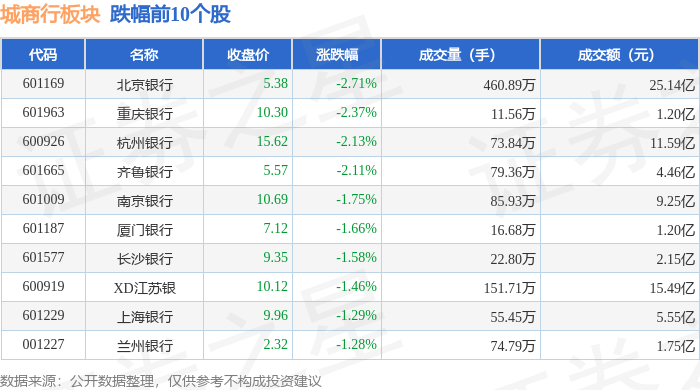
城商行板块1月14日跌2.11%,北京银行领跌,主力资金净流出7.29亿元
Zheng Xing Xing Ye Ri Bao· 2026-01-14 08:58
Core Viewpoint - The city commercial bank sector experienced a decline of 2.11% on January 14, with Beijing Bank leading the drop, while the overall market showed mixed results with the Shanghai Composite Index down 0.31% and the Shenzhen Component Index up 0.56% [1] Group 1: Market Performance - The closing price of Beijing Bank was 5.38, down 2.71%, with a trading volume of 4.6089 million shares and a transaction value of 2.514 billion [1] - Other notable declines included Chongqing Bank at 10.30 (-2.37%), Hangzhou Bank at 15.62 (-2.13%), and Qilu Bank at 5.57 (-2.11%) [1] - The city commercial bank sector saw a net outflow of 729 million in main funds, while retail investors contributed a net inflow of 53.1975 million [1] Group 2: Fund Flow Analysis - Hangzhou Bank had a main fund net inflow of 1.20 billion, but a net outflow from retail investors of 92.9469 million [2] - Suzhou Bank recorded a net inflow of 52.503 million from main funds, while retail investors had a net outflow of 54.0558 million [2] - Shanghai Bank experienced a main fund net inflow of 45.3249 million, with a retail net outflow of 46.6735 million [2]



青岛银行聊城分行:依托供应链金融破局 为小微企业输血造能
Qi Lu Wan Bao· 2026-01-14 08:01
Core Insights - The article highlights the challenges faced by small and micro enterprises in financing, which have long restricted their development [1] - Qingdao Bank's Liaocheng branch has innovatively launched supply chain financial services based on core enterprises to facilitate financing for small suppliers [1][2] - The new credit model focuses on the core enterprise, allowing for centralized approval and a variety of financial products to be offered to small enterprises [2] Financing Model - The innovative model breaks the limitations of traditional single-point credit approval by transforming complex individual audits into efficient centralized audits based on core enterprise credit [2] - This approach significantly optimizes the approval chain and simplifies the review process, enabling small enterprises to obtain financing quickly without providing complex credit materials [2] Financial Impact - As of December 31, 2025, Qingdao Bank's Liaocheng branch has issued 10 supply chain financial transactions based on the core enterprise credit, with a total loan amount of 3.2878 million yuan, alleviating the cash flow pressure on small enterprises [2] - The bank aims to continue deepening supply chain financial innovation to support the high-quality development of the regional economy by providing efficient approval processes and convenient financial products [2]
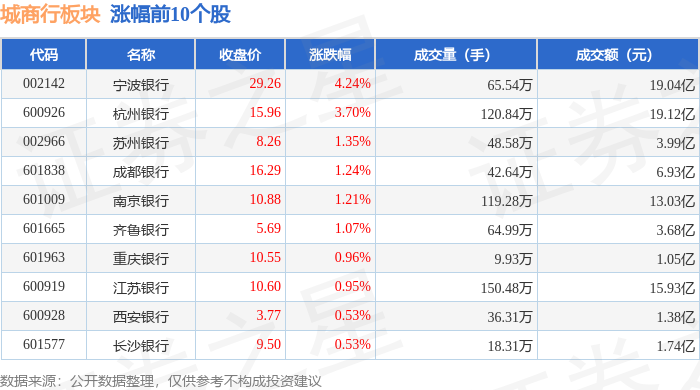
城商行板块1月13日涨1.55%,宁波银行领涨,主力资金净流入2.38亿元
Zheng Xing Xing Ye Ri Bao· 2026-01-13 09:06
Core Insights - The city commercial bank sector experienced a rise of 1.55% on January 13, with Ningbo Bank leading the gains [1] - The Shanghai Composite Index closed at 4138.76, down 0.64%, while the Shenzhen Component Index closed at 14169.4, down 1.37% [1] Stock Performance - Ningbo Bank (002142) closed at 29.26, up 4.24%, with a trading volume of 655,400 shares and a transaction value of 1.904 billion [1] - Hangzhou Bank (600926) closed at 15.96, up 3.70%, with a trading volume of 1,208,400 shares and a transaction value of 1.912 billion [1] - Suzhou Bank (002966) closed at 8.26, up 1.35%, with a trading volume of 485,800 shares [1] - Chengdu Bank (601838) closed at 16.29, up 1.24%, with a trading volume of 426,400 shares and a transaction value of 693 million [1] - Nanjing Bank (600109) closed at 10.88, up 1.21%, with a trading volume of 1,192,800 shares and a transaction value of 1.303 billion [1] - Qilu Bank (601665) closed at 5.69, up 1.07%, with a trading volume of 649,900 shares and a transaction value of 368 million [1] - Chongqing Bank (601963) closed at 10.55, up 0.96%, with a trading volume of 99,300 shares and a transaction value of 10.5 million [1] - Jiangsu Bank (616009) closed at 10.60, up 0.95%, with a trading volume of 1,504,800 shares and a transaction value of 1.593 billion [1] - Xi'an Bank (600928) closed at 3.77, up 0.53%, with a trading volume of 363,100 shares and a transaction value of 13.8 million [1] - Changsha Bank (601577) closed at 9.50, up 0.53%, with a trading volume of 183,100 shares and a transaction value of 174 million [1] Capital Flow - The city commercial bank sector saw a net inflow of 238 million from institutional investors, while retail investors contributed a net inflow of 199 million [2] - The sector experienced a net outflow of 437 million from speculative funds [2] Individual Stock Capital Flow - Hangzhou Bank (600926) had a net inflow of 70.42 million from institutional investors, while it faced a net outflow of 12.4 million from speculative funds [3] - Shanghai Bank (601229) saw a net inflow of 66.71 million from institutional investors, with a net outflow of 33.15 million from speculative funds [3] - Ningbo Bank (002142) had a net inflow of 37.18 million from institutional investors, with a net outflow of 1.4 million from speculative funds [3] - Suzhou Bank (002966) experienced a net inflow of 34.87 million from institutional investors, while facing a net outflow of 24.25 million from speculative funds [3] - Jiangsu Bank (601577) had a net inflow of 20.83 million from institutional investors, with a net outflow of 15.24 million from speculative funds [3]


牵引带动贷款投放近50亿元!“青融”模式让政策资金动能更澎湃
Qi Lu Wan Bao· 2026-01-13 05:29
Core Viewpoint - The "Qingrong" financing model in Qingdao is an innovative mechanism designed to channel central bank funds into key sectors of the real economy, demonstrating significant leverage effects and benefiting numerous market entities by providing low-cost loans [1][2]. Group 1: Mechanism Construction - The "Qingrong" model is built on a "four-party linkage" collaborative mechanism involving industry departments, central bank funding, fiscal guarantees, and financial institutions to effectively address cash flow issues faced by businesses [2][3]. - A special quota of 9 billion yuan has been established to support three sub-models: "Qingtrade," "Qingtech," and "Qingbenefit," providing stable low-cost funding for various sectors including foreign trade and technology innovation [2][3]. Group 2: Financial Support and Risk Mitigation - Fiscal guarantees are utilized to create a risk buffer, alleviating banks' concerns and enhancing their willingness to lend [3][5]. - Financial institutions are encouraged to customize credit products and streamline approval processes, exemplified by a rapid loan approval of 9 million yuan at a low interest rate of 2.9% for a company experiencing a 50% increase in orders [3][5]. Group 3: Implementation and Monitoring - The People's Bank of China in Qingdao has taken a proactive role in top-level design and mechanism construction, issuing clear guidelines for the model's support scope and operational processes [4][5]. - Continuous monitoring and feedback mechanisms are established to track the effectiveness of policy implementation, ensuring that any obstacles in the policy transmission process are promptly addressed [5]. Group 4: Practical Outcomes - The "Qingrong" model has successfully facilitated the disbursement of 4.851 billion yuan in loans, benefiting 704 market entities by effectively translating macroeconomic policy intentions into tangible support for micro-level businesses [1][2].
智通港股通资金流向统计(T+2)|1月13日




智通财经网· 2026-01-12 23:32
Core Insights - The article highlights the net inflow and outflow of funds in the Hong Kong stock market, with Xiaomi Group, Tencent Holdings, and China Construction Bank leading in net inflows, while the Yingfu Fund, Hang Seng China Enterprises, and Southern Hang Seng Technology experienced the highest net outflows [1] Group 1: Net Inflows - Xiaomi Group-W (01810) recorded a net inflow of 1.07 billion, representing a 16.36% increase in its closing price [2] - Tencent Holdings (00700) saw a net inflow of 863 million, with a 7.49% increase in its closing price [2] - China Construction Bank (00939) had a net inflow of 699 million, with a significant 41.06% increase in its closing price [2] Group 2: Net Outflows - Yingfu Fund (02800) experienced the largest net outflow of 6.289 billion, reflecting a -31.44% change in its closing price [2] - Hang Seng China Enterprises (02828) had a net outflow of 2.880 billion, with a -17.89% change in its closing price [2] - Southern Hang Seng Technology (03033) faced a net outflow of 1.289 billion, showing a -11.37% change in its closing price [2] Group 3: Net Inflow Ratios - 361 Degrees (01361) led with a net inflow ratio of 74.40%, with a net inflow of 8.9117 million [3] - BRILLIANCE CHI (01114) followed with a net inflow ratio of 64.04%, amounting to a net inflow of 36.4910 million [3] - Qin Port Co. (03369) had a net inflow ratio of 61.05%, with a net inflow of 846,600 [3] Group 4: Net Outflow Ratios - Wisdom Hong Kong 100 (02825) had a net outflow ratio of -100.00%, with a net outflow of -18,200 [3] - Stone Pharmaceutical Group (02005) recorded a net outflow ratio of -68.86%, with a net outflow of -14.1501 million [3] - Dexion Shipping (02510) experienced a net outflow ratio of -53.53%, with a net outflow of -10.0204 million [3]
金融行业周报(2026、01、11):开门红催化保险板块,看好配置策略下银行股中长线收益-20260111
Western Securities· 2026-01-11 13:11
Group 1: Core Conclusions - The financial industry saw a weekly increase of +2.60% in the non-bank financial index, underperforming the CSI 300 index by 0.19 percentage points [1] - The insurance sector outperformed with a weekly increase of +3.58%, benefiting from strong performance in listed insurance companies [1][9] - The banking sector experienced a decline of -1.90%, underperforming the CSI 300 index by 4.69 percentage points, with all types of banks showing negative performance [1][9] Group 2: Insurance Sector Insights - The insurance sector's strong performance is driven by high growth in "opening red" earnings, indicating a solid investment logic with improving fundamentals [1][13] - The sector benefits from a dual drive of asset under management (AUM) expansion and interest rate spread recovery, with a clear trend of increasing industry concentration [1][17] - Recommended companies in the insurance sector include China Pacific Insurance, China Ping An, China Life (H), and New China Life [3] Group 3: Brokerage Sector Insights - The brokerage sector saw a weekly increase of +1.90%, with a PB valuation of 1.41x, indicating potential for valuation recovery [2][18] - Notable developments include GF Securities' plan to raise funds through H-share placement to support international business expansion [2][18] - Recommended brokerages include Guotai Junan, Huatai Securities, and CITIC Securities, focusing on those with strong fundamentals and low valuations [3][19] Group 4: Banking Sector Insights - The banking sector's PB valuation stands at 0.53x, with expectations for interest margin recovery in 2026, driven by reduced re-pricing pressure on loans [2][21] - The People's Bank of China indicated a continuation of a moderately loose monetary policy, which is expected to support the banking sector's performance [2][21] - Recommended banks include Hangzhou Bank, with additional focus on Qingdao Bank and Ningbo Bank for potential recovery opportunities [3][22]