
Kering

Search documents
Kering: Monthly statement on the total number of shares and voting rights (July 2025)
Globenewswire· 2025-07-16 16:35
Core Points - Kering has released a monthly statement regarding the total number of shares and voting rights as of July 15, 2025 [3] - The total number of shares is reported to be 123,420,778, with a total number of theoretical voting rights at 176,689,404 and exercisable voting rights at 175,869,319 [3][4] Summary by Categories - **Company Information** - Kering is a société anonyme with a share capital of €493,683,112, headquartered at 40, rue de Sèvres, 75007 Paris [2] - **Shares and Voting Rights** - As of July 15, 2025, Kering has a total of 123,420,778 shares [3] - The total number of theoretical voting rights is 176,689,404, while the number of exercisable voting rights is 175,869,319 [3][4] - The calculation includes all shares with voting rights, excluding treasury shares stripped of voting rights [3][4]


Yen weakness finally subdues luxury splurge at Cartier-owner Richemont
CNBC· 2025-07-16 07:36
Core Insights - The luxury market in Japan has experienced a decline in sales for Richemont, with a 15% year-on-year decrease at constant exchange rates in the fiscal first quarter [1] - This decline follows a significant 59% increase in revenues during the same quarter last year, driven by a weaker yen that boosted international tourism and luxury spending [2] - The depreciation of the yen began last year after the Bank of Japan ended negative interest rates and its yield curve control policy, leading to the yen reaching 38-year lows [2] - Richemont had previously benefited from the yen's weakness, reporting sales growth of 20% to 25% in Japan over consecutive quarters [3] - Other luxury groups, including LVMH, Kering, and Burberry, also experienced sales increases during this period, particularly from Chinese tourists [3] - A recent strengthening of the yen in the first half of 2025 has negatively impacted these sales trends [3]

美元阴云笼罩欧股财报季:欧元升值13%重创欧企北美盈利,对冲策略成关键分水岭
智通财经网· 2025-07-15 08:24
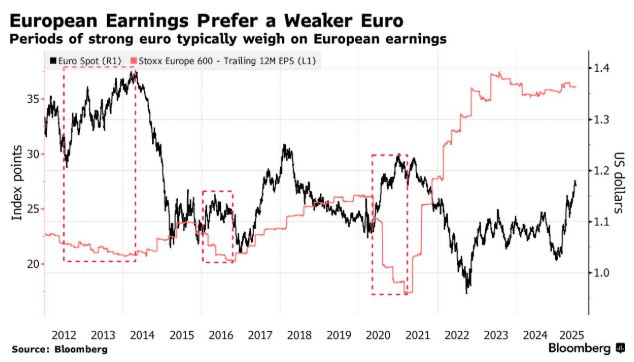
Group 1 - The weak US dollar is expected to negatively impact European companies' earnings, making currency fluctuations a key issue for the earnings season [1] - Since the beginning of 2025, the euro has appreciated nearly 13% against the dollar, while the British pound has risen about 8% [1] - Companies with over 25% of their revenue from North America may face significant impacts from currency fluctuations, especially those lacking effective hedging strategies [1][5] Group 2 - Analysts have generally lowered their expectations, predicting a decline in European corporate earnings, which could lead to further downward revisions if negative trends continue [7] - The Stoxx 600 index is expected to see a year-on-year decline in earnings per share of 3%, marking the largest drop in five quarters due to weak demand and a 3.5% increase in the euro trade-weighted index [9] Group 3 - Sectors most sensitive to currency fluctuations include healthcare, luxury goods, and technology, with companies like Argenx (84% North America exposure) and Fresenius Medical (66% North America exposure) being particularly vulnerable [4] - Companies with advanced hedging strategies tend to perform better, as seen with Brunello Cucinelli SpA, which reported double-digit growth without being affected by currency fluctuations [14]
Luxury Apparel Market to 2029 | Louis Vuitton Dominates Luxury Brands as Hermès Gained Share in 2024
GlobeNewswire News Room· 2025-07-11 09:27
Core Insights - The global luxury apparel market is projected to experience a contraction of 2.4% in 2024 due to macroeconomic challenges, including inflation in Europe and the US, and a downturn in China affecting consumer spending [2] - From 2024 to 2029, clothing is expected to achieve the strongest category compound annual growth rate (CAGR) of 3.1%, driven by ultra-wealthy shoppers prioritizing trend-driven purchases, with womenswear anticipated to outperform [2] - The Asia-Pacific region is set to achieve the highest regional CAGR of 4.0% from 2024 to 2029, supported by the recovery of China and strong economic growth in emerging markets [3] Market Performance - Louis Vuitton remains the largest luxury apparel brand, slightly increasing its market share to 9.8% in 2024 [3] - Hermes was the biggest winner in 2024, with its market share rising by 0.7 percentage points to 6.0%, attributed to its exclusivity and superior quality [3] - The luxury market is expected to slightly outperform the total apparel market starting in 2028 as macroeconomic conditions improve [5] Category Insights - Footwear is projected to underperform until 2029, as consumers favor trainers from premium and mass-market brands [5] - The report provides insights into the drivers and inhibitors within the global luxury apparel market, highlighting the demand across various categories and brands [5] Competitive Landscape - The report includes profiles of key luxury apparel brands and their competitive positions, focusing on strategies brands are employing to stand out in the market [6][8] - Notable brands mentioned include Louis Vuitton, Hermes, Chanel, Gucci, and Burberry, among others [8]


X @The Wall Street Journal
The Wall Street Journal· 2025-07-01 11:16
Company Performance - Luca de Meo revitalized Renault after financial struggles [1] Leadership Change - Luca de Meo's move to Gucci's parent company aims for a similar turnaround [1]
Simon Boosts Portfolio With Brickell City Centre's Retail Arm Buyout
ZACKS· 2025-06-30 14:50
Core Insights - Simon Property Group (SPG) has acquired Swire Properties' stake in Brickell City Centre's open-air shopping center, gaining full ownership and management of the asset, which is expected to enhance leasing and revenue growth, thereby creating shareholder value [1][9] Group 1: Acquisition Details - The acquisition includes a 500,000-square-foot retail asset within Brickell City Centre, which features over 90 retail stores and 15 dining locations across three city blocks [2][3][9] - Previously, SPG held a 25% non-managing interest in the retail space at Brickell City Centre [1] Group 2: Property Overview - Brickell City Centre is a mixed-use destination covering five million square feet, known for its architectural sophistication and completed in 2016 [2] - The shopping center is anchored by a Saks Fifth Avenue and includes a Casa Tua Cucina location, providing a diverse dining and entertainment experience [3] Group 3: Company Strategy - Simon Property has been restructuring its portfolio to focus on premium acquisitions and transformative redevelopments, including the complete takeover of The Mall Luxury Outlets from Kering and a multimillion-dollar redevelopment at Smith Haven Mall [4][5] - The company has been investing billions to enhance its properties and drive footfall [4] Group 4: Market Challenges - The company faces challenges from growing e-commerce adoption and a high debt burden, which may strain retailers' balance sheets amid macroeconomic uncertainty [6] - SPG's shares have declined by 3.4% over the past three months, slightly worse than the industry's decline of 3.1% [6]



外资交易台:全球周报
2025-06-23 02:09
Summary of Key Points from the Conference Call Industry Insights - **US Exceptionalism and Asset Performance**: The theme of US exceptionalism, USD strength, and US asset performance has garnered significant attention. Since 2012, the MSCI World Index in USD has increased by over 3 times, while a leading Norwegian asset manager's Global Equity Fund (FX-unhedged) has seen a 7x increase, indicating a greater propensity for non-USD investors to diversify their portfolios [1][1][1] - **Decline in US Student Visa Applications**: There has been a steep decline in US student visa applications, with the rejection rate doubling. Conversely, UK student visa applications have increased by 20% year-over-year, and applications for UK citizenship from US citizens have surged by 26% year-over-year, with record applications in March and April [3][3][3] - **Investor Interest in Large-Cap Tech and AI Stocks**: Investor appetite for large-cap technology stocks has risen again, with notable outperformance of the Magnificent Seven (Mag7) compared to the S&P 500. There is also increased interest in perceived AI winners, with strategies focusing on long positions in AI winners and short positions in AI-at-risk stocks approaching new highs [5][6][6] - **Strong Q1 EPS Growth and Seasonal Patterns**: The first quarter has shown standout EPS growth, with continuous news on increased use cases and adoption of technology. There is no slowdown in spending or investment, as evidenced by recent news regarding Softbank and TSMC. July is historically the strongest month for Nasdaq returns, which has been frequently cited by analysts [8][9][9] - **Impact of Fiscal Concerns on Mega-Cap Tech**: There is speculation that mega-cap tech companies may benefit from an increasingly precarious fiscal situation. Higher interest rates typically imply a higher cost of capital, but companies with strong balance sheets and cash flows may become more attractive in uncertain economic conditions [5][10][10] Economic Activity and Market Performance - **Uneven Economic Activity**: The current trajectory of economic activity is described as unusually uneven, with a notable slowdown in German weekly activity and no rebound in US retailer imports following a collapse in April and May. The European economic surprise index has outperformed the US index, highlighting the complexity of the current economic landscape [11][11][11] - **European Equity Performance**: Despite the uneven macro data and the upcoming tariff deadline on July 9th, European equities have performed well year-to-date. However, the top five largest stocks in Europe have not contributed to this performance, with both LVMH and Novo Nordisk down over 20% year-to-date [15][18][18] - **Revisiting LVMH Investment Thesis**: The investment thesis for LVMH is being revisited, with a recommendation to buy despite being below consensus for the rest of the year. The diverging outlooks for brands in the luxury sector present a compelling alpha opportunity, contrasting with the performance of European big oils [20][20][20] Conclusion - The conference call highlighted significant trends in US and European markets, particularly in technology and luxury sectors. The ongoing geopolitical tensions and economic uncertainties are influencing investor behavior and market dynamics, with a focus on diversification and sector-specific opportunities.
Trump Sets Two-Week Deadline on Iran Strikes; Israel Hits Nuclear Sites | Daybreak Europe 06/20/2025
Bloomberg Television· 2025-06-20 07:17
Geopolitical Tensions and Diplomacy - The U S President has a two-week window to decide on potential actions regarding Iran, opening a door for negotiations [1][2][3][11][12][13] - Diplomatic efforts are underway, with European ministers meeting Iranian counterparts in Geneva to discuss de-escalation and monitoring Iran's nuclear program [2][20][21][22] - The conflict between Israel and Iran has lessened in the last 24 hours, but the war of words continues, with potential involvement of Iranian proxies like Hezbollah and Iraqi militias [14][17][18][19] Market Reactions and Analysis - Markets show relief as the U S stays on the sidelines, with European stocks recovering from losses and U S markets reopening after a holiday [4] - Brent crude oil prices initially doubled due to the conflict but later dropped more than 2% to $77 per barrel as safe-haven bids fade with the possibility of diplomacy [2][6][28] - Analysts suggest that a 20% move in oil prices has not had a bigger impact because the market anticipates ample supply from OPEC and U S shale drillers [29][30] - Central banks are in a difficult position due to geopolitical and trade uncertainties, leading to a cautious approach [31][32] Economic Trends and Indicators - The EU Economy Commissioner indicates progress in trade talks with the U S, emphasizing the protection of EU economic interests [36][37] - A shift from consumer companies to defense is observed in the European economy, with Rheinmetall replacing Kering in the Euro Stoxx 50, reflecting deglobalization and reassuring trends [37][38][39][40] - SoftBank is pitching a $1 trillion AI hub to TSMC, seeking tax breaks to establish a manufacturing hub in the United States [27]

Kering: Monthly statement on the total number of shares and voting rights (June 2025)
Globenewswire· 2025-06-16 14:39
Core Points - Kering has a share capital of €493,683,112 as of June 13, 2025 [1] - The total number of shares is 123,420,778, with a total number of voting rights amounting to 176,687,858 [2] - The exercisable voting rights are recorded at 175,864,273, calculated based on all shares with voting rights, including treasury shares stripped of voting rights [2][3]
品牌消费品奢侈品奢侈品价格追踪关税后的思考
Goldman Sachs· 2025-05-23 10:55
Investment Rating - The report does not explicitly state an overall investment rating for the luxury goods industry, but it indicates a preference for companies with high-end exposure and diversified large/mid caps with margin defensiveness, while remaining cautious on turnaround stories in a tough industry backdrop [7]. Core Insights - The luxury goods market is experiencing price increases across various brands, particularly in the US, as companies aim to offset inflation and tariffs. Brands such as Louis Vuitton, Moncler, Burberry, and Hermès have implemented notable price hikes [2][7]. - The pricing tracker indicates that overall price gaps across regions have decreased, with the US experiencing a tightening price gap with Europe despite recent price increases [3][5]. - China remains the most expensive market for luxury goods, with a premium of approximately 20-25% compared to Europe. However, there is ongoing softness in the luxury market in China, raising questions about consumer appetite [6][7]. Summary by Sections Pricing Trends - Several luxury brands have increased prices in the US, with notable increases from Louis Vuitton (+L-MSD), Moncler (+LSD), and Burberry (+HSD) [2]. - The current price increases are designed to offset a 10% level of additional tariffs, with potential for more global price increases if tariffs rise further [7]. Regional Analysis - The US has seen a recent weakening of the dollar, which has tightened the price gap with Europe, making luxury goods less attractive for American consumers traveling to Europe [3][5]. - Chinese consumers are showing strong demand for luxury goods, particularly in Japan, where spending nearly doubled year-on-year in FY24 [6]. Brand-Specific Observations - Moncler has the largest price gap between Europe and China at approximately 30%, but this gap has compressed significantly over the past decade [7]. - The report highlights that brands are likely to focus on narrowing the price gap between China and Europe, with Moncler seeing further opportunities to reduce this gap [7].