Blackstone

Search documents
How Does all the Challenging Areas in United States Equities Look?
Investment Moats· 2026-02-20 00:58
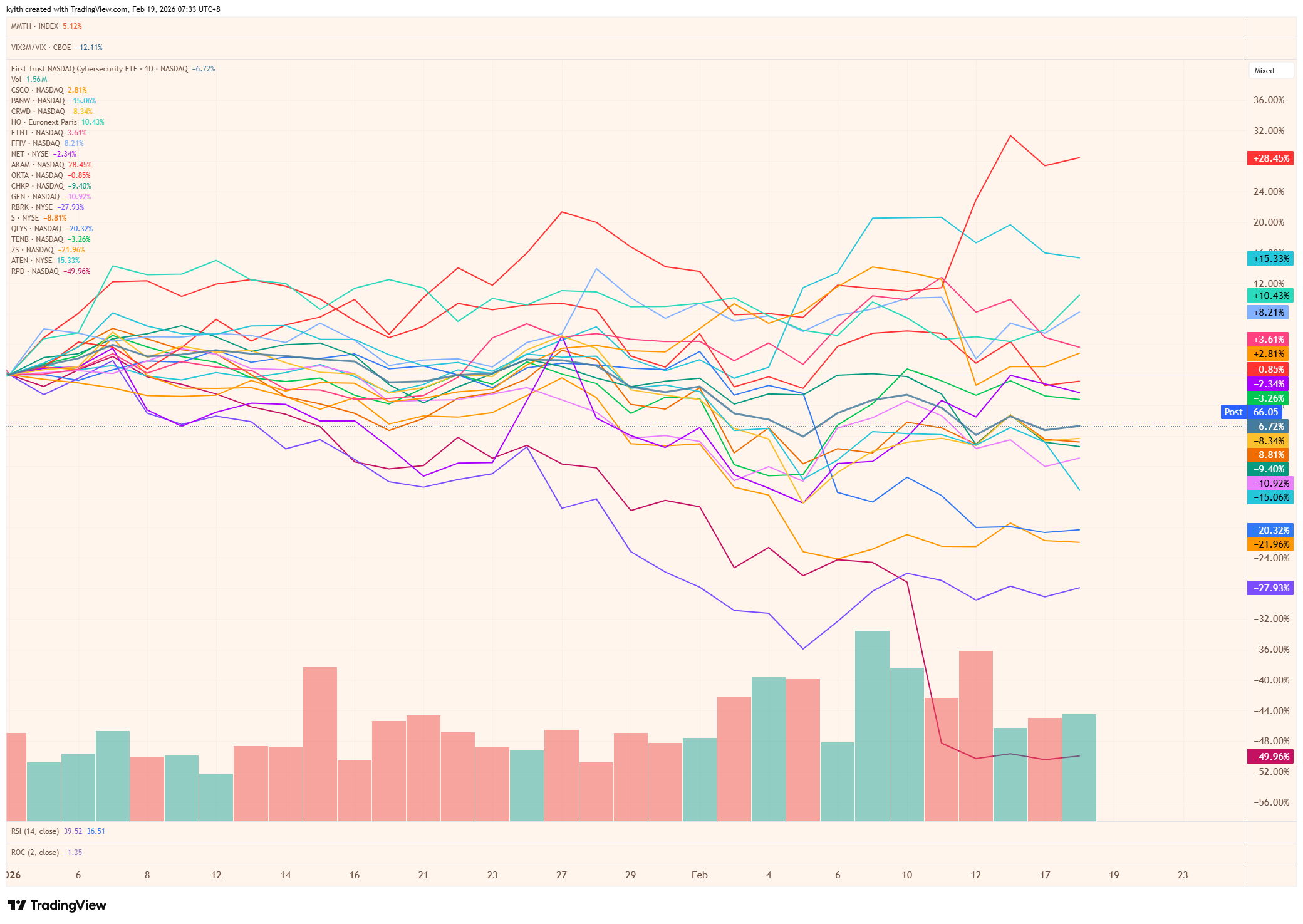
Core Insights - The article discusses potential weaknesses in various sectors of the US economy, particularly focusing on distressed areas and the implications for future earnings and revenues [1][2]. Data Providers - Data providers have shown poor performance year-to-date, with significant declines in stock prices, indicating potential margin issues despite strong competitive moats [2][3]. Biotech Sector - The biotech sector has been underperforming for four years, but there is a belief that prices may mean revert as they become too cheap [2]. Software-as-a-Service (SaaS) - SaaS companies are perceived to have stronger moats than the market currently values, but there are concerns about long-term disruption from new technologies [6][8]. Cybersecurity - The cybersecurity sector has mixed performance, with some companies showing resilience while others face significant declines. The overall outlook remains uncertain [13][14]. Payments Companies - The payments sector has seen poor performance, with companies like PayPal and Adyen experiencing significant declines. However, major players like Visa and Mastercard continue to perform relatively well [16][17]. Business Development Companies (BDCs) - BDCs have faced challenges recently, with declines in performance noted at the start of the year. They are essential for providing private credit [18][19]. US Insurance - The insurance sector is struggling, with companies like Progressive and Brown and Brown facing challenges in raising prices and organic growth capabilities [21][22]. Home Builders and Ancillary Services - The homebuilding sector shows mixed results, with some companies performing well while ancillary service providers are thriving due to increased demand for home improvements [23][24][27]. Consumer Discretionary - The consumer discretionary sector reflects the health of the economy, with mixed performance among various companies. The S&P 500 equal weight consumer discretionary index shows a modest increase [31][34]. Restaurants - The restaurant sector is a key indicator of consumer spending, with many companies showing resilience despite economic challenges. However, some, like Red Robin, are struggling significantly [39][40].


多重利空压顶,美股三大指数集体下跌
财联社· 2026-02-20 00:19
Market Overview - On February 19, U.S. stock markets opened lower and closed down, with all three major indices declining [1][2] - The Dow Jones Industrial Average fell by 0.54% to 49,395.16 points, the S&P 500 decreased by 0.28% to 6,861.89 points, and the Nasdaq Composite dropped by 0.31% to 22,682.73 points [2][3] Asset Management Sector - Blue Owl Capital announced the sale of $1.4 billion in loan assets from three private debt funds, raising concerns among investors about potential losses in the private loan sector [4] - Following this news, several asset management companies experienced significant stock declines: Blue Owl Capital down 5.93%, Blackstone down 5.37%, Apollo Global Management down 5.21%, Ares Management down 3.08%, and Brookfield down 2.68% [4] Software Industry - The software sector also showed weakness, with notable declines in stocks such as Cadence Design Systems down 2.76%, SAP down 2.41%, Intuit down 2.06%, and ServiceNow down 1.33% [4] - Concerns about artificial intelligence potentially disrupting the software industry were highlighted, with Mistral AI's CEO stating that over 50% of enterprise software could be replaced by this technology [4] Energy Sector - Energy stocks mostly rose amid ongoing tensions between the U.S. and Iran, with ConocoPhillips up 0.97% and Chevron up 0.49% [5] Retail Sector - Walmart's stock fell by 1.38% after the company provided a fiscal year profit guidance that fell short of market expectations, overshadowing its better-than-expected fourth-quarter results [5] Technology Stocks - Major tech stocks had mixed performances: Nvidia down 0.04%, Apple down 1.43%, Alphabet down 0.13%, Microsoft down 0.29%, Amazon up 0.03%, Meta up 0.24%, and Tesla up 0.12% [6][7] Chinese Stocks - The LiFeng Chinese stock index fell by 0.54%, and the Nasdaq Golden Dragon China Index decreased by 0.35% [8] - Popular Chinese stocks mostly declined, with Bawang Tea down 2.5%, Trip.com down 2.28%, Alibaba down 0.96%, and Pinduoduo down 0.94% [8] Company News - Amazon surpassed Walmart to become the highest-grossing company globally, reporting $717 billion in sales for the fiscal year ending December, compared to Walmart's $713.2 billion [9] - AMD announced it will support a $300 million loan to Crusoe, backed by chip products [10] - Hims & Hers Health is acquiring Australian digital health company Eucalyptus for up to $1.15 billion, which boosted its stock by approximately 7% in pre-market trading [11] - Yorkville America Equities LLC announced plans to acquire the Point Bridge America First ETF, focusing on investments aligned with former President Trump's "America First" ideology [12] - BE Semiconductor Industries reported fourth-quarter revenue of €166.4 million, exceeding analyst expectations, and projected a revenue growth of 5%-15% for the first quarter [13]


Blackstone, EQT and CVC make offers for VW's Everllence unit, FT reports
Reuters· 2026-02-18 05:18
Core Insights - Volkswagen has received bids from leading private equity firms such as Blackstone, EQT, and CVC for its Everllence division, indicating strong interest in the asset from major investment players [1] Group 1 - The involvement of top private equity funds suggests a competitive bidding environment for Volkswagen's Everllence division [1] - The Financial Times reported this development, highlighting the significance of the interest from these firms [1]


X @Bloomberg
Bloomberg· 2026-02-17 13:17
Blackstone is in advanced talks to acquire residential services provider Champions Group for about $2.5 billion, according to people familiar with the matter https://t.co/OZNmpXJdKm ...
X @TechCrunch
TechCrunch· 2026-02-16 00:34
Blackstone backs Neysa in up to $1.2B financing as India pushes to build domestic AI infrastructure https://t.co/ojaubSYUcu ...
Blackstone backs Neysa in up to $1.2B financing as India pushes to build domestic AI infrastructure
TechCrunch· 2026-02-16 00:30
Neysa, an Indian AI infrastructure startup, has secured backing from U.S. private equity firm Blackstone as it scales domestic compute capacity amid India’s push to build homegrown AI capabilities.Blackstone and co-investors, including Teachers’ Venture Growth, TVS Capital, 360 ONE Asset, and Nexus Venture Partners, have agreed to invest up to $600 million of primary equity in Neysa, giving Blackstone a majority stake, Blackstone and Neysa told TechCrunch. The Mumbai-headquartered startup also plans to rais ...

X @Nick Szabo
Nick Szabo· 2026-02-14 00:55
RT Casey Putsch for Ohio Governor (@CaseyPutschOhio)Ohio FIRST. Ohio ONLY.No AIPACNo foreign influenceNo data center leechingNo H1B replacementNo Blackstone buying housesNo selling out to donorsDemocrats shut us down. RINO’S sold us out. We will take it back.Ohioans built this state. Ohioans will SAVE this state. https://t.co/Kowabcobvt ...
From software to real estate, US sectors gripped by AI scare trade
BusinessLine· 2026-02-13 18:10
Market Overview - Wall Street is experiencing significant disruption concerns due to AI, leading to a sell-off in various sectors, particularly software companies, which has resulted in sharp losses in U.S. stocks this week [1][2]. Software Sector - The S&P 500 Software & Services index has lost approximately $2 trillion in value since its peak in October, with half of this loss occurring in the past two weeks due to fears that AI could disrupt traditional subscription and enterprise tools [2]. - Notable declines in the Nasdaq 100 include Atlassian down 47%, Intuit down 40%, and Workday down 33% [4]. - The U.S. software sector is facing its worst drawdown in over three years, impacting alternative asset managers with exposure to software-related loans, with firms like Ares, Blackstone, and KKR seeing declines between 13% and 24% this year [5]. Financial Brokerage, Data Analytics & Legal Services - The financial industry, especially brokerages and data analytics firms, has been negatively affected after Altruist introduced AI-enabled tax planning features, raising fears about the viability of their business models [6]. - Shares of brokers such as LPL Financial and Charles Schwab fell over 7%, while S&P Global's shares dropped more than 25% in February, marking its worst month since 2009 [7]. Real Estate Services - Commercial real estate and investment managers have suffered as investors shift away from high-fee, labor-intensive business models perceived as vulnerable to AI disruption, with CBRE Group and Jones Lang LaSalle each dropping about 12% [8]. Insurance Sector - Insurance stocks have experienced a significant decline, with the S&P 500 insurance index falling 3.9% on a single day, its largest drop since mid-October, following the release of an AI-powered comparison tool by Insurify [10]. - Shares of Willis Towers Watson have decreased by 15% this week, while Aon and Arthur J. Gallagher fell by 9% and 15%, respectively [11]. Trucking & Logistics - The trucking and logistics sector saw unexpected declines, with stocks like Landstar System and C.H. Robinson dropping sharply after Algorhythm Holdings reported a significant increase in freight volumes without a corresponding rise in operational headcount [13].


X @Bloomberg
Bloomberg· 2026-02-13 14:29
Blackstone private equity fund for wealthy individuals notched a net 20% gain last year, thanks in part to some AI investments the firm doesn’t hold in its institutional portfolios https://t.co/8Dnk55fZHJ ...
RPT(RPT) - 2025 Q4 - Earnings Call Transcript
2026-02-13 14:02
Financial Data and Key Metrics Changes - The company reported GAAP earnings of $2.5 million for Q4 2025, with a per diluted share loss of -$0.06 and a book value of approximately $300 million, or $31 per diluted share [8][9] - The common stock dividend yield is 8.7%, and the company has about $100 million in cash and liquidity [9] Business Line Data and Key Metrics Changes - The company is focused on acquiring multifamily loans from its operating business, Genesis, which is projected to produce between $6 billion and $7 billion in loans this year, up from $1.7 billion in production when acquired [11][12] - The company has identified a pool of assets worth around $1 billion that could be added to the vehicle, which would lead to an immediate increase in earnings [31] Market Data and Key Metrics Changes - The company is currently trading at roughly 50% of its book value, with a trading price around $15 [7] - The commercial real estate sector is experiencing dislocation, with many REITs facing liquidity issues, which presents an opportunity for the company to grow [9][10] Company Strategy and Development Direction - The company aims to transition into a dedicated commercial real estate vehicle and opportunistic investment vehicle, focusing on capital formation to achieve earnings growth between $1.60 and $1.70 per share [5][6] - The strategy includes acquiring multifamily loans and expanding into commercial real estate investments, with a focus on patience until market conditions stabilize [10][12] Management's Comments on Operating Environment and Future Outlook - Management expressed optimism about the potential for earnings growth and the ability to attract third-party capital, while emphasizing the importance of timing and market conditions [29][30] - The company is exploring opportunities to become a Fannie Mae and Freddie Mac servicer or originator, aiming for an end-to-end customer relationship in the lending process [43][44] Other Important Information - The company announced a reverse stock split of 6-for-1 to attract more interest in its stock [4] - Management highlighted the importance of maintaining a clean balance sheet and being patient in the current market environment [9][10] Q&A Session Summary Question: Will RPT receive a slice of the NOI from the Paramount transaction? - Management indicated that RPT has $50 million of the Paramount deal on its balance sheet, and it will be a pro rata share of what Rithm did [20] Question: Are there plans to acquire more loans from Genesis? - Management confirmed that Genesis is expected to produce $6 billion-$7 billion in loans, and there are identified loans that could go onto the balance sheet, leading to a real increase in earnings [21] Question: Is there a tolerance for finding other sources of capital? - Management stated that there is third-party capital interested in the vehicle, and they are open to bringing in additional capital as long as it is not highly dilutive [29][30] Question: What types of loans will be the primary source for RPT? - Management noted that the primary source will be multifamily loans generated by Genesis, which are expected to be highly accretive [31] Question: Is there an opportunity to acquire from banks? - Management mentioned that there is not much bank selling currently, but the regional banks pulling back has created opportunities for Genesis to grow production [41]