
Mitsubishi Electric

Search documents
Mitsubishi Electric to Power Next-Generation AI Factories with 800 VDC Infrastructure
Businesswire· 2025-10-13 15:00
Core Insights - Mitsubishi Electric Power Products, Inc. (MEPPI) supports the deployment of 800 VDC infrastructure in AI factories, leveraging its expertise in Direct Current (DC) power distribution technology [1] - Traditional 54 VDC in-rack architectures are not optimized for the megawatt-scale racks and tightly synchronized compute clusters that characterize modern AI factories [1] - The scaling demand in AI factories necessitates advanced power distribution solutions to meet operational requirements [1]


工厂自动化 - 2025 年中国国际工业博览会见闻:需求展望无变化,但竞争格局略有转变-Factory Automation-Takeaways from CIIF 2025 No Change in Demand Outlook, but We Detect a Slight Shift in Competitive Landscape
2025-09-28 14:57
Summary of CIIF 2025 Conference Call Industry Overview - **Industry**: Factory Automation in Japan - **Event**: China International Industry Fair (CIIF) 2025 held in Shanghai from September 23-27, 2025 - **Participants**: Included Japanese companies such as SMC, Misumi Group, Yaskawa Electric, Nabtesco, Mitsubishi Electric, NSK, Amada, and Greater China companies like Inovance, Airtac, Hiwin [2][6] Key Points Demand Environment - **Current Demand**: Demand remains steady, particularly in semiconductor and battery-related sectors, as well as medical-related businesses [3][11] - **Capex Recovery**: Capital expenditure-related demand has shown a steady recovery from low levels in the first half of the year, but no further recovery is expected in the latter half [3][4] - **General Outlook**: Most industry participants believe that current demand levels will hold steady without significant changes [3][4] Competitive Landscape - **Competition Intensity**: The competitive environment remains harsh, especially in middle- and low-end markets, with many companies struggling due to intensified competition [4][5] - **High-End Market Stability**: Conditions in high-end markets are largely unchanged, although local parts are increasingly adopted due to Chinese government onshoring policies [4][5] - **Company-Specific Insights**: - **Omron, Yaskawa Electric, SMC**: Facing stiff local competition and struggling somewhat [5] - **Fanuc and Nabtesco**: Competitive conditions appear stable due to strong product technologies [5] - **Misumi Group**: Has improved competitiveness through successful economy product launches and innovative products tailored for the Chinese market [5] Company Strategies - **Mitsubishi Electric**: Launched a second brand (Lingling) for the Chinese market, focusing on local development and manufacturing to reduce costs [9] - **Omron**: Plans to introduce new products tailored to the Chinese market, though these are not yet released [9] - **Yaskawa Electric**: Continues to focus on high-end markets and value-added products, avoiding low- and medium-end markets due to competition [12] - **Amada**: Reduced its Chinese business significantly over the past decade but sees future opportunities due to local manufacturers shifting to overseas production [13] - **NSK**: Focused on high-end applications with no significant changes in competitive environment [14] Additional Insights - **SMC's Focus**: Plans to concentrate on high-growth potential areas like semiconductors and medical equipment, despite tough competition in midrange markets [10] - **Misumi Group's Innovations**: Showcased new products including a small SCARA robot and AI agent for customer inquiries, with steady demand in semiconductor and medical sectors [11] Conclusion The factory automation industry in Japan is currently experiencing stable demand, particularly in high-tech sectors. However, competition remains fierce, especially in lower-end markets. Companies are adapting their strategies to enhance competitiveness and cater to local market needs, with a focus on innovation and local production.
Asian Markets Trade Mostly Lower
RTTNews· 2025-09-26 03:08
Market Overview - Asian stock markets are mostly lower, influenced by negative cues from Wall Street and new tariffs announced by U.S. President Donald Trump on various goods starting October 1 [1] - The Australian stock market is slightly higher, with the S&P/ASX 200 index above 8,750, supported by gains in iron miners and financial stocks [2][3] Australian Stocks - The S&P/ASX 200 Index is up 7.30 points or 0.08 percent to 8,780.30, after fluctuating between 8,746.30 and 8,781.10 [3] - Major miners like BHP Group are gaining almost 2 percent, while Mineral Resources and Rio Tinto are up more than 1 percent each [3] - Oil stocks show mixed performance, with Origin Energy down almost 2 percent and Woodside Energy down 0.4 percent, while Santos and Beach Energy are slightly up [4] Technology and Financial Sector - In the tech sector, Afterpay-owner Block is down 3.5 percent, and other tech stocks like Zip and Appen are also declining [4] - Among the big four banks, Commonwealth Bank, Westpac, and ANZ are up 0.1 to 0.5 percent, while National Australia Bank is gaining almost 1 percent [5] Japanese Market - The Japanese market is modestly lower, with the Nikkei 225 Index down 125.14 points or 0.27 percent to 45,629.79 [7] - Major companies like SoftBank Group are losing almost 3 percent, while automakers Toyota and Honda are slightly up [8] Economic Indicators - Overall inflation in the Tokyo region of Japan increased by 2.5 percent year-on-year in September, slightly below expectations [13] - Core CPI also rose by 2.5 percent year-on-year, missing forecasts for a 2.6 percent increase [14] Other Markets - South Korea and Taiwan are down 2.2 and 1.9 percent, respectively, while Singapore is up 1.1 percent [15] - On Wall Street, major averages ended lower, with the Nasdaq down 113.16 points or 0.5 percent [16] Notable Company News - Vulcan Energy Resources shares jumped more than 15 percent after signing a $179 million contract for a geothermal power plant in Germany [6]

Asian Markets Track Wall Street Lower
RTTNews· 2025-09-24 03:08
Market Overview - Asian stock markets are mostly trading lower, influenced by negative cues from Wall Street and rising uncertainty regarding interest rates after comments from US Fed Chair Jerome Powell [1][15] - Renewed trade tensions with the US and escalating geopolitical tensions in Europe and the Middle East are negatively impacting market sentiment [1] US Federal Reserve Insights - Jerome Powell described equity prices as "fairly highly valued" and noted a "challenging situation" for the Fed, with inflation risks tilted to the upside and employment risks to the downside [2] - Fed Governor Stephen Miran called for substantially lower interest rates, advocating for a 50 basis point cut at the last Fed meeting [3] - The general market consensus anticipates two more interest rate cuts before the end of the year, with a 94.1% chance of a 25 basis point cut at the upcoming Fed meeting [4][3] Australian Market Performance - The S&P/ASX 200 Index fell by 83.90 points or 0.95% to 8,762.00, breaking a three-session winning streak [5] - Major miners like BHP Group and Fortescue saw slight declines, while Mineral Resources gained over 2% [5] - Oil stocks generally performed well, with Woodside Energy up 0.4% and Santos gaining more than 1% [6] Japanese Market Performance - The Nikkei 225 Index closed at 45,300.30, down from earlier highs, reflecting a mixed performance across sectors [9] - Market heavyweight SoftBank Group gained almost 2%, while Fast Retailing declined more than 2% [10] Economic Indicators - Japan's manufacturing activity contracted to 48.4 in September, marking the 14th contraction in 15 months and the steepest decline since March [13] - The services PMI edged down to 53.0, indicating the lowest figure since June despite ongoing growth in the services sector [14]

Uber Invests in Drone Delivery With Flytrex Partnership
PYMNTS.com· 2025-09-18 14:04
Core Insights - Uber has initiated a partnership with Flytrex for autonomous drone food delivery, marking its first investment in this area [2][3] - The service is set to launch in Uber Eats pilot markets in the U.S. by the end of the year, leveraging Flytrex's drone technology and Uber's logistics capabilities [2][3] - Flytrex has successfully delivered over 200,000 meals in the past three years, highlighting the potential of drone delivery in suburban areas [3] Company Developments - The collaboration combines Flytrex's FAA-authorized drone delivery system with Uber's established logistics network [2] - Uber has prior experience in autonomous delivery, having previously launched robotic delivery operations in the U.S. and Japan [3][4] - The company has partnered with Avirde to utilize sidewalk robots for food delivery in select U.S. cities [5] Industry Trends - The future of delivery is expected to expand beyond food, with potential applications for medications, parcels, and groceries [6] - Robots are anticipated to play a role in reverse logistics, facilitating product returns and local commerce [6][7] - The use of delivery robots is projected to significantly reduce last-mile delivery costs [7]


Mitsubishi Electric to take full ownership of Nozomi Networks in $883m deal
Yahoo Finance· 2025-09-10 11:06
Core Viewpoint - Mitsubishi Electric is acquiring Nozomi Networks for $883 million, aiming to enhance its operational technology security solutions and digital platform capabilities [1][2]. Group 1: Acquisition Details - Mitsubishi Electric currently holds a 7% stake in Nozomi Networks and plans to fully acquire the company in a deal valued at $883 million [1]. - The acquisition will be executed through a reverse triangular merger, with Mitsubishi Electric's special purpose vehicle merging with Nozomi Networks [3]. - Shareholders of Nozomi Networks will receive cash consideration for their shares, which will be cancelled and converted into the right to receive the merger consideration, excluding shares already owned by Mitsubishi Electric [3]. Group 2: Strategic Objectives - The integration of Nozomi Networks' advanced technologies is expected to accelerate Mitsubishi Electric's Serendie digital platform and facilitate the co-creation of new services with customers [2]. - Nozomi Networks, established in 2016, has over 300 employees and is headquartered in San Francisco, California [2]. Group 3: Related Collaborations - In February, Mitsubishi Electric collaborated with HD Renewable Energy to work on projects aimed at achieving carbon neutrality, which includes acquiring a stake in HD Renewable Energy [4][5]. - The joint venture will focus on the development and management of solar power and battery storage systems, as well as electricity retailing [5].
亚洲策略篮子- 评估亚洲人工智能驱动的投资机会;推出亚洲 “核心动力” 篮子-Asia Strategy Baskets_ Assessing AI-Powered Investment Opportunities in Asia; Introducing the Asia Nuclear Power Basket (GSSZNUCL)
2025-09-06 07:23
Summary of Key Points from the Conference Call Industry Overview - **Industry Focus**: The conference call discusses the energy sector in Asia, particularly the nuclear power and renewable energy industries, highlighting the strategic importance of these sectors amid rising electricity demand and geopolitical tensions [1][2][4][9][38]. Core Insights and Arguments - **AI-Driven Power Demand**: Global electricity demand is projected to grow at a CAGR of 3.7% from 2024 to 2026, with emerging markets in Asia, particularly China and India, expected to drive 60% of this growth [9][10]. Data centers are anticipated to increase their share of global electricity use from 1-2% to 3-4% by 2030, contributing a 0.3% CAGR to overall power demand [1][10]. - **Green Energy Transition**: Renewables now account for over 45% of global electricity capacity, a 15 percentage point increase over the past decade, primarily replacing coal rather than adding new supply [2][20][21]. - **Nuclear Power's Role**: Nuclear energy, with a capacity factor exceeding 90% and zero carbon emissions, is positioned as a key player in providing clean baseload power. Investment in nuclear has surged, growing at a ~14% CAGR from 2020 to 2024 [3][22][30]. The share of nuclear in global generation is projected to rise from ~9% today to over 12% by 2040 [22]. - **Investment Opportunities**: The Asia Nuclear Power basket (GSSZNUCL) has been introduced to capture investment opportunities in companies involved in the nuclear energy cycle. This basket, along with Environmental & Renewables (GSSZEVMT) and Power & Electricity (GSSZPOWE), forms the Power Up Asia aggregate basket (GSSZPOWU) [5][38]. Important but Overlooked Content - **Diverging Energy Landscape in Asia**: Different countries in Asia are taking varied approaches to energy transition. China is leading in energy transition investments, while Japan is restarting nuclear plants, and South Korea is expanding its nuclear footprint. India is focusing on renewables and coal to address power deficits, and Australia remains a key uranium exporter [4][35]. - **Core-Satellite Investment Recommendation**: The recommendation is to accumulate or buy nuclear stocks on weakness, given their strong year-to-date performance (+40%). Renewables are also favored due to China's anti-involution policy trends, while Power and Electricity sectors are seen as stable with compelling valuations [6][41][42]. - **Valuation Trends**: Nuclear stocks have recently experienced a sharp re-rating, now trading at the highest P/E multiples, while Power & Electricity stocks remain relatively inexpensive compared to their historical averages [44][59]. Conclusion - The conference call emphasizes the strategic importance of nuclear and renewable energy in Asia's energy landscape, driven by rising electricity demand and the need for energy security. Investment opportunities are highlighted through the introduction of specific baskets targeting these sectors, with a focus on the long-term growth potential of nuclear energy amidst a backdrop of technological innovation and policy support [38][64].
全球及中国汽车电子油泵行业研究及十五五规划分析报告
QYResearch· 2025-08-15 09:59
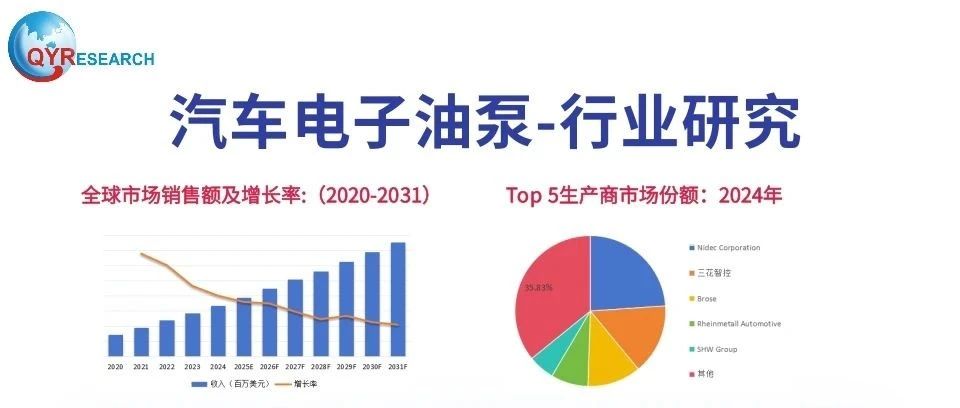
Core Viewpoint - The automotive electronic oil pump industry is poised for significant growth driven by the transition to electric vehicles and the increasing demand for efficient cooling systems, particularly oil cooling technology, which outperforms traditional water cooling methods [2][12][16]. Industry Overview and Market Size Forecast - The global automotive electronic oil pump market is projected to reach approximately $673.29 million in 2024 and is expected to grow to $1,504.01 million by 2031, with a compound annual growth rate (CAGR) of 11.59% from 2025 to 2031 [4]. - In 2024, China is anticipated to hold a 41.81% share of the global market, while the U.S. is expected to account for 13.40%. China's market is projected to grow at a CAGR of 11.30%, reaching $673.84 million by 2031 [4]. - The Asia-Pacific region, including Japan, South Korea, India, and Southeast Asia, is expected to play a crucial role in the market's growth, with Germany maintaining its leadership in Europe with a CAGR of approximately 9.41% from 2025 to 2031 [4]. Product Type and Technology - Integrated pumps dominate the market, accounting for 94.02% of the market share in 2024, and are expected to reach $1,430.68 million by 2031. Integration reduces weight and enhances cooling efficiency [5][6]. - The separation of the motor and control unit in some electronic oil pumps allows for greater flexibility in configuration based on specific needs, such as flow and pressure levels [7]. Application Market Situation - The electric drive system is projected to dominate the market, with a share of 67.40% by 2031, and a CAGR of approximately 19.30% from 2025 to 2031, driven by the rapid development of electric vehicles [8]. Favorable Factors for Industry Development - The global push for energy-efficient and smart vehicles is accelerating the development of core technologies in automotive components, with significant government support for the growth of the electric vehicle sector [15]. - The trend towards integration, modularization, and lightweight design in electric vehicles is expected to enhance production efficiency and vehicle performance [15]. Challenges and Barriers to Entry - The industry faces risks from policy changes that could impact support for electric vehicle development, potentially hindering growth [18]. - Rapid technological advancements necessitate significant investment and understanding of industry trends, posing a challenge for companies to keep pace with innovation [19]. - The automotive electronic oil pump market has high entry barriers due to stringent certification processes required by major manufacturers, which can take several years to establish [20][21]. Competitive Landscape - The market is currently dominated by major players such as Nidec Corporation, Sanhua Intelligent Controls, Brose, Rheinmetall Automotive, and SHW Group, with the top three companies holding approximately 50.51% of the global market share [14].
高盛:光学时代_技术变革受益者
Goldman Sachs· 2025-07-14 00:36
Investment Rating - The report upgrades Sumitomo Electric Industries (SEI) to Buy from Neutral and Furukawa Electric to Neutral from Sell [1] Core Insights - The industrial electronics sector is experiencing increased demand for optical products driven by generative AI and data centers, leading to significant capacity expansion investments [2] - The report highlights the shift towards medium-distance data center interconnections (DCI) due to land and power constraints, creating additional demand for optical fiber products [17] - SEI is expected to see a substantial increase in profit contribution from its infocommunications business, which is projected to grow from 6% of total profits in FY3/25 to approximately 20% by FY3/28 [41][43] Summary by Sections Industry Trends - Demand for optical products is significantly exceeding supply, prompting companies to invest in capacity expansion [2] - The emergence of projects like Stargate and increasing domestic data center demand from a national security perspective are expected to sustain high levels of investment in data center construction [2] Company Performance - SEI's operating profit estimates for FY3/26 to FY3/28 have been raised by 11%/11%/12% due to increased demand for optical products [51] - Furukawa Electric is also expected to benefit from marginal profit growth due to rising demand [1] Financial Estimates - The report provides updated sales and operating profit estimates for key companies in the sector, indicating a general upward trend in financial performance [11] - For SEI, the new target price is set at ¥4,300, reflecting a significant increase from the previous target of ¥2,800 [54][55] Technological Developments - The report discusses advancements in optical device technology, particularly the shift towards higher communication speeds and the potential for co-packaged optics (CPO) to become a key area of growth [22][23] - SEI has been selected as a technology partner by NVIDIA, indicating its strong position in the optical devices market [50]
高盛:全球半导体-硅片、碳化硅衬底、氮化镓的供需模型更新,中国产能及对全球企业的影响
Goldman Sachs· 2025-06-24 02:28
Investment Rating - The report maintains a "Buy" rating for several companies including NAURA, SICC, SUMCO, Shin-Etsu Chemical, Mitsubishi Electric, and Infineon [2]. Core Insights - The report highlights significant growth in local production and demand for silicon wafers and SiC substrates in China, with local coverage expected to increase from 41% to 54% for 12-inch silicon wafers and from 80% to 87% for 6-inch SiC substrates by 2027E [1][6]. - Pricing trends indicate a decline in average selling prices (ASP) for 8-inch silicon wafers at a CAGR of -10% from 2024 to 2026E, while 12-inch wafers are expected to decline at -6% CAGR during the same period. SiC substrate ASP is projected to decrease from US$443 in 2024 to US$384 in 2026E [1][6]. - Capacity expansion is notable, with 12-inch silicon wafer capacity expected to grow at a CAGR of 21% from 2024 to 2027E, significantly outpacing the 3% CAGR for 8-inch silicon wafers. SiC substrate capacity is also set to expand at 26% and 96% CAGR for 6-inch and 8-inch substrates, respectively [1][6]. - The report anticipates a consolidation in the industry, with the top three Chinese silicon wafer suppliers projected to cover 36% of domestic demand by 2027E, up from 26% in 2024 [1]. Summary by Sections China TAM - The total addressable market (TAM) for silicon wafers in China is projected to grow from US$1.999 billion in 2021 to US$4.511 billion by 2030E, with a notable increase in shipments from 36,962k units in 2021 to 103,570k units by 2030E [37]. - The SiC substrate market is expected to grow from US$197 million in 2021 to US$2.770 billion by 2030E, driven by rising EV penetration and SiC adoption rates [39]. - The GaN devices market is projected to expand from US$66 million in 2021 to US$1.611 billion by 2030E, supported by applications in EVs, data centers, and consumer electronics [42]. Supply and Demand Dynamics - Local suppliers' capacity expansion in silicon wafers is primarily driven by logic and memory clients, while SiC substrate capacity is expanding due to increased adoption in EVs and fast charging technologies [43]. - The report notes that local suppliers are expected to cover 75% of SiC substrate demand in China by 2025E, increasing to 84% by 2027E [6][39]. - The demand for SiC and GaN is anticipated to replace IGBT in high power and high frequency applications, with SiC penetration rates projected to reach 75% in EVs by 2030E [52]. Pricing Trends - The ASP for silicon wafers is expected to decline, with 8-inch wafers decreasing at a CAGR of -10% and 12-inch wafers at -6% from 2024 to 2026E [1][6]. - SiC substrate pricing is also expected to narrow, making SiC MOSFETs more competitive against silicon IGBTs [1]. Industry Consolidation - The report indicates a trend towards consolidation in the silicon wafer industry, with the top three suppliers expected to significantly increase their market share in China by 2027E [1].
