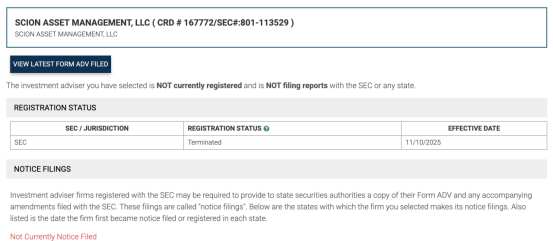
Scion Asset Management

Search documents
Michael Burry’s 12 Failed Bets on Market Crashes Over the Past 8 Years
New Trader U· 2025-11-15 10:12
Core Insights - Michael Burry, known for his successful prediction of the 2008 financial crisis, has made numerous forecasts about market collapses from 2017 to 2023, which have largely not materialized as he anticipated [1][2][3][31] - Despite his sharp insights into systemic risks, Burry's predictions often failed to align with market momentum, leading to significant missed opportunities and losses [3][31][32] Group 1: Predictions and Market Responses - In January 2017, Burry warned of a global financial meltdown and potential World War III due to overleveraged debt markets, but the S&P 500 rose 19% over the following year [5][6] - By September 2019, he compared the rise of index funds to the CDOs that contributed to the 2008 crisis, yet the market continued to rally, with the S&P 500 increasing by 28% that year [7][8] - In December 2020, Burry took a $530 million short position against Tesla, calling its valuation "ridiculous," but the stock doubled in value shortly after [9][11] - In January 2021, he reiterated his bearish stance on Tesla, which continued to rise, leading to significant losses for his position [12][13] - During the GameStop frenzy in January 2021, Burry cautioned against the sustainability of such rallies, only to see the stock surge another 1,000% shortly after [14][15] - In February 2021, he described the stock market as "dancing on a knife's edge," predicting a recession, but the S&P 500 continued to climb [16][17] - Burry's warnings about Bitcoin in February 2021, predicting inflation would destroy its value, were contradicted by Bitcoin's subsequent rise to new highs [18][19] - He labeled Robinhood a "dangerous casino" in February 2021, but the platform's user growth and stock price continued to soar [21][22] - In June 2021, Burry predicted the "mother of all crashes," yet the S&P 500 rose 15% year-to-date, demonstrating market resilience [25][26] - In September 2022, amid a bear market, Burry forecasted more stock failures, but the market rebounded sharply by the end of the year [27][28] - His largest bet came in August 2023, with a $1.6 billion wager against the S&P 500 and Nasdaq 100, which ultimately expired worthless as the market advanced [28][29] Group 2: Analysis of Burry's Approach - Burry's predictions often highlighted real vulnerabilities in the market, such as inflation and speculative bubbles, but his timing consistently faltered [31][32] - The missed opportunities resulting from following Burry's signals amounted to trillions in market cap gains for retail investors [33] - Burry's legacy serves as a reminder that even the most astute analysts can misjudge market dynamics, emphasizing the importance of timing in investment strategies [34]



Data 'fog' has some investors feeling for the exits as AI stock valuation fears flare
The Economic Times· 2025-11-15 04:15
Market Overview - The Nasdaq experienced its heaviest selloff in a month, down approximately 4% from its peak in October, driven by unease in the market [1] - Early trading on Friday saw blue-chip indices from Tokyo to Paris and London in the red, but the S&P 500 ended slightly lower while the Nasdaq Composite rose by 0.13% [1] - Gold and bitcoin also faced declines, with bitcoin dropping below $96,000, a level not seen since May [1] Economic Data and Federal Reserve - The recent U.S. government shutdown has created an information vacuum, leading to uncertainty regarding upcoming economic data releases, including October's inflation and employment reports [1][11] - The Federal Reserve's confidence in making rate cuts may be affected by the lack of data points, with expectations for a 25-basis point cut in December dropping to about 46% [4][11] - Analysts suggest that the Fed may hold off on further rate cuts due to the current economic uncertainty, with some policymakers expressing reluctance [10][11] Valuation Concerns - The forward price-to-earnings ratio for the S&P 500 is currently at 22.8 times, significantly above its 10-year average of 18.8, raising concerns about extreme valuations [5][11] - Major tech stocks, including Palantir and Oracle, have seen losses of approximately 12% and 14% respectively this month, while Nvidia is down 6% [6][11] - Michael Burry's closure of his hedge fund has heightened concerns over inflated AI valuations, particularly regarding tech companies' financial practices [7][11] Hedge Fund Positioning - Hedge funds have shown signs of bearishness towards tech stocks, with Tiger Global Management reducing its stake in Meta Platforms [8][11] - The mixed economic signals during the shutdown have led to increased scrutiny of corporate debt markets, particularly for companies like Oracle that are heavily investing in AI infrastructure [7][11] Investor Sentiment - Investors are increasingly looking to lock in gains after significant market rallies, leading to a more cautious mood [6][11] - The current market environment is characterized by skepticism regarding valuations and expectations, as noted by investment strategists [1][11]



辟谣!9亿美元做空AI?大空头Burry:我没有,别乱算,错了100倍
华尔街见闻· 2025-11-14 10:27
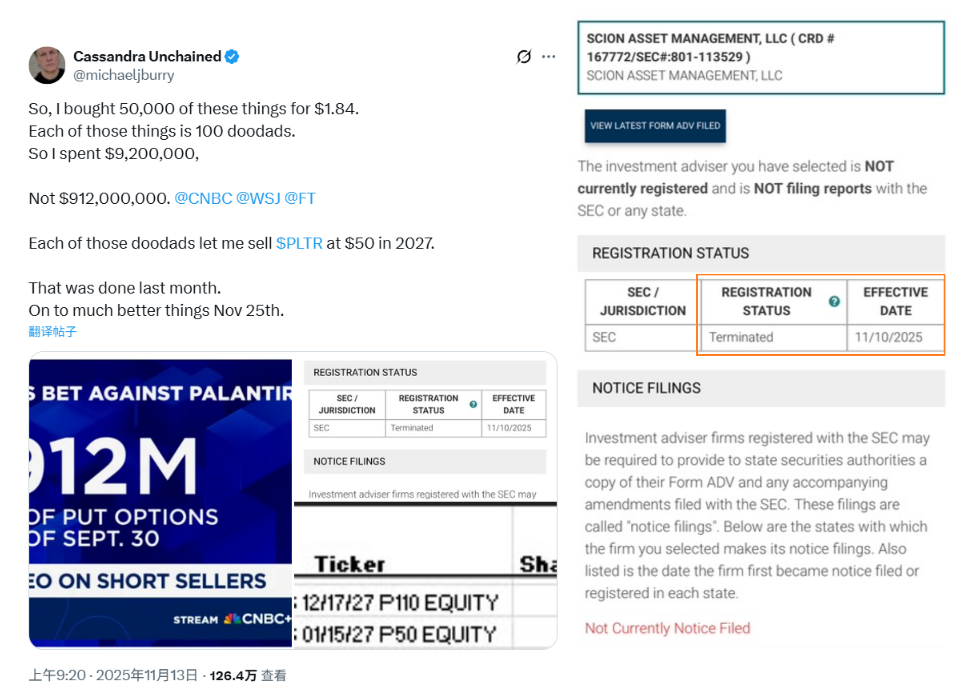
Core Viewpoint - Michael Burry, known for predicting the 2008 subprime mortgage crisis, has sparked market discussions again after being reported to have made a significant bet against AI stocks. However, he clarified that the reported amount of $912 million was a media error, and his actual investment was only $9.2 million [2][5][12]. Group 1: Investment Actions - Burry purchased 50,000 put options on Palantir, each costing $1.84, totaling an investment of approximately $9.2 million, not $912 million as reported [5][10]. - The notional value of his options, which corresponds to 5 million shares of Palantir at a stock price of $182, was reported as $912 million, but this figure represents potential exposure rather than actual investment [9][10]. Group 2: Market Concerns - Burry has expressed concerns about an AI bubble, comparing the current market situation to the internet bubble of 2000, citing overinflated valuations in companies like Nvidia, Palantir, Meta, and Oracle [11][12]. - He criticized these companies for excessive capital expenditures and for artificially inflating profits by extending asset depreciation periods [11]. Group 3: Fund Management Changes - Burry has quietly terminated the SEC registration of his hedge fund, Scion Asset Management, indicating a potential shift in his investment strategy [13][16]. - In a letter to investors, he announced plans to liquidate the fund and return capital to investors, expressing disappointment with market valuations [14][16]. - Speculation arises that Burry may move towards a new independent platform for sharing investment insights, potentially bypassing traditional regulatory frameworks [17][18].

美国“大空头”,撤了
Zhong Guo Ji Jin Bao· 2025-11-13 22:45
Core Insights - Barry's reported "short position of $1 billion" is clarified as a media miscalculation, with his actual investment being only $9.2 million [2][4] - Scion Asset Management, managed by Barry, has terminated its registration as of November 10 [2] Group 1: Short Position Details - Barry's Scion fund disclosed holdings in put options for AI companies Palantir and NVIDIA, indicating a bearish outlook on the market [4][5] - The media misinterpreted the notional value of the options as the actual investment amount, leading to confusion regarding the scale of Barry's short position [5] Group 2: Market Reaction - Following the reports of Barry's supposed short position, U.S. tech stocks, including NVIDIA, experienced a significant decline [5][11] - NVIDIA's stock opened lower, dropping over 3% during trading [11] Group 3: Future Announcements - Barry hinted at a significant announcement on November 25, suggesting potential developments in his investment strategy [9]
Who Is Phil Clifton? Michael Burry Names Successor as Famed Investor Deregisters Hedge Fund.
Yahoo Finance· 2025-11-13 21:52
Core Insights - Michael Burry has closed his hedge fund, Scion Asset Management, and appointed Phil Clifton as his successor [1] - Burry has taken bearish positions against Nvidia and Palantir, indicating concerns over the tech sector's valuation growth [2] - Following Burry's disclosures, tech stocks experienced significant declines, with Nvidia dropping 7.1% and Palantir falling 11.2% [4] Company Developments - Burry's decision to terminate his registration with the SEC and close his hedge fund has generated considerable media attention [1] - The bearish positions taken by Burry have coincided with a downturn in the Nasdaq Index, marking its worst week since April [4] - A letter to investors indicated Burry's plans for a new venture launching on November 25, though details remain unclear [5] Industry Reactions - The exchange between Burry and Palantir's CEO, Alex Karp, highlights the contentious atmosphere surrounding Burry's market predictions [3] - Burry's actions and statements reflect a broader skepticism towards the sustainability of current tech valuations [2]

What 'Better Things' Does Investor Michael Burry of 'The Big Short' Have Planned Next?
Investopedia· 2025-11-13 20:10
Michael Burry is known for his big, and successful, bet against the U.S. housing market. Tony Avelar / Bloomberg via Getty Images Close Key Takeaways One of the most-famous bearish investors of his time could be headed to "better things." Michael Burry—known for his bet against the U.S. housing market in the first decade of this millennium, but also for his portrayal by Christian Bale in the movie "The Big Short" and his branding on social media as "Cassandra," a seer of legend who bears the curse of not be ...

Michael Burry Shutters Hedge Fund as Trump’s 50-Year Mortgage Threatens an $11 Trillion Housing Collapse – Is Big Short 2.0 Brewing in Housing, Not Tech?
Yahoo Finance· 2025-11-13 16:45
Group 1 - Michael Burry has closed his hedge fund, Scion Asset Management, effective November 10, indicating a disconnect between his valuation of securities and current market conditions [1][2] - Burry's recent focus has been on betting against major tech companies like Nvidia and Palantir, while also highlighting emerging risks in the mortgage market [1][2] Group 2 - The Trump administration is considering a 50-year mortgage product, which could lower monthly payments by approximately 10% but significantly increases total interest paid over the life of the loan [3][4] - For a $425,000 loan at 6.5% over 30 years, total interest would be $542,064, while over 50 years, it would rise to $1,012,478, adding an extra $470,414 in interest [4][5] - This proposal introduces complexities for both borrowers and investors in mortgage-backed securities (MBS), as longer terms lead to higher total interest and potential prepayment risks [6][8] Group 3 - The mortgage-backed securities market, valued at $11 trillion, faces compounding risks due to the introduction of 50-year mortgages, which could affect long-term credit exposure and equity cushions for borrowers [8]
大空头,深夜突发!
券商中国· 2025-11-13 14:40
Core Viewpoint - Michael Burry, known for predicting the 2008 financial crisis, has withdrawn his Scion Asset Management from SEC registration, indicating a shift away from traditional investment management and a potential move towards independent platforms for sharing investment insights [1][6]. Group 1: Investment Actions - Burry's actual investment in put options for Palantir was only $9.2 million, contrary to media reports claiming a nominal value of $912 million [3][4]. - The nominal value reported for Burry's put options reflects theoretical exposure based on stock prices, not actual cash outlay [4][5]. - Burry's put options for Palantir correspond to 5 million shares, with a strike price of $50, while the current stock price is $184, indicating a significant market premium [5][6]. Group 2: Market Commentary - Burry has expressed concerns about the current market being in a bubble, likening it to the 2000 internet bubble, and criticized tech companies for manipulating depreciation schedules to obscure investment impacts on profits [7][8]. - His decision to close the fund is interpreted as a response to the disconnect between his market outlook and prevailing market conditions, suggesting a desire to avoid the challenges of a potential market downturn [8].

悄悄关闭旗下基金,大空头Burry辟谣9亿美元做空英伟达和Palantir:一共才花了920万
美股IPO· 2025-11-13 14:29
Core Viewpoint - Michael Burry refuted media claims of a $912 million short position on Nvidia and Palantir, clarifying that his actual investment was only $9.2 million, highlighting a significant misunderstanding in the reporting of notional values versus actual investment amounts [1][3][5]. Group 1: Investment Details - Burry's actual investment involved purchasing 50,000 put options at $1.84 each, totaling approximately $9.2 million, rather than the reported $912 million [5][7]. - The discrepancy arose from the SEC's requirement for institutions to report the notional value of options, which reflects theoretical exposure based on the underlying stock's market value, rather than the actual cash invested [7][8]. Group 2: Market Commentary - Burry expressed concerns about the inflated valuations of AI stocks, specifically naming Nvidia and Palantir, and warned that the market is experiencing an AI bubble reminiscent of the 2000 internet bubble [9][10]. - He criticized these companies for excessive capital expenditures and for artificially inflating profits by extending asset depreciation periods [9][10]. Group 3: Fund Management Changes - Burry's fund, Scion Asset Management, has been quietly deregistered as of November 10, indicating a potential shift in his investment strategy [4][12]. - In a letter to investors, Burry announced the liquidation of the fund and the return of investor capital, citing disappointment with market valuations [12][17]. - Speculation arises that Burry may be moving towards a new independent platform for sharing investment insights, potentially bypassing traditional regulatory frameworks [17][18].
认定AI泡沫 “大空头”伯里果断清算Scion基金
智通财经网· 2025-11-13 14:14
Core Insights - Michael Burry, known for predicting the 2008 financial crisis, is exiting asset management, with his firm Scion Asset Management LLC officially terminating its registration as of November 10, 2025 [1][5] - Burry plans to liquidate his funds and return capital to investors by the end of the year, citing a significant divergence between market valuations and his assessments [1][5] - His recent actions and statements indicate a belief that the market is overvalued and lacks rationality, particularly regarding large tech companies and AI valuations [5][6] Company Actions - Scion Asset Management managed $155 million in assets as of March and has been viewed as a barometer for detecting bubble risks [5] - Burry has established short positions against AI-related stocks like Nvidia and Palantir, reflecting his cautious stance on the AI-driven market rally [5][6] - The firm’s termination and Burry's decision to return capital signal a retreat from what he perceives as a fundamentally manipulated market [5][8] Market Context - Burry's exit highlights the challenges faced by short-sellers in a market characterized by optimism towards the tech sector and retail investor enthusiasm [7] - The recent performance of AI-related stocks has significantly contributed to the S&P 500's gains, with reports indicating that these stocks accounted for 75% of the index's increase since November 2022 [8] - Burry's actions may symbolize a protest against speculative trends in the market, as he adheres to a value-driven investment philosophy [8][9] Future Outlook - It remains uncertain where Burry will direct his investments post-liquidation, with speculation suggesting a shift towards family office or private investment strategies [8] - Burry's upcoming announcement on November 25 may provide insights into his future investment direction [6][8]