Toyota

Search documents
Beyond Budgeting: How Lean Finance Will Redefine The CFO’s Strategic Blueprint For 2025
Yahoo Finance· 2025-10-03 10:30
How lean financial operations will define the CFO role in 2025 In an era of economic unpredictability and tight margins, chief financial officers are under mounting pressure to do more with less. Nearly half of C-suite executives have considered budget cuts for their own departments amid macroeconomic challenges. At the same time, financial risks are rising. A recent survey found that 79% of organizations were targeted by payment fraud attempts in 2024. For CFOs, the challenge is clear: reduce costs witho ...
Could Buying QuantumScape Stock Today Set You Up for Life?
The Motley Fool· 2025-10-02 08:27
Core Viewpoint - QuantumScape is a speculative investment in the solid-state battery sector, with significant stock price appreciation despite no revenue generation yet [1][10]. Company Overview - QuantumScape develops solid-state lithium batteries that utilize solid-state electrolytes, offering advantages such as higher charging capacities, faster charging times, and improved thermal resistance compared to traditional lithium-ion batteries [2][4]. - The company aims to introduce its QSE-5 batteries to the electric vehicle (EV) market, which have an energy density of 844 watt hours per liter (Wh/L) and can charge from 10% to 80% in 12.2 minutes [4]. Production and Financial Outlook - QuantumScape has not yet commercialized its products, initially targeting 2024 for commercialization but currently only shipping samples to automotive partners [5]. - Analysts project a slight reduction in net loss from $478 million in 2024 to $457 million in 2025, with expectations of generating $5 million in revenue in 2026 and $62 million in 2027 [5][8]. Strategic Partnerships - The company has shifted from manufacturing its own batteries to a licensing model, with Volkswagen's battery division PowerCo as its first major customer [7]. - QuantumScape has expanded its partnership with Volkswagen, securing milestone payments to extend its cash runway through 2029 [8]. Market Potential and Competition - The solid-state battery market is expected to grow at a compound annual growth rate of 56.6% from 2025 to 2030, positioning QuantumScape as an early mover in this expanding market [9]. - However, the company faces competition from established automakers like Toyota and other startups, which could impact its market position if they commercialize their solid-state batteries first [10]. Valuation Concerns - With a market cap of $7.17 billion, QuantumScape is valued at 116 times the revenue expected in 2027, raising concerns about its current valuation relative to growth potential [10].

U.S. EV tax credit ending will be a long-term win for Tesla, says Deepwater's Gene Munster
Youtube· 2025-10-01 19:01
Core Insights - The removal of the tax credit has led traditional automakers to reduce their investment in electric vehicles (EVs), which may hinder their ability to compete with Tesla in the long run [4][5] - Tesla's Full Self-Driving (FSD) technology is gaining traction among consumers, providing a competitive edge over traditional automakers who are struggling with profitability in EV production [3][7] - The automotive industry is at a critical juncture where the ability to scale EV production and achieve technological advancements in autonomy will determine future success [8][10] Industry Impact - Traditional automakers like GM, Ford, and Volkswagen have announced cuts in EV factory output and model offerings, estimating a reduction of 20% to 30% in recent months [4] - The shift in consumer demand towards cheaper EVs, driven by the tax credit's removal, has resulted in a pull-forward in demand, with approximately 40,000 of the expected 75,000 to 80,000 deliveries attributed to this factor [2] - The profitability of EV production is a significant concern, with traditional automakers reportedly losing tens of thousands of dollars per vehicle, while Tesla is managing to produce vehicles profitably [7] Technological Advancements - Tesla's FSD technology is perceived as a major advantage, with users experiencing a near hands-free driving experience, although it is not yet fully autonomous [6] - The regulatory landscape requires FSD to achieve a high level of accuracy (99.999%) before widespread approval, indicating that significant technological milestones are still needed [8] - The competition in the autonomous driving space is narrowing down to Tesla and Waymo, with Tesla facing challenges in its robo-taxi initiatives due to more frequent interventions than anticipated [9]


Joby Aviation Just Scored Another Air Taxi Win. Should You Buy JOBY Stock Here?
Yahoo Finance· 2025-10-01 17:25
Core Insights - Joby Aviation is pioneering all-electric vertical takeoff and landing (eVTOL) aircraft for urban air mobility and aerial ridesharing, with a focus on quiet operation, zero emissions, and a range of up to 150 miles at speeds of 200 mph [1] - The company is advancing toward full FAA certification and has strategic partnerships with Delta and Toyota to launch commercial air taxi services in key global markets [1] Financial Performance - Joby Aviation reported a Q2 2025 EPS loss of $0.41, which was wider than the expected loss of $0.19, with revenue of only $0.02 million, missing analyst estimates of $0.05 million and marking a 94.6% year-over-year decline [5][6] - The company experienced a net loss of $325 million, primarily due to non-cash revaluations, while adjusted EBITDA showed a loss of $132 million [6] - Operating expenses increased by 16% year-over-year due to higher research and development costs, but the balance sheet remains strong with $991 million in cash and short-term investments, supported by a $250 million investment from Toyota [6] Stock Performance - Joby Aviation's shares have increased by 9.6% in the last five days and 10.7% over the past month, with a remarkable 234% gain in the last six months and a 211% rise over the past 52 weeks, significantly outperforming the Russell 2000 [3][4] - The stock's rally is attributed to strong momentum in its electric air taxi program and regulatory progress, making it a standout performer among small-cap stocks in 2025 [4]

Toyota Motor North America Reports September, Third Quarter 2025 U.S. Sales Results
Prnewswire· 2025-10-01 17:00
Core Insights - Toyota Motor North America (TMNA) reported a significant increase in vehicle sales for September 2025, with total sales reaching 185,748 units, marking a 14.2% increase compared to September 2024 [1] - Electrified vehicle sales for September totaled 85,092 units, up 8.1% year-over-year, representing 45.8% of total sales volume [1][3] - For the third quarter of 2025, TMNA's total vehicle sales were 629,137 units, a 15.9% increase from the same period in 2024, with electrified vehicle sales reaching 282,794 units, up 10.5% [1][2] Sales Performance - TMNA's sales for September 2025 showed a daily selling rate (DSR) increase of 9.5% compared to the previous year [1] - The Toyota division's September sales were 158,959 vehicles, up 13.4% on a volume basis, while Lexus division sales reached 26,789 vehicles, up 19.4% [1][3] - For the third quarter, the Toyota division reported sales of 537,528 vehicles, up 16.4%, and Lexus division sales of 91,609 vehicles, up 13.1% [1][3] Electrified Vehicle Strategy - TMNA currently offers 30 electrified vehicle options across Toyota and Lexus brands, contributing to nearly 50% of total sales [2][3] - The sales of electrified vehicles for the third quarter represented 44.9% of total sales volume, indicating a steady growth trend [1][3] - The company maintains one of the lowest incentive levels among full-line manufacturers, which may contribute to its sales performance [3] Market Position and Future Outlook - Strong customer demand is noted across the entire lineup, with vehicles selling as quickly as they are produced [2] - The upcoming next-generation RAV4 is anticipated to further enhance sales, as the current model remains popular among customers [2] - The company is committed to advancing sustainable mobility through its electrified vehicle offerings and initiatives [4]

Toyota's third-quarter US sales up nearly 16%
Reuters· 2025-10-01 15:31
Core Insights - Toyota Motor's North American unit experienced a nearly 16% increase in auto sales, driven by strong demand for pickup trucks and cars [1] Sales Performance - The reported sales growth of nearly 16% indicates a robust performance in the North American market [1] - The increase in sales is attributed to the popularity of Toyota's pickup trucks and cars, suggesting a favorable market response to these vehicle categories [1]
Ford Q3 EV sales up 30.2%
Youtube· 2025-10-01 14:05
Summary of Ford's Third Quarter Sales Performance Core Insights - Ford experienced a strong third quarter with total sales increasing by 8.2%, aligning with analyst expectations [1] - The breakdown of sales shows internal combustion engine (ICE) vehicles up by 6.3%, hybrids up by 14.7%, and electric vehicles (EVs) up by 30.2% [1][2] Sales Breakdown - Internal combustion engine vehicles saw a growth of 6.3% [1] - Hybrid vehicle sales surged by 14.7%, indicating strong consumer demand [1][2] - Electric vehicle sales increased significantly by 30.2%, although a slowdown in EV sales is anticipated across the industry [1][2] Market Trends - Hybrids currently represent about 14% of the automotive market, with expectations to exceed 20% in the coming years [3][4] - Automakers, including Toyota, are pivoting towards hybrid models, as seen with the RAV 4 being offered only as a hybrid or plug-in hybrid [4][5] - The consumer preference for hybrids is expected to drive more manufacturers to adapt their offerings accordingly [5]

Robotaxi Market Set for 91.8% CAGR Explosion as Major Companies Race to Capture $45.7B Industry by 2030
Medium· 2025-10-01 06:51
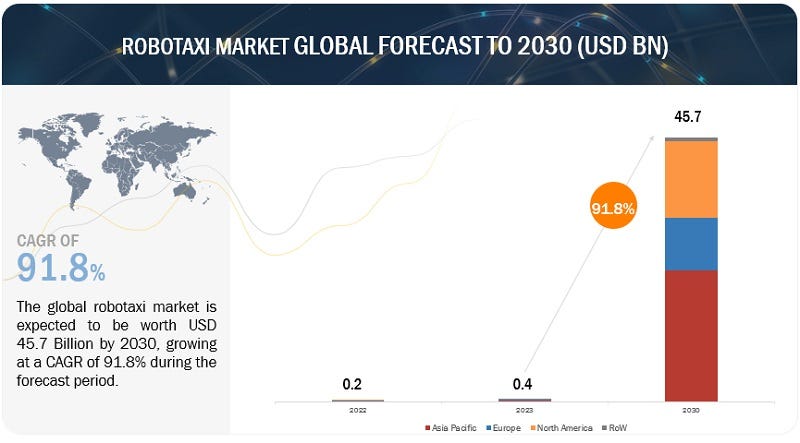
Core Insights - The global robotaxi market is projected to grow from $400 million in 2023 to $45.7 billion by 2030, representing a compound annual growth rate (CAGR) of 91.8% [1][2][3] Market Dynamics - The growth is driven by economic factors, technological advancements, and changing urban mobility trends [4] - Major ride-hailing companies face high driver compensation costs, consuming 60-80% of gross revenues, which robotaxis aim to eliminate [5] - The shift to robotaxis could reduce per-mile costs by 40-60% and enhance profit margins for operators deploying autonomous fleets [6] Competitive Landscape - Five major companies dominate the robotaxi market, attracting significant investment from automotive OEMs like Ford, Volkswagen, Toyota, and General Motors [7] Market Segmentation - **Vehicle Type**: Autonomous cars will lead in market share and growth, while vans and shuttles are emerging for public transit and goods delivery [9] - **Autonomy Level**: Level 4 autonomous vehicles will dominate near-term deployments due to lower regulatory barriers [10] - **Propulsion**: Electric vehicles are expected to account for over 95% of robotaxi deployments, aligning with emission reduction goals and lower operating costs [11][13] Regional Insights - The Asia Pacific region is expected to capture the largest market share, bolstered by supportive regulatory frameworks in China [14][15] - North America benefits from advanced testing infrastructure and permissive regulations, particularly in states like California, Arizona, and Nevada [16] Challenges - Despite optimistic forecasts, challenges such as technical complexity and capital requirements for operating robotaxi fleets remain significant [17]

Toyota adds another $1.5B to its bet on startups at every stage
TechCrunch· 2025-09-30 22:15
Core Insights - Toyota is investing $1.5 billion in the startup ecosystem, focusing on the entire lifecycle of startups from inception to maturity [1] - The company has established a strategic investment subsidiary, Toyota Invention Partners Co., with approximately $670 million in capital, alongside a second $800 million fund from its growth-stage venture arm, Woven Capital [3][11] Investment Strategy - Toyota Invention Partners will adopt a long-term strategy targeting Japan-based startups, avoiding traditional fixed investment periods [4] - The investment structure includes three tiers: Toyota Invention Partners for early-stage, Toyota Ventures for early-stage, and Woven Capital for growth-stage investments [5] - The total commitment across these investment arms exceeds $3 billion, indicating a strong focus on meeting the evolving needs of market founders [8] Recent Developments - A recent investment was made in Machina Labs, an advanced manufacturing startup that integrates AI and robotics, highlighting Toyota's interest in innovative technologies [8][9] - Woven Capital has invested in 18 companies from its first fund, which launched in 2021 with an $800 million capital, and will continue to support follow-on investments [10]
3 AI Stocks Perfect for Gen Z Investors to Add to Their Portfolios
The Motley Fool· 2025-09-30 07:57
Core Insights - The wealthiest 1% of Americans own nearly half of the stocks in the U.S, with baby boomers holding 53.5% of all stocks, while Gen Xers and millennials hold 21.9% and 8.5%, respectively [1] - Gen Z investors are often associated with speculative investments rather than blue-chip stocks, which may lead to short-term gains but are challenging to sustain long-term [2] Company Summaries Navitas Semiconductor - Navitas produces gallium nitride (GaN) and silicon carbide (SiC) chips, which are used in various applications including laptop chargers and EV chargers [4] - The company expects revenue growth from AI workloads processed using its chips, particularly after a deal with Nvidia, although significant revenue from this deal is not expected until 2027 [5] - Analysts predict a 42% revenue drop in 2025, but a CAGR of 40% from 2025 to 2027 as the company narrows net losses and benefits from increased adoption of its chips [6] SoundHound AI - SoundHound AI develops AI-powered audio and voice recognition tools, with significant growth coming from its Houndify platform [7] - The company serves diverse industries and has expanded through acquisitions, enhancing its ecosystem [8] - Analysts forecast a CAGR of 47% for revenue from 2024 to 2027, with adjusted EBITDA turning positive by the final year [9] Datadog - Datadog's platform helps IT professionals unify real-time data from various computing platforms, simplifying problem detection [10] - The company serves over 30,000 customers globally, positioning itself well in the expanding data observability market, which is expected to grow at a CAGR of 10.7% from 2024 to 2030 [11] - Analysts expect Datadog's revenue and adjusted EBITDA to grow at CAGRs of 22% and 19%, respectively, from 2024 to 2027 [12]