
Samsung Electronics

Search documents
亚洲科技- 历史经验对存储芯片价格影响智能手机行业的启示-Asia Tech_ What history tells about memory pricing impact on smartphone sector_
2025-11-24 01:46
Summary of Key Points from the Conference Call Industry Overview - The conference call focuses on the **smartphone sector**, particularly the impact of rising **memory prices** on **smartphone OEMs** (Original Equipment Manufacturers) such as **Xiaomi** and **Transsion**, as well as **camera component suppliers** [1][15]. Core Insights and Arguments - **Memory Price Trends**: - A strong demand from AI has led to a significant memory price increase, with mobile DRAM contract prices expected to rise by **30-40% QoQ** in **4QCY25** and potentially continue into **1HCY26** [2]. - NAND pricing is also expected to increase, albeit at a milder rate [2]. - **Impact on Smartphone OEMs**: - Rising memory prices affect low-to-mid-end smartphones more than flagship models. For example, memory accounts for **4%** of an iPhone's ASP, **7%** for a Xiaomi flagship, and over **10%** for a Redmi model [3][16]. - A **40% increase** in memory prices could reduce Xiaomi's smartphone gross margins by **2-3 percentage points**. Xiaomi may pass some costs to consumers, which could affect sales volume [3]. - **Xiaomi's Premiumization Strategy**: - Xiaomi's shift towards premium models is helping to offset some of the pressures from rising memory costs. The **Xiaomi 17 series** saw a **30% increase** in shipments compared to the previous generation, with **80%** of the mix being premium models [3]. - **Camera Component Suppliers**: - The correlation between memory pricing and camera lens margins is historically weak, with a delayed impact on camera modules. The camera lens market is more consolidated, leading to less margin impact from rising memory prices [3][42]. - The current memory upcycle is expected to negatively impact camera budgets for low-to-mid-end Android models, but high-end Android and Apple supply chains are less affected [44]. Additional Important Insights - **Sunny Optical's Outlook**: - Concerns regarding Sunny Optical's performance due to rising memory prices are considered overstated. The bear case suggests a **6%** revenue growth and **1%** EPS growth for 2026, which is below consensus estimates [4][66]. - The price target for Sunny Optical in the bear case is set at **HKD 82**, indicating a potential upside of **~25%** [4]. - **Market Dynamics**: - The smartphone market has been saturated since the late 2010s, with annual shipments fluctuating due to various factors, including the Huawei ban and COVID-19 [17][31]. - The transition from **memory downcycle** to **upcycle** is expected to stabilize the market, with both Xiaomi and Transsion gaining market share and improving ASPs [17]. - **Investment Ratings**: - Sunny Optical is rated **Outperform** with a price target of **HKD 110** [7]. - Xiaomi is also rated **Outperform** with a price target of **HKD 57** [9]. Conclusion - The rising memory prices present challenges for smartphone OEMs, particularly in the low-to-mid-end segments, while high-end models and Apple suppliers remain relatively insulated. The premiumization strategy of companies like Xiaomi may help mitigate some of these pressures. The outlook for camera component suppliers is mixed, with expectations of budget constraints for lower-end models but stability in high-end segments.
Is This the Most Underrated AI Infrastructure Play of the Decade?
Yahoo Finance· 2025-11-23 17:00
Core Viewpoint - Micron Technology is a leading memory chip manufacturer that is currently underappreciated in the market, despite its critical role in AI infrastructure and partnerships with major companies like Nvidia [1][2]. Group 1: Company Overview - Micron Technology is one of the three dominant memory chip manufacturers globally, producing essential components like DRAM and NAND Flash memory for computing devices [1]. - It is the only U.S.-based memory chip manufacturer in a market predominantly occupied by South Korean companies, which may provide a strategic advantage in the current geopolitical climate [2]. Group 2: Technological Advancements - The company's momentum in the AI sector is driven by its high bandwidth memory (HBM) technology, which stacks memory chips vertically, enhancing performance [3]. - Micron's HBM3E chips are integral to Nvidia's latest Blackwell architecture, delivering 1.8 terabytes per second, showcasing the company's technological validation by a key player in the AI space [4]. Group 3: Product Development - Micron has begun sending samples of its 192GB SOCAMM2 memory modules to customers, designed specifically for AI data centers, which utilize one-third the power of standard memory while providing 2.5 times higher bandwidth [5]. Group 4: Stock Performance - Micron's stock is currently trading at approximately $225 per share, with a remarkable gain of over 130% in the past year and nearly 270% over the last five years, significantly outperforming the broader market [6]. Group 5: Market Position and Analyst Sentiment - Micron is positioned to benefit from supply constraints and HBM shortages, which provide it with pricing power and margin potential [7]. - Analysts have rated Micron as a strong buy, anticipating growth driven by HBM4 and SOCAMM2 technologies [7].

Tech Corner: TSMC & the Global Semiconductor Trade
Youtube· 2025-11-22 18:00
Core Viewpoint - Taiwan Semiconductor Manufacturing Company (TSMC) is a pivotal player in the global semiconductor industry, demonstrating strong financial performance and technological leadership, particularly in AI and high-performance computing sectors [1][5][13]. Company Overview - TSMC specializes in manufacturing, packaging, testing, and selling integrated circuits, with a diverse range of wafer fabrication processes [2]. - The company holds a dominant position in the global foundry market, particularly in advanced nodes like 3nm and 5nm technologies, serving major clients such as Apple, Nvidia, and Qualcomm [2][4]. Financial Performance - In Q3, TSMC reported a 41% year-over-year revenue growth, with net income increasing over 39% to $33.10 billion, surpassing estimates [5][7]. - The company's forward estimated revenue growth is exceptional at over 29%, significantly higher than its 5-year historical average [7]. Profitability Metrics - TSMC's net income margin stands at over 43%, well above the sector median of approximately 11%, indicating strong profitability [8]. Competitive Landscape - TSMC faces competition from major players like Intel, Global Foundries, and Samsung, but maintains a unique value proposition through its technological leadership and scale [3][4]. Strategic Initiatives - The company is expanding globally with new fabs in the US, Japan, and Germany, reducing reliance on Taiwan and enhancing its role in the global supply chain [4][13]. - TSMC announced a $100 billion investment in US chip manufacturing, building on a previous $65 billion commitment [5]. Market Challenges - TSMC is experiencing valuation challenges with a forward PE ratio at multi-year highs, which may limit upside price performance [9]. - The company faces production constraints and relies heavily on cyclical AI demand, which poses risks to future profitability [10]. Technical Analysis - Current momentum for TSMC is slowing, with bearish indicators in the near term, although it remains above its 200-day moving average, suggesting intermediate-term strength [11][12]. Conclusion - Despite macro risks such as export controls and geopolitical tensions, TSMC's technological leadership and global footprint position it favorably for growth in the semiconductor and AI sectors [13].


Futures Slide As Bitcoin Flash Crashes To April Low Ahead Of $3.1 Trillion Opex
ZeroHedge· 2025-11-21 12:28
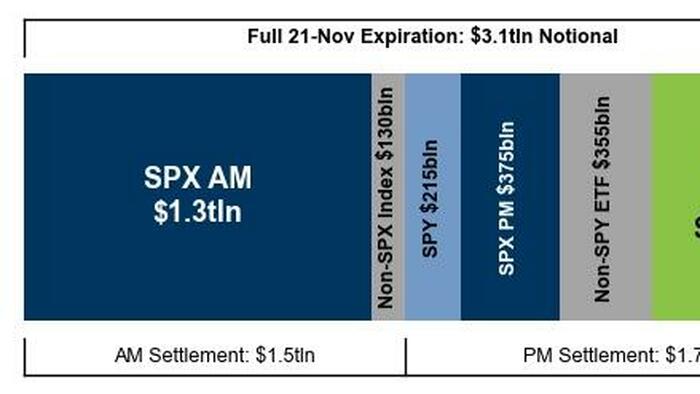
Economic Developments - Japan's government approved a JPY 21.3 trillion ($135.5 billion) economic stimulus package, marking the largest since the COVID pandemic, with JPY 17.7 trillion in new spending [28][53] - Japan's inflation rate increased to 3% in October, aligning with market expectations, and has remained above the Bank of Japan's 2% target for 43 consecutive months [52][54] - The U.K. government is facing a borrowing overshoot in October, leading to plans for tax increases and spending cuts in the upcoming budget [5] Currency and Trade - The Indian rupee fell to a record low against the dollar amid uncertainty regarding a potential U.S. trade deal [3] - The U.S. is considering lifting tariffs on EU goods, including beef and other foods, to help maintain affordable grocery prices [4] - Trump's administration lifted a 40% tariff on certain Brazilian agricultural products, including coffee and beef, to help reduce domestic food prices [6] Corporate News - Netflix, Comcast, and Paramount Skydance submitted bids for Warner Bros. Discovery by the November 20 deadline [5] - OpenAI is partnering with Hon Hai to design and manufacture hardware for data centers, with Hon Hai planning to invest up to $5 billion in U.S. manufacturing [5] - AnaptysBio shares fell 15% after GSK initiated litigation against the company [4] Market Performance - The S&P 500 experienced its sharpest intraday reversal since April, with a decline of 1.56% after initially rising [42][50] - Bitcoin is on track for its worst monthly performance since the June 2022 crypto crash, down 35% from its October highs [10][43] - Gap Inc. shares rose 4.5% after reporting stronger-than-expected sales, indicating effective marketing strategies [11] Central Bank Insights - The Fed's Anna Paulson expressed caution ahead of the December meeting, indicating that each rate cut raises the bar for the next [7][13] - JPMorgan and Morgan Stanley's economists no longer expect a rate cut in December, citing a rebound in payrolls [13][27] - The Congressional Budget Office revised its estimate of Trump's tariffs' impact on deficits to approximately $3 trillion over the next 10 years, down from $4 trillion [9]

Asian stocks track Wall Street's drop, erasing previous day's gains
ABC News· 2025-11-21 07:25
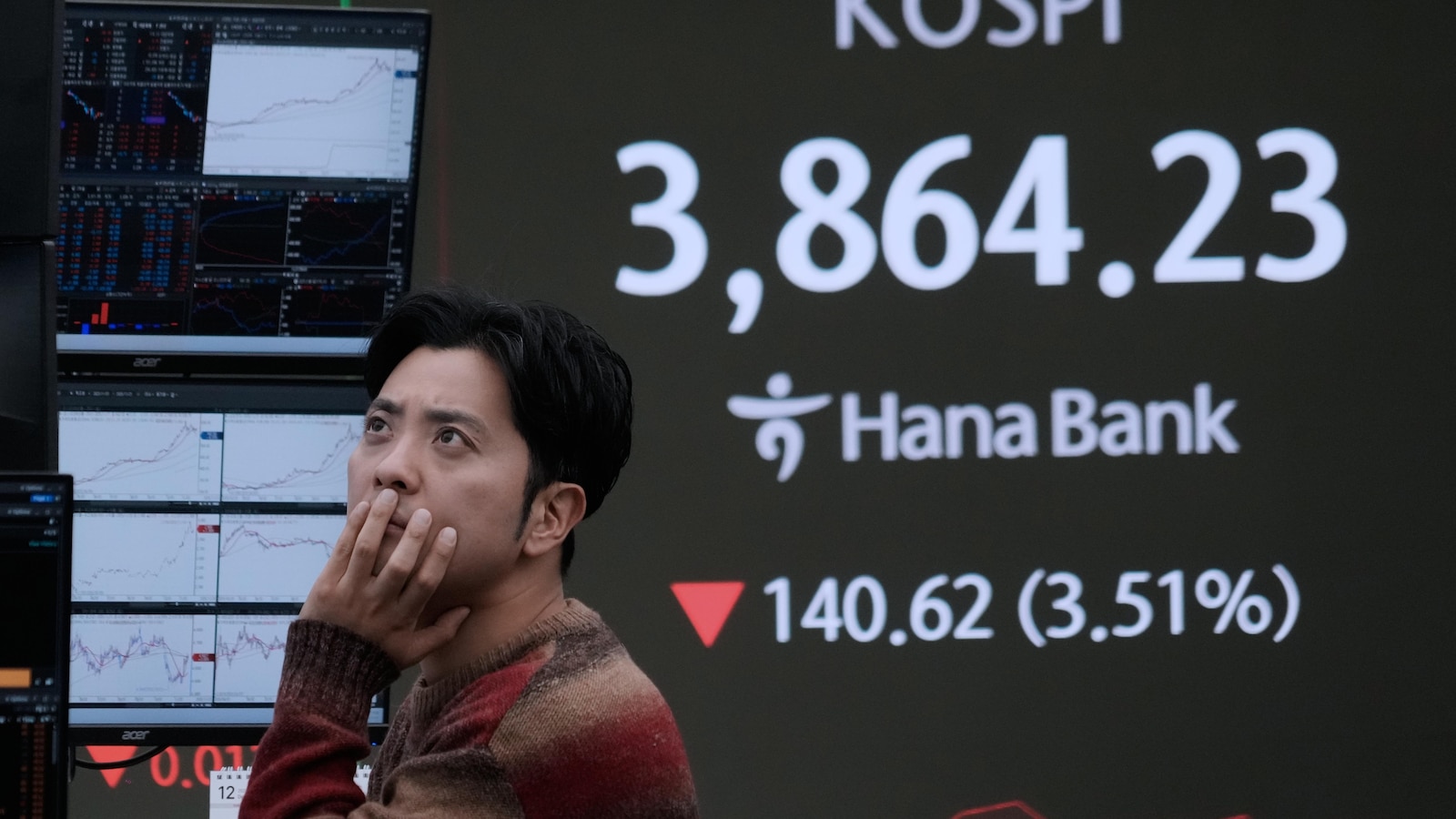
Asian stocks have tracked Wall Street’s plunge in skittish trading, with the region’s major benchmarks erasing the previous day’s gainsA currency trader watches monitors near a screen showing the Korea Composite Stock Price Index (KOSPI) at the foreign exchange dealing room of the Hana Bank headquarters in Seoul, South Korea, Friday, Nov. 21, 2025. (AP Photo/Ahn Young-joon)MANILA, Philippines -- Asian stocks on Friday tracked Wall Street’s sharp drop in skittish trading, with the region’s major benchmarks e ...
SoftBank sinks over 10% as Nvidia-fueled rout sweeps Asian chip names
CNBC· 2025-11-21 02:25
Core Insights - A sector-wide pullback in Asian chip stocks was triggered by a significant decline in SoftBank, following Nvidia's unexpected drop despite strong earnings and a positive outlook [1][4] Company-Specific Summary - SoftBank's stock fell over 10% in Tokyo after it recently sold its Nvidia shares, although it still retains control of British semiconductor company Arm, which provides chip architecture and designs for Nvidia [2] - SK Hynix, a major supplier of high-bandwidth memory for AI applications, saw its stock decline nearly 10%, while Samsung Electronics, another supplier, dropped over 5% [3] - Taiwan Semiconductor Manufacturing Company, the largest contract chipmaker and manufacturer of Nvidia's chip designs, experienced a decline of over 4% [3] - Renesas Electronics, a key supplier for Nvidia, fell by 2.3%, and Tokyo Electron, which supplies essential chipmaking equipment, was down 5.32% [5] Industry Overview - The overall retreat in major Asian semiconductor companies followed Nvidia's decline of over 3% in the U.S., despite the company beating Wall Street expectations for its third-quarter earnings and providing a stronger-than-expected fourth-quarter sales guidance [4]


Samsung Elec names mobile chief co-CEO in return to traditional structure
Yahoo Finance· 2025-11-21 01:43
Core Viewpoint - Samsung Electronics has appointed TM Roh as co-CEO and head of its device experience division, reinstating its traditional co-CEO structure after the death of co-CEO Han Jong-Hee in March [1][2] Group 1: Leadership Changes - TM Roh has been acting head of the consumer business since April, indicating a continuity in leadership during a transitional period [2] - The appointment is seen as a "safe and predictable" choice aimed at strengthening competitiveness in key business areas [2] Group 2: Business Focus - Samsung's strongest-performing sectors this year have been memory chips and mobile, and the appointment of TM Roh signals a strategic emphasis on these divisions [3] - The memory business is currently benefiting from a favorable market and is making progress in the AI chip sector under co-CEO Jun Young-hyun's leadership [3] Group 3: Organizational Structure - The reshuffle follows the appointment of a new head of the business support office, which is a critical decision-making body within Samsung Group [4] - This office acts as a strategy unit that coordinates across various business units and affiliates within the conglomerate [4] Group 4: Market Reaction - Samsung Electronics shares fell by 4.2%, while the benchmark KOSPI index dropped by 3.2%, attributed to broader market trends rather than the leadership changes [5] - Analysts noted that the decline in shares was linked to concerns over AI valuations and unclear U.S. job data affecting interest rate outlooks [5]
X @外汇交易员
外汇交易员· 2025-11-21 01:31
Regulatory Landscape - US bipartisan lawmakers introduced a bill in the House of Representatives to ban recipients of CHIPS Act subsidies from purchasing Chinese chip manufacturing equipment for ten years [1] - The ban covers a wide range of equipment, from complex lithography equipment to processing machinery used for cutting and dicing silicon wafers [1] Impacted Companies - Companies receiving CHIPS Act subsidies include Intel, TSMC, Samsung Electronics, Micron Technology, and SK Hynix [1]
Samsung Elec names mobile chief as new co-CEO
Reuters· 2025-11-21 00:18
Core Insights - Samsung Electronics has appointed TM Roh, the mobile chief, as the new co-CEO and head of its device experience division [1] Company Developments - The appointment of TM Roh signifies a strategic move by Samsung to enhance leadership within its mobile and device experience sectors [1]


NVIDIA-Led Relief Rally in Tech Sector? Undervalued ETFs in Focus
ZACKS· 2025-11-20 13:36
Core Viewpoint - Global technology shares experienced a rally as investors shifted back to AI-linked stocks following NVIDIA's strong earnings report, despite ongoing concerns about overvaluation in the AI sector [1][2]. Company Performance - NVIDIA reported $57 billion in revenue for the quarter ending in October, a 62% increase year-over-year, driven by a 66% surge in sales from its AI data center division, which exceeded $51 billion [3][4]. - The company's earnings per share (EPS) for Q3 was $1.30, surpassing the Zacks Consensus Estimate of $1.24, while revenues exceeded estimates by 4.14% [4]. - NVIDIA's data center business generated $51.2 billion, outperforming the Bloomberg consensus estimate of $49.3 billion [4]. - The company provided an optimistic fourth-quarter revenue guidance of $65 billion, beating the Zacks Consensus Estimate of $60.30 billion, leading to a 5% increase in shares during premarket trading [5]. Market Reaction - The positive sentiment from NVIDIA's results extended to global chipmakers, with Dutch semiconductor companies BESI and ASMI rising over 3% and 2%, respectively, and Asian companies like Samsung Electronics and Hon Hai Precision Industry also seeing gains [6]. - U.S. tech stocks rebounded in pre-market trading, with AMD shares up about 5%, Arm nearly 4%, Marvell Technology adding 3.7%, and Broadcom climbing 3% [7]. Industry Concerns - There are concerns regarding the concentration of major AI players, as highlighted by Karen McCormick, who noted the potential vulnerability of the market if an AI bubble bursts, despite the strong balance sheets of these firms [8][9]. - The interconnected nature of AI companies, particularly with NVIDIA and Microsoft planning significant investments in Anthropic, raises caution about market stability [8][9]. Investment Opportunities - Amidst the mixed scenario of growth and risks, investing in undervalued tech-based exchange-traded funds (ETFs) is suggested as a viable option, with several ETFs showing lower valuations compared to the broader tech ETF iShares U.S. Technology ETF (IYW) [10]. - Specific undervalued ETFs include Invesco Next Gen Connectivity ETF (P/E: 20.98X), Invesco S&P 500 Equal Weight Technology ETF (P/E: 22.74X), and others with P/E ratios ranging from 22.99X to 23.45X [11][12].
