
萤石网络

Search documents
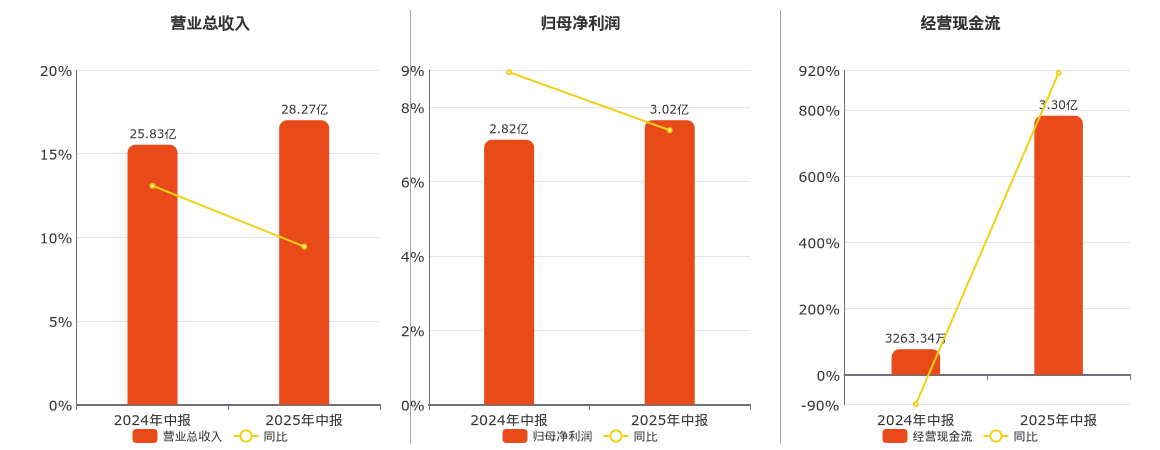
萤石网络(688475.SH):2025年中报净利润为3.02亿元、同比较去年同期上涨7.38%
Xin Lang Cai Jing· 2025-08-02 01:11
Core Viewpoint - The company reported a continuous increase in revenue and net profit for the first half of 2025, indicating strong financial performance and operational efficiency [1][2]. Financial Performance - The company's total revenue for the first half of 2025 was 2.827 billion yuan, an increase of 244 million yuan compared to the same period last year, representing a year-on-year growth of 9.45% [1]. - The net profit attributable to shareholders was 302 million yuan, an increase of 20.78 million yuan year-on-year, reflecting a growth of 7.38% [1]. - The net cash inflow from operating activities was 330 million yuan, up by 297 million yuan from the same period last year, marking a significant increase of 911% [1]. Profitability Metrics - The latest gross profit margin stood at 43.59%, up by 1.04 percentage points from the previous quarter and 0.43 percentage points from the same period last year, indicating four consecutive years of growth [2]. - The return on equity (ROE) was 5.48%, an increase of 0.13 percentage points year-on-year [2]. - The diluted earnings per share were 0.38 yuan, an increase of 0.02 yuan compared to the same period last year, reflecting a year-on-year growth of 5.56% [2]. Efficiency Ratios - The total asset turnover ratio was 0.34 times, an increase of 0.02 times year-on-year, indicating a growth of 5.64% [2]. - The inventory turnover ratio was 2.09 times, up by 0.02 times from the same period last year, representing a year-on-year increase of 1.21% [2]. Shareholder Information - The number of shareholders was 11,500, with the top ten shareholders holding 671 million shares, accounting for 85.21% of the total share capital [2]. - The largest shareholder was Hangzhou Hikvision Digital Technology Co., Ltd., holding 48.01% of the shares [2]. Leverage Ratio - The company's latest debt-to-asset ratio was 34.37%, indicating a moderate level of financial leverage [3].


杭州萤石网络股份有限公司2025年半年度报告摘要
Shang Hai Zheng Quan Bao· 2025-08-01 18:18
公司代码:688475 公司简称:萤石网络 第一节 重要提示 1.1本半年度报告摘要来自半年度报告全文,为全面了解本公司的经营成果、财务状况及未来发展规 划,投资者应当到http://www.sse.com.cn/网站仔细阅读半年度报告全文。 1.2重大风险提示 报告期内,不存在对公司生产经营构成实质性影响的重大风险。公司已于本报告中详细描述了存在的相 关风险,详见"第三节管理层讨论与分析"中关于公司风险因素的相应内容。 1.3本公司董事会、监事会及董事、监事、高级管理人员保证半年度报告内容的真实性、准确性、完整 性,不存在虚假记载、误导性陈述或重大遗漏,并承担个别和连带的法律责任。 1.4公司全体董事出席董事会会议。 1.5本半年度报告未经审计。 1.6董事会决议通过的本报告期利润分配预案或公积金转增股本预案 不适用 1.7是否存在公司治理特殊安排等重要事项 □适用 √不适用 第二节 公司基本情况 2.1公司简介 公司股票简况 ■ 公司存托凭证简况 □适用 √不适用 联系人和联系方式 ■ 2.2主要财务数据 单位:元 币种:人民币 ■ 2.3前10名股东持股情况表 单位: 股 ■ 2.4前十名境内存托凭证持 ...
萤石网络: 2025年半年度募集资金存放与实际使用情况的专项报告
Zheng Quan Zhi Xing· 2025-08-01 16:23
| 用 | | | | | | | | | | | | | | --- | --- | --- | --- | --- | --- | --- | --- | --- | --- | --- | --- | --- | | 项目 | | | | | | | | | | | | | | 智能 | | | | | | | | | | | | | | 家 | | | | | | | | | | | | | | 不 | | | | | | | | | | | | | | 居核心 否 308,526,100.00 308,526,100.00 | | 390,750,600.00 | | | | | 0.92 | 313,752,549.93 | | 5,226,449.93 | | | | 2025 年 5] | [注 | 适 | 否 | | | | | | | | | | | | | | | | | | | | | | [注 | 1] | | 关键 | | | | | | | | | | | | | | 技 | | | | | | | | | | | | | | 用 | | | | | | | | | | | | ...
萤石网络: 关于取消监事会、调整董事会人数、修订《公司章程》并办理工商变更登记及修订、制定部分治理制度的公告
Zheng Quan Zhi Xing· 2025-08-01 16:23
Core Viewpoint - The company has announced the cancellation of its supervisory board, adjustments to the board of directors, and revisions to its articles of association, which will be submitted for approval at the upcoming extraordinary general meeting of shareholders [1][3]. Summary by Sections Cancellation of Supervisory Board - The company will no longer have a supervisory board or supervisors, with the audit committee of the board of directors assuming the responsibilities previously held by the supervisory board [1][2]. - The relevant rules governing the supervisory board will be abolished, and any references to the supervisory board in the company's regulations will no longer apply [1][2]. Adjustment of Board of Directors - To enhance corporate governance and protect the interests of shareholders and employees, the company plans to add one employee director, increasing the total number of directors from 7 to 8 [2]. Revision of Articles of Association - The company intends to revise its articles of association to comply with the latest legal and regulatory requirements, including changing references from "supervisory board" to "audit committee" [1][3]. - The revisions will involve numerous changes, including the deletion of terms related to the supervisory board and adjustments to the numbering of clauses without altering substantive content [1][3]. Governance System Revisions - The company will revise and establish several governance systems to promote standardized operations and improve internal governance mechanisms [4]. - Specific governance systems proposed for revision include the "Management System for Preventing Occupation of Funds by Controlling Shareholders and Related Parties" and the "Management System for Shareholding and Changes by Directors, Senior Management, and Key Technical Personnel" [4].
萤石网络: 董事及高级管理人员离职管理制度(2025年8月)
Zheng Quan Zhi Xing· 2025-08-01 16:23
Core Points - The article outlines the management system for the resignation of directors and senior management at Hangzhou Yingshi Network Co., Ltd, aiming to enhance corporate governance and protect shareholder rights [1][2]. Group 1: General Provisions - The system is established to regulate the resignation of directors and senior management, ensuring stability in corporate governance and compliance with relevant laws and regulations [1]. - The system applies to all directors (including independent directors) and senior management personnel [1]. Group 2: Resignation Conditions and Effectiveness - Directors can resign before their term ends by submitting a written resignation report, which becomes effective upon receipt by the company [2]. - If a director resigns and causes the board to fall below the legal minimum number of members, they must continue to perform their duties until a new director is appointed [2]. - The company can dismiss directors through a shareholder resolution, effective immediately upon the resolution's adoption [2]. Group 3: Transfer Procedures and Unresolved Matters - Resigning directors and senior management must hand over all company-related documents and assets within three working days after their resignation becomes effective [4]. - If the departing personnel are involved in significant transactions, an audit committee may initiate a departure audit [4]. Group 4: Obligations of Departing Directors and Senior Management - Departing directors and senior management retain their obligations of loyalty and confidentiality even after their term ends [4]. - They are prohibited from transferring more than 25% of their shares annually during their term and cannot transfer shares within six months after leaving [5]. Group 5: Accountability Mechanism - The board will review any breaches of commitments or obligations by departing personnel and may pursue compensation for losses incurred [5][6]. - Departing personnel can appeal the board's accountability decisions within 15 days of notification [6]. Group 6: Supplementary Provisions - Any matters not covered by this system will be governed by national laws and regulations [6]. - The system and its amendments take effect upon approval by the company's board of directors [6].
萤石网络: 关于与中国电子科技财务有限公司开展金融服务业务的风险持续评估报告
Zheng Quan Zhi Xing· 2025-08-01 16:23
Core Viewpoint - The report evaluates the ongoing risks associated with the financial services business between Hangzhou Yingshi Network Co., Ltd. and China Electronics Technology Finance Co., Ltd., highlighting the financial company's operational status, internal controls, and risk management practices [2][10]. Group 1: Financial Company Overview - China Electronics Technology Finance Co., Ltd. is a non-bank financial institution approved by the National Financial Supervision Administration, with a registered capital of 580 million RMB and established on December 14, 2012 [2]. - The financial company's business scope includes accepting deposits, providing loans, bill discounting, and offering various financial advisory services [2]. Group 2: Internal Control and Risk Management - The financial company has established a comprehensive internal control system with 13 categories and 191 items of regulations to ensure effective management and compliance [8]. - It has a structured governance framework including a board of directors and various committees to oversee risk management and internal controls [3][8]. - Risk identification and assessment are conducted through a series of internal control systems, ensuring that each department has its own risk management protocols [3][4]. Group 3: Financial Performance - As of June 30, 2025, the financial company reported total assets of 89.495 billion RMB, liabilities of 78.103 billion RMB, and equity of 11.392 billion RMB, with a net profit of 0.597 billion RMB for the first half of 2025 [9]. - The company maintains a healthy cash position with 3.964 billion RMB in cash and deposits at the central bank, and a loan balance of 28.212 billion RMB [9]. Group 4: Regulatory Compliance - The financial company adheres to various regulatory requirements, including maintaining a capital adequacy ratio above the minimum regulatory threshold and ensuring liquidity ratios are not below 25% [11]. - The company has not engaged in any financial transactions with its parent company, maintaining a zero balance in loans and deposits as of June 30, 2025 [10].
萤石网络: 关于召开2025年半年度业绩说明会的公告
Zheng Quan Zhi Xing· 2025-08-01 16:23
证券代码:688475 证券简称:萤石网络 公告编号:2025-027 杭州萤石网络股份有限公司 关于召开 2025 年半年度业绩说明会的公告 本公司董事会及全体董事保证本公告内容不存在任何虚假记载、误导性陈述 或者重大遗漏,并对其内容的真实性、准确性和完整性承担法律责任。 重要内容提示: ? 会议召开时间:2025 年 08 月 11 日(星期一)15:00-16:00 ? 会议召开地点:上海证券交易所上证路演中心(网址: https://roadshow.sseinfo.com/) ? 会议召开方式:上证路演中心网络互动 ? 投资者可于 2025 年 08 月 04 日(星期一)至 08 月 08 日(星期五)16:00 前 登录上证路演中心网站首页点击"提问预征集"栏目或通过公司邮箱 ir@ezviz.com 进行提问。公司将在说明会上对投资者普遍关注的问题进行回答。 杭州萤石网络股份有限公司(以下简称"公司")已于 2025 年 8 月 2 日发布 公司 2025 年半年度报告,为便于广大投资者更全面深入地了解公司 2025 年半年 度经营成果、财务状况,公司计划于 2025 年 08 月 11 日( ...
萤石网络: 关于首次公开发行股票募投项目结项并将节余募集资金部分用于其他募投项目、部分永久补充流动资金的公告
Zheng Quan Zhi Xing· 2025-08-01 16:23
Core Viewpoint - The company has completed the investment projects from its initial public offering (IPO) and plans to allocate surplus funds to other projects and to permanently supplement working capital [1][4][6]. Fundraising Overview - The company raised a total of RMB 3,236.63 million by issuing 112,500,000 shares at a price of RMB 28.77 per share on December 28, 2022 [1][2]. - After deducting underwriting fees of RMB 89.15 million, the actual amount received was RMB 3,121.37 million [1][2]. Project Completion Status - The completed projects include: - "Chongqing Base Project for Intelligent Manufacturing" - "Next-Generation IoT Cloud Platform Project" - "Core Key Technology R&D Project for Smart Home" - "Industrialization Base Project for Smart Home Products" [1][4][6]. - These projects have reached a state of readiness for use and meet the conditions for completion [4][6]. Surplus Fund Allocation - The estimated surplus from the "Chongqing Base Project for Intelligent Manufacturing" is RMB 155.93 million, excluding future cash management income and net interest [4][6]. - The company plans to transfer RMB 41.54 million of the surplus to the "Industrialization Base Project for Smart Home Products" to cover construction costs and warranty payments [4][6]. - The remaining surplus will be used to permanently supplement working capital for daily operations and business development [4][6]. Fund Management and Compliance - The company has established a special account for the raised funds, which is subject to a tripartite supervision agreement with the sponsor and the bank [2][5]. - The decision to conclude the projects and reallocate surplus funds aligns with regulatory requirements and aims to optimize resource allocation and improve fund utilization efficiency [6][8]. Approval Process - The board of directors and the supervisory board approved the allocation of surplus funds on August 1, 2025, without needing to present the matter to the shareholders' meeting [6][8].
萤石网络: 重大事项内部报告制度(2025年8月)
Zheng Quan Zhi Xing· 2025-08-01 16:23
Core Viewpoint - The internal reporting system for significant events at Hangzhou Yingshi Network Co., Ltd. aims to ensure accurate, timely, and complete information disclosure, protecting shareholder interests and ensuring regulatory compliance [1][2]. General Provisions - The internal reporting system is designed to clarify the reporting obligations and procedures for significant events that may impact the company's securities trading or investment decisions [2]. - The system applies to the company, its subsidiaries, and branches [2]. Reporting Obligations - Reporting obligations include company shareholders holding more than 5%, directors, senior management, and other relevant personnel [6]. - The board secretary is responsible for managing and disclosing significant event information [3][4]. Scope of Significant Events - Significant events include important meetings, major transactions, related party transactions, major risks, accidents, and other events that could impact stock prices [5][8]. - Specific thresholds for reporting major transactions include asset totals exceeding 10% of the company's audited total assets or transaction amounts exceeding 10% of market value [5][7]. Reporting Procedures - Reporting personnel must notify the board secretary immediately upon becoming aware of significant events, using various communication methods [15]. - The board secretary must analyze reports and propose disclosure plans for matters requiring public announcement [16]. Responsibilities and Penalties - Reporting personnel are responsible for the accuracy and completeness of the information provided [22]. - Violations of the reporting obligations may lead to disciplinary actions, including warnings or legal consequences [23]. Confidentiality Obligations - All personnel involved in significant events must maintain confidentiality until the information is publicly disclosed [24][25].
萤石网络: 杭州萤石网络股份有限公司章程(2025年8月)
Zheng Quan Zhi Xing· 2025-08-01 16:23
General Provisions - The company is established as a joint-stock limited company in accordance with the Company Law of the People's Republic of China and other relevant regulations [2] - The company, Hangzhou Yingstone Network Co., Ltd., was registered with the Zhejiang Provincial Market Supervision Administration and obtained a business license [2] - The company was approved for registration by the China Securities Regulatory Commission and issued 112.5 million shares to the public, listed on the Shanghai Stock Exchange's Sci-Tech Innovation Board on December 28, 2022 [2][3] - The registered capital of the company is RMB 787,500,000 [2] Company Purpose and Scope - The company's business purpose is to become a trusted provider of smart home and IoT cloud platform services, focusing on core self-developed technologies such as smart hardware, internet cloud services, AI, and robotics [4] - The company’s business scope includes technology services, software development, information technology consulting, and various manufacturing and sales activities related to electronic devices and smart home products [5] Shares - The company's shares are issued in the form of stocks, with each share having a par value of RMB 1 [6] - The total number of shares issued by the company is 787,500,000, all of which are ordinary shares [6] - The company is not allowed to provide financial assistance for others to acquire its shares, except under specific conditions approved by the shareholders' meeting [7] Shareholder Rights and Meetings - Shareholders have rights to dividends, attend meetings, supervise the company’s operations, and request information [12] - The company must hold an annual shareholders' meeting within six months after the end of the previous fiscal year [22] - The company’s shareholders' meeting is the authority of the company, responsible for electing directors, approving reports, and making significant decisions [20] Decision-Making and Voting - Ordinary resolutions require a simple majority of the voting rights held by attending shareholders, while special resolutions require two-thirds majority [80] - Shareholders can propose agenda items for meetings, and the company must notify shareholders of the meeting details in advance [58][60] - The company must ensure that the voting process is transparent and that results are disclosed promptly [83]