Samsung

Search documents
Nova (NasdaqGS:NVMI) FY Conference Transcript
2026-01-14 18:47
Summary of Nova (NasdaqGS:NVMI) FY Conference Call - January 14, 2026 Company Overview - **Company**: Nova (NasdaqGS:NVMI) - **Event**: 28th Annual Needham Growth Conference - **Key Speaker**: Guy Kizner, CFO Industry Insights - **Semiconductor Industry Growth**: The semiconductor industry is expected to reach $1 trillion in revenues by 2026, driven by demand from AI, data centers, automotive, and industrial sectors [4][5] - **Investment Trends**: Customers are making long-term capacity investments, particularly in advanced nodes and memory, with a focus on DRAM and advanced packaging [3][5] Financial Performance and Projections - **2026 Outlook**: Nova anticipates a growth year in 2026, with a second-half weighting due to project timing rather than demand [3][5] - **Revenue Target**: The company is on track to meet its $500 million cumulative revenue target from Gate-All-Around technology by 2026 [8] - **Advanced Packaging Growth**: Advanced packaging revenue is projected to grow from 10% in 2023 to around 20% in 2026, driven by both inorganic acquisitions and organic product adjustments [12][14] Market Segments - **Leading Edge Logic**: The transition from FinFET to Gate-All-Around is enhancing Nova's position in metrology, with significant growth expected from major players like TSMC, Intel, Samsung, and Rapidus [7][9] - **Memory Market**: DRAM is a key growth driver, with Nova well-positioned among top spenders. However, the NAND market is currently focused on upgrades rather than capacity expansions [15][16][17] - **China Market**: Nova's exposure to China is expected to decrease percentage-wise but increase in dollar terms. The company does not view China as a growth market for 2026 [18][19] Competitive Landscape - **Market Position**: Nova holds over 70% market share in integrated metrology and is growing in the optical CD standalone segment, competing with Onto and KLA [22][24] - **Chemical Metrology**: Nova has a strong presence in the backend of the process, while KLA dominates the front end [25] - **Chinese Competitors**: Local Chinese players are emerging, but Nova maintains a technological edge [26][27] M&A Strategy - **Capital Allocation**: Nova raised $750 million through convertible notes to fund M&A opportunities, focusing on companies that align with their financial model and offer clear synergies [29][30][31] - **Target Criteria**: The company seeks acquisitions that are accretive to EPS within 12 months and fit their operational and financial criteria [30][31] Long-term Goals - **Revenue Target for 2027**: Nova aims to achieve $1 billion in revenue by 2027, with a commitment to organic growth supplemented by potential acquisitions [32][33] - **Growth Trajectory**: The company plans to double revenues every five years, with a focus on maintaining long-term targets rather than adjusting based on short-term performance [35][36] Conclusion - Nova is positioned for significant growth in the semiconductor industry, with a strong focus on advanced technologies and strategic investments. The company is committed to achieving its long-term revenue targets while navigating competitive and market dynamics effectively.

InterDigital (NasdaqGS:IDCC) FY Conference Transcript
2026-01-14 17:02
InterDigital Conference Call Summary Company Overview - **Company**: InterDigital - **Industry**: Semiconductor and wireless technology - **Focus**: Research and development in wireless, video, AI, and related technologies, licensing innovations globally to various sectors including wireless communications, consumer electronics, IoT, and cloud-based services [1][2] Core Business Model - **Licensing Model**: Operates on an IP as a service model, where customers pay for a subscription to a portfolio of patents, resulting in recurring revenue [6][7] - **Patent Portfolio**: Emphasizes an evergreen patent portfolio, with an average of six new patents added daily, ensuring long-term value [21][22] - **Revenue Growth**: Revenue is growing rapidly, with a year-over-year increase and profitability growing faster than revenue due to high margins [7][25] Financial Performance - **Contracts**: Over $4 billion worth of contracts signed in the last four years, with a focus on long-term agreements averaging five years [23][24] - **Annualized Recurring Revenue (ARR)**: Target to grow ARR from $400 million to $1 billion by 2030, with current figures showing significant progress [27][39] - **Dividend Increase**: Increased dividend by approximately 50% from $0.45 to $0.70 per quarter [26] Market Position and Strategy - **Customer Base**: Major clients include Apple, Samsung, Lenovo, and Oppo, with long-term relationships [8][24] - **Growth Strategy**: Focus on expanding into consumer electronics, IoT, and online streaming, with a goal of monetizing $200 million in recurring revenue from these segments by 2030 [34][35] - **Standard Development**: Actively involved in standard development organizations, influencing the future direction of technology [16][19] Industry Dynamics - **Video Consumption**: Video accounts for 80% of internet traffic, driving demand for efficient video delivery technologies [11][12] - **Emerging Technologies**: Investing in foundational AI technologies, with a focus on integrating AI into wireless and video standards [10][11] Legal and Competitive Landscape - **Litigation**: Recently won a litigation battle against Disney, with ongoing litigation against Amazon, highlighting the company's commitment to enforcing its IP rights [42][43][46] - **Competitive Advantages**: Positioned as a leader in foundational technology development, with a strong emphasis on standardization and long-term partnerships [47][48] Future Outlook - **Long-Term Goals**: Aim to maintain a 60% adjusted EBITDA margin while achieving double-digit year-over-year growth in ARR [39] - **Investment in R&D**: Committed to long-term investments in research and development to sustain growth and innovation [38] This summary encapsulates the key points discussed during the conference call, highlighting InterDigital's strategic focus, financial performance, and market positioning within the semiconductor and wireless technology industry.

Advanced Energy Industries Touts Data Center Growth, Sees 2026 Semi Upswing at Needham Conference
Yahoo Finance· 2026-01-14 16:08
Core Viewpoint - Advanced Energy Industries expresses strong confidence in its long-term data center growth, driven by the unique demands of the AI data center market and the need for continuous product innovation [1][5]. Data Center Business - The company has improved data center margins from the "teens" towards the corporate average, aiming to sustain this level despite a complex tariff regime that poses a 100 basis point headwind to gross margin [4][11]. - Data center revenue now constitutes approximately 37% to 38% of total revenue, up from the low 20% range a year ago, contributing positively to overall company margins [10]. - Advanced Energy anticipates significant contributions from new products (Everest, eVoS, NavX) in 2025, with expected revenues of $10–20 million, accelerating in 2026 and having a more substantial impact in 2027 and 2028 [3][15]. Semiconductor Equipment Outlook - The company expects 2026 to be a growth year for semiconductor equipment, driven by DRAM and leading-edge logic, with increased optimism based on customer feedback [12][13]. - Management highlighted that the semiconductor equipment segment is approximately 42% of total revenue, with a focus on high-end power delivery markets [2][5]. Product Development and Capacity - Advanced Energy is actively expanding its manufacturing capacity in the Philippines, Mexicali, and a new factory in Thailand, ready to support increased demand [6][19]. - The company is selective in its competitive positioning, achieving a win rate close to 100% in its engagements [8]. Financial Performance and Strategy - The company aims for operating expense leverage as revenue grows, expecting operating expenses to increase at roughly half the rate of revenue growth, with a target of 35% to 45% operating leverage at the operating income level [20]. - Advanced Energy has a strong balance sheet with $750 million in cash and approximately $565 million in debt as of the end of September [20]. M&A Activity - Management remains active in pursuing mergers and acquisitions, aiming to close a significant deal this year to build scale in industrial/medical and fill capability gaps through technology tuck-ins [21].

QCOM vs. AMD: Which Semiconductor Stock is the Smarter Buy in 2026?
ZACKS· 2026-01-14 16:05
Core Insights - Qualcomm Technologies Inc. and Advanced Micro Devices, Inc. are leading firms in the semiconductor industry, focusing on mobile, PC, and data center markets, with an emphasis on AI and advanced chip technologies [2][4] - Qualcomm is transitioning from a wireless communications firm to a connected processor company, leveraging its extensive intellectual property portfolio [5][6] - AMD has evolved from a consumer-PC chip provider to an enterprise-focused company, bolstered by its acquisition of Xilinx and the introduction of new products [3][10] Qualcomm's Position - Qualcomm is well-positioned for long-term revenue growth, driven by strong 5G traction and a diversified revenue stream [5] - The company is expanding its Snapdragon chipsets for AI PCs and gaming, aiming to reduce reliance on the slowing smartphone market [6][9] - Despite its advancements, Qualcomm faces stiff competition from Intel in the AI PC market and from Samsung and MediaTek in the smartphone sector [7] AMD's Position - AMD is benefiting from rising demand for its EPYC processors and strong enterprise adoption, particularly in cloud deployments and AI applications [11] - The company is expanding its AI market presence with new products like the MI350 series and is seeing strong demand across various sectors [10][11] - AMD faces competition from Intel in traditional computing and from NVIDIA in the GPU market, but has had success in the mobile segment [12] Financial Performance - Qualcomm's fiscal 2026 sales and EPS estimates suggest modest growth of 2.7% and 1%, respectively, with positive trends in EPS revisions [13] - In contrast, AMD's 2025 sales estimates indicate a significant growth of 31.6%, with EPS expected to rise by 19.6%, although EPS estimates have been trending downward [14] - Over the past year, Qualcomm's stock has gained only 0.6%, while AMD has surged by 84.2%, indicating a stronger market performance for AMD [16] Valuation Metrics - Qualcomm appears more attractive from a valuation perspective, with a price/earnings ratio of 13.46 compared to AMD's 34.67 [17] - Both companies are rated with a Zacks Rank of 3 (Hold), but Qualcomm's lower valuation may provide a slight edge as a better investment option [18][19]



Sold-Out AI Chips and Growing Foundry Buzz: Is Intel’s Rally Just Getting Started?
Yahoo Finance· 2026-01-14 15:51
Quick Read Intel (INTC) stock is up 28% year-to-date following an 84% gain in 2025. KeyBanc upgraded Intel to Overweight with a $60 price target. Intel is sold out of server CPU capacity for 2026 due to AI demand from hyperscalers. Average selling prices could rise 10% to 15%. Intel’s 18A manufacturing process now achieves yields over 60%. Apple is reportedly evaluating Intel foundry for low-end M-series processors starting in 2027. A recent study identified one single habit that doubled Americans’ ...

Universal Display (NasdaqGS:OLED) FY Conference Transcript
2026-01-14 15:32
Summary of Universal Display Corp FY Conference Call Industry Overview - **OLED Market Penetration**: - Smartphones: Over 60% penetration, with growth driven by premium and mid-tier models adopting OLED displays. Foldable smartphones are expected to further boost this market due to increased surface area [5][6]. - TVs: Currently at approximately 3% penetration in the overall TV market, with LG Display being a major player. Growth is anticipated as more consumers adopt OLED TVs [7]. - IT Market: Only about 5% penetration, but significant growth is expected as OEMs invest in OLED displays for tablets, laptops, and monitors [8][11]. Key Market Dynamics - **Smartphone Growth**: Continued growth is projected as more mid-tier and low-end models convert to OLED. The introduction of foldable smartphones is seen as a major opportunity for Universal Display Corp (UDC) [6][7]. - **TV Market Challenges**: The OLED TV market faces challenges due to consumer price sensitivity and competition from premium LCDs. However, the narrowing price gap between OLED and LCD TVs is expected to drive further adoption [14][15][39]. - **IT Market Momentum**: The IT market is gaining momentum with new capacity coming online, and many OEMs are planning to introduce OLED displays into their products [8][11][20]. Capacity Investments - **New Fabs**: Samsung and BOE are investing over $12 billion collectively in new 8.6 Gen capacity for the IT market, expected to come online in Q2 and Q3 of 2026. This new capacity is anticipated to provide a significant tailwind for UDC [21][22]. - **Future Capacity**: Additional investments from Visionox and China Star are expected to come online in 2027-2028, which may present revenue opportunities for UDC in the future [25][26]. Technological Developments - **Tandem Architecture**: Tandem displays, which use two emissive layers, are being adopted in IT products for better brightness and longevity. This technology is expected to increase material usage by 1.5 to 2 times compared to single-layer products [28][29]. - **Phosphorescent Blue**: The introduction of phosphorescent blue materials is projected to enhance energy efficiency by up to 25%. LG Display has showcased this technology, indicating a growing interest in high-efficiency blue materials [42][43]. Competitive Landscape - **Local Competition in China**: Increased competition from local suppliers in China is noted, but UDC maintains a strong position due to its extensive patent portfolio and ongoing partnerships with major players [55][56]. Financial Outlook - **Revenue Growth**: UDC expects growth in 2026, driven by increased demand for OLED materials, particularly in the IT market. The company is monitoring various factors, including component prices, that could impact demand [36][58]. - **Capital Allocation**: UDC has a strong cash position of approximately $1 billion and is focused on investing in IP, returning capital to shareholders, and exploring growth opportunities through acquisitions [62][63]. Conclusion - UDC is well-positioned to capitalize on the growing OLED market across smartphones, TVs, and IT products. The company is actively investing in new technologies and capacity to meet increasing demand while navigating competitive pressures and market dynamics.

3 cheap stocks that could turn $1,000 into $10,000
Finbold· 2026-01-14 14:23
Group 1: Market Overview - At the start of 2026, the stock market shows signs of instability, with concerns about the potential bubble in the artificial intelligence sector, yet the S&P 500 has reached unprecedented highs [2] - Despite market fears, there are opportunities for investors to identify undervalued stocks that could yield significant returns in the mid to long-term [2] Group 2: Rocket Pharmaceuticals (RCKT) - Rocket Pharmaceuticals is a clinical-stage gene therapy developer focused on rare diseases, with shares dropping from approximately $6.59 to about $2.50 due to a trial-related issue, currently priced at $3.80 [3] - The stock has seen a mild positive trend with an 8% year-to-date rally, and the company is advancing its gene therapy programs, notably in Phase 2 trials for Danon disease [5] - The average Wall Street 12-month price target for RCKT is $8.63, indicating a potential upside of 127% by the end of 2026 [6] Group 3: Fiserv (FISV) - Fiserv is a well-established company in the global payments and financial infrastructure sector, with a significant drop of 40% in stock price due to a poor earnings report, currently priced at $66.79 [8] - Analysts suggest FISV is undervalued based on fundamentals, with expectations of at least a 40% rally in 2026 as the digital payments sector grows [10] - Congressional trading patterns show Representative Gilbert Cisneros purchased FISV shares, highlighting potential investor confidence [11] Group 4: Intel (INTC) - Intel's stock price is currently at $47.29, significantly lower than competitors Nvidia and AMD, despite gaining ground through 2025 [12] - The company is strategically important for the U.S. and is on a path to potentially become the second-largest microchip foundry, surpassing Samsung [14] - Intel's significance is underscored by the geopolitical risks associated with semiconductor production concentrated in Taiwan [15]


Retail traders pile into memory chipmakers as AI boom squeezes supplies, lifts prices
Yahoo Finance· 2026-01-14 11:57
Industry Overview - Retail investors have significantly increased their purchases of U.S. memory and data storage chipmakers in January 2026, driven by expectations of rising prices due to booming artificial intelligence infrastructure demand and a global shortage of memory chips [1] - The memory chip shortage is described as "unprecedented" by Samsung's co-CEO TM Roh, with industry rivals warning that supply constraints may last for months or even years as AI infrastructure continues to consume available supplies [2] Company Performance - SanDisk has experienced a remarkable surge in its stock price, rising approximately 65% in 2026, with over $7.1 million in retail inflows recorded in a single day, marking the largest one-day move on record [2] - Western Digital has attracted nearly $10 million in inflows in the first two weeks of January 2026, indicating a strong monthly performance, while Seagate Technology has seen over $2.1 million in inflows this year [3] - Micron Technology, one of the leading memory makers, has increased by 18% in 2026 after a substantial rise of 240% in 2025, highlighting its strong market position alongside Samsung and SK Hynix [4] Retail Investor Trends - In 2025, U.S. retail inflows reached a record high, with individual investors contributing significantly to the market rally, particularly in memory chip stocks, which saw total flows exceeding $117.2 million for the year [3] - Micron and SanDisk were among the five most actively traded stocks on Interactive Brokers' platform recently, indicating strong retail interest [5]


Omdia: Global Smartphone Market Grew 4% in 4Q25 as Apple Leads the Market for the Third Consecutive Year
Businesswire· 2026-01-14 11:18
Core Insights - The global smartphone market experienced a 4% year-on-year growth in Q4 2025, driven by seasonal demand and improved inventory management, despite rising component costs affecting some vendors [1][3] - Apple maintained its position as the leading smartphone vendor with a 25% market share in Q4 2025, achieving record shipment volumes due to strong demand for the iPhone 17 series [1][4] - Samsung followed with an 18% market share, benefiting from strong sales in the sub-$300 segment, particularly the Galaxy A17 models [2][6] - Xiaomi retained third place with an 11% market share, although it faced challenges in key markets [2][6] - The overall global smartphone shipments for 2025 reached 1.25 billion units, reflecting a 2% year-on-year increase, with a notable recovery in the second half of the year [3] Vendor Performance - Apple recorded its highest-ever fourth-quarter shipment volumes, driven by solid demand for the iPhone 17 series and older models during the holiday season [4][5] - Samsung's growth was primarily in the budget segment, with the Galaxy A17 models contributing significantly to its market share [2][6] - Xiaomi's market share declined to 11% in Q4 2025, indicating challenges in maintaining volume in competitive markets [2][6] - Vivo held an 8% market share, supported by strong performance in India, while OPPO re-entered the top five with an 8% share, marking a positive turnaround [2][6] Market Dynamics - The smartphone industry is facing supply-side pressures due to tight DRAM supply, which is expected to impact the market significantly in 2026 [5] - Rising memory costs and a slowing refresh cycle are anticipated to constrain shipment momentum, prompting vendors to adopt tighter configurations and align launch strategies with component availability [5] - The trend towards consolidation is evident, with realme moving under OPPO's umbrella to achieve greater scale and manage rising costs [5]


IDC 2025: OPPO第四季度国内双位数增长,安卓唯一
Xin Lang Cai Jing· 2026-01-14 06:23
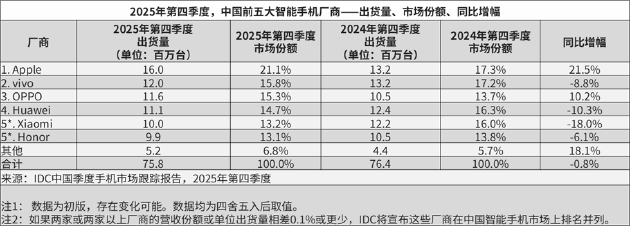
Core Insights - The global smartphone market is expected to reach a total shipment of 1.26 billion units in 2025, reflecting a year-over-year growth of 1.9%, indicating a continued recovery trend in the market [1] - In the fourth quarter of 2025, global smartphone shipments reached 336.3 million units, marking a 2.3% increase compared to the previous year [3][8] Group 1: Global Market Performance - The fourth quarter of 2025 saw a total shipment of 336.3 million smartphones, with Apple leading the market with a share of 24.2% and shipments of 81.3 million units, up 4.9% year-over-year [3][8] - Samsung followed with a market share of 18.2%, achieving a significant year-over-year growth of 18.3% with shipments of 61.2 million units [3][8] - The overall smartphone market in China experienced a slight decline of 0.8% in shipments, totaling approximately 75.8 million units in the fourth quarter [7] Group 2: Company-Specific Insights - OPPO was the only major Android brand in China to achieve double-digit growth in the fourth quarter of 2025, with a year-over-year increase of 10.2%, resulting in shipments of 11.6 million units [2][7] - OPPO's strong performance is attributed to the successful launch of competitive new products, particularly the OPPO Find X9 series, which sold 1 million units within 10 days of its domestic launch [5][9] - The OPPO Reno series has seen significant activation numbers, nearing 100 million units in China and over 130 million globally, maintaining a leading position in the competitive $400–$600 price segment [6][9]