
Elastic N.V.

Search documents
Inseego (INSG) Lags Q3 Earnings Estimates
ZACKS· 2025-11-07 01:01
Core Insights - Inseego reported quarterly earnings of $0.12 per share, missing the Zacks Consensus Estimate of $0.28 per share, and compared to a loss of $0.07 per share a year ago, representing an earnings surprise of -57.14% [1] - The company posted revenues of $45.89 million for the quarter ended September 2025, surpassing the Zacks Consensus Estimate by 9.36%, but down from $54.03 million year-over-year [2] - Inseego shares have increased approximately 40.4% since the beginning of the year, outperforming the S&P 500's gain of 15.6% [3] Earnings Outlook - The current consensus EPS estimate for the upcoming quarter is $0.24 on revenues of $45.4 million, and for the current fiscal year, it is $0.97 on revenues of $160.1 million [7] - The estimate revisions trend for Inseego was mixed ahead of the earnings release, resulting in a Zacks Rank 3 (Hold) for the stock, indicating expected performance in line with the market [6] Industry Context - The Internet - Software industry, to which Inseego belongs, is currently in the top 35% of over 250 Zacks industries, suggesting a favorable outlook compared to the bottom 50% [8] - Another company in the same industry, Elastic, is expected to report quarterly earnings of $0.58 per share, with a year-over-year change of -1.7%, and revenues projected at $418.13 million, up 14.4% from the previous year [9]



Understanding Tenable Holdings, Inc.'s (NASDAQ:TENB) Capital Efficiency in the Cybersecurity Sector
Financial Modeling Prep· 2025-10-31 15:00
Core Insights - Tenable Holdings, Inc. specializes in vulnerability management within the cybersecurity sector, competing with companies like Rapid7, Varonis Systems, Qualys, Elastic N.V., and Smartsheet [1] Financial Performance - Tenable's Return on Invested Capital (ROIC) is -0.97%, which is below its Weighted Average Cost of Capital (WACC) of 7.20%, indicating insufficient returns to cover capital costs [2] - Rapid7 has a positive ROIC of 1.29% against a WACC of 5.90%, resulting in a ROIC to WACC ratio of 0.22, suggesting better capital efficiency than Tenable, though still not optimal [3] - Varonis Systems demonstrates a stronger performance with a ROIC of 9% and a WACC of 6.26%, leading to a ROIC to WACC ratio of 1.43, indicating superior returns on invested capital [3] - Qualys exhibits the highest ROIC of 27.75% and a WACC of 6.58%, resulting in a ROIC to WACC ratio of 4.21, showcasing the best capital utilization among its peers [4]

新浪财经ESG:ESTC MSCI(明晟)ESG评级调升至AAA
Xin Lang Cai Jing· 2025-10-30 23:09
Core Insights - ESTC's MSCI ESG rating has been upgraded from AA to AAA as of October 30, 2025 [1] Group 1 - The upgrade reflects an improvement in ESTC's environmental, social, and governance practices [1]

OpenAI begins to threaten software stocks
CNBC Television· 2025-10-28 13:53
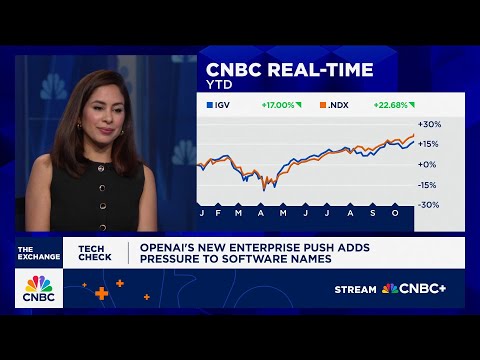
Welcome back. Twilio, that was our mystery chart. So, Twilio and Service Now both report this week.And the launch of enterprise products from some AI companies could soon threaten some of those software names. Sema Modi takes a look at the companies that could be most impacted in today's tech check. Hi, Sema.>> Morgan, this is a key debate, right. You have open AI just in the past month unveiling a suite of advanced artificial intelligence tools for not just customers but corporations. And the goal of CEO S ...
Sumble emerges from stealth with $38.5M to bring AI-powered context to sales intelligence
Yahoo Finance· 2025-10-22 13:30
Core Insights - The sales intelligence market is crowded, with services that help identify prospects, provide background information, and automate follow-ups [1] - Sumble, a startup from San Francisco, aims to provide contextual information by aggregating data from various online sources [2] Company Overview - Sumble was founded by Anthony Goldbloom and Ben Hamner, who previously created the data science community Kaggle [3] - The startup utilizes a knowledge graph supported by large language models to connect diverse data points, offering insights into a company's technographic data, organizational structure, and potential contacts [3] Market Position and Growth - Despite the competitive landscape, Sumble has successfully signed 17 enterprise customers since its launch in April 2024, including notable companies like Snowflake and Figma [4] - The startup has experienced significant growth, with a reported 550% year-over-year revenue increase, although specific revenue figures were not disclosed [4] User Engagement and Funding - Sumble's user base has grown rapidly within companies, often expanding from a few users to hundreds in a short period, primarily through word of mouth and internal communication channels like Slack [5] - The company recently emerged from stealth mode with $38.5 million in funding, including an $8.5 million seed round and a $30 million Series A led by prominent investors [5]
摩根大通:AI将颠覆美股哪些软件巨头?一张图看清与“悬崖”的距离
美股IPO· 2025-10-21 10:03
Core Insights - Morgan Stanley warns that AI is disrupting the software industry, introducing the "AI Cliff" assessment framework to analyze the vulnerability of software companies [1][3] - Companies with strong ecosystems and high user visibility, such as Microsoft Windows and Bloomberg, are more defensively positioned, while traditional systems and niche software face greater risks [1][3] AI Cliff Assessment Framework - The framework evaluates software companies' vulnerability to AI disruption across nine dimensions, providing a clear risk landscape for investors [3][5] - Key dimensions include replacement cost, criticality, automation level, user visibility, ecosystem size, data resources, scale and resources, adaptability, and regulatory requirements [5][6][7][8][9][10][11][12][13][14] Key Dimensions Explained - **Replacement Cost**: Evaluates the time, financial investment, and customer disruption involved in replacing software; for example, Microsoft Windows has high replacement costs due to learning curves, while Alteryx is easier to replace [6][15] - **Criticality**: Differentiates between mission-critical software (e.g., CDK) and auxiliary tools (e.g., Alteryx) [7][15] - **Automation Level**: Highly automated systems are less likely to be affected by AI, whereas software reliant on manual processes (e.g., Microsoft Excel) is more vulnerable [8][15] - **User Visibility**: Software that users interact with daily (e.g., Microsoft Windows) has higher stickiness compared to backend middleware (e.g., TIBCO) [9][15] - **Ecosystem Size**: A large user ecosystem and vendor support (e.g., Bloomberg) make replacement more difficult compared to niche market software (e.g., PTC) [10][15] - **Data Resources**: Proprietary data sets (e.g., Experian) are more valuable than non-proprietary data (e.g., CoreLogic) [11][15] - **Scale and Resources**: Larger companies (e.g., Google) can better weather disruptions compared to smaller firms (e.g., ZipRecruiter) [12][15] - **Adaptability**: Modern API-based software (e.g., Elastic) can integrate AI more easily than legacy systems (e.g., Unisys) [13][15] - **Regulatory Requirements**: Industries like finance and healthcare provide additional protection for existing software [14][15] Heatmap Analysis - Morgan Stanley applied the framework to various software companies, creating a defense capability heatmap to visualize their proximity to the "cliff" [17] - Examples include CrowdStrike, which excels in criticality and adaptability but scores low in automation, and GoDaddy, which has moderate data resources but low scale and resources [18][19] Conclusion - The analysis indicates that while AI will likely impact nearly all software companies, the timing and extent of this disruption vary significantly [4][23] - The framework serves as a tool for assessing the relative vulnerability of software companies to AI challenges, highlighting the importance of various factors in determining their risk profiles [23]


Buyback Boom: 3 Companies Betting Big on Themselves
MarketBeat· 2025-10-14 21:19
Core Viewpoint - Recent buyback announcements from three companies signal confidence in their future cash generation and potential undervaluation of their shares [1][2]. Group 1: Lockheed Martin - Lockheed Martin announced a $2 billion increase to its share buyback capacity, bringing the total to $9.1 billion, which is 7.7% of its market capitalization of approximately $118 billion [3][4]. - The company has underperformed with a 6% return in 2025, compared to a 43% return of the iShares U.S. Aerospace & Defense ETF, suggesting a belief that the market is undervaluing its shares [4][5]. - Over the past 12 months, Lockheed Martin spent around $3 billion on buybacks, indicating a potential to utilize its full capacity to support share prices [5]. Group 2: Elastic - Elastic announced its first-ever buyback program of $500 million, representing 5.4% of its market capitalization of approximately $9.2 billion [6][7]. - The company reported a 20% revenue growth last quarter, its fastest in nearly three years, yet shares are down about 13% in 2025 [6][7]. - Elastic's free cash flow reached $314 million over the last 12 months, nearly double the previous year's $160 million, allowing for significant buyback capacity [7][8]. Group 3: AutoZone - AutoZone increased its buyback authorization by $1.5 billion, bringing its total capacity to approximately $2.13 billion, which is about 3.1% of its $68 billion market capitalization [9][10]. - The company has performed well in 2025 with a 27% increase, and its stock is only down about 6% from its all-time high [10][11]. - Over the last 12 months, AutoZone spent around $1.8 billion on buybacks, indicating a potential for rapid utilization of its new capacity [12].


A $500 Million Reason to Buy This Little-Known AI Stock
Yahoo Finance· 2025-10-14 20:09
Core Insights - Elastic (ESTC) announced a $500 million share-repurchase authority, indicating management's confidence in the company's execution and balance sheet [1] - The company reported strong first-quarter results for FY 2026, surpassing Wall Street forecasts due to growth in AI-powered search, security, and observability offerings [1][2] - Elastic's market capitalization is approximately $9 billion, and it serves over half of the Fortune 500 companies [3] Financial Performance - Elastic's shares have fluctuated between $70.14 and $118.84 over the past 52 weeks, currently trading around $82, which is a 30% decline from the year-high [4] - Year-to-date, ESTC has shown modest negative performance compared to the S&P 500 Index, which has gained about 11% [4] - The company has seen a 3% gain in the last five days, indicating renewed purchasing power following strong financial results and capital-return announcements [4] Valuation Metrics - Elastic trades at 6.2 times price-to-sales (P/S) and 9.46 times price-to-book (P/B), reflecting investor confidence in its recurring revenue model and margin expansion [5] - The company is currently unprofitable on a GAAP basis with a -7.3% profit margin, but it has strong cash flow generation and $1.5 billion in cash reserves [5] - Compared to peers in the cloud software sector, Elastic's stock multiple is lower than premium-rated observability peers, suggesting potential for rerating if profitability improves [5]
Elastic Launches AutoOps for Self-Managed Enterprise Users at No Additional Cost
Yahoo Finance· 2025-10-13 12:44
Core Insights - Elastic (NYSE:ESTC) has launched AutoOps for self-managed enterprise users at no additional cost, marking a significant development in its service offerings [1][3] - AutoOps is designed to enhance cluster management by providing cloud-connected services while ensuring that customer data remains within their self-managed environments [2][3] - The service offers real-time issue detection and resolution, simplifying cluster management through insights and automatic detection of operational issues [3] Company Overview - Elastic is a search AI company that provides software platforms for hybrid, public, or private clouds, as well as multi-cloud environments both in the US and internationally [4]
Stocks Fall Sharply on China Trade Tensions
Yahoo Finance· 2025-10-10 20:40
Most stock indexes rallied to record highs this week on optimism that growth in the AI sector and spending on artificial intelligence will translate into corporate profits. Stocks are also underpinned by hopes that a resilient US economy and additional Fed easing will continue to support the economy.St. Louis Fed President Alberto Musalem said that, "Looking ahead, I am open-minded about a potential further reduction in interest rates to provide further insurance against labor market weakening."Fed Governor ...