Seagen

Search documents
Is PFE Stock a Buy After 14% Rise Post Drug Pricing Deal With Trump?
ZACKS· 2025-10-03 15:01
Core Insights - Pfizer has entered a significant agreement with the Trump administration to reduce drug prices and enhance U.S. innovation and manufacturing [1][10] - The deal includes price reductions for certain drugs to match costs in comparable developed countries and substantial discounts through a new purchasing platform [2][4] - Pfizer will invest an additional $70 billion in U.S. manufacturing in exchange for a three-year exemption from tariffs on pharmaceutical imports [3][10] Drug Pricing and Market Impact - Pfizer will implement price cuts of up to 85%, averaging 50%, on key treatments [2] - The stock price of Pfizer increased nearly 14% following the announcement, alleviating major concerns in the pharmaceutical industry regarding tariffs and pricing proposals [4][10] - Other major drugmakers also saw stock gains, indicating potential for similar agreements in the industry [4] Oncology and Product Pipeline - Pfizer is a leading player in oncology, with revenues from oncology drugs growing 9% in the first half of 2025 [6] - The acquisition of Seagen has strengthened Pfizer's oncology portfolio, with expectations of eight or more blockbuster oncology medicines by 2030 [7][10] - New and acquired products contributed $4.7 billion in revenues in the first half of 2025, reflecting a 15% operational increase year-over-year [9][10] Financial Performance and Projections - Pfizer anticipates a revenue compound annual growth rate (CAGR) of approximately 6% from 2025 to 2030, with the Seagen acquisition expected to add over $10 billion in risk-adjusted revenues by 2030 [11][10] - The company expects to face challenges from declining COVID product sales, with revenues dropping from $56.7 billion in 2022 to around $11 billion in 2024 [12] - Pfizer is preparing for a significant impact from loss of exclusivity (LOE) on key products between 2026 and 2030 [13] Cost Management and Future Outlook - Pfizer aims to achieve savings of $7.7 billion by the end of 2027 through cost cuts and restructuring [22] - Despite anticipated revenue challenges, Pfizer expects earnings per share (EPS) growth and maintains a dividend yield of around 7% [22][24] - The company has announced plans to acquire Metsera, re-entering the obesity drug market after previously halting development on another weight-loss drug [23][24] Valuation and Investment Considerations - Pfizer's stock is trading at a price/earnings ratio of 8.70, significantly lower than the industry average of 15.93, indicating attractive valuation [18] - The Zacks Consensus Estimate for earnings has increased for 2025 and 2026, reflecting positive sentiment [20] - Investors are encouraged to consider Pfizer for long-term investment due to its cheap valuation, high dividend yield, and growth prospects [24]


Pfizer (PFE): A Healthcare Giant Offering Steady Dividend Income
Yahoo Finance· 2025-10-01 17:09
Group 1 - Pfizer Inc. is recognized as one of the 10 highest dividend-paying stocks in the S&P 500 [1] - The company has made significant acquisitions to enhance its drug pipeline, including a $43 billion acquisition of Seagen and a $4.9 billion purchase of Metsera [2] - Pfizer has a strong track record of dividend payments, having raised its payouts for 15 consecutive years, with a current quarterly dividend of $0.43 per share and a dividend yield of 7.24% as of September 27 [3] Group 2 - The products from Metsera are aimed at the growing GLP-1 market, although it is too early to determine their success in clinical trials [3] - Pfizer's core business fundamentals suggest that the stock may be attractive for long-term investment [3]
Immatics Appoints Venkat Ramanan as Chief Financial Officer
Globenewswire· 2025-10-01 11:00
Core Insights - Immatics N.V. has appointed Venkat Ramanan, Ph.D., as Chief Financial Officer, effective immediately, bringing over 25 years of experience in the biopharmaceutical industry [1][2] - Dr. Ramanan's expertise includes facilitating product launches, establishing scalable operations, and enabling corporate transactions, which will support Immatics' growth and commercialization efforts [1][2] - The company is focused on advancing its PRAME cell therapy, anzu-cel, towards commercialization for patients with metastatic melanoma [2][3] Company Overview - Immatics is a clinical-stage biopharmaceutical company and a global leader in precision targeting of PRAME, a target expressed in over 50 cancers [3] - The company has a robust clinical pipeline with the broadest PRAME franchise, including TCR T-cell therapies and TCR bispecifics [3]


3 Ultra-High-Yield Dividend Stocks -- Sporting an Average Yield of 9.5% -- Which Are No-Brainer Buys in October
The Motley Fool· 2025-10-01 07:51
Core Viewpoint - The article highlights three ultra-high-yield dividend stocks that present significant investment opportunities for patient investors, emphasizing the historical performance of dividend stocks compared to non-payers and the potential for wealth creation through strategic investments in these securities [1][2][3]. Group 1: Dividend Stock Performance - Research indicates that dividend-paying stocks have outperformed non-payers with an annualized return of 9.2% compared to 4.31% over a 51-year period [3]. - Dividend stocks have shown less volatility than the S&P 500, making them a more stable investment choice [3]. Group 2: Pfizer (PFE) - Pfizer offers a 7.24% yield, significantly higher than the S&P 500 average [6]. - The company experienced a dramatic revenue drop from COVID-19 products, with sales falling from over $56 billion in 2022 to an estimated $11 billion in 2024 [7]. - Despite this decline, Pfizer's net sales increased by over 50% from 2020 to 2024, indicating underlying growth [8]. - The acquisition of Seagen for $43 billion is expected to enhance Pfizer's oncology pipeline and create cost synergies [9]. - Pfizer's shares are trading at a historically low valuation of 7.5 times forward earnings, 25% lower than its average P/E multiple over the past five years [10]. Group 3: United Parcel Service (UPS) - UPS has a yield of 7.84%, despite a 34% drop in share price in 2025, underperforming the S&P 500 by 46 percentage points [11]. - The company is shifting focus from volume to margin quality, planning to reduce shipments from Amazon by over 50% by the second half of 2026 [12][13]. - UPS aims to target higher-margin opportunities, including small and medium-sized businesses and temperature-controlled shipping [13]. - The management intends to maintain its dividend payout, with a forward P/E ratio of less than 12, representing a 27% discount to its average over the last five years [15]. Group 4: PennantPark Floating Rate Capital (PFLT) - PennantPark offers a substantial yield of 13.41%, with monthly dividend payments [16]. - The company primarily invests in debt securities, with a $2.4 billion investment portfolio, of which $2.15 billion is in various debt instruments [17]. - PennantPark's average yield on debt investments is 10.4%, benefiting from lending to middle-market companies that lack access to traditional banking [18]. - The company's loans are predominantly variable rate, allowing it to maintain a superior yield even as interest rates fluctuate [19]. - PennantPark is currently trading at over a 16% discount to its book value, indicating a historically cheap valuation [20].


Why Pfizer's Post-COVID Future Looks Brighter Than Ever
Yahoo Finance· 2025-09-28 17:28
Core Insights - Pfizer's stock has declined approximately 61% since late 2021, primarily due to falling sales of its COVID-19 products, Comirnaty and Paxlovid, which generated $36.8 billion in 2021 but saw sales drop to $945 million and $918 million respectively in the first half of 2025 [1][7] - Despite the decline in COVID-19 product sales, Pfizer's future appears promising due to significant investments in cancer drug development, particularly through its acquisition of Seagen [2][7] Group 1: COVID-19 Product Sales - Comirnaty sales fell to $945 million in the first half of 2025 from $36.8 billion in 2021 [1] - Paxlovid sales decreased by 60% year over year to $918 million [1] Group 2: Cancer Drug Development - Pfizer invested $43 billion in Seagen, enhancing its cancer treatment portfolio, including the successful drug Padcev, which saw a 38% increase in sales to an annualized $2.2 billion in Q2 [2][7] - Padcev's sales growth is supported by positive results from a clinical trial showing improved long-term survival rates for patients receiving the drug before and after surgery [3] - Elrexfio, another acquired treatment, has shown promising results, shrinking tumors in 97% of newly diagnosed patients, with potential peak sales exceeding $5 billion annually [4][5]
Jim Cramer Discusses Sentiment Surrounding Pfizer (PFE)
Yahoo Finance· 2025-09-26 12:55
We recently published 14 Stocks Jim Cramer Discussed Including His 2 Top Quantum Computing Stocks. Pfizer Inc. (NYSE:PFE) is one of the stocks Jim Cramer recently discussed. Pfizer Inc. (NYSE:PFE)’s shares are down by 10% year-to-date. In this appearance, Cramer discussed the firm’s $43 billion acquisition of drug company Seagen. Cramer has commented on the acquisition several times in 2025. For instance, in January, he stated that Pfizer Inc. (NYSE:PFE) had yet to launch any breakout drugs that would jus ...
Where Will Pfizer Be in 5 Years?
The Motley Fool· 2025-09-24 07:55
Core Viewpoint - Pfizer is transitioning towards a new era of growth after experiencing significant revenue from coronavirus-related products, but is now facing challenges due to declining sales and upcoming patent expirations [1][2]. Revenue and Financial Performance - Pfizer achieved over $100 billion in annual revenue in 2022, primarily driven by its coronavirus products, but is now realigning costs to match future revenue opportunities, aiming for over $7 billion in cost savings by 2027 [4]. - The company has seen its stock decline nearly 30% over the past five years due to concerns over patent expirations for key products [2][5]. Product Pipeline and Growth Strategy - Pfizer is preparing for the loss of exclusivity on four major drugs, including Eliquis and Ibrance, which could lead to revenue declines [5]. - The company has launched a significant number of new products, predicting that these could generate $20 billion in revenue by 2030, with recent launches contributing $4.7 billion [7][9]. - Pfizer's acquisition of Seagen is expected to enhance its oncology portfolio, with projections of $10 billion in revenue from Seagen's drugs by 2030 [8]. Research and Development Focus - Pfizer is reinvesting savings from its cost realignment into R&D to support ongoing programs and maintain a robust pipeline [8]. - The company aims to achieve over $80 billion in non-coronavirus product revenues by 2030, up from approximately $63 billion last year [9]. Future Outlook - Despite facing hurdles from patent expirations, Pfizer's strategic initiatives are expected to yield new growth opportunities, with the potential for new blockbuster drugs to drive revenue gains in the coming years [10].

PFE vs. AZN: Which Cancer-Focused Drug Giant Is the Better Pick?
ZACKS· 2025-09-19 13:30
Core Insights - Pfizer (PFE) and AstraZeneca (AZN) are leading players in the oncology sector, with significant revenue contributions from this area [1][2] - Pfizer's oncology sales account for over 25% of total revenues, growing by 9% in H1 2025, while AstraZeneca's oncology sales represent around 43% of total revenues, increasing by 16% in the same period [1][2][11] - Both companies have robust R&D pipelines that are expected to drive future growth [3] Pfizer Overview - Pfizer's acquisition of Seagen in 2023 has bolstered its oncology position [4] - Non-COVID operational revenues are improving, with key products generating $4.7 billion in H1 2025, a 15% operational increase year-over-year [5] - Pfizer anticipates $7.7 billion in cost savings by the end of 2027 and projects a revenue CAGR of approximately 6% from 2025 to 2030 [6] - Challenges include potential declines in COVID-related sales and significant patent expirations expected between 2026 and 2030, impacting key products [7][8] AstraZeneca Overview - AstraZeneca's portfolio includes several blockbuster drugs, with sales exceeding $1 billion, contributing to strong revenue growth [9] - The company plans to launch 20 new medicines by 2030, targeting $80 billion in total revenues [12] - AstraZeneca's newer drugs are contributing positively to top-line growth in 2025 [10] - Challenges include the impact of Medicare Part D redesign on key drug sales and competition from generics and biosimilars [13][14] Financial Estimates and Performance - Pfizer's 2025 sales and EPS estimates indicate modest growth of 0.3% and 1.0%, respectively, with EPS estimates rising from $3.05 to $3.14 [15] - AstraZeneca's 2025 sales and EPS estimates suggest stronger growth of 8.4% and 11.4%, with EPS estimates increasing from $4.50 to $4.58 [16] - Year-to-date stock performance shows Pfizer declining by 9.0%, while AstraZeneca has increased by 17.6% [18] Valuation and Dividend Yield - AstraZeneca's shares trade at a forward P/E ratio of 15.44, while Pfizer's are at 7.79, indicating a more attractive valuation for Pfizer [19] - Pfizer offers a higher dividend yield of 7.1% compared to AstraZeneca's 2.4% [22] - AstraZeneca has a higher return on equity at 32.8% versus Pfizer's 21.4% [22] Investment Outlook - Both companies are rated with a Zacks Rank 3 (Hold), making it challenging to determine a clear investment preference [23] - AstraZeneca is viewed as a safer investment due to its efficient profitability and clearer growth targets, despite Pfizer's attractive valuation and dividend yield [25]


12.95亿!荣昌生物与日本参天制药达成合作
Xin Lang Cai Jing· 2025-08-19 11:52
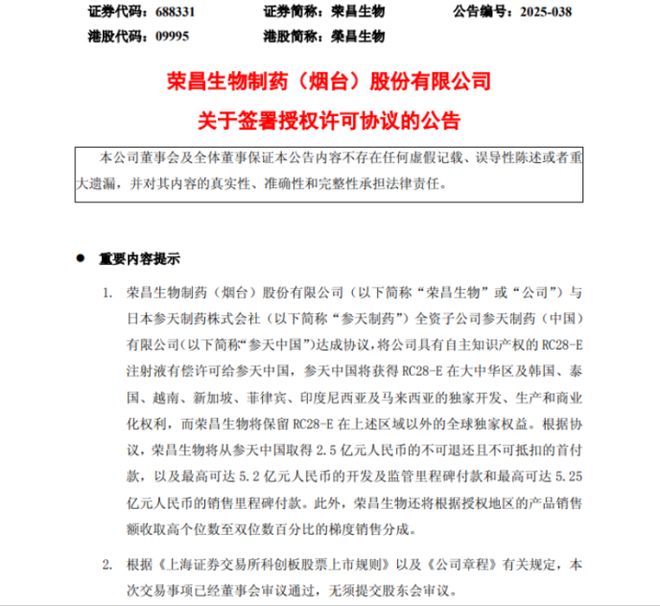
Core Viewpoint - Rongchang Biopharmaceutical has signed an agreement with Santen Pharmaceutical for the exclusive development, production, and commercialization rights of its innovative drug RC28-E in several Asian markets, marking a significant step in China's ophthalmic drug innovation [1][3][4]. Group 1: Agreement Details - The agreement grants Santen exclusive rights in Greater China, South Korea, Thailand, Vietnam, Singapore, the Philippines, Indonesia, and Malaysia for the drug RC28-E, which targets ocular neovascular diseases [1]. - Rongchang will receive an upfront payment of 250 million RMB, with potential milestone payments totaling up to 5.2 billion RMB for development and regulatory achievements, and up to 5.25 billion RMB for sales milestones [1]. - Additionally, Rongchang will earn a tiered sales royalty based on product sales in the authorized regions, ranging from high single-digit to double-digit percentages [1]. Group 2: Product Information - RC28-E is a dual-target fusion protein drug that addresses VEGF/FGF pathways, currently in Phase III clinical trials for treating major ocular diseases such as Diabetic Macular Edema (DME) and Wet Age-related Macular Degeneration (wAMD) [4]. - The company plans to submit a marketing application for DME in the second half of 2025 and for wAMD by mid-2026 in China [4]. Group 3: Strategic Implications - The collaboration with Santen, which has over 130 years of expertise in ophthalmology and a strong sales network across more than 60 countries, is expected to maximize the potential of RC28-E and provide innovative solutions for retinal disease treatment [3][4]. - This partnership signifies a shift in China's pharmaceutical landscape, moving from a "follower" to a "leader" in the global value chain of ophthalmic drugs [1][7]. Group 4: Recent Achievements - Rongchang has previously made significant strides in international collaborations, including granting global rights for its ADC drug to Seagen, with potential revenues reaching 2.6 billion USD, and a recent deal with Vor Biopharma for another innovative product, totaling 4.23 billion USD [5][7]. - These milestones highlight the rapid innovation and industrial strength of Chinese pharmaceuticals on the global stage [7].

Is Pfizer's 6.8%-Yielding Dividend Too Good to Be True?
The Motley Fool· 2025-08-19 08:50
Core Viewpoint - Pfizer offers a high dividend yield of 6.8%, significantly above the S&P 500 average of 1.2%, raising questions about the sustainability of this yield given its high payout ratio of around 90% [2][4]. Financial Metrics - Pfizer's payout ratio is approximately 90%, indicating a potential risk to dividend sustainability [4]. - The company's free cash flow for the trailing 12 months was $12.4 billion, exceeding the $9.6 billion paid out in dividends, suggesting the dividend is safe [6]. - In the most recent quarter, Pfizer reported revenue growth of 10% year-over-year, with sales reaching $14.7 billion and diluted earnings per share of $0.51, which is higher than the quarterly dividend payment of $0.43 [9]. Strategic Developments - Pfizer is actively working to reduce costs while expanding operations, including a significant $43 billion acquisition of oncology company Seagen in 2023, which is expected to create new opportunities [8]. - The company is adapting to declining demand for its COVID-19 vaccine and pill while continuing to focus on cost reduction [9]. Market Position - Despite a 5% decline in stock price year-to-date, Pfizer's financials do not indicate any immediate concerns regarding its dividend [7][10]. - The stock is currently trading at a price-to-earnings multiple of 13, suggesting it is relatively cheap compared to its earnings potential [10].