Singtel

Search documents
X @Bloomberg
Bloomberg· 2025-09-25 00:22
Australian Communications Minister Anika Wells summoned Singtel to a meeting following a fatal outage at its Optus division, warning it was likely to lead to major financial penalties https://t.co/QJMEbUxMXk ...
SingTel falls after Optus network failure linked to emergency call disruptions, deaths
Reuters· 2025-09-22 03:23
Core Viewpoint - Shares of Singapore Telecommunications fell over 2% following a technical failure at its subsidiary Optus, which disrupted emergency call services for 13 hours and has been linked to four fatalities [1] Company Impact - The technical failure at Optus, Australia's second-largest telecom carrier, has raised significant concerns regarding service reliability and safety [1] - The incident has led to a direct impact on the stock performance of Singapore Telecommunications, indicating potential investor apprehension [1] Industry Context - The disruption of emergency services highlights vulnerabilities within the telecommunications sector, particularly in crisis management and operational resilience [1] - The incident may prompt regulatory scrutiny and calls for improved infrastructure and service protocols within the telecom industry [1]



4 Ways to Identify Promising Growth Stocks
The Smart Investor· 2025-09-19 09:30
Core Insights - The current investment landscape presents opportunities for growth investors despite market volatility, facilitated by modern brokerages that provide access to a wide range of global stocks [1] Group 1: Strategic Reviews and Resets - Companies undergoing strategic reviews can reposition themselves for sustainable growth by focusing on high-potential areas and exiting unprofitable segments [3] - Hongkong Land Holdings announced a strategic review in October, planning to exit the build-to-sell property segment and focus on integrated commercial developments to generate steady income [4] - Singtel has been executing a strategic reset since May 2021, aiming to capitalize on 5G opportunities and improve return on invested capital (ROIC), targeting low double-digit ROIC by fiscal 2026 [5][6] Group 2: Sustainable Trends and Catalysts - Identifying sustainable trends, such as the rise of athleisure, can uncover promising growth stocks, exemplified by Lululemon's revenue growth from US$8.1 billion in fiscal 2023 to US$10.6 billion in fiscal 2025 [9][10] - Mercadolibre's revenue surged from US$10.8 billion in 2022 to US$20.8 billion in 2024, driven by the e-commerce market's projected 19% CAGR from 2022 to 2027 [11] - Coupang's revenue increased from US$20.6 billion in 2022 to US$30.3 billion in 2024, achieving profitability in 2023 with US$1.4 billion in net income [12] Group 3: Large Total Addressable Market (TAM) - Companies with a large TAM, such as ResMed, which aims to serve 500 million people by 2030, present significant long-term growth potential [13][14] - Dexcom targets a growing market for continuous glucose monitoring, with only 5% penetration among Type 2 diabetics not on insulin, indicating substantial room for expansion [15] Group 4: Successful Serial Acquirers - Companies like Hawkins have successfully executed multiple acquisitions, resulting in revenue growth from approximately US$935 million in fiscal 2023 to over US$974 million in fiscal 2025 [18] - Rollins, a pest control company, added 24 businesses through acquisitions in 2023 and 32 in 2024, leading to revenue growth from US$2.7 billion in 2022 to US$3.4 billion in 2024 [19][20]


4 Blue-Chip Stocks to Watch as the STI Hits Record Levels
The Smart Investor· 2025-09-17 03:30
Group 1: DBS Group Holdings Ltd - DBS Group Holdings Ltd is up 17.8% year to date (YTD) and reported solid results for the second quarter of 2025, with net interest income (NII) remaining resilient despite expected interest rate cuts [2][3] - The bank experienced strong deposit growth of 5% year on year (YoY) in the first half of 2025 and proactive hedging against lower rates [3] - Fee income from wealth management grew 25.3% YoY to S$649 million, contributing 46.5% of total fee income [3][4] Group 2: SATS Ltd - SATS Ltd is down approximately 10.4% YTD, but global travel demand is projected to grow at 6.5% YoY in 2025, which may aid in recovery [5] - Following the acquisition of Worldwide Flight Services (WFS), SATS's total income increased 5% YoY to S$5.7 billion, with net interest income up 2% YoY to S$3.6 billion [6] - The company declared a dividend per share of S$0.75 for 2Q 2025, with an ordinary dividend increase of 11% compared to the previous year [6][8] Group 3: Genting Singapore Ltd - Genting Singapore Ltd's shares are relatively unchanged YTD, with lackluster results in the first half of 2025 due to renovation disruptions and temporary closures [9][14] - The company is expected to benefit from a rise in international visitor arrivals, particularly from Chinese tourists, which could boost its premium gaming market [10] - A final dividend of S$0.02 per share was declared, unchanged from the previous year, despite a decline in gaming revenue by 12.3% YoY [14] Group 4: Singtel - Singtel is up 40.5% YTD, driven by recovery in mobile and roaming services, alongside growth in data centres and regional associates [11] - The company plans to invest S$2.5 billion in capital expenditures, with S$1.7 billion allocated for core expenditure and S$0.8 billion for data centres [12] - Singtel's underlying net profit for dividend payout increased 14% YoY to S$686 million, with a total core dividend of S$0.123 per share, representing a 2.8% yield [15][16]

亚太 数据中心要点 - 如何看待冷却、通用算力即服务-Data Centers - Asia-Pacific_ DC takeaways - Thailand interest picking up, how to think of cooling, GPUaaS
2025-09-11 12:11
Summary of Key Points from the Conference Call Industry Overview - **Data Center Market in Asia-Pacific**: The data center market in Thailand is emerging as a new destination for regional deployment, with a pipeline capacity of 2.6GW in Bangkok, which increased by over 1.7GW in 2024 [1][12]. Johor, Malaysia, has a pipeline market of 5.7GW but has seen a slowdown in incremental supply growth due to stricter local regulations [1]. Core Insights - **AI Demand Growth**: AI-related demand is expected to contribute approximately 25-30% of incremental data center demand in markets like Thailand, although current AI capacity in APAC (excluding China) is only about 1GW [2]. Customers remain cost-sensitive regarding AI workloads, leading to deployments in markets like Malaysia and Australia [2]. - **Edge Data Centers**: There is a strong demand for smaller edge data centers at metro edges, which are essential for AI inference due to low latency requirements. Telecom operators are well-positioned to capitalize on this trend [3]. - **GPU as a Service (GPUaaS)**: The GPUaaS market is projected to be significant, with estimates ranging from $35 billion to $70 billion globally by 2030. Companies like Singtel are well-positioned to benefit from this growth [4]. Pricing and Cost Analysis - **Data Center Pricing Variability**: Pricing for data centers varies significantly across the region, with Singapore being the most expensive at up to $300/KW/month, while Malaysia offers lower rates around $90-95/KW/month due to lower land costs [27][30]. - **Cost Structure**: In Japan, MEP (Mechanical, Electrical, and Plumbing) costs constitute 59% of total data center build costs, highlighting the importance of these components in overall expenditure [25]. Market Dynamics - **Regulatory Environment**: In Johor, the local government is becoming more selective in approving new data center projects, focusing on water and power usage efficiency [46]. There are currently 13 live projects with a total approved capacity of 1774MW, but only about 500MW is operational [46]. - **Investment Trends**: The Johor Special Economic Zone (SEZ) agreement between Malaysia and Singapore is expected to enhance cross-border connectivity and attract global investments, particularly in data centers [46]. Emerging Technologies - **Liquid Cooling Solutions**: Liquid cooling is becoming increasingly relevant for data centers hosting AI workloads, as traditional air-cooling systems fail to support higher rack densities required for AI [30][31]. Various liquid cooling methods are being explored, including direct-to-chip and immersion cooling [31]. - **AI Workloads and Infrastructure**: AI workloads require higher densities, with rack densities exceeding 100KW/rack, necessitating advanced cooling solutions [38]. The demand for AI infrastructure is expected to grow rapidly, with significant investments needed to meet this demand [24]. Conclusion - The data center industry in the Asia-Pacific region is experiencing rapid growth driven by AI demand, regulatory changes, and technological advancements. Companies like Singtel and Indosat are positioned to benefit from these trends, particularly in GPUaaS and liquid cooling technologies. The evolving landscape presents both opportunities and challenges, particularly in terms of regulatory compliance and infrastructure development.
Is Singtel Still a Buy After Its Strong 2025 Rally?
The Smart Investor· 2025-09-09 23:30
Core Viewpoint - Singtel has experienced a significant increase in its share price in 2025, outperforming the Straits Times Index, raising questions about potential upside as an interest rate cut is anticipated [1] Financial Performance - In the first quarter of FY26, Singtel reported a 14% year-on-year increase in underlying net profit, driven by strong EBIT from Optus and NCS, along with higher contributions from regional associates Airtel and AIS [2] - The net profit reached nearly S$2.9 billion, largely due to S$2.2 billion in exceptional gains from the partial sale of its Airtel stake and the Intouch-Gulf Energy merger [3] Growth Drivers - Optus saw a 4% year-on-year revenue increase to approximately A$2 billion, with EBIT rising 36% year-on-year to A$133 million, attributed to higher mobile ARPU and effective cost control [4] - NCS's revenue increased by 4% year-on-year to S$733 million, with EBIT up 22% year-on-year, supported by stronger margins and a healthy project pipeline, securing S$0.7 billion in bookings in 1Q FY26 [4] - Airtel India's profit after tax more than doubled due to a mobile price increase, while AIS experienced strong growth in mobile and fixed broadband [5] Challenges - Domestic revenue in Singapore remained flat, with mobile service revenue declining by 11% year-on-year due to weakened roaming and voice services [6] - Optus continues to face challenges in reputation recovery following a data breach incident in 2022, and competition in the Australian telecom market remains intense [6] Valuation Concerns - Analysts suggest that Singtel's shares may be overvalued, with Morningstar estimating a fair value of S$3.67 per share, while the stock traded at S$4.39 per share recently, indicating a valuation close to 1.2 times its fair value [7] Dividend and Capital Management - Singtel has committed to a dividend payout ratio of 70% to 90% of its underlying net profit after tax, with plans to enhance payouts through a "value realisation dividend" [8] - The company has raised its asset recycling target to S$9 billion, allocating S$2 billion for share buybacks to enhance shareholder value [9] Investment Outlook - The bullish case for Singtel includes strong growth from associates, potential recovery of Optus, execution of NCS projects, active capital recycling, and a sustainable dividend payout [10] - However, the recent share price increase may indicate overstretched valuation, coupled with headwinds in the Singapore mobile business and ongoing risks associated with Optus [10]
新加坡在Counterpoint Research的《2025年全球AI城市指数》中获评全球顶级AI城市
Counterpoint Research· 2025-08-07 01:03
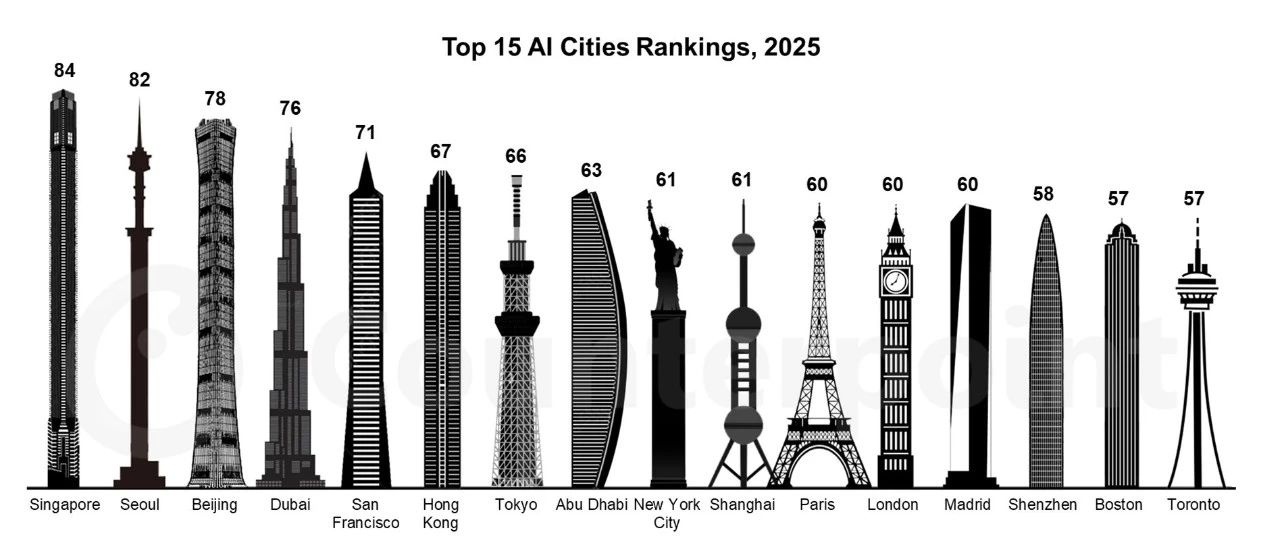
Core Insights - Counterpoint Research's report ranks Singapore as the top AI city globally, followed by Seoul, Beijing, Dubai, and San Francisco in the top five [4][8][9] Ranking Summary - The report evaluates AI adoption in the world's 100 largest metropolitan areas, scoring each city out of 100 [6][8] Regional Highlights - Singapore's success is attributed to government-supported initiatives that foster a vibrant startup ecosystem and public-private collaboration in sectors like healthcare and transportation [7] - Seoul ranks second due to active AI deployment in healthcare and education, with significant contributions from companies like SK Telecom and Naver [7] - Beijing is set to provide formal AI education to all primary and secondary students starting in 2025, alongside initiatives with China Unicom and Huawei [7] - North America leads in AI city development, but China is rapidly catching up, with cities like Wuhan, Chengdu, and Suzhou making significant investments in supercomputing [7][8] - Europe lags behind due to a more complex regulatory environment, while the Middle East shows potential for growth [7][8] Key Players in AI City Development - Microsoft and Google are identified as major players driving AI city initiatives through data center development and AI training programs [8][11] - Huawei excels in promoting AI in telecommunications with its 5G-A technology [8] - Nvidia's supercomputing facilities in Dallas position it as a leader in global computing capabilities [8] Noteworthy City Performances - Dubai surpasses San Francisco in overall scores due to substantial investments in AI across various economic sectors, including a plan to train 1 million AI engineers [9] - Riyadh, Bangalore, and Hangzhou are highlighted as rapidly developing AI cities with significant investment potential [9][12] Telecommunications Ecosystem - Telecommunications infrastructure is crucial for AI city development, with cities like Beijing deploying 10G fiber and Boston expanding to meet AI computing demands [12] - Innovations such as GPU-as-a-Service by Singtel and AI-driven network management by STC in Riyadh are examples of how telecom companies are enhancing AI city capabilities [12]
Inside Singtel’s AI Cloud: Scalable, Secure, and Built for the Nation
DDN· 2025-06-30 18:27
AI Infrastructure & Market Focus - Singal's mission is to empower every generation with products ranging from telecommunication to ICT, focusing on AI solutions for operational efficiency and new revenue streams [1] - The company is expanding its value proposition into AI infrastructure, building sovereign GPU clouds for mission-critical applications in both public and private sectors [4] - Top verticals include research (model training for R&D), public sector (nationwide AI-enabled citizen services and public safety), and fintech (fraud and scam prevention) [4][5] Challenges in AI Adoption - A significant challenge is the lack of AI-ready talent, prompting the need for no-code/low-code platforms to empower domain experts [2] - Enterprises face challenges related to AI-ready infrastructure, particularly concerns about data sovereignty and data leaving the country [3] Strategic Partnerships & Solutions - The company partners with providers like Nvidia and DDN to offer a unified platform, leveraging DDN as the data intelligence platform within the AI infrastructure stack [5] - The company provides turnkey digital infrastructure, from data centers to cloud infrastructure, enabling seamless workload hosting for enterprises [5]
对话爱立信:5G增量不增收,通信行业到了必须转型的时刻
Tai Mei Ti A P P· 2025-06-05 07:16
Core Viewpoint - The communication industry is at a critical juncture requiring transformation, particularly in the Chinese market, which is characterized by a large user base and strong demand for 5G capabilities, yet faces challenges such as weak monetization and low user value [2][3]. Industry Overview - China has approximately 1.4 billion users, with the three major telecom operators generating around 1.96 trillion yuan in revenue, while the U.S. with 345 million users generates over 3.1 trillion yuan, and Japan with 125 million users generates over 1.3 trillion yuan [2]. - Despite leading in infrastructure coverage and performance, Chinese operators are experiencing a common industry issue of "incremental growth without revenue increase," which is exacerbated by the rise of mobile internet, cloud computing, and AI technologies [2][3]. AI Integration in Communication - AI applications in the communication sector can be categorized into two parts: AI for Network, which enhances network planning and management, and Network for AI, which ensures that telecom networks support future AI services effectively [3]. - The telecom industry has historically focused on providing consistent network connectivity, but declining revenues necessitate a shift towards platform-based network services that offer differentiated connections tailored to various applications and user needs [3][4]. Business Model Transformation - Ericsson aims to create higher value through differentiated network connections and assist the telecom industry in developing new business models, leveraging high-performance programmable networks and AI technologies [4][5]. - The challenge for enterprise users lies in upgrading networks to support more use cases and complex demands, with the benefits of differentiated network connections being clearer in terms of enhanced productivity [4][5]. Consumer Market Dynamics - In the consumer sector, Ericsson seeks to enhance user experience through superior and differentiated network connections, although the willingness to pay among users remains limited [4][5]. - The consumer market's size and subscription volume imply that even a small shift towards differentiated network services could lead to significant market changes [4]. Current Market Challenges - The scale of 5G commercial applications in China is still underdeveloped, and telecom operators are encouraged to pursue new use cases without waiting for complete technological maturity, emphasizing the need for synergy between business models and technology [6]. - Examples from the U.S. and Singapore illustrate how operators have built competitive advantages through differentiated network connections, highlighting the potential for similar strategies in the Chinese market [6].


eSIM产业热点问题研究报告(2025年)
中国信通院· 2025-05-13 03:15
Investment Rating - The report does not explicitly provide an investment rating for the eSIM industry Core Insights - The eSIM technology represents a significant evolution in telecommunications, transitioning from traditional physical SIM cards to embedded SIMs, which are crucial for the Internet of Things (IoT) and 5G applications [7][8] - The report highlights the global adoption of eSIM technology, with various countries commercializing it and establishing a robust industrial ecosystem, while also addressing challenges in standardization and data security [7][8] Industry Development Overview - The report outlines the historical development of telecommunications cards, detailing the evolution from magnetic cards to IC cards, SIM, USIM, and finally to eSIM technology [15][20][22] - eSIM technology is characterized by its ability to support remote configuration and management, making it suitable for a wide range of applications in consumer electronics and IoT [23][49] Current Status of eSIM Industry Technical Standards - The GSMA has established a comprehensive standardization framework for eSIM technology, which is recognized by international organizations, facilitating its global interoperability and scalability [40][44] - The report notes that the CCSA and TAF are actively developing eSIM standards in China, aligning with international standards while promoting innovation [46][48] Application Areas - eSIM technology is increasingly utilized in consumer electronics, enabling seamless network switching for travelers and enhancing connectivity for remote work and e-commerce [49][50] - In the IoT sector, eSIM technology is gaining traction across various industries, including smart homes, healthcare, automotive, and energy management, due to its flexible configuration and efficient management capabilities [51][52] Market Size - In 2023, global eSIM chip shipments reached 446 million, with significant contributions from smartphones, tablets, and wearables [58][60] - The report forecasts that by 2025, approximately 1 billion eSIM-enabled smartphones will be connected globally, indicating a strong growth trajectory for the eSIM market [62] Industry Chain - The eSIM industry chain is well-established in the US and Europe, with key players in chip manufacturing, security certification, and product design leading the market [68]